
1. Background
Minimally invasive dentistry (MID) has become a leading paradigm in preventive and restorative dental care over recent decades (1-3). Minimally invasive dentistry conceptualizes dental caries as a multifactorial and dynamic disease, and instead of extensive removal of tooth structure, it emphasizes early detection of initial lesions, individualized caries risk assessment, strengthening of protective factors, and the use of conservative treatment modalities (1-3).
Core principles of MID include early lesion detection, personalized caries risk assessment, plaque and diet control, application of remineralizing agents such as topical fluorides and calcium–phosphate-based products, and conservative cavity designs aimed at preserving as much sound tooth structure as possible (2, 4-6). In this framework, sensitive diagnostic methods such as digital radiography and careful clinical assessment of approximal surfaces play an important role in detecting early lesions (5). Modern approaches abandon the classic “extension for prevention” concept and instead advocate smaller cavity preparations, pulp vitality preservation, and regular follow-up of high-risk patients (1-3, 6).
Clinical guidelines and review articles indicate that proper implementation of MID principles can reduce the need for extensive treatment, post-operative complications, and overall costs of oral health care, while enhancing patient satisfaction (1, 3, 4, 6). In pediatric dentistry, the adoption of minimally invasive techniques such as atraumatic restorative treatment (ART), sealants, and stepwise or staged caries management can markedly improve caries outcomes when accepted and used by practitioners (7). Nevertheless, in many countries a gap persists between scientific evidence and day-to-day clinical practice, and a substantial proportion of restorative treatments are still performed according to traditional concepts involving extensive tooth preparation (4, 6).
Dentists’ knowledge, attitudes, and clinical behaviors are key determinants of successful implementation of MID. Numerous studies from different countries have examined dentists’ knowledge and practice in this field. In Jeddah, Saudi Arabia, Shah et al. reported that dentists’ knowledge and attitudes toward MID were at a moderate level (8). In Chennai, India, Rayapudi and Usha found that although most dentists were familiar with general MID concepts, the routine use of novel diagnostic methods and conservative cavity designs remained limited (9). In another Indian study, Kumar et al. reported satisfactory knowledge of MID among general dentists, but limited integration of MID principles into treatment decision-making (10).
Bag et al. in West Bengal showed that while dental professionals were somewhat familiar with MID concepts, their use of early diagnostic methods and caries risk assessment was suboptimal (11). In Karachi, Pakistan, Khan et al. found that dentists’ knowledge of MID ranged from moderate to good, but only a subset routinely used risk-based and minimally invasive strategies in clinical practice (12). In Brazil, Katz et al. reported that although most dentists endorsed MID principles, behavioral change toward conservative practice was progressing slowly (13). Gaskin et al. in the United States also described a marked discrepancy between dentists’ knowledge and their clinical behaviors related to MID (14).
Torres et al., in a review of minimally invasive techniques for caries management, emphasized the critical role of structured training and hands-on courses in promoting the adoption of these approaches (7). Overall, the existing evidence suggests that despite widespread theoretical acceptance of MID, full implementation in clinical practice requires improved knowledge, attitude shifts, and meaningful educational and structural support (1-4, 7-12).
In Iran, interest in MID has grown in recent years; however, few studies have specifically evaluated dentists’ knowledge and practice in this area, and local evidence remains limited. Given the cultural, educational, and health system differences, results from other countries cannot be directly generalized to the Iranian context. Zahedan, with its distinct demographic characteristics and oral health challenges, requires its own data to inform educational and policy planning.
Therefore, assessing the knowledge and practice of dentists in Zahedan regarding MID can help identify strengths and gaps, support the design of targeted continuing education programs, and guide curriculum revisions.
2. Objectives
This study aimed to investigate the knowledge and practice of dentists in Zahedan regarding MID and to examine their associations with age, sex, work experience, workplace, and level of training in MID in 2022.
3. Methods
3.1. Study Design
This study was designed as a descriptive–analytical cross-sectional survey conducted in 2022 among dentists in Zahedan, Iran.
3.2. Setting, Population, and Sampling
The study population comprised all general and specialist dentists actively practicing in public and private dental settings in Zahedan. Based on the available list, 90 dentists met the eligibility criteria, and all were invited to participate. Thus, the sample size was equal to the entire accessible population, and sampling was performed by census with stratification based on workplace (public/university vs. private).
Inclusion criteria were holding a DDS or specialty degree in dentistry, active clinical practice in Zahedan at the time of data collection, and willingness to participate. Exclusion criteria included incomplete completion of the questionnaire or withdrawal during the study.
3.3. Instruments
Data were collected using a self-administered questionnaire comprising two main parts:
Demographic and professional characteristics: This section included age, sex, type of degree (general/specialist), workplace (private clinic vs. public/university setting), work experience (< 2 years, 3 - 5 years, 6 - 10 years, >10 years), level of training in MID (not trained, partially trained, fully trained), timing of MID-related training (undergraduate, postgraduate, both, after graduation), and mode of training (lecture, hands-on workshop, demonstration, online/social media, etc.).
Knowledge and practice regarding MID: This instrument was developed and adapted to the context of MID based on previous studies and authoritative sources (1-4, 6-11, 13, 14).
Knowledge section: Consisted of 6 items on key MID concepts, including the role of remineralizing agents (e.g., fluorides), the use of sealants, importance of early lesion detection and caries risk assessment, conservative cavity designs, and selection of restorative approaches based on risk. Responses were recorded on a 5-point Likert scale from “strongly disagree” to “strongly agree” and then recoded to a 0 - 4 scale. The total knowledge score ranged from 0 to 24. For interpretation, knowledge levels were categorized as poor (0 - 8), moderate (9 - 16), and good (17 - 24).
Practice section: Included 9 items assessing clinical behaviors aligned with MID, such as the use of non-invasive diagnostic tools, caries risk assessment, pulp-preserving treatments, prioritization of conservative approaches over “extension for prevention,” and regular recall of high-risk patients. The total practice score ranged from 0 to 36 and was categorized as poor (0 - 12), moderate (13 - 24), and good (25 - 36).
3.4. Validity and Reliability
Content validity of the questionnaire was evaluated by a panel of 10 experts in restorative dentistry, pediatric dentistry, and dental public health. The Content Validity Index (CVI) for simplicity, clarity, and relevance of the knowledge items was 85%, 85%, and 85%, respectively; the corresponding values for the practice items were 94%, 84.7%, and 78.8%. The overall content validity ratio (CVR) was 80% for the knowledge section and 70.5% for the practice section, indicating acceptable content validity.
For reliability, a pilot test was conducted on a small group of dentists outside the main sample. Internal consistency was measured using Cronbach’s alpha, which was 0.929 for the knowledge section and 0.818 for the practice section, demonstrating good internal consistency.
3.5. Data Collection Procedures
After obtaining the necessary permissions, the researcher visited private clinics and public/university dental centers in Zahedan. The objectives and procedures of the study were explained to potential participants, and written informed consent was obtained. The anonymous, self-administered questionnaires were then distributed and collected either during the same visit or at a mutually agreed time. Participants were assured of the confidentiality of their responses and that results would be reported in aggregate form only.
3.6. Statistical Analysis
Data were checked for completeness and entered into SPSS software version 24 for analysis. Descriptive statistics (mean, standard deviation, median, minimum, maximum, frequency, and percentage) were used to summarize all variables. For comparisons of mean scores between two groups (e.g., sex, workplace), independent t-tests were used when the distribution was normal, and Mann-Whitney tests were used otherwise. For comparisons of mean scores across more than two groups (e.g., work experience, level of MID training), one-way analysis of variance (ANOVA) was used when parametric assumptions were met, and the Kruskal-Wallis test was used when these assumptions were not met. A P-value < 0.05 was considered statistically significant in all analyses.
3.7. Ethical Considerations
All procedures were conducted in accordance with the ethical principles of research involving human participants. Written informed consent was obtained from all dentists. Participation was voluntary, confidentiality of data was ensured, and participants were free to withdraw at any stage. An ethics approval was reportedly obtained from the committee; IR.ZAUMS.REC.1400.359.
4. Results
4.1. Demographic and Professional Characteristics
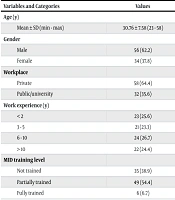
A total of 90 dentists participated in the study. The mean age was 30.76 ± 7.58 years (range 23 - 58). Of the participants, 56 (62.2%) were male and 34 (37.8%) were female. Regarding workplace, 58 (64.4%) worked in private settings and 32 (35.6%) in public or university-affiliated centers. In terms of work experience, 23 (25.6%) had less than 2 years, 21 (23.3%) had 3 - 5 years, 24 (26.7%) had 6 - 10 years, and 22 (24.4%) had more than 10 years of experience.
With respect to MID training, 35 dentists (38.9%) reported having received no training, 49 (54.4%) were partially trained, and 6 (6.7%) stated that they were fully trained in MID. Most respondents indicated that MID-related content had been addressed primarily after graduation through continuing education activities. Table 1 presents the demographic and professional characteristics of the participating dentists.
Table 1.
Demographic and Professional Characteristics of Dentists in Zahedan (N = 90) a
| Variables and Categories | Values |
|---|---|
| Age (y) | |
| Mean ± SD (min - max) | 30.76 ± 7.58 (23 - 58) |
| Gender | |
| Male | 56 (62.2) |
| Female | 34 (37.8) |
| Workplace | |
| Private | 58 (64.4) |
| Public/university | 32 (35.6) |
| Work experience (y) | |
| < 2 | 23 (25.6) |
| 3 - 5 | 21 (23.3) |
| 6 - 10 | 24 (26.7) |
| > 10 | 22 (24.4) |
| MID training level | |
| Not trained | 35 (38.9) |
| Partially trained | 49 (54.4) |
| Fully trained | 6 (6.7) |
Abbreviation: MID, minimally invasive dentistry.
a Values are expressed as No. (%) unless otherwise indicated.
4.2. Knowledge and Practice Scores
The mean knowledge score regarding MID was 19.57 ± 3.41 (range 12 - 24; median 20), corresponding to 81.5% of the maximum possible score. The mean practice score was 22.28 ± 6.32 (range 6 - 35; median 23), corresponding to 61.9% of the maximum possible score.
Based on the predefined cut-offs, 3.3% of dentists had poor knowledge, 15.6% had moderate knowledge, and 81.1% had good knowledge about MID. Regarding practice, 18.9% had poor practice, 43.3% had moderate practice, and 38.9% had good practice. Table 2 summarizes the descriptive statistics of knowledge and practice scores.
Table 2.
Descriptive Statistics of Knowledge and Practice Scores Regarding Minimally Invasive Dentistry (N = 90)
| Variables | Theoretical Range | Mean ± SD | Median | Min-Max | % of Maximum Score |
|---|---|---|---|---|---|
| Knowledge | 0 - 24 | 19.57 ± 3.41 | 20 | 12 - 24 | 81.5 |
| Practice | 0 - 36 | 22.28 ± 6.32 | 23 | 6 - 35 | 61.9 |
4.3. Comparisons by Work Experience and Level of Training
The Kruskal-Wallis test showed no significant difference in mean knowledge scores across work experience categories (P = 0.507). One-way ANOVA also showed no significant difference in mean practice scores across work experience groups (P = 0.413).
However, comparison of mean practice scores by level of MID training revealed a statistically significant difference (F = 4.89, P = 0.010), with fully trained dentists demonstrating higher practice scores than partially trained and untrained dentists. Mean knowledge scores did not differ significantly by level of MID training (P = 0.169). Table 3 presents the mean knowledge and practice scores by level of MID training.
Table 3.
Comparison of Knowledge and Practice Scores by Level of Training in Minimally Invasive Dentistry
| Outcome/MID Training Level | N | Mean ± SD | Median | Test | Test Statistic | P-Value a |
|---|---|---|---|---|---|---|
| Knowledge | Kruskal-Wallis | H = 3.54 | 0.169 | |||
| Not trained | 35 | 19.07 ± 3.38 | 19 | |||
| Partially trained | 49 | 19.84 ± 3.35 | 20 | |||
| Fully trained | 6 | 20.16 ± 4.21 | 20 | |||
| Practice | One-way ANOVA | F = 4.89 | 0.010 | |||
| Not trained | 35 | 20.09 ± 6.69 | 22 | |||
| Partially trained | 49 | 23.22 ± 4.12 | 23 | |||
| Fully trained | 6 | 27.50 ± 8.84 | 32 |
Abbreviations: MID, minimally invasive dentistry; ANOVA, one-way analysis of variance.
a No significant differences in knowledge or practice scores were observed by sex or workplace (P > 0.05 for all comparisons).
5. Discussion
This study assessed dentists’ knowledge and practice regarding MID in Zahedan and examined their associations with selected professional characteristics. Overall, participants demonstrated good knowledge of core MID concepts but only moderate MID-oriented practice, underscoring a notable knowledge-practice gap. Moreover, dentists who reported higher levels of MID training had significantly better practice scores, while knowledge did not vary significantly by training level. Taken together, these findings suggest that, in this setting, awareness of MID principles is not consistently translated into routine clinical behaviors and that training may be more closely related to practical implementation than to theoretical knowledge. Importantly, this work contributes local evidence from an underrepresented region of Iran and provides a baseline for curriculum planning and continuing professional development focused on MID implementation.
The high knowledge score observed in our sample (approximately 81.5% of the maximum) indicates that most dentists were familiar with the contemporary preventive and conservative paradigm of caries management. This pattern is comparable to reports from other regions where dentists generally endorse MID principles. Kumar et al. found satisfactory knowledge among general dentists in India, although they noted that evidence-based approaches were not always integrated into day-to-day decision-making (10). Similarly, Rayapudi and Usha reported that practitioners in Chennai were aware of MID concepts but demonstrated limited uptake of advanced diagnostic approaches and conservative preparation designs (9). In Saudi Arabia, Shah et al. described moderate knowledge and attitudes toward MID among dentists in Jeddah (8). Collectively, these studies suggest that MID knowledge is increasingly widespread, potentially reflecting broader dissemination of guidelines, continuing education activities, and the inclusion of MID topics in undergraduate curricula (1-3, 6).
Despite this favorable knowledge profile, the practice score in the current study was only moderate (approximately 61.9% of the maximum), which is consistent with international evidence showing a persistent disconnect between what dentists know and what they do clinically. Gaskin et al. documented a substantial gap between knowledge and clinical behavior related to minimal intervention concepts among federal service and civilian dentists, with many still preferring more invasive restorative approaches (14). In Pakistan, Khan et al. reported that while knowledge levels were moderate to good, routine application of caries risk assessment and minimally invasive techniques was limited to a subset of dentists (12). Bag et al. also noted that dental professionals’ use of early diagnostic methods and risk-based decision-making was suboptimal even when conceptual familiarity with MID existed (11). Katz et al. similarly described slow behavioral transition toward conservative clinical practice despite broad endorsement of MID principles (13). Therefore, the present results align with the broader literature indicating that improving knowledge alone may be insufficient to achieve sustained changes in clinical practice (7-14).
The association between self-reported MID training and higher practice scores is an important finding with practical implications. Torres et al. emphasized that structured training and hands-on learning opportunities, alongside access to appropriate diagnostic tools and materials, are key enablers of minimally invasive caries management (7). In line with this, our findings suggest that skill-based exposure may facilitate the operationalization of MID principles during patient care. However, because the study design was cross-sectional, the observed relationship between training and practice should not be interpreted as causal; training may be a marker of dentists’ motivation, workplace culture, or access to resources that also supports MID adoption. Future longitudinal or interventional studies are needed to clarify whether targeted training leads to measurable changes in real-world clinical behavior.
Several factors may explain the observed knowledge-practice gap. First, structural and contextual barriers can limit consistent MID implementation, including limited availability of advanced diagnostic tools, higher costs of contemporary restorative or preventive materials, time pressure during patient visits, and reimbursement or financial considerations that may incentivize traditional restorative pathways (4, 6). Such constraints may be particularly relevant in settings where dental services are delivered across heterogeneous private and public clinics with variable equipment and patient case-mix. In addition, patient expectations and preferences — such as the desire for definitive restorative treatment rather than staged or preventive management — may influence clinicians’ choices, especially when follow-up adherence is uncertain.
Second, clinical decision-making is shaped by professional socialization and prior training. Traditional restorative concepts (including more extensive cavity preparation consistent with the legacy notion of “extension for prevention”) may remain ingrained and can persist even when clinicians acknowledge newer evidence (1-3, 6). If undergraduate or postgraduate training emphasizes MID primarily at a conceptual level, without sustained clinical mentoring, case-based discussion, and supervised application, dentists may revert to familiar approaches under time pressure or uncertainty. This concern has been highlighted in prior work showing that limited opportunities for hands-on practice and feedback can hinder translation of knowledge into consistent behaviors (9, 10). Accordingly, educational strategies should prioritize competency-based learning, simulation, and supervised clinical exposure to MID decision pathways rather than relying solely on didactic instruction.
From a policy and implementation perspective, the present findings support several actionable directions. Continuing professional development programs should be designed to be practical and skill-oriented (e.g., workshops, demonstrations, and clinical auditing/feedback), focusing on early lesion detection, risk assessment, non- and minimally invasive treatment options, and conservative cavity design (4, 6, 7, 11). At the system level, improving access to appropriate diagnostic tools and evidence-based materials may reduce the friction costs of adopting MID in routine practice (4, 6, 7). In addition, integrating MID competencies more explicitly into undergraduate and residency training — through objective structured clinical examinations, reflective case reviews, and mentorship — may help consolidate MID behaviors early in professional development (1-3, 6).
The study also has limitations that should be considered when interpreting the findings. Because data were collected using self-administered questionnaires, practice measures may be affected by social desirability bias, and reported behaviors may not fully represent actual chairside practice. Direct observational studies, record audits, or standardized clinical vignettes could provide more objective assessments of MID-related decision-making and behaviors. In addition, the sample size was modest (n = 90) and restricted to dentists practicing in a single city, which may limit generalizability to other regions of Iran. Finally, the knowledge domain was assessed using six items; although these items covered key MID principles, a broader set of questions could capture greater nuance and subdomains of MID knowledge.
Despite these limitations, the study provides an informative snapshot of MID-related knowledge and practice in Zahedan and highlights a practical gap that can be targeted through training and system support. Overall, the findings reinforce the need to move beyond awareness-raising and toward hands-on, competency-driven strategies that enable dentists to consistently implement MID in everyday clinical care.
5.1. Strengths and Limitations
This study has several strengths. It included all general and specialist dentists in Zahedan using a census approach, thereby providing a comprehensive picture of the local situation. The use of a psychometrically evaluated questionnaire with acceptable content, validity, and internal consistency enhances the credibility of the results. Moreover, the separate assessment of knowledge and practice, and their relationships with work experience and training, allows for a more nuanced understanding of the gaps between what dentists know and what they do.
Limitations: Due to the cross-sectional design of this study, causal relationships between training in MID and clinical practice cannot be inferred. The observed associations should therefore be interpreted with caution.
Additionally, data on clinical practice were collected through self-reported questionnaires, which may be subject to social desirability bias. Consequently, reported practices may not fully reflect actual clinical behaviors.
The sample size was relatively modest (n = 90) and limited to dentists practicing in a single city, which may reduce the generalizability of the findings to other regions of Iran.
Knowledge assessment was based on six items addressing key MID concepts. Although these items covered core principles, a broader set of questions could provide more nuanced insights into dentists’ knowledge.
Practice assessment relied on self-reported data rather than direct clinical observation, which may weaken the validity of practice-related findings. Future studies using observational or audit-based methods are recommended.
5.2. Implications and Recommendations
Given the combination of good knowledge but only moderate practice, several practical recommendations emerge:
Curriculum integration: Concepts and skills related to MID should be more strongly integrated into undergraduate and postgraduate dental curricula, with particular emphasis on case-based learning, simulation, and supervised clinical practice (1-4, 6).
Structured continuing education: Well-designed continuing education programs focusing on MID — especially hands-on workshops and clinical demonstrations — should be offered to practicing dentists. These programs should address early diagnosis, risk assessment, non- and minimally invasive treatment options, and conservative cavity design (4, 6-11).
Strengthening infrastructure: Access to appropriate diagnostic tools, materials, and equipment in both public and private settings should be enhanced to enable dentists to implement MID consistently (4, 6, 7).
5.3. Conclusions
Dentists in Zahedan demonstrated good knowledge but only moderate practice regarding MID. The findings highlight a clear gap between awareness of MID principles and their translation into clinical behavior. Structured, skill-focused education — both at the undergraduate level and through continuing professional development — alongside supportive infrastructure, appears essential to move from theoretical endorsement of MID toward consistent, evidence-based application in daily practice.