
1. Background
Poultry meat is one of the most economical and available sources of meat in the world. Its global production is ranked second after pork. Chicken meat is one of the foods with high perishability and is exposed to chemical decomposition and microbial spoilage, and therefore rotten meat is considered a potential risk for the health of the consumer. Guts, skin, air, and water are considered sources of poultry carcass contamination (1). For years, people have suffered from food poisoning due to the spoilage of meat and meat products, which has even led to death (2, 3). Due to the significant consumption of meat products sold in stores as a source of protein and the possibility of the presence of Bacillus cereus poisoning bacteria in them, preventive measures should be taken to prevent the contamination of these important food sources, which, in addition to preventing economic losses and reducing treatment costs, improves the health of society and also improves and guarantees the health and safety of meat products (4, 5).
Bacillus cereus is one type of microorganism that can be transmitted through meat and meat products. This dangerous aerobic and facultative anaerobic bacterium is rod-shaped and spore-forming, and is usually found in soil, dust, and water. The minimum growth temperature of B. cereus is about 4 - 5 degrees Celsius and the maximum temperature is about 48 - 50 degrees Celsius. Bacillus cereus is one of the food poisoning agents and causes two types of acute food poisoning in humans, with the diarrheal form mostly related to meat and its products. Its enterotoxin is produced in food or in the intestine. The main symptoms of the diarrheal form include diarrhea, abdominal cramps, and belching (6).
A part of the toxin binds to a lipid ganglioside of the gastrointestinal lumen membrane (GM). A protein called G is phosphorylated from the G-alpha part and finally binds to adenylate cyclase. Active adenylate cyclase makes cAMP from ATP, and an increase in cAMP activates many membrane proteins. These proteins move sodium ions, and therefore chloride ions are drawn out, and the osmotic pressure inside the cell decreases, causing diarrhea.
Carum carvi and Trachyspermum are among the plants that are highly valued for their aroma and taste. Black cumin is one of the most important and valuable medicinal plants. Black cumin or cumin or caraway, with the scientific name Bunium persicum and the English name Blake Carwey, is obtained from the Chetrian family. Black cumin seeds are found wild in areas of Iran with a dry climate, such as Kerman, Fars, Isfahan, and Yazd provinces, and in traditional medicine are used as anti-bloating, anti-diarrheal, to reduce blood fat and cholesterol, anti-allergy, and to relieve indigestion. It is used as a flavoring for food, soft drinks, chocolate, cheese, and pilafs (7). The scientific name of the plant is Curaum capticumi; it is a herbaceous, annual, aromatic plant that grows in the eastern regions of India, Iran (Sistan and Baluchistan, Kerman, Khorasan, etc.), and Egypt (8). This plant has high essential oil content, and its main compounds include thymol, paracymene, alpha-pinene, and iso-thymol (9). Trachyspermum is widely used in health, food, and pharmaceutical industries.
2. Methods
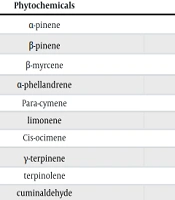
Black cumin seeds were collected from the mountains of Baft city in Kerman province in the summer of 2016 and dried under suitable conditions. High-quality and green seeds were also purchased from the market of Zabol city and approved and used by the research institute of medicinal plants of Jihad University. Extraction of essential oil from black cumin and zenian seeds was performed by the steam distillation method with the help of a Cloninger machine; essential oil was extracted for two hours, then water was removed using anhydrous sodium sulfate and analyzed using a GC/MS machine, as shown in Table 1 and Table 2. The essential oil was kept at 4 degrees Celsius until the experiment.
Table 1.
Identified Compounds of Bunium persicum Essential Oil (Black Cumin)
| No. | Phytochemicals | Retention Index | Percent |
|---|---|---|---|
| 1 | α-pinene | 935 | 0.74 |
| 2 | β-pinene | 978 | 1.63 |
| 3 | β-myrcene | 987 | 0.63 |
| 4 | α-phellandrene | 1003 | 0.20 |
| 5 | Para-cymene | 1026 | 2.95 |
| 6 | Limonene | 1032 | 3.30 |
| 7 | Cis-ocimene | 1039 | 0.44 |
| 8 | γ-terpinene | 1060 | 23.93 |
| 9 | Terpinolene | 1088 | 1.15 |
| 10 | Cuminaldehyde | 1253 | 20.53 |
| 11 | 3-caren-10-al | 1270 | 27.99 |
| 12 | 2-caren-10-al | 1289 | 9.49 |
| 13 | Trans-caryophyllohol | 1414 | 0.29 |
| 14 | Germacrene-D | 1485 | 0.32 |
| 15 | Zingiberene | 1495 | 0.25 |
| Total identified | 93.48 |
Table 2
. Identified Compounds of Trachyspermum Essential Oil
| No. | Phytochemicals | Retention Index | Percent |
|---|---|---|---|
| 1 | α-Pinene | 11.35 | 0.29 |
| 2 | β-Pinene | 13.45 | 0.43 |
| 3 | β-Myrcene | 14.28 | 0.34 |
| 4 | α-Phellandrene | 14.89 | 0.065 |
| 5 | α-Terpinen | 15.54 | 0.311 |
| 6 | p-Cymene | 16.21 | 22.55 |
| 7 | β-Phellandrene | 16.29 | 0.541 |
| 8 | γ-Terpinene | 17.93 | 13.07 |
| 9 | α-Terpinolene | 19.18 | 09/0 5 |
| 10 | α-Terpineol | 24.92 | 0.155 |
| 11 | L-Carvone | 27.97 | 0/908 |
| 12 | Trans-anethole | 28.68 | 1.7 |
| 13 | Thymol | 29.73 | 57.18 |
| 14 | Carvacrol | 29.84 | 0.524 |
| 15 | 3-Dodecen-l-al | 36.51 | 0.161 |
| 16 | Apiol | 42.73 | 0.566 |
| Total identified | 98.886 |
2.1. Preparation of Bacterial Suspension
Bacillus cereus 11778 ATCC, prepared from the food microbiology laboratory of the Faculty of Veterinary Medicine, University of Tehran, after being removed from the lyophilized form, was transferred to the BHI broth medium and two consecutive 18-hour cultures were performed. Then, using the spectrophotometric method at a wavelength of 600 nm with measurement of optical absorption and confirmation of the number of bacteria CFU/mL 1 × 10⁸ through spread plate count, the amount of bacteria needed to inoculate the samples was calculated.
The samples from the thigh and breast chicken carcasses, after separating the surface fat, were each cut into fillets 1.5 cm thick and weighing 90 - 100 grams and packed in sterile polyethylene nylons with low density. The groups were given gamma rays in the amount of 1.5 kilograms at the food irradiation science and technology center in Tehran, and after receiving 1 × 10³ CFU/mL of bacteria in sterile conditions, they were injected into the fillet and it was completely expanded. Pans containing different concentrations of essential oil in four treatment groups: 0, 0.015, 0.03, 0.06, 0.09% of black cumin essential oil and zenian and combined concentrations (black cumin+zenian) 0.015 and 0.015, 0.03 and the control group without essential oil, 1 × 10³ CFU/mL of bacteria were also added and transferred to the refrigerator. Then, the study of the bacterial condition was done on days 0 to 21 by spread plate count and transferred for 24 hours at a temperature of 37 degrees, then the colonies were counted by the colony counter and the results were recorded.
2.2. Statistical Analysis
The one way ANOVA method was used to compare the average treatments on each day. Tukey's supplementary test was also used to compare treatments two by two on each day. A significance level of P-value < 0.05 was considered. SPSS version 23 statistical software was used for data analysis.
3. Results
In this study, the result of the analysis of the compounds of black cumin essential oil and zenian essential oil is that the main compounds in Kermani black cumin are 3-caren-10al, γ-terpinene, and cumin aldehyde (Table 1), and in Trachyspermum essential oil, L-carvone, trans-anethole, and thymol are the main compounds, as reported in Table 2.
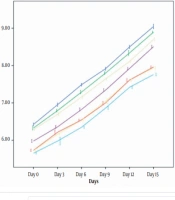
ANOVA statistical test showed that from the first day to the end of the experiment (the twenty-first day), the average logarithm of the number of bacteria in different treatments had a statistically significant difference. It was P = 0.001 on the first day and P < 0.001 on the following days. In all the treatments, with increasing concentration of the essential oil, the effect was greater; at the concentration of 0.09% of cumin, the essential oil had a bactericidal effect from the 6th day onwards and caused the complete destruction of the bacteria. The effectiveness of Trachyspermum essential oil was greater than that of black cumin, which inhibited bacterial growth at a concentration of 0.06 until the 9th day, and at a concentration of 0.09 from the 3rd day onwards, the lethal effect was observed and the growth was completely stopped. In the combined concentrations, an increase in the inhibitory power was observed compared to the same concentrations alone and the control group.
4. Discussion
Chicken meat and meat products, due to having nutritious and available compounds, such as fats, proteins, high carbon, and unsaturated amino acids, are highly susceptible to spoilage and food poisoning (10). Delgado et al., studied the bactericidal effect of thymol and simon on two strains of B. cereus bacteria. By increasing the concentration of thymol to 0.2 mmol⁻¹ and simone to 0.2 mmol⁻¹ in buffer conditions and a temperature of 30°C, their bactericidal effect on B. cereus increased. On the other hand, when thymol and simon are combined together, their natural bactericidal effect increases; in other words, they have a synergistic effect (11). Mohaghegzadeh et al., in order to investigate the chemical composition of the essential oil of zenian, used the gas chromatography-mass spectrometer method and in their analysis, the main part of the composition of the essential oil was thymol (54.50%), terpinene (26.10%), and simon (10.22%) (9). Valero et al., investigated the effect of pH and temperature on the growth of B. cereus in vegetables. The cold-oriented strains of B. cereus were able to grow at refrigerator temperature; in acidic conditions with pH: 5 and refrigerator temperature less than 8°C, the growth of B. cereus in vegetables is prevented for 60 days (12). The study of Hassanshahian et al. was on the antimicrobial activity of Trachyspermum ammi essential oil against human bacteria. The results show that the highest MIC values of essential oil were determined as 100 ppm against E. coli and the highest MIC value for K. pneumoniae was 250 ppm (13). Another study was on the inhibitory effect of ajowan essential oil on bacterial growth. The results show that the antibacterial activity of AEO was assessed against all selected pathogens and different MIC levels were observed. The essential oil was effective for S. aureus with MIC of 1.25 mg/mL, followed by E. coli with MIC of 2.5 mg/mL and Klebsiella with MIC of 5 mg/mL (14).
4.1. Conclusions
The amount of essential oil concentration needed for inhibitory effects on bacteria is more than the amount of essential oil used to flavor food. For this reason, they may have adverse effects on the taste of food. Therefore, the use of essential oils in low concentrations or in the form of a multi-barrier system with other preservation techniques, such as reducing the temperature, pH changes, and other preservatives, and paying attention to their synergistic effects, can be a suitable solution to prolong the growth delay phase and slow the growth of bacteria.