
Introduction
Growth and development of new blood vessels through sprouting or existing endothelial cells lead to the formation of complex and larger vascular system which is called angiogenesis [1]. This process needs to degradation of extracellular matrix, proliferation and migration of endothelial cells [2]. Angiogenesis plays an important role in different pathologic conditions like growth and tumor metastasis, rheumatoid arthritis and also in physiologic processes like organs' development, wound healing, and reproduction [3]. Researchers believed that for inducing angiogenesis in physiologic and pathologic condition which is depended on different steps, hypoxia of tissue has very important role [4]. In such a way, hypoxiated tissue starts synthesis and releasing angiogenic factors like vascular endothelial growth factor (VEGF) [5]. Among other important angiogenic factors, we can name fibroblast growth factor, angiopoietin and the platelet-derived growth factor [6]. Deferoxamine (DFO) is an iron chelator, and derived from actinobacter Streptomyces pilosus, exerts an iron-chelating action. DFO is clinically used as an iron-chelating drug in diseases of iron overload and make complex with iron ions. This drug also affects angiogenesis and induced VEGF augmentation is mediated through HIF-1 α activation via inhibiting prolyl 4-hydroxylase [7]. Richards et al. also showed that iron depletion by iron chelators specially deferoxamine in some cancerous cells lead to different expression some of molecular involved in cells cycle and so, due to the iron depletion, apoptosis is induced [8]. Wide distribution and application of pulses electromagnetic producing vehicles in daily life attracted the attention of many researchers to the evaluation of the effects of these waves on the growth and development of living organisms [9]. Research on the biological effects of low frequency electromagnetic fields, forms an important group of findings that are based on field type, intensity and their execution time which has different effects on the growth and development processes of living organisms [10, 11]. Also, many studies show that electromagnetic field, through change in function or cells' functional processes, induces different responses in living organisms like effect on cell proliferation and differentiation, disorder in cell cycle, induction of planned death, disorder in intracellular interactions, DNA transcription, gene expression and free radical production [12]. Low frequency electromagnetic fields are applied as treatment for some specific pathologic conditions like bone fractures, skin ulcers, migraines [13]. Also changes in gene expression, interactions and cellular communications are among samples which are affected by electromagnetic fields and induced angiogenesis disorders [14]. In present study, this question is answered whether synergic application of deferoxamine with low frequency electromagnetic field has a significant effect on angiogenesis or not? In present study, synergic effects of electromagnetic field with 50 Hz frequency and 100 G intensity with 10 and 100 µmol deferoxamine on angiogenesis in chick chorioallantoic membrane had studied.
Materials and Methods
This experimental study was done in research laboratory of animal development in biology department of Mashhad Islamic Azad University in 2011. Eighty fertilized Ross eggs held in an incubator with 38ºC temperature and 65% moisture. In day 2 of incubation, windows were opened for eggs under sterile condition (Laminair flow, Teslar AV-100, Spain) and fertilized eggs were divided into 8 random groups including: control (that were held in normal condition), laboratory control 1 (treatment with normal saline), laboratory control 2 (that were placed in electromagnetic field, but in turn of position), experimental groups 1 (treatment with low frequency electromagnetic field and 100 G intensity 2) treatment with 10 µmol deferoxamine 3) treatment with 100 µmol deferoxamine 4) treatment with 10 µm deferoxamine, low frequency electromagnetic field and 100 G intensity 5) treatment with 100 µmol deferoxamine, low frequency electromagnetic field and 100 G intensity (Fig. 1). In day 8 incubation, windows were removed in a completely sterilized conditions and a gelatine sponge with 1×4×4 (mm) diameter was placed on chorioallantoic membrane (CAM). This gelatin sponge (it was a combination of albumen and agar solution in normal saline in equal proportion) made in a sterile conditions. In 8 day incubation, 10 µL deferoxamine 10 µmol in the experimental groups of 2, 4 and 10 µL deferoxamine 100 µM in the experimental groups 3 and 5 were added to gelatin sponge (deferoxamine powder, solved in 100 mL normal saline). Then windows were covered once again and eggs were returned to incubator. Formation of chorioallantoic membrane starts on fifth day incubation and on eighth day it occupies a half of eggs inner width. On this day, heart is formed completely and separation of vein and artery blood happened. So, treatment of vascular system may be started on eighth incubation day. On 10 day, 1, 4, and 5 group’s samples were placed in an electromagnetic field system for four hours. This electromagnetic field generator system (designed by Baharara and Ashraf at Mashhad Islamic Azad University) is nourished by a cooper coil from urban electric system. Coil is placed in urban electric current route with 50 Hz frequency and resistor three 200 volts voltage that the intensity of entering electric current to coil is adjusted by them. this coil is able to supply electromagnetic field intensity between 10 to 400 G. Field intensity was calibrated by gausmeter and temperature and moisture condition were supplied by the use of incubation system designed same as incubator. On 12 day, photographed (by photo-stereomicroscope, Zeiss, Germany) at 0.65×10×4 magnification evaluated data include the number and length of vascular was measured for all samples by the use of image J software in a 15 inches monitor. Then obtained data were analyzed by the use of SPSS-19, t-test and ANOVA, in p<0.05 level.
Results
The mean of number (65.75±11.26) and length (222.74±31.688 mm) of vascular in control group in comparison to mean of the number (61.61±16.15) and length (218.92±28.612 mm) of vascular of laboratory control 1 group had no significant difference. The mean of the number (69.25±10.57) and length (218.48±21.228 mm) of vascular in laboratory control 2 group in comparison to control group had no significant difference. The mean of the number (66.8±12.25) and the length (232.42±18.65 mm) of vascular of the experimental 1group in comparison to control group had no significant difference. The mean of the number (47.25±12.10) and length (186.07±23.73 mm) of vascular in experimental 3 group in comparison to control group had a significant difference (p=0.027). The mean of the number of vascular in experimental group 3 (44.52±17.21) in comparison to control group showed a significant difference (p=0.006) but the mean of the length of the samples in experimental 3 group in comparison to control group had no significant difference. The mean of the number (38.93±7.63) and the length (185.63±32.527 mm) of vascular in experimental 4 group in comparison to control group showed a significant difference (p=0.001) the mean of the number (45.42±8.52) of vascular in experimental 5 group in comparison to control group showed a significant difference (p=0.01) but the mean of the length of the samples in experimental 5 group in comparison to control group had no significant difference (Fig. 2, 3).
Discussion
Obtained results in present study on the synergic effects of deferoxamine and low frequency electromagnetic field with 100 G intensity on angiogenesis in chick embryo chorioallantoic membrane of prove the exasperating effect of 100 G electromagnetic field on inhibit vessel growth by 10 and 100 µmol/L deferoxamine which. This result was observed in form of a significant decrease in the number and length of vascular treated samples with 10 mol/L deferoxamine and electromagnetic field and also a significant decrease in the number of vascular in 100 µm/L deferoxamine and 100 G electromagnetic field. Angiogenesis is the growth and development of new blood vessels through the sprouting of endothelial cells of existing vessels [15].
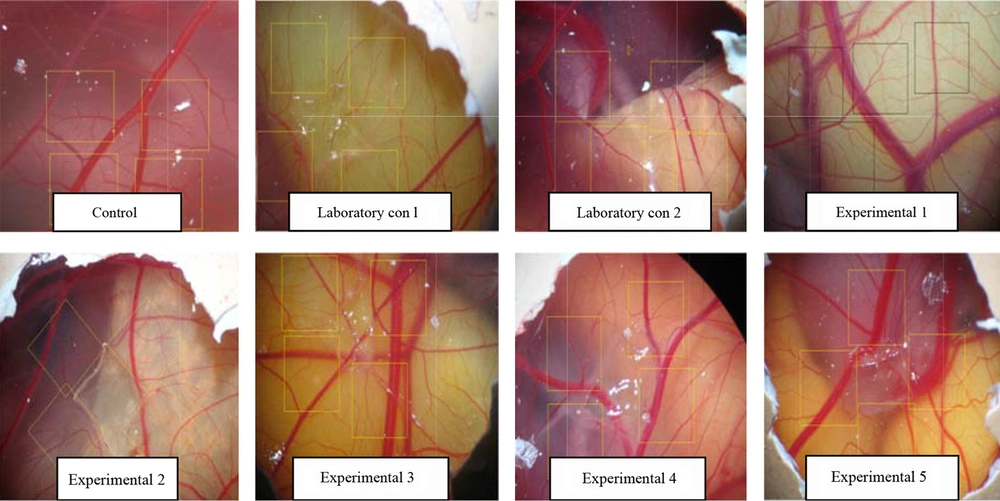
Figure 1.
Control, laboratory control 1 (treatment with normal saline), laboratory control 2 (treatment in electromagnetic field generator in off state), experimental group 1 (treatment with 100 G electromagnetic field), experimental group 2 (treatment with 10 µmol/L deferoxamine), experimental group 3 (treatment with 100 µmol/L deferoxamine), experimental group 4 (simultaneous treatment of 10 µmol/L deferoxamine and 100 G electromagnetic field), experimental group 5 (simultaneous treatment of 100 µmol/L deferoxamine with 100 G electromagnetic field).
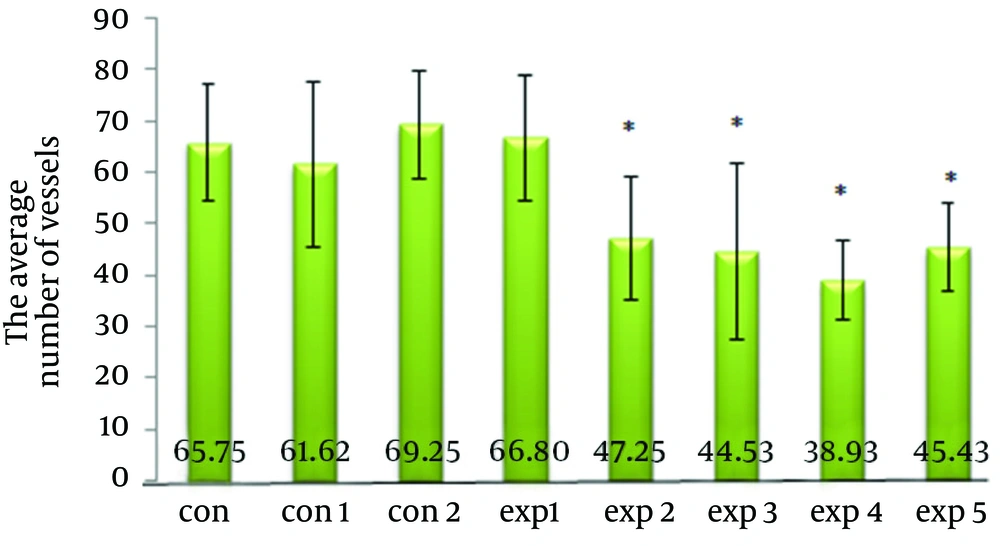
Figure 2.
Comparison of the average of the number of vascular divergences in control, laboratory control, and experimental groups; *p<0.05
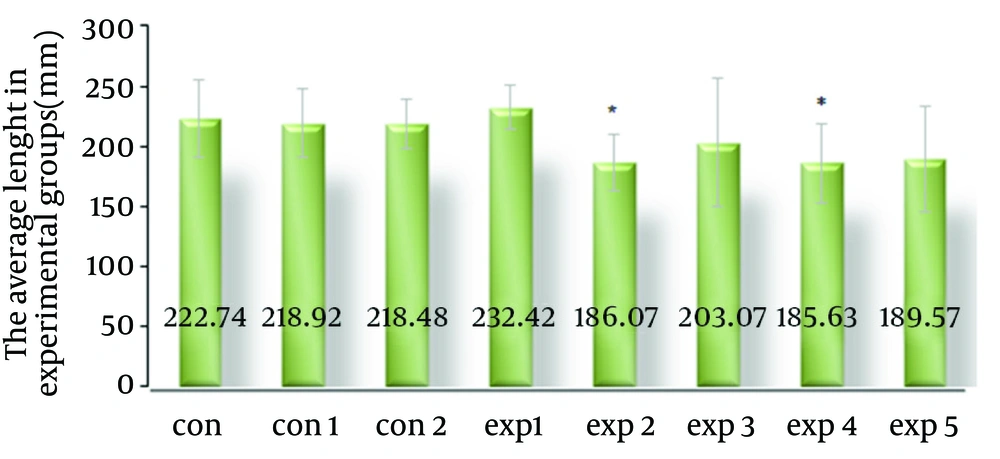
Figure 3.
Comparison of the average vascular length in control, laboratory control, and experimental groups; *p<0.05
Growth process depends on extended reactions among different molecules and cells and is controlled by peptides and different adjusting factors [16]. VEGA pro-angiogenic factor plays an important role in angiogenesis. VEGA and its receptors are angiogene key mediates and they are also purpose for several pharmacological agents [17]. Deferoxamine is an iron chelator, which is used for treatment of iron overload diseases. It also affects vessel growth phenomenon. Ikeda et al. reported that deferoxamine has pro-angiogenic effects which lead to the stimulation of new vessels' growth. Deferoxamine with eNOS phosphorylation through P13K-AKT pathway lead to endothelial cell proliferation, migration and differentiation. It should be said that in Ikeda's study deferoxamine effects have been evaluated in vivo condition and on rat and in form of drug daily injection and in vitro on human aortic endothelial cells [18]. Obtained results from present study on deferoxamine effects on angiogenesis in chick embryo chorioallantoic membrane (in vivo and injection on 8 day of incubation) were different from Ikeda's et al. findings [18]. In Kalinowski and Richardson study was shown that deferoxamine has had an antiproliferative activity against tumors' progress. This antiproliferative activity of deferoxamine has been known related to its effects on ribonucleoreductases enzyme that through iron decrease by deferoxamine and induction of disorder in the function of ribonucleoreductases enzyme and finally inhibit of DNA synthesis, inhibit proliferation of tumors and cells’ viability also decrease [19]. Also in Kim et al. study, it is shown that deferoxamine, through the decrease in expression of metalloproteinase matrix and caspases activation, leads to the induction of apoptosis [20]. Le and Richardson reported that deferoxamine, through inhibit cyclin dependent kinase (CDK) activities, inhibit phosphorylation of retinoblastoma protein (RB) and stopping Cycle recycling cyclin D1, and finally disorder in CDK-CD1 complex function causes stopping cell transition from G1 to S step in cell cycle [21]. It should be mentioned that in Kim et al., Le, Kalinowski study, deferoxamine effects in vitro condition and on cancerous cells are evaluated and present study results are correspond with Kalinowski and Richardson [19], Kim et al. [20], and Le and Richardson [21] results. While, in present study deferoxamine effect on chick embryo chorioallantoic membrane and in vivo (injection on 8 day of incubation) has been studied. Probable suggested mechanism for present study may be considered correspond with Kim et al., Le and Richardson, and Kalinowski and Richardson reports. As deferoxamine effect is depended on concentration and incubation time [22] and iron has an important role in cellular proliferation and differentiation [23]. Iron depletion by deferoxamine inhibits these processes [24], and in our study, significant decrease is observed in the number and the length of blood vessels. Pulse Electromagnetic effects on angiogenesis are detected formerly. Ruggerio reported to the significant inhibit of angiogenesis by a 0.2 T electromagnetic field [25]. Tsai et al. found that electromagnetic fields stimulate osteoblasts’ proliferation and differentiation in vitro condition [26]. Some important factors which cause 311 electromagnetic field different effects include: Field intensity, frequency, the time of exposure of electromagnetic field, and the genetics of the treated cases, too [27] While, that intensities like 100 and 300 G had no effect on Angiogenesis, but 200 G intensity caused inhibit vessel growth [28]. In this research it is observed that 100 G electromagnetic field with deferoxamine had inhibition effect on Angiogenesis which was along with significant decrease in the number and length of blood vessels. Based on this research, it can be concluded that a low frequency electromagnetic field and 100 G intensity may increase inhibitory effect of deferoxamine on angiogenesis in chick chorioallantoic membrane, in such a way that this effect has been observed in a form of more significant decrease in the mean of the number and length of blood vessels which were exposed to deferoxamine and electromagnetic field in comparison to the samples which were only exposed to deferoxamine. It is suggested that higher electromagnetic fields and higher dose deferoxamine to be used to reach to more and complete results.