
1. Background
Obesity is a chronic disease and a health problem in today’s societies, and its prevalence increases from the first half of the twentieth century because of the industrialization life in the world (1). Thus, overweight and obesity in the world’s populations were estimated at 937 and 396 million in 2005, respectively. This figure has doubled during the past 25 years. It is predicted that 1.3 billion and 573 million of worldwide people will be overweight and obese until 2020, respectively (2). The World Health Organization (WHO) also reminded the obesity epidemic in the world. National recent estimates in Iran reported that more than 50% of Iranian adults are overweight or obese. According to the WHO report, the prevalence of overweight among Iranian men and women were 54% and 70% in 2005, respectively, and also predicted that the trend of overweight among women is increasing (3, 4).
According to the definition of the WHO, health is a multidimensional concept that deliberates psychological and social aspects in addition to the physical dimension. Recently, the concept of sexual health has been considered in relation to physical and mental health, which WHO considers this as adaptation and coordination of physical, emotional, intellectual, and social aspects of human sexual affairs so that promotes and enriches the personality and love relationships.
It should be noted that sexual health is an important part of life, and different aspects of health interact with and influence each other (5). Obesity causes many diseases such as diabetes, hypertension, cardiovascular disease, osteoarthritis, hyperlipidemia, impaired lung function, some cancers, and psychological problems (1, 5, 6).
Sexual health means that one can achieve their reproductive behavior and away from the factors that cause inhibit sexual response and pleasure in relationships and sexual function. In obese patients, negative body image, and low self-confidence, low self-esteem, poor interpersonal relationships, and feelings of guilt and shame due to the weight of these people are the main factors of sexual dysfunction because they have an important role in sex. In addition, obesity can be regarded as a physical barrier in sex (4, 5, 7). Few studies examined the relationship between obesity and sexual function. Obesity of men can lead to decreased sexual satisfaction, increase penile erectile dysfunction, and cardiovascular disease, but the relationship between obesity and sexual dysfunction among women has been less known (6, 8-10). Adolfsson et al. (8) indicated that 18-49-year-old obese women had a progressive reduction in sexual desire in comparison to women who had normal weight. Sexual relationship is one of the major causes of marital happiness/satisfaction, and its dissatisfaction has a number of negative consequences and results in the feeling of depression and frustration, and can even lead to marital disruption (11-14).
2. Objectives
Owing to the limited number of studies on female sexual function in Iran, the role of sexual function in women’s lives and maintaining physical and mental health of individual and family, as well as the importance of sexual problems in relationships between spouses and the high prevalence of overweight and obesity among women, this study was performed to investigate the relationship between obesity and sexual function of women referred to health centers of Birjand City in Iran.
3. Methods
This cross-sectional study was conducted on 126 women referred to health centers affiliated to Birjand University of Medical Sciences. Sample size was calculated using the results obtained from Kolotkin et al. study (6) and formula for difference in means, α = 0.5, β = 0.1, S1= 1.31, S2 = 1.351, and d = 0.8.
Sampling was done using a multi-stage method. First, Birjand City was divided into four regions based on geographical situation, and Birjand Health centers were placed inside these categories; then, out of each category, one health center was selected with a simple random method. The researcher was attended at each of these centers for 6 days and selected eligible women to enter the study using a participant selection checklist based on purposeful sampling method. The data were collected. Considering that body mass index (BMI) was the cornerstone of this study in each BMI group (obese, overweight, and normal), the same sample size was taken in the study. According to the sample size, women were assigned into three groups of BMI, including normal, overweight, and obese groups (42 subjects in each group). BMI ≥ 30 was obese, BMI: 25 - 29.9 was overweight, and BMI 18.5 - 24.9 was normal.
The inclusion criteria included being Iranian women who resided in Birjand, aged between 15 - 49 years, married, and her husband’s monogamy. The exclusion criteria were BMI less than 18.5, well-known diseases of women or their husbands, which impact on sexual function, genital tract disorders, injuries or surgeries, smoking, alcohol consumption or using drugs that affecting sexual function, menopause, pregnancy, infertility, experiencing some stress like marital infidelity or death, major changes in living conditions, premature ejaculation or erectile dysfunction in husbands and sexual abuse in childhood.
Approval to conduct the study was obtained from the Research Ethics Committee of the Birjand University of Medical Sciences (code: 413). Written informed consent was obtained from the participants. Furthermore, the women were also informed that they had the right to withdraw from the study and were assured of the study’s confidentiality.
It should also be noted that the BMI of the samples was determined using standard balance and stadiometer.
A two-part questionnaire was used for data collection. The first part included socio-demographic characteristics, and the second part was the female sexual function index questionnaire (FSFI). Socio-demographic characteristics were gathered to describe the study participants since these characteristics (e.g., education or age) could be potential confounders for the association of BMI and FSFI.
This questionnaire has 19 items, and six dimensions, including desire, arousal, lubrication, orgasm, satisfaction, and pain. The scores considered for the desire dimension were 1 - 5, arousal, lubrication, orgasm, pain were 0 - 5, and satisfaction were 0 or 1 to 5. The total score was calculated by summing up the scores of six dimensions together. In this way, a higher score indicates better sexual function. The maximum score for the whole scale was 95. The validity and also also reliability with an internal consistency within the acceptable range (α ranging from 0.72 to 0.90) were approved in the study of Fakhri et al. (15). The questionnaire was completed by a self-administered method.
For data analysis, STATA version 14.1 software was used in this study. Data were analyzed using descriptive and inferential statistics tests, including central and dispersion parameters (mean, standard deviation [SD], and frequency distribution). Also, multiple linear regression models were used to study the factors related to sexual function. First, the association between independent and dependent variables (sexual function) was investigated using univariate statistical test. Then variables with P values of less than 0.2 were entered the final model. The significance level was considered 0.05.
4. Results
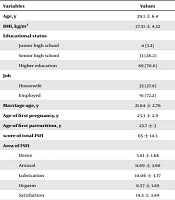
According to the results, the participant’s mean age and BMI were 29.1 and 27.31 years, respectively. More than two-thirds of the participant had academic education (70.6%) and were employed (72.2 %). The mean and standard deviation (SD) of the participant’s marriage age was 21.64 ± 2.76 (Table 1).
Table 1.
The Demographic Characteristics and Sexual Function of Study Participantsa
| Variables | Values |
|---|---|
| Age, y | 29.1 ± 6.4 |
| BMI, kg/m2 | 27.31 ± 4.32 |
| Educational status | |
| Junior high school | 4 (3.2) |
| Senior high school | 33 (26.2) |
| Higher education | 89 (70.6) |
| Job | |
| Housewife | 35 (27.8) |
| Employed | 91 (72.2) |
| Marriage age, y | 21.64 ± 2.76 |
| Age of first pregnancy, y | 23.3 ± 2.9 |
| Age of first parturition, y | 23.7 ± 3 |
| score of total FSFI | 65 ± 14.3 |
| Area of FSFI | |
| Desire | 5.81 ± 1.68 |
| Arousal | 11.69 ± 3.68 |
| Lubrication | 14.06 ± 3.37 |
| Orgasm | 6.57 ± 1.89 |
| Satisfaction | 14.3 ± 3.49 |
| Pain | 9.82 ± 3 |
aValues are expressed as No. (%) or mean ± SD.
This study showed a significant difference in the mean age between the three groups. So, the difference between normal and obese, normal and overweight, and overweight and obese groups was statistically significant (One-way ANOVA, P < 0.001). The results of the comparison between the groups showed significant differences between the groups in terms of education level and occupation. Most of the participants had academic education in the normal and overweight group but had secondary and academic educations in the obese group. Most of the participants belonged to the normal and overweight groups, and most of them were homemakers in the obese group. The study showed a significant difference between the groups in total score of sexual function. This difference between normal and obese, normal and overweight, and obese and overweight group was statistically significant (P < 0.001). In addition, a statistically significant difference was observed in desire and arousal scores between the groups. The difference between the normal and overweight, normal and obese groups was statistically significant (P < 0.001). A significant difference was observed in lubrication, orgasm, and sexual satisfaction scores between the groups. The difference between normal and obese, overweight, and obese groups was statistically significant (P < 0.001).
The results based on one-way ANOVA showed a significant difference between the three study groups regarding BMI in the total score of sexual function (P < 0.001). The highest score belonged to the normal group (72.5 ± 15.5) and the lowest score (56.2 ± 10.6) belonged to the obese group. Also, a significant difference was observed among the BMI-based categorized groups in six dimensions of FSFI. Based on Post hoc test, in the dimension of desire and arousal, the difference between the normal and overweight, normal and obese groups was statistically significant (P < 0.001) and in lubrication, orgasm, and sexual satisfaction dimensions a statistically significant difference was observed between normal and obese, overweight and obese groups (P < 0.001) (Table 2).
Table 2.
Comparison the Demographic Characteristics and Score of Total Sexual Function and its 6 Categories Among Three Groupsa
| Variables | Normal (N = 42) | Overweight (N = 42) | Obese (N = 42) | P Value |
|---|---|---|---|---|
| Age, yb | 28.8 ± 5.8 | 29.4 ± 6.1 | 30.1 ± 5.3 | 0.08 |
| BMI, kg/m2b | 22.10 ± 1.54 | 27.82 ± 1.32 | 32.02 ± 1.47 | < 0.001 |
| Educational statusc | < 0.001 | |||
| Junior high school | 1 (2.4) | 0 (0) | 3 (7.1) | |
| Senior high school | 10 (23.8) | 3 (7.1) | 20 (47.6) | |
| Higher education | 31 (73.8) | 39 (92.9) | 19 (45.2) | |
| Jobc | < 0.001 | |||
| Housewife | 8 (19) | 4 (9.5) | 23 (54.8) | |
| Employed | 34 (81) | 38 (90.5) | 19 (45.2) | |
| Marriage age, yb | 21.31 ± 2.64 | 22.33 ± 2.48 | 21.26 ± 3.04 | 0.13 |
| Age of first pregnancy, yb | 23 ± 3.5 | 24.1 ± 2.3 | 22.7 ± 3 | 0.13 |
| Age of first parturition, yb | 23.9 ± 3.9 | 24.5 ± 2.4 | 23.1 ± 3 | 0.13 |
| FSFI scoresb | ||||
| Total | 72.5 ± 15.5 | 66.2 ± 11.3 | 56.2 ± 10.6 | < 0.001 |
| Desire | 6.69 ± 1.94 | 6.23 ± 1.62 | 5.23 ± 1.41 | < 0.001 |
| Arousal | 4.69 ± 3.67 | 12.69 ± 3.2 | 10 ± 3 | < 0.001 |
| Lubrication | 16.47 ± 3.85 | 15 ± 2.93 | 12.64 ± 2.77 | < 0.001 |
| Orgasm | 7.92 ± 2.31 | 7.04 ± 1.71 | 5.8 ± 1.45 | < 0.001 |
| Satisfaction | 16.78 ± 3.54 | 15.5 ± 3.14 | 12.69 ± 2.86 | < 0.001 |
| Pain | 9.97 4.23 | 9.76 ± 2.86 | 9.8 ± 2.59 | 0.93 |
aValues are expressed as mean ± SD.
bANOVA.
cChi-square test.
The results of the regression model showed that after adjustment based on other variables, obesity had a significant correlation with sexual function so that the sexual function score of obese people was lower by 15.87 units than normal people. Also, the sexual function score of overweight people was 4.67 units lower than normal people; however, this difference was not significant. There was also a significant and correlation between high salaries with sexual function so that sexual function score in people with high salaries compared with low-paid people was higher by 16.68 units. The sexual function score of individuals with average salary compared with low-paid people was higher by 10 units, however, this difference was not significant. Moreover, the duration of the marriage and the age at first pregnancy had an inverse correlation with sexual function such that for one year increasing in marriage during and the age at first pregnancy, sexual function score increased by 0.90 and 0.28, respectively. Variables such as age, education, occupation, gravidity, parity, and age at first childbirth did not show a significant correlation with sexual function score (Table 3).
Table 3.
Results of Multiple Linear Regression Model for Determining Factors Related to Score of Sexual Function
| Variables | B | P | 95% CI |
|---|---|---|---|
| BMI | |||
| Normal | - | Ref. | - |
| Overweight | -4.67 | 0.15 | -11.15, 1.80 |
| Obese | -15.87 | 0.000 | -23.79, -7.96 |
| Occupation | |||
| Housewife | - | Ref. | - |
| Employed | -3.92 | 0.307 | -11.51, 3.66 |
| Level of education | |||
| Junior high school | - | Ref. | - |
| Senior high school | 15.07 | 0.09 | -2.39, 32.54 |
| Higher education | 15.37 | 0.10 | -3.42, 34.16 |
| Family income level (according to self-judgment) | |||
| Less than sufficient | - | Ref. | - |
| Sufficient | 10.00 | 0.06 | -0.47, 20.47 |
| More than sufficient | 16.68 | 0.01 | 3.90, 29.46 |
| Age | -0.51 | 0.19 | -1.28, 0.26 |
| Duration of marriage | 0.90 | 0.01 | 0.19, 1.62 |
| Gravidity | 0.63 | 0.78 | -3.89, 5.15 |
| Parity | -1.55 | 0.42 | -5.38, 2.26 |
| Age at First pregnancy | -0.45 | 0.03 | -0.89, -0.02 |
| Age at First childbirth | 0.28 | 0.2 | -0.17, 0.74 |
5. Discussion
In this study, sexual function scores decreased with increasing BMI. In other words, this score was significantly higher in women with normal BMI in comparison to women who were overweight and obese (16). Raisi et al. (17) reported that there was a significant relationship between BMI and sexual dysfunction. Also, a case-control study of Mozafari et al. (2010 - 2011) revealed that the FSFI score was significantly lower in overweight women (P < 0.05). Data analysis of another study (2011) indicated that sexual quality of life decreased with BMI. The univariate binary logistical regression showed an association between high BMI values and sexual dissatisfaction (18). But in the cross-sectional study of Yazdznpanahi et al. (19), this difference was not statistically significant because a large number of the participants (43.6%, n = 224) had normal BMI, and BMI scores were slightly higher in patients with sexual dysfunction than those without sexual dysfunction (20). Fatemi et al. (18) found no statistically significant relationship between sexual function and BMI.
Also, the results of the present study showed that significant differences were observed within three groups related to sexual function dimensions. In addition, a significant difference was observed in desire, arousal, lubrication, orgasm, and sexual satisfaction scores between the groups, but the pain did not correlate with BMI. Yazdanpanahi et al. (19) reported that among all sexual function domains, only sexual desire and sexual arousal were significantly associated with BMI. In contrast, the other domains, including quality of lubrication, orgasm, sexual satisfaction, and pain, did not show any significant correlation with BMI. In Mozafari et al.’s study (20), there was a strong and inverse correlation between BMI and arousal, lubrication, orgasm, and satisfaction, while pain and desire did not correlate with BMI. In the study of Dor Mohammadi et al. (21), an increase in BMI was considered a risk factor for sexual dysfunction. In addition, sexual desire, arousal, lubrication, orgasm, satisfaction, and pain were statistically significant in both groups. Rada et al. (22) found that obese persons in comparison to normal weight ones reported the lack of desire and sexual pleasure, abstention, and difficulties in sexual contact accomplishment. In Jamali et al.’s study (16), the most common sexual problems in infertile females decreased libido (95.2%) and anorgasmia (94.6%). However, Bajos et al. (23) found that there was no difference in sexual dysfunction (lack of sexual desire, arousal, painful intercourse) between obese or overweight women compared with women with a normal BMI. Nevertheless, the results show a significant trend towards decreasing sexual desire with increasing BMI (P = 0.01) (19).
Although the present study only considered the relationship between obesity and sexual dysfunction, testosterone levels, in addition to obesity, were also considered in some studies. For example, one study reported that the variation in androgen levels immediately after weight loss in obese women with regular menstrual cycles is due to the sustained increase in SHBG after weight loss, which leads to the decrease of free testosterone (24, 25). This androgen insufficiency is associated with reduced sexual desire. In contrast, greater androgen levels correlate with increased sexual desire, arousal, orgasm, and satisfaction. Weight loss results in lower scores in these domains; in other words, sexual satisfaction increases when weight decreases (4). The study conducted by Yaylali et al. (25) showed that the level of sexual hormone-binding globulin and testosterone hormone could be less in obese individuals compared to the normal group, which led to sexual dysfunction. In another study, Kolotkin et al. (6) concluded that sexual problems (such as lack of enjoyment of sexual activity, lack of sexual desire, difficulties with sexual performance, and avoidance of sexual encounters) are greater in obese persons due to their high weight. According to his findings, higher BMI with inconsistency has an impact on an individual’s sexual quality of life (6). Abu Ali et al. (24) observed that obese women are more likely to have arousal and orgasm disorders. According to their findings, age and BMI have a negative effect on women’s sexual function.
The results of this study are compatible with other studies. It can be said negative body image, low self-confidence, lack of interpersonal relationships, and shame feeling because of the weight are the main reasons for sexual dysfunction. Obesity caused sexual dysfunction by several potential mechanisms, including aggravated medical complications, changes levels of circulating hormones that affect the body’s response and sexual desire, and changing body image (26). Female sexual response depends on physiological and personal factors. Obesity causes negative body image and self-esteem and decreases quality of life, which can lead to sexual dysfunction (1). Levels of circulating sex hormones are effective in increasing sexual response.
Also, out of demographic and social variables, salary, duration of marriage, and the age at first pregnancy correlated with female sexual function. In Jamali’s study, a significant relationship was found between sexual function and age (P = 0.02), education level (P < 0.001), and occupation (P < 0.001) (16). Also, the results of Mozafari et al. (20) showed age had a significant correlation with FSFI (P < 0.001) (22).
Various differences of studies about the relationship between sexual function and BMI can be attributed to different researchers’ methods in the field of sexual function assessment such as questionnaires, interviews, phone, email, etc. and the population who participated in the research.
The limitations of this study consist of a small sample size in comparison to groups, an individual’s psychological characteristics, differences in social and cultural status that can affect the results of the study. In this study, it was tried to control the most important and known factors affecting women’s sexual function. However, there might be other factors that cannot be controlled by the researchers. Also, trusting to the accuracy of responses, which were recorded by the subjects, was another limitation of the present study that it was tried to provide the explanations and ensure them about the privacy of their information; however, they might hide some information, which led to wrong answers.
It is recommended that other researchers use longitudinal studies and interventional studies to evaluate the effect of sexual consultation on sexual function to obtain precise conclusions and improve sexual function in obese women. Moreover, it is suggested that researchers investigate the factors affecting the sexual quality of life in women, the relationship between BMI and sexual function in underweight individuals, and the effect of weight loss on women’s sexual quality of life in overweight and obese people in the future.
5.1. Conclusions
Given that obesity can affect sexual function in a variety of its dimensions, and obesity and overweight are related to physical health, healthcare providers try to preserve physical health and improve sexual satisfaction by proposing BMI reduction, which is considered one of the most important factors in mental health so provide the basis for women’s health. Sexual education and referring women with sexual dysfunction to a psychologist are highly recommended because diagnosing sexual dysfunction and identifying the factors affecting this problem can help solve women’s problems and improve it. In this regard, people can enjoy their sexual life and be away from factors that disturb their sexual relationships.