


1. Background
Milk and dairy products are an essential part of the human diet that are recommended for all ages. They are known as super-beneficial food with significant effects on health (1). Milk is considered to be the only food that contains almost all the nutrients required for the human body (2, 3). Milk is an important source of protein, calcium, B vitamins (thiamine, riboflavin, niacin, vitamin B6 and folate), vitamins A, vitamins C, magnesium, and zinc (4, 5). Various milk compounds such as vitamin D, protein, calcium, conjugated linoleic acid (CLA), and other fatty acids may be effective in protecting against cancer (3). Therefore, the safety and quality of milk and dairy products are of great importance in public health.
Although technological advances and the development of industry have brought innumerable benefits, serious problems threatening human health have emerged. One of the most important substances that has received great attention today, is the contamination of food with toxic heavy metals. The presence of these environmental pollutants as the most important chemical contaminants in milk and dairy products can have irreversible effects in a long time for consumers. Lead and cadmium are the most abundant heavy metals among contaminated environments that are able to enter food through compounds resulting from industrial activities and contaminants or chemical fertilizers, etc. The heavy metals in food that entered the body are not defecated and accumulate in tissues such as fat, muscles, bones, and joints, which causes various diseases and complications in the body (6). The presence of these heavy metals, even at low amounts results in metabolic disorders with serious impacts on the body and may cause health problems such as weakness, heart failure, kidney problems, and cancer (7). Heavy metals affect cellular organelles and components, such as cell membrane, mitochondrial, lysosome, endoplasmic reticulum, nuclei, some enzymes involved in metabolism, detoxification, and damage repair. Metal ions bind to DNA and nuclear proteins causing DNA damage and conformational changes. Also, reactive oxygen species (ROS) have a substantial role in inducing metal-induced cellular responses and carcinogenesis (8).
Lead is more toxic than other heavy metals and causes neurobehavioral problems, loss of IQ, distraction, mild fatigue, headache, nausea, and vomiting in acute cases while in chronic cases it can cause antisocial behaviors, defects in hemoglobin synthesis, renal dysfunction, deafness, blindness, backwardness, kidney dysfunction, decreased IQ, decreased libido and fatigue (9) (Figure 1). The main target of lead toxicity includes the liver, central nervous system, reproductive system, hematopoietic system, and endocrine system (10). The International Agency for Research on Cancer (IARC) has categorized lead (Pb) as a probable carcinogen to humans (11). In addition, numerous studies have indicated that lead can increase chromosome aberrations or sister chromatid exchange and, therefore, increase the risk of lung, stomach, kidney (gliomas), and brain cancer (12). Koh et al. reported an increased risk of bladder, stomach, and kidney cancers through exposure to lead at workplaces (13). Therefore, due to the acute and chronic irreversible effects of these heavy metals especially the lead in the human body, which is classified from the effect on the nervous system to carcinogenicity, its presence in food products is of great concern. In this respect, monitoring the levels of heavy metals in food, especially milk and dairy products, is an important issue to maintain the health status of consumers and achieve safe food products.
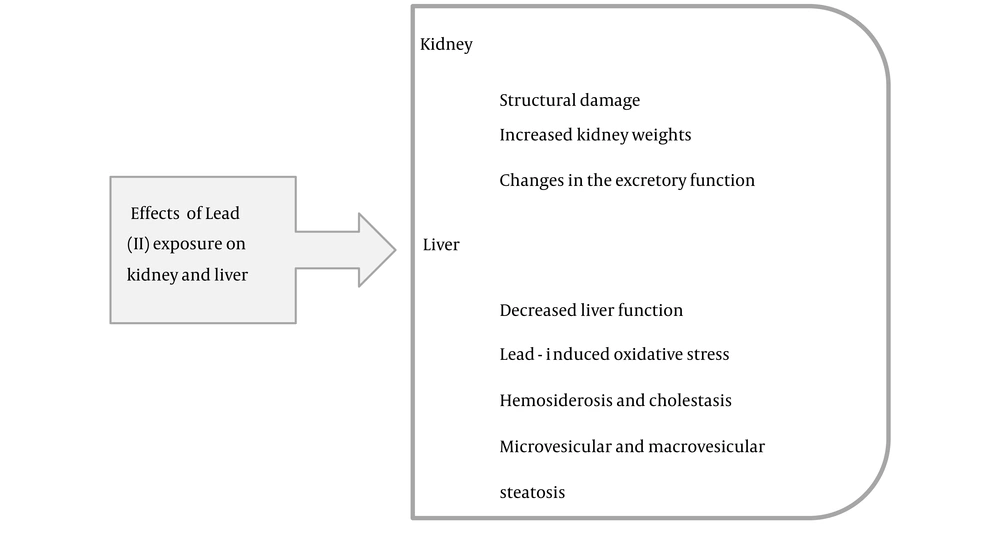
Figure 1.
The effects of lead (II) exposure on liver and kidney
2. Objectives
The aim of this study was to determine the level of lead in pasteurized milk and some dairy products and evaluate the health risks caused by consuming these products in children and adults.
3. Methods
3.1. Sampling
Pasteurized milk and dairy products were selected from the most-consumed brands in Tehran, Iran. Eighteen samples of pasteurized milk, 5 of cheese, 3 of cream, 3 of butter, 3 of yogurt, and 6 of milk powder were selected from different brands. Therefore, a total of 38 samples were collected for analysis.
3.2. Chemicals and Standards
Lead standard, H2O2, nitric oxide, and distilled water were purchased from Merck (Darmstadt, Germany). Standard lead solutions were prepared at concentrations of 1000 mg/L in order to draw a calibration curve. One gram of lead was dissolved in 7 mL of nitric oxide in a 1000 mL volumetric flask and its volume was increased to 1000 mL.
3.3. Preparation of Test Samples
All samples were collected in clean and acid-washed polyethylene bottles, labeled, and stored at -18°C until analysis. Milk samples stored at -18°C were vigorously shaken at room temperature using a vortex-Genie2 mixer. First, 2 g of milk samples were weighed, then 5 mL nitric acid and 2 mL nitrogen peroxide were added to these samples, and then were placed in the microwave for a few minutes in a low-setting step. The microwave program was set up in 4 steps including: (1) power of 250 watts for 3 minutes; (2) power 630 watts for 5 minutes; (3) power of 500 watts for 22 minutes; (4) power of 0 watts for 15 minutes. This program was valid as long as the full capacity of the microwave oven was used. After ingestion of samples, the vessels were taken out of microwave oven and allowed to be completely cooled and the volume was increased to 25 mL.
3.4. Pb Analysis
A graphite furnace atomic absorption spectrometer (Perkin Elmer/HGA 6002 German) equipped with a sampler was used to determine the Pb level in milk samples. A hollow element cathode lamp operating at a wavelength of 283.3 nm was used. The atomic absorption spectrometer program was defined in 4 stages, including: (1) T: 130°C, ramping time: 10 s, holding time: 30 s; (2) T: 450°C, ramping time: 15 s, holding time: 10 s; (3) T: 1900°C, ramping time: 0 s, holding time: 4 s; and (4) T: 2500°C, ramping time: 2 s, holding time: 2 s.
To measure lead (Pb) in yogurt and cheese, 5 g yogurt and 2 g of cheese samples were weighed and placed in an oven at 90°C for 12 h to remove the moisture, then the crucibles were heated until burning the samples. Afterward, the crucibles were placed in a muffle furnace at 550°C for 12 h. After this stage, the crucibles were taken out of the furnace and placed in a desiccator until cooling. The obtained ash was dissolved in 25% nitric acid solution and transferred to a 250 mL Erlenmeyer flask. To evaluate the amount of lead in butter and cream, 18 g butter and 18 g cream were weighed in crucibles and were dried in an oven at 120°C for 24 h and then were heated until burning the samples. Afterward, the crucibles were placed in a muffle furnace at 550°C for 8 h to obtain ash. After cooling the ash, 1 mL water and 3 mL of HNO3 were added to the ash and the resulting solution was transferred to a 25 mL flask and distilled twice (14).
In the case of milk powder, 25 g sample was transferred to a crucible previously washed with nitric acid, and 10 mL nitric acid 65% was added to the sample and heated until complete burning. Then the samples were placed in a muffle furnace at 500°C for obtaining ash. The ash was removed from the furnace and placed in a desiccator for one hour to be cooled. Then ash was dissolved in 10 mL of nitric acid. All samples were analyzed by atomic absorption spectrophotometry.
3.5. Human Health Risk Assessment
Human health risk assessment of lead was calculated according to the study of Abedi Sarvestani and Aghasi (15) for children and adults in the Iranian population using the following formula.
Hazard quotient (HQ) of metal was determined using equation 1, where: EF, exposure frequency (365 days/year); ED, exposure duration with respect to 30 years for adults and 6 years for children equivalent to an average lifetime when consuming milk; FIR, food ingestion rate (g/day); C, heavy metal contents in milk (mg/kg); RFD, the oral reference dose (0.0035 mg/kg.day); W, average body weight (children: 15 kg and adult: 70 kg); and AT, average exposure time for non-carcinogenic effects (ED × 365) and 70 × 365 for carcinogenic effects. In equation 2, CR is a carcinogenic risk, EF, ED, C, FIR, AT, and W are similar to equation (1) and CSFo stands for oral carcinogenic slope factor considered as 0.0085 mg/kg.day (9).
3.6. Statistical Analysis
All experiments were performed in triplicates and data analysis was carried out by SPSS 24 (IBM Corporation, Somers, NY). Mean values and standard deviations were analyzed by ANOVA. Duncan’s test was used to analyze the significant differences among the means and statistical significance was reported as ‘P-value < 0.05’. Graphs were drawn using Excel software.
4. Results
Figure 2 shows the concentration of lead in pasteurized milk samples. In all samples, the concentration of lead was less than the maximum allowable amount in pasteurized milk (20 µg/kg according to Codex, EU, and Iran National Standard). The highest amount of lead was observed in brands 2 and 4 with 0.019 and 0.018 mg/kg, respectively; while the lowest amount was 0.0095 mg/kg in brand 3. Figure 3 shows the concentration of lead in different dairy products. In all samples, the concentration of lead was less than the maximum allowable level in dairy products (20 µg/kg according to Codex, EU, and Iran National Standard). The highest amount of lead was observed in yogurt and butter with values of 0.02 and 0.018 mg/kg, respectively, and the lowest amount was recorded in cheese and milk powder with 0.011 mg/kg. Various studies investigating the concentration of Pb in pasteurized milk and dairy products are presented in Table 1. As shown in Tables 2 and 3, CR and HQ for pasteurized milk and dairy products are separately calculated according to the US Environmental Protection Agency (USEPA). In terms of HQ, in all pasteurized milk samples and dairy products, they were higher in children than adults. The results of our study showed that HQ was < 1 in all experiments, both in pasteurized milk and in dairy products, so there is no health risk for the children and adults by consumption of milk and dairy products. In the case of CR, the results of our study showed that CR is in the acceptable range for pasteurized milk and dairy products.
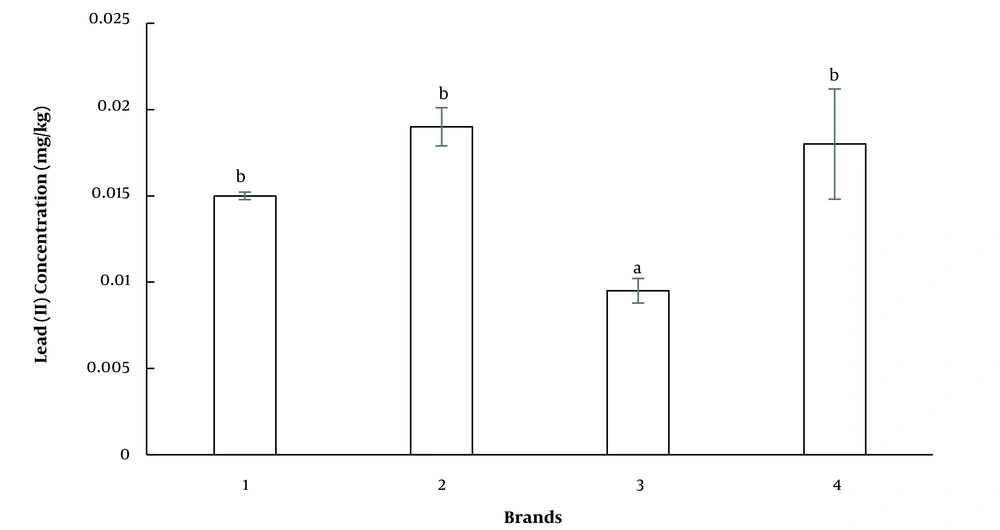
Figure 2.
Level of lead (II) (mg/kg) in pasteurized milk samples from four main brands
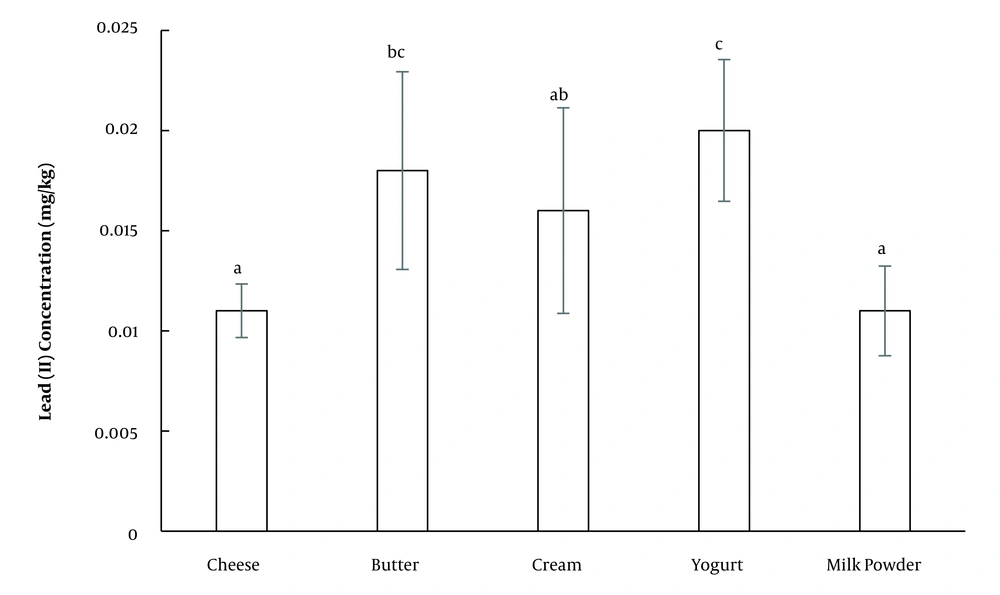
Figure 3.
Lead (II) concentrations (mg/kg) of different dairy products
Table 1.The Reported Concentrations for Lead (II) in Pasteurized Milk and Milk Products
| Location/Sample | Year Study | Method of Detection | Metal Concentration (Mean ± SD, ppm) | References |
|---|---|---|---|---|
| Present study | 2020 | GFAAS | Present study | |
| Pasteurized milk | 0.016 ± 0.003 | |||
| Cheese | 0.010 ± 0.001 | |||
| Yogurt | 0.022 ± 0.003 | |||
| Butter | 0.017 ± 0.004 | |||
| Cream | 0.016 ± 0.005 | |||
| Milk powder | 0.011 ± 0.002 | |||
| Hamadan | 2014 | ICP-OES | (9) | |
| Pasteurized milk | 0.025 ± 0.026 | |||
| Golpayegan, Damavand, Varamin and Tehran | 2014 | FAAS | (14) | |
| Cream | 0.832 ± 0.151 | |||
| Butter | 0.879 ± 0.137 | |||
| Puebla, Mexico | 2016 | ICP-OES | (16) | |
| Cheese | 0.05± 0.03 | |||
| Hamadan | 2016 | ICP-OES | (17) | |
| Cheese | 0.012 ± 0.002 | |||
| Butter | 0.021 ± 0.001 | |||
| Shahroud | 2015 | GFAAS | (18) | |
| Pasteurized milk | 0.048 ± 0.001 | |||
| Tabriz | 2016 | GFAAS | (19) | |
| Pasteurized milk | 0.009 ± 0.000 | |||
| Yogurt | 0.012 ± 0.000 | |||
| Arak | 2013 | ICP-OES | (20) | |
| Pasteurized milk | 0.012 ± 0.007 | |||
| Cheese | 0.018 ± 0.009 | |||
| Yogurt | 0.016 ± 0.008 | |||
| Iran | 2013 | Voltametric | (21) | |
| Pasteurized milk | 0.009 ± 0.001 | |||
| Cheese | 0.014 ± 0.002 | |||
| Yogurt | 0.007 ± 0.001 | |||
| Korea | 2012 | ICP-MS | (22) | |
| Cheese | 0.005 ± 0.002 | |||
| Butter | 0.0021 ± 0.002 | |||
| Cream | 0.001 ± 0.001 | |||
| Turkey | 2004 | ICP-AES | (23) | |
| Butter | 0.116 ± 0.21 | |||
| Yogurt | 0.009 ± 0.014 | |||
| Ayran | 0.039 ± 0.023 | |||
| Izmir, Turkey | 2002 | Differential Pulse Polarography | (24) | |
| Pasteurized milk | 0.98 ± 0.15 | |||
| Cheese | 1.05 ± 0.21 | |||
| Ayran | 0.24 ± 0.02 | |||
| Southern Italy | 2002 | GFAAS | (25) | |
| Cheese | 0.58 ± 0.27 | |||
| Ankara, Turkey | 2001 | GFAAS | (26) | |
| Cheese | 0.086 ± 0.063 | |||
| Egypt | 2014 | FAAS | (27) | |
| Cheese | 0.43 ± 0.029 | |||
| Butter | 0.49 ± 0.021 | |||
| Alexandria, Egypt | 2019 | AAS | (28) | |
| Yogurt | 0.29 ± 0.043 | |||
| Cream | 0.18 ± 0.037 |
Table 2.Hazard Quotients (HQ) and Carcinogenic Risk (CR) for Lead (II) Intake Through Pasteurized Milk
| Brands | HQ | CR |
|---|---|---|
| 1 | ||
| Adults | 0.0085 | 1.1 × 10⁻⁷ |
| Children | 0.04 | 1.0 × 10⁻⁷ |
| 2 | ||
| Adults | 0.0108 | 1.3 × 10⁻⁷ |
| Children | 0.0506 | 1.2 × 10⁻⁷ |
| 3 | ||
| Adults | 0.0054 | 6.9 × 10⁻⁸ |
| Children | 0.0253 | 6.4 × 10⁻⁸ |
| 4 | ||
| Adults | 0.0102 | 1.3 × 10⁻⁷ |
| Children | 0.048 | 1.2 × 10⁻⁷ |
| Total mean | ||
| Adults | 0.0087 | 1.1 × 10⁻⁷ |
| Children | 0.0409 | 1.0 × 10⁻⁷ |
Table 3.Hazard Quotients (HQ) and Carcinogenic Risk (CR) for Lead (II) Intake Through Dairy Products
| Dairy products | HQ | CR |
|---|---|---|
| Cheese | ||
| Adults | 0.0062 | 8.0 × 10⁻⁸ |
| Children | 0.0293 | 7.4 × 10⁻⁸ |
| Butter | ||
| Adults | 0.0102 | 1.3 × 10⁻⁷ |
| Children | 0.048 | 1.2 × 10⁻⁷ |
| Cream | ||
| Adults | 0.0091 | 1.1 × 10⁻⁷ |
| Children | 0.0426 | 1.0 × 10⁻⁷ |
| Yogurt | ||
| Adults | 0.0114 | 1.4 × 10⁻⁷ |
| Children | 0.0533 | 1.3 × 10⁻⁷ |
| Milk powder | ||
| Adults | 0.0062 | 8.0 × 10⁻⁸ |
| Children | 0.0293 | 7.4 × 10⁻⁸ |
| Total mean | ||
| Adults | 0.0086 | 1.0 × 10⁻⁷ |
| Children | 0.0405 | 9.9 × 10⁻⁸ |
5. Discussion
Nowadays, environmental risk factors substantially contribute to the incidence of numerous diseases. These pollutants are highly stable and bioaccumulate in nature leading to public health concerns (29). It seems that the mechanisms of toxic effects of heavy metals on the human body as one of the dangerous pollutants include induction of oxidative stress, inactivation of enzyme systems, and DNA damage. Furthermore, their toxicity depends on the route of exposure, the concentrations of absorbed metals, and chronic or acute exposure (30, 31). Toxic heavy metals such as lead are common air pollutants that are emitted into the air as a consequence of industrial activities. Contamination of soil, water sources, and plants with this metal leads to the entrance of Pb into the food chain including milk. Furthermore, lead can contaminate animal milk via equipment and machinery used during the processing milk (32). According to the Joint FAO/WHO Expert Committee on Food Additives (JECFA), provisional tolerable weakly intake (PTWI) of Pb is reported 25 μg/kg body weight/week (33).
The comparison of heavy lead concentration in different dairy products in the current study with other studies is provided in Table 1. In some studies including the study of Ghafari and Sobhanardakani (17), Madani-Tonekaboni et al. (18), Sobhanardakani (9), Aminzadeh Vahedi et al. (14), Rezaei et al. (20), Ayar et al. (23), Yuzbasi et al. (26), and Castro-Gonzalez et al. (16), the level of lead in pasteurized milk and dairy products was higher than the allowable level which can be attributed to several reasons. In the study of Aminzadeh Vahedi et al. (14) conducted in Golpayegan, the level of lead in cream and butter was greater than the allowable limit, which could be related to the supply of raw milk from farms that were close to industrial areas and this is one of the reasons for the possibility of contamination of fodder and livestock water and as result contamination of pasteurized milk and dairy products with lead. Also, the investigation of Pb in milk and cheese samples showed a high level of this toxic metal that exceeded the maximum allowed concentration. The Proximity of industrial factories to the water sources of the farms was introduced as the possible source of contamination (34).
In our study, among dairy products, the amount of lead in yogurt was slightly higher than other products, but was still within the allowable range. In terms of the allowable level, the results of other researchers were within the allowable range and in accordance with our results. Beikzadeh et al. (19) mentioned lead concentrations in 20 yogurt and pasteurized milk samples in Tabriz regions, Iran were in the range of 5.54 - 19.34 and 6.06 - 10.83 ppb, respectively, which the average of lead contents in yogurt was more than pasteurized milk. In another study by Meshref et al. (27), heavy metals and trace elements (Pb, Cd, Zn, Cu, and Fe) have been determined in milk and milk products and the results showed that the range of Pb concentration was 0.044 - 0.751 ppm that exceeded the maximum permissible limit. Investigation of the level of heavy metals in different brands of pasteurized milk in Gorgan city, Iran revealed that the mean concentration of Pb was 0.02 μg/g and about 67% of samples had Pb content lower than the Codex limit (35). Also, researchers have found that the amount of heavy metals in the soil directly affects their levels in animal feed and milk (36).
In a survey conducted by Kim et al. (22) the samples of powdered milk, cheese, cream, and butter were investigated for lead contents in Korea that indicated the amount of 5.36, 5.64, 1.84, and 2.17 ppb, respectively. They reported that all of the samples were lower than the Korean legal permissible limit. Tokusoglu et al. (24) declared the concentration of lead in natural yogurt and kasar cheese sold in Izmir, Turkey was 0.39 and 1.05 ppm which they were higher than the lead level in our study.
The hazard quotient based on the USEPA calculates non-carcinogenic risk and is the ratio of determined dose of heavy metal to a reference dose (37). HQ < 1 indicates no risk to human health. Although HQ was within the acceptable limits in the current study in all cases, the amount of HQ was higher for children than adults due to the consumption of more milk by children compared to adults. On the other hand, the absorption rate of heavy metals in adults and children is 10 and 50%, respectively. The gastrointestinal tract, kidneys, and immature blood-brain barrier in children increase the load of heavy metals in children (38). Inconsistent with our results, Feizi et al. (35) determined the health risk index through consumption of pasteurized milk samples and reported no health risk associated with the milk samples. In another research in Aswan, the hazard quotient caused by buffalo, cow, and goat milk consumption was 0.6, 0.4, and 0.2, respectively for daily intake of lead that confirmed that the consumption of different kinds of milks had no health risk for Aswan people (39).
Based on the International Agency for Research on Cancer (IARC) (40) heavy metals such as Pb, are considered to have a carcinogenic effect. According to USEPA, If CR is less than 10-6, it is acceptable and there is no concern about the carcinogenicity (41). If CR is in the range of 10-6 to 10-4, it is considered tolerable and values above 10-4 are considered as carcinogenic risk range. In the present study, the method used for quantification of Pb in milk and dairy products was suitable
without the need for pretreatments and the obtained results can be used by health agencies in establishing policies. However, there are some limitations in this study that the studied samples were collected from a limited area and for a short time which makes it impossible to extrapolate the data to the whole country. Also, the determination of other toxic heavy metals such as cadmium, mercury, and arsenic seems necessary to evaluate the safety status of milk and dairy products. Moreover, the effect of season and storage time on the distribution of Pb in milk and dairy products has not been investigated.
5.1. Conclusions
In general, the results indicated that the lead levels in all brands of pasteurized milk and dairy products were below the allowable limit (0.02 mg/kg). The results of the risk assessment showed that HQ was < 1 for all samples of pasteurized milk and dairy products. This indicates that there is no risk of carcinogenicity in children and adults. However, the amount of HQ in children was higher than in adults because of higher consumption of milk and consequently higher lead uptake in children. The risk of carcinogenicity in all experiments was within acceptable limits. In order to prevent the detrimental effects of lead on the body, it is suggested to strictly monitor the milk processing units (instruments, animal feed, and source of drinking water) and in this context, performing food safety programs such as HACCP, good manufacturing practices, and food safety management system can be helpful. Furthermore, food authorities should regulate the presence of heavy metals in milk and dairy products to reduce the contamination of dairy products with heavy metals.



