Full Text
Full text is available in PDF
International Journal of Endocrinology and Metabolism
Research Institute for Endocrine Sciences
Authors
Recent clinical studies have shown that moderate and severe traumatic brain injury (TBI) is a common cause of hypopituitarism. Mild TBI has also been associated with hypopituitarism, which since it is often not evaluated, the hypopituitar-ism may remain under diagnosed. In this study we aimed at determining the clinical and hor-monal profile of mild TBI patients admitted a year after their injury. Materials & Methods: The sample was a descrip-tive, prospective cohort in a tertiary hospital. A hypopituitarism clinical evaluation form was used to evaluate the patients for signs and symp-toms of hypopituitarism a year after mild TBI. Pituitary hormonal function was tested a year af-ter their injury for IGF-1, FT4, TSH, cortisol, LH, FSH and testosterone. Results: Six male patients with mild TBI were studied. Mean age was 27 8 years old. All of them had intra-cranial hemorrhage on CT-scan and five underwent emergency decompressive cranial surgery. Evaluation was done 481 ? 67 days after the event. Signs of hypopituitarism were not observed but symptoms of decreased vigor and weight gain was present in five of the six patients. IGF-1 was low in 33% (2/6) and tes-tosterone level was low in 17% (1/6).8 am cortisol levels were equivocal in 83% (5/6) but ACTH-stimulated cortisol values were normal. Thyroid function test were normal for all subjects. Conclusion: The most common symptoms were weight gain & decreased vigor. Signs of hypopi-tuitarism were not noted among the mild TBI pa-tients. Pituitary hormone testing revealed ab-normalities in the somatotrophic & gonado-trophic axes.
© 2009, Author(s). This open-access article is available under the Creative Commons Attribution 4.0 (CC BY 4.0) International License (https://creativecommons.org/licenses/by/4.0/), which allows for unrestricted use, distribution, and reproduction in any medium, provided that the original work is properly cited.
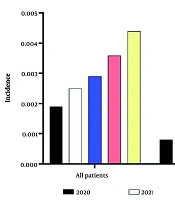
Arjipour M, Amini K, Ghiasi F, Mehrpoya M, Tabatabaei Mohammadi A. The Prevalence and Incidence of Endocrine Disorders After Traumatic Brain Injury in Hamadan City, Iran. Compr Health Biomed Stud. 2025;4(2):e168290. doi: https://doi.org/10.69107/chbs-168290
Kirac Unal Z, Karaca Umay E, Tombak Y, Gundogdu I, Erdem Sultanoglu T, et al. Guillain Barre Syndrome Following Traumatic Brain Injury: A Rare Case. Middle East J Rehabil Health Stud. 2016;3(3):e38121. doi: https://doi.org/10.17795/mejrh-38121
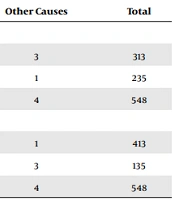
Mohammadi HR, Sadeghi S, Hatefi M, Rahmatian A. Prevalence of Subarachnoid Hemorrhage in Traumatic Brain Injury Patients: A Cross-Sectional Study. Arch Neurosci. 2023;10(2):e136402. doi: https://doi.org/10.5812/ans-136402
Sanei Taheri M, Hemadi H, Sajadi Nasab M, Jalali A, Eftekharpour D. Evaluation of Incidental Findings in Brain CT Scans of Mild Head Trauma Patients (GCS: Thirteen to Fifteen). Int J Cancer Manag. 2010;3(1):e80654. doi:
Kazemnejad E, Mousavi H, Yousefzadeh S, Asgari K, Rezaei S. Identifying Risk Factors for Incidence of Mental Disorders after Traumatic Brain Injury. Zahedan J Res Med Sci. 2014;16(9):. doi:
Last Update: 2 days ago
Last Update: 2 days ago
Last Update: 2 days ago
Last Update: 5 days ago