Materials and Methods
All reagents used in this study were purchased from Merck AG and Aldrich Chemical companies without further purifications. Melting points were determined with a Thomas–Hoover capillary apparatus. Perkin Elmer Model 1420 spectrometer was used to acquire Infrared spectra. 1HNMR spectra with TMS as internal standard were acquired with Bruker FT-500 MHz instrument (Brucker Biosciences, USA. Chloroform-D was used as solvent. Coupling constant (J) values are estimated in hertz (Hz) and spin multiples are given as s (singlet), d (double), t (triplet), q (quartet), and m (multiplet). The mass spectral measurements were performed on a 6410 Agilent LCMS triple quadrupole mass spectrometer (LCMS) with an electrospray ionization (ESI) interface. Microanalyses, determined for C and H, were within ±0.4% of theoretical values.
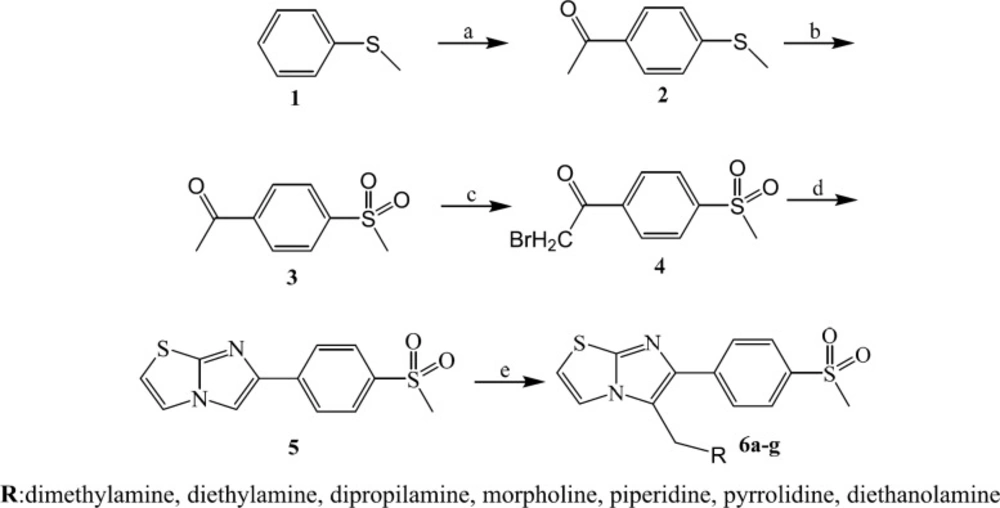
Preparation of 4-(methylthio)acetophenone (2)
11.5 g AlCl3 (87 mmol) was suspended in 200 mL CHCl3 and stirred until disperse uniformly. After cooling to 10 ºC, 6.2 mL (87 mmol) acetyl chloride was added, followed by dropwise addition of 7.5 mL (80 mmol) thioanisole when the temperature was under 4 ºC and allowed the mixture to stir at room temperature for 2 h. The mixture was poured into crushed ice, organic layer was separated with CHCl3 and washed with saturated NaHCO3 solution and finally dried over anhydrous Na2SO4. The solvent was evaporated under reduced pressure. The precipitate was filtered and washed with n-hexane. Yield 87%; white crystalline powder; mp: 81-82 ºC; IR (KBr disk): υ (cm-1) 1690 (C=O); LC-MS (ESI) m/z: 167 (M+1, 100).
4-(Methylsulfonyl)acetophenone (3)
To a solution of 4 g of 1 (24 mmol) in 20 mL THF, mixture of 20 g oxone in THF and water (1:1) was added and stirred at room temperature for 2 h. THF was removed under reduced pressure and extracted with CHCl3 (3 × 25 mL). The organic layer was washed twice with saturated NaHCO3 solution and dried over anhydrous Na2SO4. The solvent was evaporated and white precipitate was recrystallized in ethanol. Yield 95%; white crystalline powder; mp: 128-130 ºC; IR (KBr disk): υ (cm-1) 1148, 1309 (SO2), 1681 (C=O); LC-MS (ESI) m/z: 198.9 (M+1, 100).
α-Bromo-4-(methylsulfonyl)acetophenone (4)
Dissolve 2 g (10.1 mmol) of 2 in 20 mL CHCl3. The bromine was added drop wise. After the reaction was completed (monitored by TLC), the solvent was evaporated under reduced pressure and the precipitate was recrystallized in ethanol. Yield 83%; white crystalline powder; mp: 125-127 ºC; IR (KBr disk): υ (cm-1) 1165, 1308 (SO2) 1710 (C=O); LC-MS (ESI) m/z: 276.7 (M+1, 100).
6-(4-(Methylsulfonyl)phenyl)imidazo[2,1-b]thiazole (5)
To 1 g of 3 (3.62 mmol) in ethanol, 0.38 g Na2CO3 (7.25 mmol) and 0.36 g 2-aminothiazole (3.4 mmol) were added and refluxed for 24 hours. The precipitate was filtered off and washed with water. Yield 70.5%; brown powder; mp: 145.5-147 ºC; IR (KBr disk): νcm-1 1149, 1298 (SO2); 1HNMR (CDCl3): δ ppm 3.08 (s, 3H, SO2CH3), 6.94 (d, 1H, imidazothiazole H2), 7.51 (d, 1H, imidazothiazole H3), 7.89-8.01 (m, 5H, imidazothiazole H5, 4-methylsulfonylphenyl H2, H3, H5 & H6, J = 6.9 Hz); LC-MS (ESI) m/z: 279.0 (M+1, 100). Anal. Calcd. for C12H10N2O2S2: C, 51.78; H, 3.62; N, 10.06. Found: C, 51.52; H, 3.85; N, 10.25.
6-(4-(Methylsulfonyl)phenyl)imidazo[2,1-b]thiazole derivatives (6a-g)
At 0 ºC, acetic acid, ~36% formalin solution (1.37 mmol) and appropriate aliphatic amine 1.37 mmol) were added in the flask. Then, 4 (0.3 g, 1.10 mmol) was added and the reaction mixture stirred at 50 ºC for reaction completion. The reaction mixture was cooled under 10 ºC and pH was adjusted to ~8-9 with 20% sodium hydroxide solution. The solid was filtered and washed with water. The crude was purified by chromatography to give compounds (6a-g) (Yield 50-70%).
N,N-Dimethyl-1-(6-(4-(methylsulfonyl)phenyl)imidazo[2,1-b]thiazol-5-yl)methanamine (6a)
Yield 61%; Yellow powder; mp: 123-124 ºC; IR (KBr): 1 ν (cm-1) 1156, 1316 (SO2); 1HNMR (CDCl3): δ ppm 2.28 (s, 6H, CH3), 3.08 (s, 3H, SO2CH3), 3.79 (s, 2H, -CH2-N), 6.85 (d, 1H, imidazothiazole H2, J = 4.4 Hz), 7.68 (d, 1H, imidazothiazole H3, J = 4.4 Hz), 7.98 (dd, 4H, 4-methylsulfonylphenyl H2, H3, H5 and H6, J = 6.6 Hz); LC-MS (ESI) m/z : 336.0 (M+1, 100). Anal. Calcd. for C15H17N3O2S2: C, 53.71; H, 5.11; N, 12.53. Found: C, 53.51; H, 5.35; N, 12.84.
N-Ethyl-N-((6-(4-(methylsulfonyl)phenyl)imidazo[2,1-b]thiazol-5-yl)methyl)ethanamine (6b)
Yield 55.1%; Yellow powder; mp: 132-135 ºC; IR (KBr): ν (cm-1) 1152,1304 (SO2); 1HNMR (CDCl3): δ ppm 1.04-1.07 (t, 6H, CH3, J = 7.1 Hz), 2.54-2.58 (q, 4H ,CH2-CH3, J = 7.1 Hz), 3.12 (s, 3H ,SO2CH3), 3.97 (s, 2H -CH2-N), 6.86 (d, 1H, imidazothiazole H2, J = 4.5 Hz), 7.81 (d, 1H, imidazothiazole H3, J = 4.5 Hz),8.01 (dd, 4H, 4-methylsulfonylphenyl H2, H3, H5 & H6, J=6.6 Hz); LC-MS (ESI) m/z : 364.0 (M+1, 100). Anal. Calcd. for C17H21N3O2S2: C, 56.17; H, 5.82; N, 11.56. Found: 56.35; H, 6.02; N, 11.71.
N-((6-(4-(Methylsulfonyl)phenyl)imidazo[2,1-b]thiazol-5-yl)methyl)-N-propylpropan-1-amine (6c)
Yield 54.9%; Yellow powder; mp: 165-167 ºC; IR (KBr): ν (cm-1) 1155,1307 (SO2); 1HNMR (CDCl3): δ ppm 0.84-0.87 (t, 6H, CH3, J = 7.3 Hz), 1.46-1.53 (m, 4H,-CH2-CH3), 2.41-2.43 (t,4H,-CH2-CH2, J = 7.1 Hz), 3.12 (s, 3H, SO2CH3), 3.96 (s, 2H, -CH2-N), 6.86 (d, 1H, imidazothiazole H2, J = 4.0 Hz), 7.76 (d, 1H, imidazothiazole H3, J = 4.0 Hz), 8.01 (dd, 4H, 4-methylsulfonylphenyl H2, H3, H5 and H6, J = 6.7 Hz) ; LC-MS (ESI) m/z : 392.1 (M+1, 100). Anal. Calcd. for C19H25N3O2S2: C, 58.28; H, 6.44; N, 10.73. Found: C, 58.33; H, 6.57; N, 10.98.
6-(4-(Methylsulfonyl)phenyl)-5-(pyrrolidin-1-ylmethyl)imidazo[2,1-b]thiazole (6d)
Yield 51%; Yellow powder; mp: 144-146 ºC; IR (KBr): ν (cm-1) 1147,1307 (SO2); 1HNMR (CDCl3): δ ppm 1.82 (m, 4H, CH2-), 2.57 (m, 4H, -N-CH2-), 3.11 (s, 3H, SO2CH3), 4.03 (s, 2H, -CH2-N), 6.87 (d, 1H, imidazothiazole H2, J = 4.2 Hz), 7.78 (d, 1H, imidazothiazole H3, J = 4.2 Hz), 8.00 (dd, 4H, 4-methylsulfonylphenyl H2, H3, H5 and H6, J = 6.8 Hz); LC-MS (ESI) m/z : 362.00 (M+1, 100). Anal. Calcd. for C17H19N3O2S2: C, 56.49; H, 5.30; N, 11.62. Found: C, 56.13; H, 5.51; N, 11.88.
6-(4-(Methylsulfonyl)phenyl)-5-(piperidin-1-ylmethyl)imidazo[2,1-b]thiazole (6e)
Yield 60%; Yellow powder; mp: 142.6-144 ºC; IR (KBr): ν (cm-1) 1151, 1309 (SO2); 1HNMR (CDCl3): δ ppm 1.50 (m, 2H, -CH2-),1.58-1.63 (m, 4H, -CH2-), 2.46 (s, 2H, -CH2-N), 3.12 (s, 3H, SO2CH3), 3.84 (t, 4H, N-CH2-), 6.87 (d, 1H, imidazothiazole H2, J = 4.4 Hz), 7.78 (d, 1H, imidazothiazole H3, J = 4.4 Hz), 8.02 (dd, 4H, 4-methylsulfonyl-phenyl H2, H3, H5 and H6, J = 6.7 Hz) ; LC-MS (ESI) m/z : 376 (M+1, 100). Anal. Calcd. for C18H21N3O2S2: C, 57.58; H, 5.64; N, 11.19. Found: C, 57.78; H, 5.91; N, 11.26.
4-((6-(4-(Methylsulfonyl)phenyl)imidazo[2,1-b]thiazol-5-yl)methyl)morpholine (6f)
Yield 69.5%; Yellow powder; mp: 203-206 ºC; IR (KBr): ν (cm-1) 1173, 1331 (SO2); 1HNMR (CDCl3): δ ppm 2.49 (t, 4H, -N-CH2-, J = 5.0 Hz), 3.08 (s, 3H, SO2CH3), 3.69-3.71 (t, 4H, -CH2-O, J = 4.2), 3.86 (s, 2H, -CH2-N), 6.87 (d, 1H, imidazothiazole H2, J = 4.4 Hz), 7.70 (d,1H, imidazothiazole H3, J = 4.4 Hz), 7.98 (dd, 4H, 4-methylsulfonylphenyl H2, H3, H5 and H6, J = 6.9 Hz ); LC-MS (ESI) m/z : 378.1 (M+1, 100). Anal. Calcd. for C17H19N3O3S2: C, 54.09; H, 5.07; N, 11.13. Found: C, 54.23; H, 5.29; N, 11.33.
2,2′-(((6-(4-(Methylsulfonyl)phenyl)imidazo[2,1-b]thiazol-5-yl)methyl)azanediyl)bis(ethan-1-ol) (6g)
Yield 65%; white powder; mp: 168.8-170 ºC; IR (KBr): ν (cm-1) 1170, 1331 (SO2), 3417 (OH) ; 1HNMR (CDCl3): δ ppm 2.13-2.14 (bs, 2H, O-H), 2.74-2.76 (t, 4H, -N-CH2-, J = 5.0 Hz), 3.13 (s, 3H, SO2CH3), 3.66-3.68 (t, 4H, O-CH2-, J = 5.0 Hz), 4.18 (s, 2H, -CH2-N), 6.91 (d, 1H, imidazothiazole H2, J = 4.4 Hz), 7.91 (d, 1H, imidazothiazole H3, J = 4.4 Hz), 7.96-7.98 (d, 2H, 4-methylsulfonylphenyl H2 and H6, J = 8.3 Hz); 8.02 (d, 2H, 4-methylsulfonylphenyl H3 and H5, J = 8.3Hz); LC-MS (ESI) m/z: 396.1 (M+1,100). Anal. Calcd. for C17H21N3O4S2: C, 51.63; H, 5.35; N, 10.62. Found: C, 51.77; H, 5.65; N, 10.82.
Molecular modeling studies
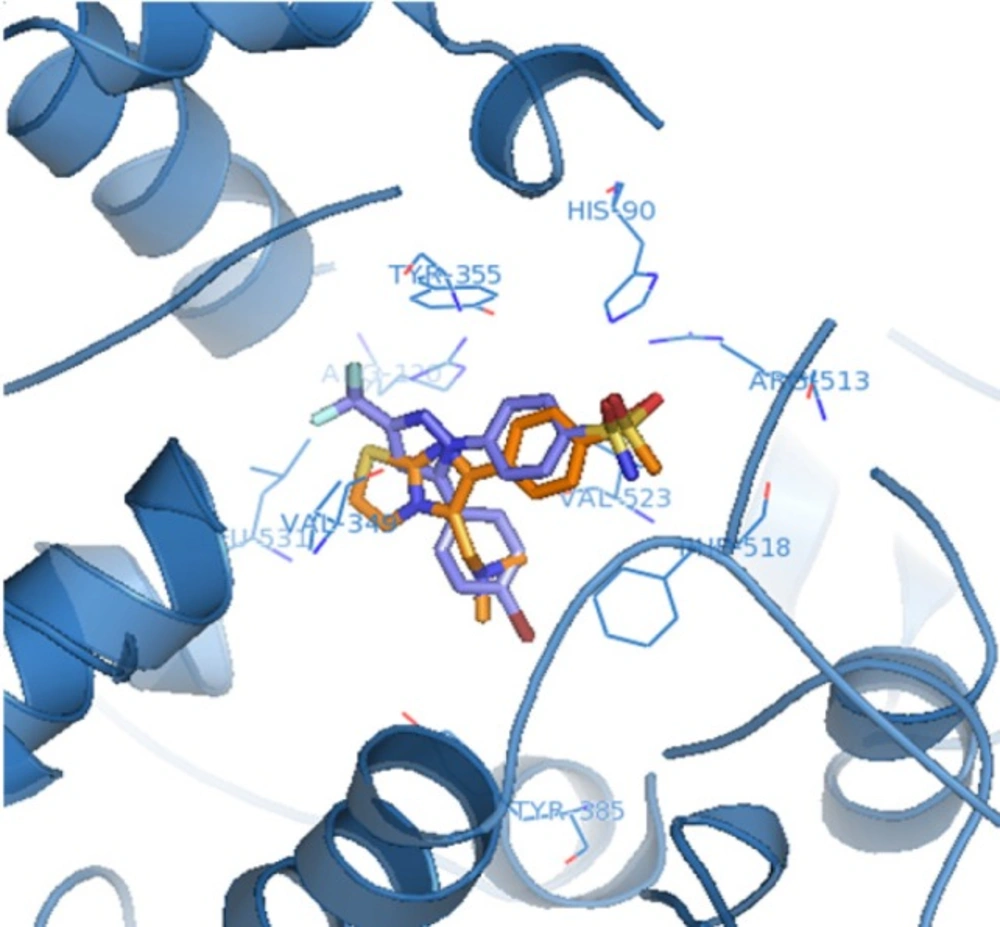
Docking studies were implemented using AutoDock software Version 4.2. The coordinates of the X-ray crystal structure of SC-558 as known selective COX-2 inhibitor bound to the murine COX-2 enzyme was obtained from the RCSB Protein Data Bank (6COX) and hydrogens were added. All the ligand molecules were built by the Builder module and were energy minimized for 1000 iterations reaching a convergence of 0.01 kcal/mol Å. The energy minimized ligands were superimposed on SC-558 in the PDB file of 6COX after which SC-558 was deleted. Searching for the desired binding configuration between the small flexible ligands and the rigid protein is the purpose of docking study. For efficiency, protein residues with atoms greater than 6.0 Å from the docking box were removed. The quality of the docked structures was evaluated by measuring the intermolecular energy of the ligand-enzyme assembly (
32,
33).
In-vitro cyclooxygenase (COX) inhibition assay
Enzyme chemiluminescent kit (Cayman chemical, MI, USA) was used to evaluate inhibition activities of synthesized compounds based on our previous reported procedure (
34). The Cayman chemical chemiluminescent COX (ovine) inhibitor screening assay employs the heme-catalyzed hydroperoxidase activity of ovine cyclooxygenases to produce luminescence in the presence of a cyclic naphthalene hydrazide and the substrate arachidonic acid. Arachidonate-induced luminescence was shown to be an index of real-time catalytic activity and demonstrated the turnover inactivation of the enzyme. COX inhibitory activity, measured by luminescence, by a variety of selective and nonselective inhibitors showed potencies similar to those observed with other
in-vitro and whole cell methods.


![Docking N,N-dimethyl-1-(6-(4-(methylsulfonyl)phenyl)imidazo[2,1-b]thiazol-5- yl)methanamine (<b>6a</b>) in the active site of murine COX-2. Hydrogen atoms have been removed to improve clarity](https://brieflands.com/journals/ijpr/articles/124856/figures/ijpr-17-1288-g003-preview.webp)