

Introduction
Diosmin (3’, 5, 7-trihydroxy-4’-methoxyflavone 7-rutinoside = diosmetin 7-O-rutinoside) is a naturally occurring flavonoid glycoside found in various plant materials, mainly citrus fruits. Due to the high demand for the substance, it is obtained semi-synthetically from hesperidin (3’, 5, 7-trihydroxy-4’-methoxyflavanone 7-rutinoside = hesperitin 7-O-rutinoside).
Diosmin (Figure 1A) is a component of formulations used in the treatment of venous insufficiency, hemorrhoids, lymphedema, diabetes, melanoma, dermatitis, mastalgia, colitis, pre-menstrual syndrome and many other conditions (1, 2). Hesperidin (Figure 1B) is also used with diosmin in various formulations and plant extracts.
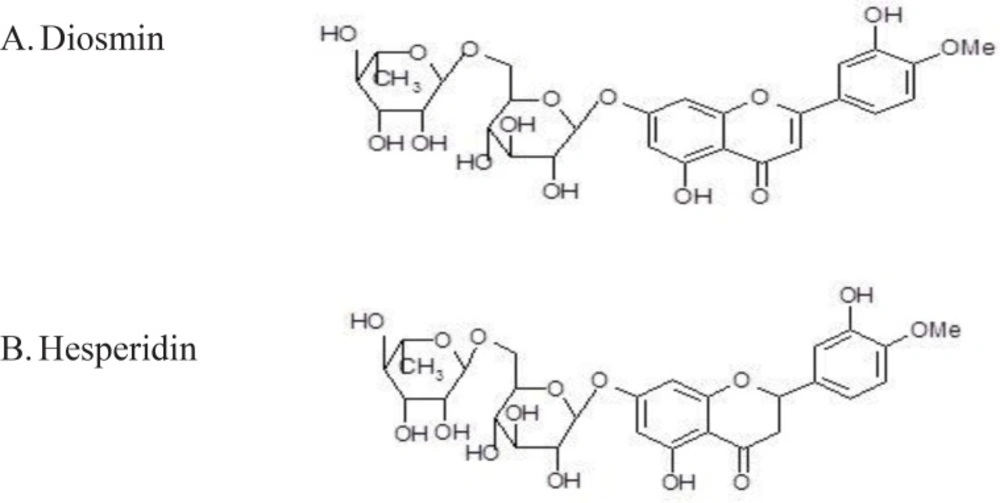
Figure 1
Chemical structures A - Diosmin, B – Hesperidin
Due to their low water solubility, both drugs are barely absorbed from the gastrointestinal tract; therefore, diosmin is more and more frequently micronised to obtain particles smaller than 2-20 m particles. The bioavailability of the formulations is thus much higher, as so their efficiency (3).
Diosmin may be assayed spectrophotometrically with UV-Vis detection (with 4-aminoantypirine using the Berthelot reagent, with 3-methyl-2-benzothiazolinone hydrazone (MBTH) or with 2, 4, 6-trimethylaniline) or densitometrically with UV detection. Traces of diosmin in pharmaceuticals are assayed voltamperometrically using a glass carbon electrode (4, 5, 6). Hesperidin, in turn, may be assayed spectrofluorimetrically, by measuring the intensity of the highly fluorescent complex between hesperidin and Al (III) ions in a micellar solvent (sodium dodecylsulfate in water) (7). Even though there are several distinct methods for the assay of diosmin and hesperidin in pharmaceutical formulations and body fluids, there is no accurate and rapid method for the co-assay of the substances. Diosmin and hesperidin may be assayed simultaneously by reversed-phase HPLC with the following eluent: THF/water/acetic acid (21:77:2, v/v/v) at a wavelength of 280 nm (8) or methanol/water (60:40, v/v) at 345 nm (9).
The most frequently used column packing for the assay of biological or pharmaceutical samples is silica modified by hydrophobic hydrocarbon chains of various lengths (usually ODS) or by polar functional groups. When such packing types are used for the separation of certain analytes, in particular basic compounds, long retention times and peak tailing is observed. The effect results from adsorption interactions between free active silanols and the analyte being resolved, which significantly hinders analysis. In order to block active silanols, ionic liquids have been used as mobile phase additives in the separation of ephedrines (10), catecholamines (11), amines (12), basic drugs (13), phenoxy acid herbicides and phenols (14), vitamins (15) among other compounds. In this work, didecyldimethylammonium lactate (Figure 2) is used as the mobile phase additive for diosmin and hesperidin resolution.
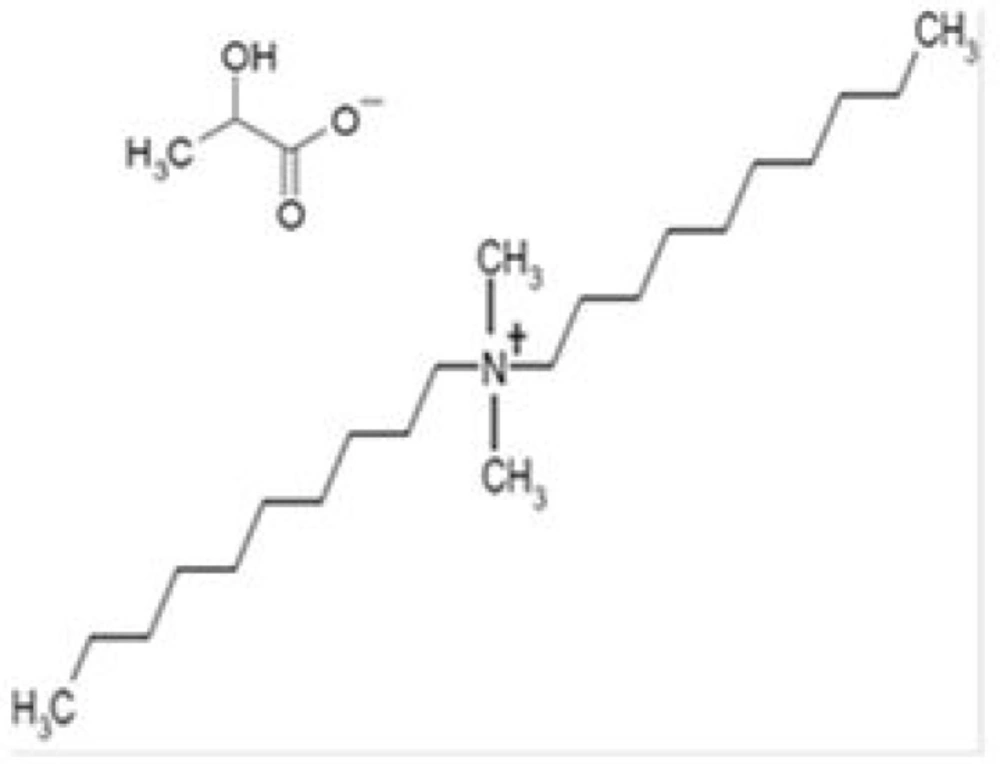
Figure 2
Didecyldimethylammonium lactate
Experimental
Chemicals and reagents
Diosmin and hesperidin were obtained from LKT Laboratories, Saint Paul, USA. The following solvents were used: dimethylsulfoxide (DMSO), methanol and chloroform (high-performance liquid chromatography grade) were from POCh, Gliwice, Poland. The ionic liquid, didecyldimethylammonium lactate, was synthesized by the group of Prof. Juliusz Pernak from the Faculty of Chemical Technology, Poznań University of Technology, Poland.
Test formulations
The pharmaceutical formulations are given in Table 1.
Table 1Pharmaceutical formulations used in the study
| Product | Declared content (mg/one tablet) | Manufacturer | |
|---|---|---|---|
| diosmin | hesperidin | ||
| Diosminex | 500 | - | Przedsiębiorstwo Farmaceutyczne LEK-AM Sp.z o.o. |
| Diohespan forte | 600 | - | Aflofarm Fabryka Leków Sp. z o.o. |
| Pelethrocin | 500 | - | HELP Pharmaceuticals S.A. |
| Belissa anti red | 65 | 50 | Aflofarm Fabryka Leków Sp. z o.o. |
Standards and samples
Stock standards (concentration: 1 mg/mL) were prepared separately by dissolving 0.0500 g of diosmin and hesperidin in DMSO: methanol 1:1. Working solutions were obtained by the successive dilution of the standard solution using the mobile phase used in the chromatographic analysis.
Samples of the test products were prepared by dissolving 0.0500 g of the powdered product in DMSO: methanol 1:1.
Instrumentation
A Hewlett Packard Liquid Chromatograph (model HP 1050, Waldbronn, Germany) was used, composed of a quaternary pump, a variable-wavelength UV detector operating at 280 nm and a Rheodyne model 7125 injection valve with a 20 µL sample loop. The separation was performed on a LiChrospher, RP-18 (5 µm, 250 mm x 4.6 mm ID) stainless steel column (Merck, Darmstadt, Germany). Before use, the mobile phase was vacuum-filtered through a 0.45 µm cellulose filter and degassed with helium.
The water was distilled and then purified by a Milli-Q water purification system (Millipore, Billerica, USA).
Chromatography conditions
The mobile phase consisted of methanol:water = 45:55%, v/v with 0.025% ionic liquid added. Mobile phase flow rate was 1 mL/min. Peaks were monitored at 280 nm.
Analytical method validation parameters
Calibration curves
Calibration curves were obtained based on the results of chromatographic analysis of diosmin and hesperidin standard solutions. The resulting solutions contained 2.5; 5; 10; 25; 50; 75 and 100 µg of each compound per 1 mL of mobile phase. Each standard solution was injected six times. The regression equations were calculated in the form of y = ax + b, where y and x were peak area and sample concentrations, respectively.
Precision
The repeatability of the chromatographic system was assessed under the chromatographic conditions previously selected by means of 10 replicate injections of a solution with 5 µg/mL diosmin and 5 µg/mL hesperidin and finding out the peak area by the proposed method. From this peak area %RSD was calculated.
Intra–day precision was determined by injecting three different concentrations (5, 50 and 100 µg/mL) for three times in the same day. Peak area was measured and %RSD was calculated.
Inter-day precision was determined by injecting three different concentrations (5, 50 and 100 µg/mL) for three days in a week. Peak area was measured and %RSD was calculated.
Limit of Detection and Quantification
The limit of detection (LOD) under the present chromatographic conditions is defined by the concentration of the analyte giving a signal to noise ratio of 3: 1. The limit of quantification (LOQ) is the lowest analyte concentration which can be assayed with required precision and accuracy. Based on 6 parallel results obtained for each standard solution concentration, relative standard deviations were derived, and LOQ for RSD = 10% was derived from the relationship between RSD and test glycoside concentrations.
Accuracy
The accuracy of the method was determined by recovery experiments. The recovery value was determined by adding known quantities of the test compounds to the test formulations (standard addition method) (ICH Q2A, Text of validation of analytical procedures, International Conference on Harmonization tripartite guidelines, adapted 27 Oct. 1994 B). The recovery of the standards added (diosmin and hesperidin) was performed for three different concentration levels, corresponding to approx. 120, 140 and 160% of the analytes in a tablet. Subsequently, they were assayed in the test formulations. Each sample was tested six times at each concentration level according to the above procedure.
Results and discussion
Optimization of Chromatographic Analysis
Reversed-phase chromatography was suggested as a suitable procedure for the co-assay of diosmin and hesperidin in complex matrices, such as pharmaceutical formulations. The optimization of the chromatographic process involved first the determination of the detection wavelength suitable for the co-assay of the test compounds and second, the selection of mobile phase parameters suitable for the total resolution of diosmin and hesperidin as rapidly as possible, with no interference from other ingredients of the test samples. The selection of appropriate conditions involved testing the effects on retention of type and concentration of organic solvent in the mobile phase, and the concentration of the ionic liquid added to the eluent on retention.
The analysis of UV spectra for diosmin and hesperidin and initial HPLC studies of the test matrices gave appropriate conditions for chromatographic resolution to facilitate the co-assay of both analytes. When an ionic liquid was added, analysis time was significantly reduced and peak symmetry was greatly improved. An example of the chromatograms obtained for a standard mixture of diosmin and hesperidin is shown in Figure 3. Chromatogram a was obtained without addition of ionic liquid and chromatogram b with 0.025% ionic liquid in mobile phase. The retention times of diosmin and hesperidin were 8.01 ± 0.03 and 5.73 ± 0.02 min, respectively. The retention of the drugs is repeatable with very good precision.
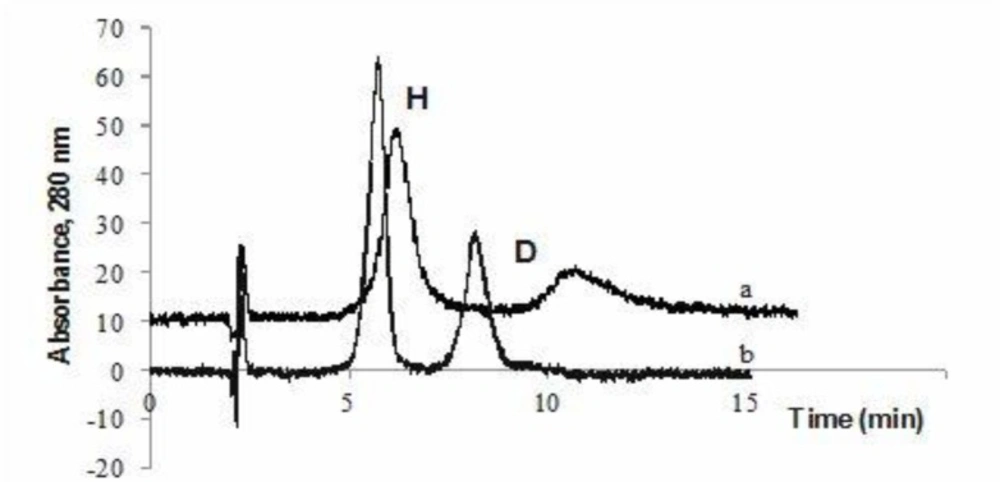
Figure 3
Chromatograms of diosmin D and hesperidin H for standard without addition of ionic liquid (a) and with 0.025% ionic liquid (b) in mobile phase
We note very good peak symmetry and also the fact that the retention of the test compounds is repeatable with very good precision (low RSD values).
Assay validations
The linearity of the method was tested for both flavonoid glycosides assayed in a concentration range of 2.5 to 100 µg/mL by injecting standard solutions in the chromatographic conditions as above. The calibration curves for diosmin and hesperidin were derived by the least-squares method. Table 2 shows the linearity range tested and parameters of the fitted straight-lines. The linear correlation coefficient are satisfactory.
Table 2Calibration range and fitted parameters
| Linearity range [µg/mL] | Slope | Intercept | Correlation coefficient | |
|---|---|---|---|---|
| Diosmin | 2.5 – 100 | 0.26 | -0.73 | 0.9983 |
| Hesperidin | 2.5 – 100 | 0.45 | -1.40 | 0.9992 |
In the simultaneous determination of diosmin and hesperidin, the calibration curves were found to be linear for both compounds in the aforementioned concentrations and the correlations coefficients for the regression lines were 0.9983 and 0.9992 for diosmin and hesperidin, respectively.
Repeatability expressed as relative standard deviation and determined for both analytes was 0.39 and 0.42% for diosmin and hesperidin, respectively.
The precision of the method was demonstrated by inter day and intra day variation studies. In the intra day studies, six repeated injections of sample solutions were made and the mean area of analyte peaks and percentage RSD were calculated and presented in Table 3. In the inter day variation studies, six repeated injections of sample solutions were made for three consecutive days and mean area of analyte peaks and percentage RSD were calculated and presented in Table 3.
Table 3Precision of the method
| Intraday precision | Interday precision | |||||||
| µg/mL | mean area | % RSD | µg/mL | mean area | % RSD | |||
| Diosmin | 5 | 1,02 | 0,39 | 5 | 0,98 | 0,51 | ||
| Hesperidin | 5 | 1,62 | 0,42 | 5 | 1,59 | 0,79 | ||
From the data obtained, the developed HPLC method was found to be precise. The limits of detection for diosmin and hesperidin were 2.5 and 1.2 μg/mL, respectively, and the limits of quantification were 5.5 and 3.5 µg/mL, respectively.
The method was used for the assay of diosmin and hesperidin in four pharmaceutical products available in Poland. The preparation of analytical samples is discussed in the experimental part. Product compositions and manufacturers are listed in Table 1. The results of analyses calculated based on calibration curve equations are shown in Table 2.
Table 4.Product analysis (n = 6).
n.a.– data not available
The results listed in Table 4 show that the method can be used for the co-assay of diosmin and hesperidin in various pharmaceutical products. The procedure has high precision. RSD values for six independent determinations in the test pharmaceuticals were within a range of 1.10 to 3.21% and 0.57 to 3.37% of diosmin and hesperidin, respectively. Larger differences were noted between analyte quantities assayed and declared by the manufacturers. In order to account for the inconsistencies and to verify the correctness of our method, an experiment was performed to determine analytical accuracy. A solution of the test product was prepared with analyte concentration x within a range of concentrations used for the calibration curve and three series of identically prepared solutions to which diosmin and hesperidin with known concentrations a were added. The value of a for diosmin in Pelethrocin and Diosminex was 100, 200 and 300 mg per one tablet, respectively; for Diohespan forte: 120, 240 and 360 mg per tablet; for Belissa anti red: 15, 25 and 35 mg per tablet. The value of a for hesperidin in Diosminex and Diohespan forte was 2.5, 5.0 and 7.5 mg per tablet; for Diohespan Pelethrocin: 5.0, 7.5 and 10.0 mg per tablet; for Belissa anti red: 10, 20 and 30 mg per tablet. Three series of solutions with concentration x + a were thus obtained. The determinations were performed for all the test products and both analytes (six independent analyses for each series of solutions in the same conditions). Four series of results were obtained, x and x + a, listed in Table 5.
The concentration values shown in Table 4 correspond to diosmin and hesperidin concentrations with respect to one tablet. Method accuracy is determined by recovery values for quantities a of diosmin and hesperidin added to pharmaceutical product solutions. The recovery values are close to 100%, within a range of 96.9 to 103% and 96 to 102.9 for diosmin and hesperidin, respectively.
Table 5Accuracy of diosmin and hesperidin assay in the test products (n = 6).
| Test product | Ingredient assayed | x | x+a | (x+a)-x | recovery a | ||||
|---|---|---|---|---|---|---|---|---|---|
| mg/tablet | % | ||||||||
| Pelethrocin | diosmin | 518 | 620 | 102 | 102.0 | ||||
| 518 | 723 | 205 | 102.5 | ||||||
| 518 | 816 | 298 | 99.3 | ||||||
| hesperidin | 9.21 | 14.03 | 4.82 | 96.4 | |||||
| 9.21 | 16.52 | 7.31 | 97.5 | ||||||
| 9.21 | 19.46 | 10.25 | 102.5 | ||||||
| Diohespan | diosmin | 729 | 849 | 120 | 100.0 | ||||
| forte | 729 | 969 | 240 | 100.0 | |||||
| 729 | 1078 | 349 | 96.9 | ||||||
| hesperidin | 6.03 | 8.43 | 2.40 | 96.0 | |||||
| 6.03 | 11.06 | 5.03 | 100.6 | ||||||
| 6.03 | 13.31 | 7.28 | 97.1 | ||||||
| Diosminex | diosmin | 563 | 666 | 103 | 103.0 | ||||
| 563 | 758 | 195 | 97.5 | ||||||
| 563 | 860 | 297 | 99.0 | ||||||
| hesperidin | 17.00 | 19.41 | 2.41 | 96.4 | |||||
| 17.00 | 22.06 | 5.06 | 101.2 | ||||||
| 17.00 | 24.72 | 7.72 | 102.9 | ||||||
| Belissa anti | diosmin | 65.9 | 81.1 | 15.2 | 101.3 | ||||
| red | 65.9 | 91.6 | 25.7 | 102.8 | |||||
| 65.9 | 101.7 | 35.8 | 102.3 | ||||||
| hesperidin | 51.10 | 61.12 | 10.02 | 100.2 | |||||
| 51.10 | 70.78 | 19.68 | 98.4 | ||||||
| 51.10 | 80.81 | 29.71 | 99.0 | ||||||
The results shown in the tables confirm that our method for the co-assay of diosmin and hesperidin in pharmaceuticals has both high precision and accuracy. They confirm the correctness of our method and the procedure used; the discrepancies between the analytical results and the amounts declared by the manufacturers are consistent with the requirements specified by Pharmacopoeia VIII (diosmin should not contain more than 5% hesperidin, considered an impurity).
Conclusions
The paper puts forward a method for the co-assay of diosmin and hesperidin in pharmaceutical products using HPLC in which some ionic liquid is added to the mobile phase. When the ionic liquid was added, analysis time was reduced and resulting peak symmetry was improved. It is the first time an ionic liquid has been used for the resolution and assay of the compounds. The method has high precision from 1.10 to 3.21% and 0.57 to 3.37% for diosmin and hesperidin, respectively; accuracy from 96.9 to 103% and from 96 to 102.9 for diosmin and hesperidin, respectively and very good repeatability (0.39 and 0.42% for diosmin and hesperidin, respectively). The precision of the proposed method was carried in terms of the repeatability, inter-day and intra-day time periods. The low % RSD values of repeatability (0.39 and 0.42% for diosmin and hesperidin, respectively), intra-day (0,39 % – 1,12% ) and inter-day (0.51% - 1.19% ) variations reveal that the proposed method is precise.
The limit of detection and quantification is 2.5 and 1.2 µg/mL and 5.5 and 3.5 µg/mL for diosmin and hesperidin, respectively. The results show that the method may be used for the control of diosmin and hesperidin contents in pharmaceutical products.
