


1. Background
2. Objectives
3. Patients and Methods
3.1. Patients
3.2. Instruments and Examination Protocol
3.3. The American Orthopedic Foot and Ankle Society (AOFAS) Ankle-Hindfoot Score (AHS)
3.4. Statistical Analysis
4. Results
4.1. Patients’ Demographic Characteristics
4.2. Achilles Tendon Width and Thickness
| Variables | Width (mm) | Thickness (mm) |
|---|---|---|
| Normal Achilles tendons | 11.24 ± 1.193 (9.650 - 13.08) | 4.333 ± 0.602 (3.590 - 5.430) |
| Ruptured Achilles tendons | - | - |
| One month after surgery | 19.52 ± 3.658 (13.36 - 25.58) | 11.37±1.606 (8.840-14.28) |
| Three months after surgery | 15.53 ± 2.254 (12.22 - 19.44) | 9.186 ± 1.816 (6.440 - 13.19) |
| Six months after surgery | 13.09 ± 1.372 (11.77 - 16.60) | 6.144 ± 0.692 (5.010 - 8.030) |
| Fc | 64.36 | 187.1 |
| P-value | < 0.01 | < 0.01 |
a Width and thickness of normal and postoperative repaired ruptured Achilles tendons.
b Values are expressed as mean ± SD (range).
c One way ANOVA.
4.3. Emean of the Achilles Tendon
| Variables | Emean (kPa) |
|---|---|
| Normal Achilles tendons | 447.4 ± 59.57 (349.9 - 521.2) |
| Ruptured Achilles tendons | 63.84 ± 45.18 (5.590 - 176.2) |
| One month after surgery | 110.3 ± 35.60 (58.80 - 179.7) |
| Three months after surgery | 183.4 ± 46.08 (103.9 - 258.7) |
| Six months after surgery | 279.1 ± 48.18 (193.3 - 350.0) |
| Fb | 418.5 |
| P | < 0.01 |
Abbreviation: Emean, the mean elasticity of the Achilles tendon in the region of interest (ROI).
a Values are expressed as mean ± SD (range).
c One way ANOVA.
4.4. AOFAS-AHS
4.5. Ultrasonography of the Achilles Tendon
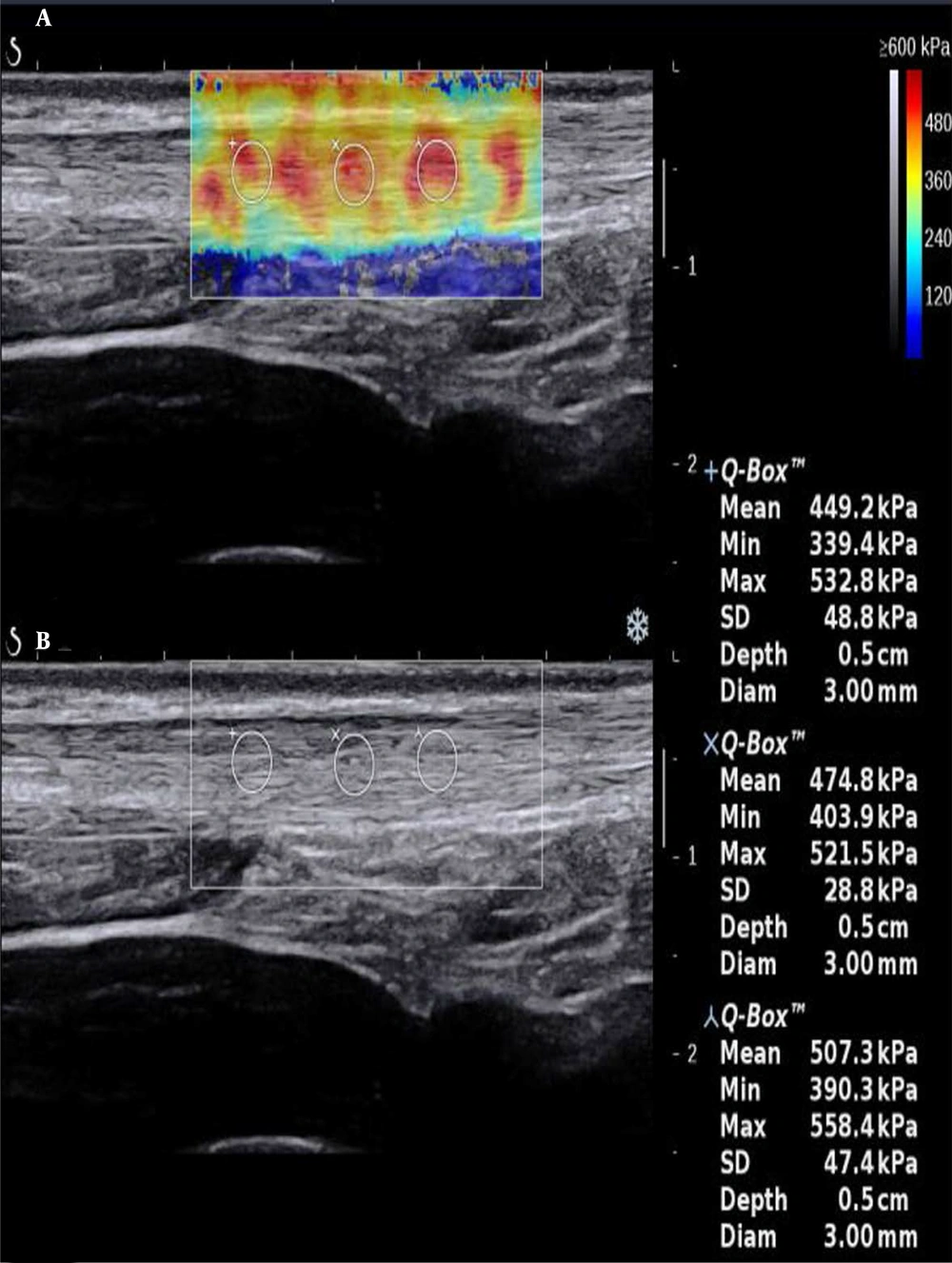
Longitudinal scans of a normal Achilles tendon (male, 32 years old). A, The shear wave elastography (SWE) image is characterized by red and yellow colors; B, B-mode sonography shows that the echo of the tendon is homogeneous.
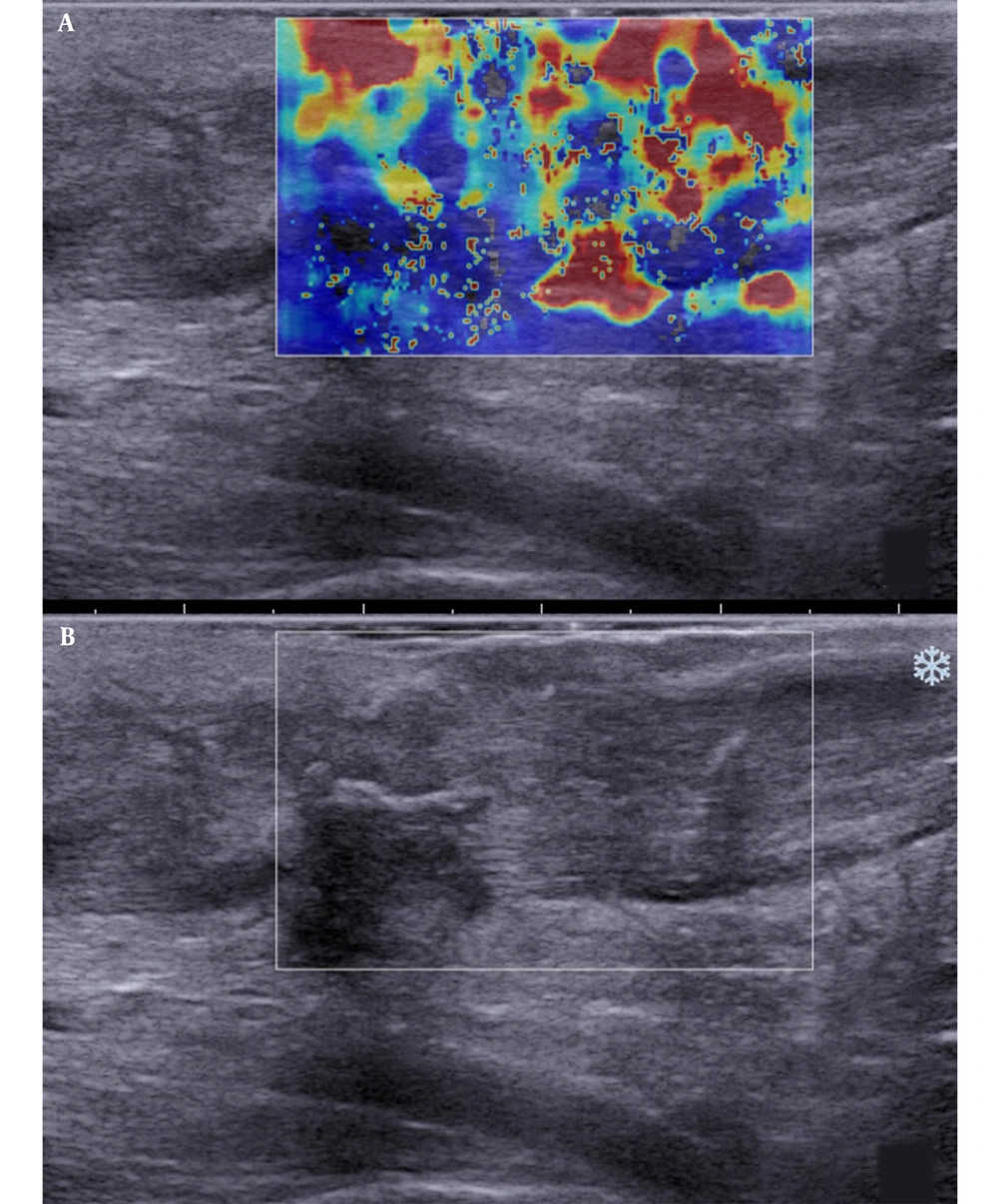
Longitudinal scans of a ruptured Achilles tendon one month after surgery. A, The shear wave elastography (SWE) image is characterized by red-and-yellow and blue colors. B, B-mode sonography shows that the tendon echostructure is heterogeneous.
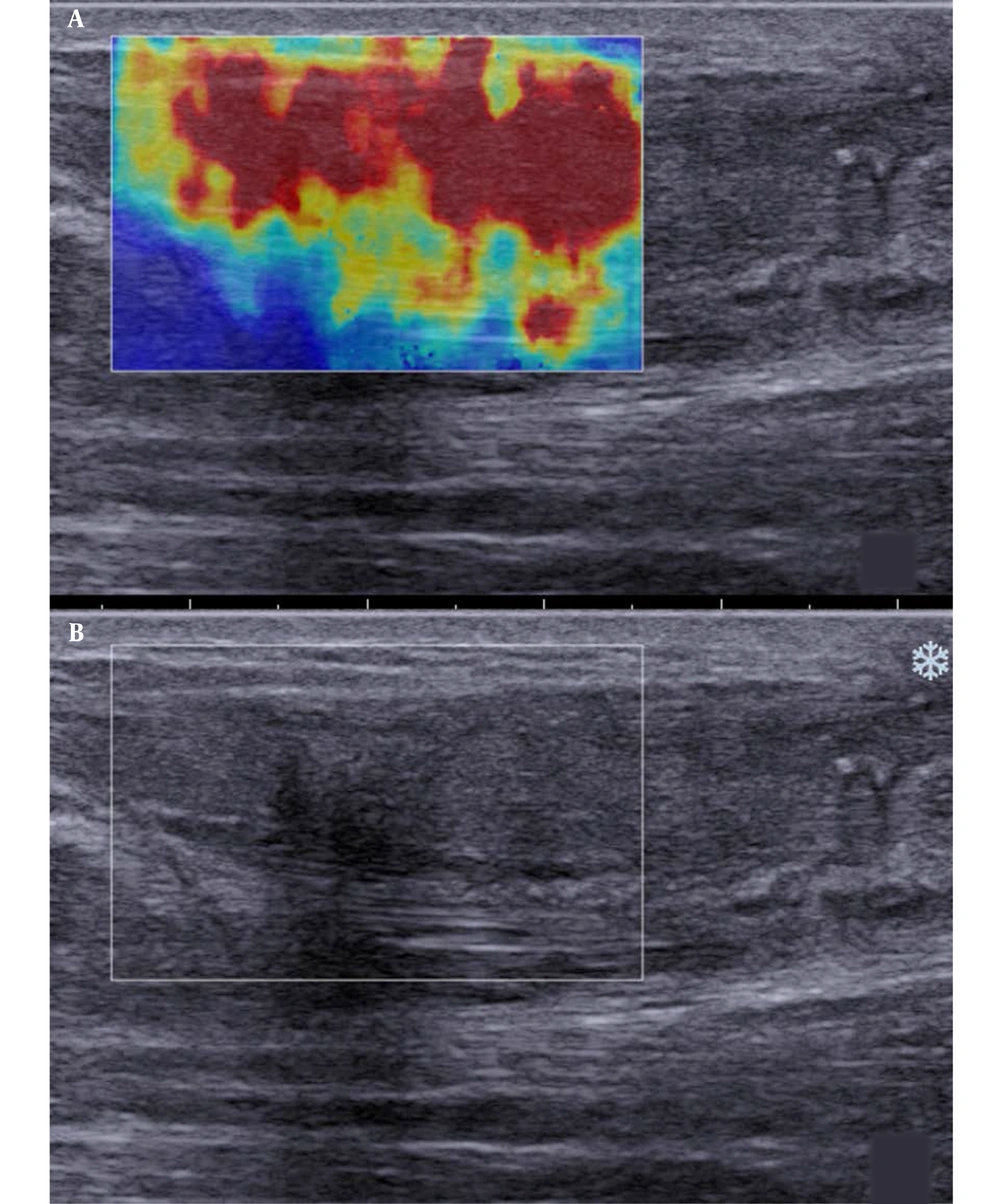
Longitudinal scans of a ruptured Achilles tendon at three months after surgery. A, The shear wave elastography (SWE) image is composed of large red sheets and small blue and yellow segments. B, B-mode sonography shows that the tendon echostructure is heterogeneous.
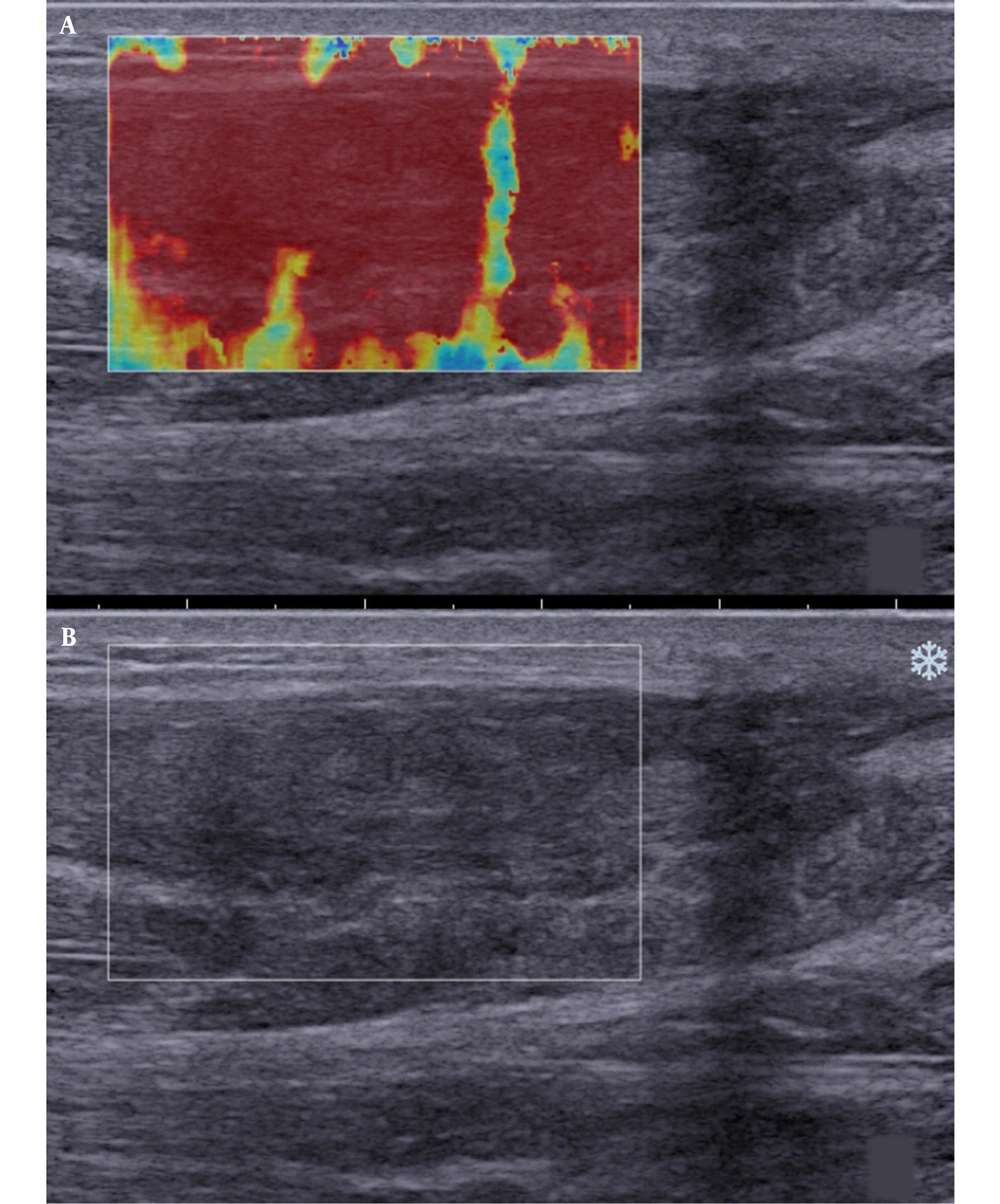
Longitudinal scans of a ruptured Achilles tendon of six months after surgery. A, The shear wave elastography (SWE) image is almost completely red; B, B-mode sonography shows that the tendon echostructure is heterogeneous (^: fiber cord structure).
5. Discussion
![The E<sub>mean</sub> of a normal Achilles tendon [E<sub>mean</sub>, the mean elasticity of the tendon in the region of interest (ROI)]. Elasticity has a large fluctuation range.](https://brieflands.com/journals/ijradiology/articles/106415/figures/iranjradiol-106415-i001-F5-preview.webp "The E<sub>mean</sub> of a normal Achilles tendon [E<sub>mean</sub>, the mean elasticity of the tendon in the region of interest (ROI)]. Elasticity has a large fluctuation range.")
The Emean of a normal Achilles tendon [Emean, the mean elasticity of the tendon in the region of interest (ROI)]. Elasticity has a large fluctuation range.
![The E<sub>mean</sub> values of normal and ruptured Achilles tendons [E<sub>mean</sub>, mean elasticity of the Achilles tendon in the region of interest (ROI) E<sub>mean-A</sub>, E<sub>mean</sub> of a ruptured Achilles tendon before surgery; E<sub>mean-B,</sub> E<sub>mean</sub> of a ruptured Achilles tendon at one month after surgery; E<sub>mean-C</sub>, E<sub>mean</sub> of a ruptured Achilles tendon at three months after surgery; E<sub>mean-D</sub>, E<sub>mean</sub> of a ruptured Achilles tendon at six months after surgery; E<sub>mean-E</sub>, E<sub>mean</sub> of a normal Achilles tendon (**P < 0.01)].](https://brieflands.com/journals/ijradiology/articles/106415/figures/iranjradiol-106415-i002-F6-preview.webp "The E<sub>mean</sub> values of normal and ruptured Achilles tendons [E<sub>mean</sub>, mean elasticity of the Achilles tendon in the region of interest (ROI) E<sub>mean-A</sub>, E<sub>mean</sub> of a ruptured Achilles tendon before surgery; E<sub>mean-B,</sub> E<sub>mean</sub> of a ruptured Achilles tendon at one month after surgery; E<sub>mean-C</sub>, E<sub>mean</sub> of a ruptured Achilles tendon at three months after surgery; E<sub>mean-D</sub>, E<sub>mean</sub> of a ruptured Achilles tendon at six months after surgery; E<sub>mean-E</sub>, E<sub>mean</sub> of a normal Achilles tendon (**P < 0.01)].")
The Emean values of normal and ruptured Achilles tendons [Emean, mean elasticity of the Achilles tendon in the region of interest (ROI) Emean-A, Emean of a ruptured Achilles tendon before surgery; Emean-B, Emean of a ruptured Achilles tendon at one month after surgery; Emean-C, Emean of a ruptured Achilles tendon at three months after surgery; Emean-D, Emean of a ruptured Achilles tendon at six months after surgery; Emean-E, Emean of a normal Achilles tendon (**P < 0.01)].


