


1. Background
2. Objectives
3. Patients and Methods
3.1. Study Population
3.2. Echocardiographic Measurements
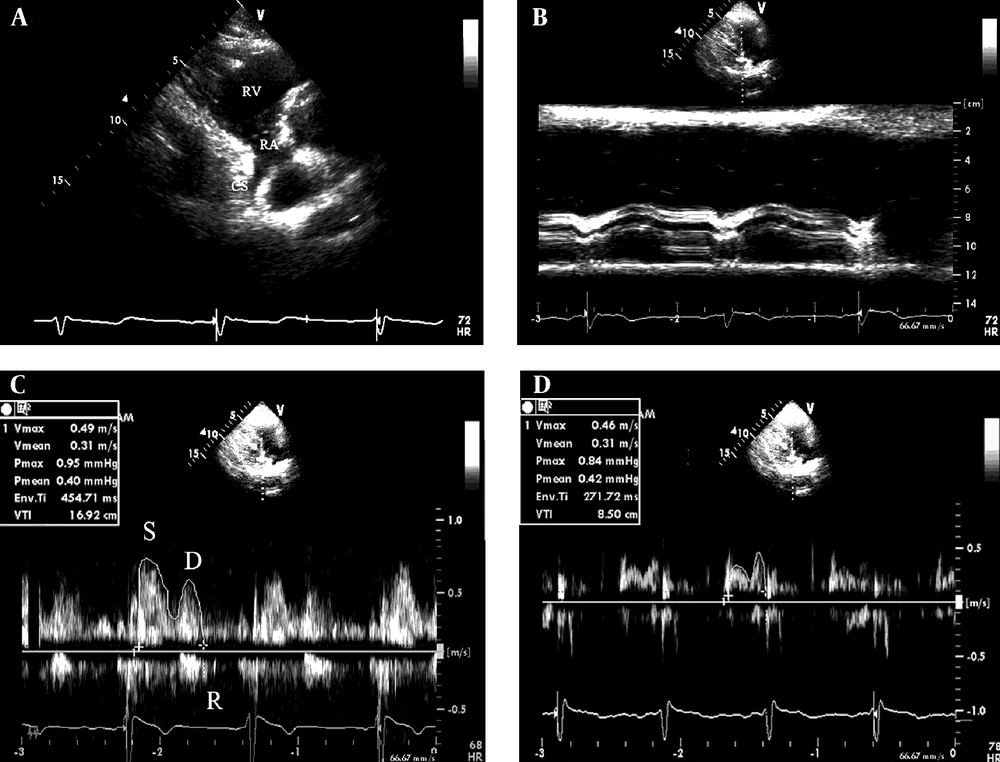
A, The coronary sinus seen from the parasternal right ventricular inflow tract view and B, the measurement of the diameter of the coronary sinus using adjust M-mode ultrasonography; C, the Doppler spectrum of coronary blood flow in the coronary sinus obtained from the parasternal right ventricular inflow tract view and the measurement of Doppler parameters of the coronary sinus flow by digitized Doppler spectral envelops in normal subjects and D, patients with coronary artery disease. RA, right atrium; RV, right ventricle; CS, coronary sinus; S, systolic wave of the antegrade blood flow; D, diastolic wave of the antegrade blood flow; R, retrograde blood flow; Env. Ti, duration of measured envelope
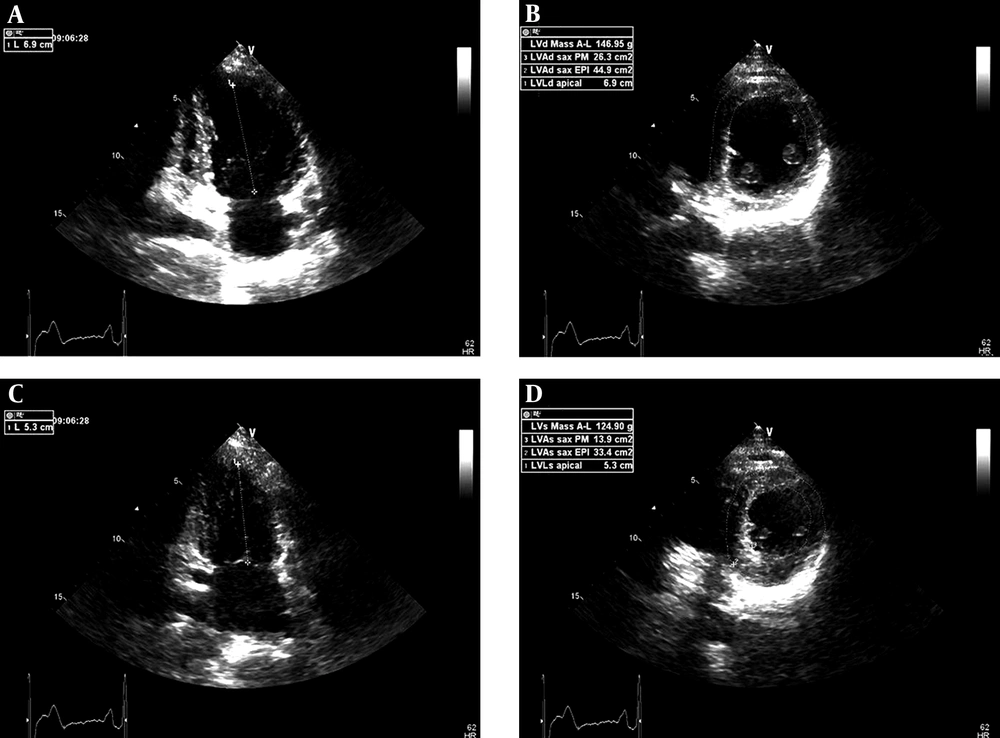
The measurements of left ventricular mass (area-length) at end diastole and peak systole using biplane two-dimensional echocardiographic methods. A, LVLd apical, left ventricular length at end diastole, apical; B, LVAd SAX EPI, left ventricular epicardial short axis area at the level of the papillary muscle tips at end diastole; B, LVAd SAX PM, left ventricular endocardial short axis area at papillary muscle level at end diastole; C, LVLs apical, left ventricular length at peak systole, apical; D, LVAs SAX EPI, left ventricular epicardial short axis area at the level of the papillary muscle tips at peak systole; D, LVAs SAX PM, left ventricular endocardial short axis area at papillary muscle level at peak systole
3.3. Coronary Angiography
3.4. Reproducibility
3.5. Statistical Analysis
4. Results
4.1. Echocardiographic Parameters
| Parameters | Normal Subjects | Patients with CAD |
|---|---|---|
| Clinical Parameters | ||
| HR, beats/min | 72.51 ± 11.84 | 71.33 ± 10.89 |
| SBP, mmHg | 119 ± 20.79 | 125.44 ± 23.31 |
| DBP, mmHg | 75.21 ± 6.64 | 73.75 ± 8.89 |
| PP, mmHg | 40.23 ± 4.57 | 47.75 ± 8.56b |
| Echocardiographic Parameters | ||
| IVST, mm | 9.38 ± 0.92 | 9.94 ± 1.05 |
| LVPWT, mm | 9.42 ± 0.85 | 9.83 ± 1.01 |
| LVEDD, mm | 43.21 ± 5.44 | 45.36 ± 6.62 |
| LVEF,% | 65.78 ± 5.76 | 63.47 ± 6.02 |
| Dcs, cm | 5.75 ± 1.14 | 4.43 ± 1.26b |
| VTI, cm | 15.48 ± 4.37 | 13.48 ± 2.19b |
| Flow, mL/minute | 306.78 ± 120.81 | 181.38 ± 108.72b |
| LVM, M-mode g | 132.43 ± 22.61 | 163.67 ± 37.79b |
| Flow/LVM, mL/minuteg | 2.51 ± 1.43 | 1.97 ± 1.14b |
| LVd Mass A-L, g | 128.93 ± 31.78 | 124.52 ± 34.89 |
| LVs Mass A-L, g | 89.87 ± 28.71 | 101.97 ± 30.34b |
| LV(d-s) Mass A-L, g | 39.95 ± 18.47 | 22.91 ± 17.14c |
aAbbreviations; CAD, coronary artery disease; HR, heart rate; SBP, systolic blood pressure; DBP, diastolic blood pressure; PP, pulse pressure; IVST, diastolic interventricular septal thickness; LVPWT, diastolic posterior wall thickness; LVEDD, left ventricular end-diastolic diameter; LVEF, left ventricular ejection fraction; Dcs, the diameter of coronary sinus; VTI, velocity time integral; LVM(M- mode), left ventricular mass using M mode formulas calculation methods; LVd Mass A-L, left ventricular mass at end diastole using area-length calculation methods; LVs Mass A-L, left ventricular mass at peak systole using area-length calculation methods; LV(d-s) Mass A-L, the difference of left ventricular mass at end diastole and peak systole using area-length calculation methods
bP < 0.05., unpaired t test, compared to the values of normal subjects
cP < 0.01, unpaired t test, compared to the values of normal subjects
| Parameters | Single-Vessel Patients (n = 12) | Double-Vessel Patients (n = 16) | Triple-Vessel Patients (n = 12) |
|---|---|---|---|
| Clinical Parameters | |||
| HR, beats/min | 73.51 ± 10.76 | 73.54 ± 11.09 | 74.4 ± 11.05 |
| SBP, mmHg | 123 ± 17.79 | 124 ± 25.79 | 124.58 ± 26.37 |
| DBP, mmHg | 71.21 ± 6.85 | 70.21 ± 6.64 | 72.75 ± 9.23 |
| PP, mmHg | 52.23 ± 7.96 | 54.23 ± 4.85 | 53.75 ± 8.98 |
| Echocardiographic Parameters | |||
| IVST, mm | 9.63 ± 0.84 | 9.67 ± 0.99 | 9.74 ± 0.95 |
| LVPWT, mm | 9.54 ± 0.88 | 9.62 ± 0.95 | 9.76 ± 0.71 |
| LVEDD, mm | 48.25 ± 5.49 | 47.29 ± 5.66 | 49.39 ± 5.67 |
| LVEF, % | 66.79 ± 6.78 | 65.78 ± 5.76 | 64.47 ± 5.92 |
| Dcs, cm | 4.79 ± 1.84 | 4.66 ± 1.54 | 3.43 ± 0.86b |
| VTI, cm | 11.46 ± 2.63 | 12.13 ± 2.65 | 10.25 ± 3.17b |
| Flow, mL/minute | 256.68 ± 112.87 | 249.78 ± 109.65 | 193.59 ± 76.74b |
| LVM, M- Mode g | 135.45 ± 20.59 | 136.43 ± 28.64 | 137.97 ± 29.75 |
| Flow/LVM, mL/minute g | 1.98 ± 1.56 | 1.97 ± 1.53 | 1.85 ± 0.94b |
| LVd Mass A-L, g | 132.96 ± 30.76 | 129.93 ± 32.77 | 131.51 ± 36.94 |
| LVs Mass A-L, g | 109.67 ± 26.73 | 107.87 ± 28.71 | 109.96 ± 32.05 |
| LV(d-s) Mass A-L, g | 23.95 ± 16.85 | 22.95 ± 19.42 | 22.91 ± 18.14 |
aAbbreviations: HR, heart rate; SBP, systolic blood pressure; DBP, diastolic blood pressure; PP, pulse pressure; IVST, diastolic interventricular septal thickness; LVPWT, left ventricular diastolic posterior wall thickness; LVEDD, left ventricular end-diastolic diameter; LVEF, left ventricular ejection fraction; Dcs, the diameter of coronary sinus; VTI, velocity time integral; LVM (M- mode), left ventricular mass using M mode formulas calculation methods; LVd Mass A-L, left ventricular mass at end diastole using area-length calculation methods; LVs Mass A-L, left ventricular mass at peak systole using area-length calculation methods; LV (d-s) Mass A-L, the difference of left ventricular mass at end diastole and peak systole using area-length calculation methods
bP < 0.05, unpaired t test, compared to the values of single-vessel and double-vessel CAD patients.
4.2. Coronary Angiographic Findings
| Portion | Number of Lesions |
|---|---|
| LAD | |
| Proximal | 13 |
| Middle | 27 |
| Distal | 15 |
| LCX | |
| Proximal | 23 |
| Middle | 11 |
| Distal | 9 |
| RCA | |
| Proximal | 4 |
| Middle | 10 |
| Distal | 12 |
| FDB | 11 |
aAbbreviations: LAD, left anterior descending coronary artery; LCX, left circumflex artery; RCA, right coronary artery; FDB, the first diagonal branch
4.3. The Pearson Correlation Coefficient of Echocardiographic Parameters with a Percentage of Stenosis in Patients with Coronary Artery Disease
4.4. ROC Analysis
![Receiver operating characteristic curve showing the performance of blood flow in the coronary sinus [flow (mL/minute)], the global left ventricular perfusion that was measured by dividing coronary sinus flow by the left ventricular mass [flow/LVM (mL/minuteg)] and the difference of left ventricular mass at end diastole and peak systole using area-length calculation methods [LV (d-s) mass A-L (g)] in discrimination between patients with or without CAD](https://brieflands.com/journals/ijradiology/articles/17952/figures/iranjradiol-12-01-11405-i001-preview.webp "Receiver operating characteristic curve showing the performance of blood flow in the coronary sinus [flow (mL/minute)], the global left ventricular perfusion that was measured by dividing coronary sinus flow by the left ventricular mass [flow/LVM (mL/minuteg)] and the difference of left ventricular mass at end diastole and peak systole using area-length calculation methods [LV (d-s) mass A-L (g)] in discrimination between patients with or without CAD")
Receiver operating characteristic curve showing the performance of blood flow in the coronary sinus [flow (mL/minute)], the global left ventricular perfusion that was measured by dividing coronary sinus flow by the left ventricular mass [flow/LVM (mL/minuteg)] and the difference of left ventricular mass at end diastole and peak systole using area-length calculation methods [LV (d-s) mass A-L (g)] in discrimination between patients with or without CAD
