1. Background
Women with breast cancer are at increased risk of having additional breast lesions (other than the index cancer) in the same or different quadrants of the ipsilateral and contralateral breasts. Previous studies of mastectomy specimens found that 20 - 63% of additional malignant lesions occurred in the breast ipsilateral to the index cancer and 10% occurred in the contralateral breast (1-7). The presence of multiple cancer sites may significantly alter the course of treatment; therefore, it is essential to detect and evaluate additional lesions preoperatively.
Magnetic resonance imaging (MRI) is now widely used in preoperative assessment due to its high sensitivity. In particular, 3T dynamic contrast enhanced (DCE) MRI has demonstrated greater utility than mammography or ultrasound and has been shown to detect the extent of the index cancer more precisely and to identify more additional breast lesions than are detectable using conventional imaging techniques (2, 3, 8, 9). Previous studies have demonstrated that preoperative MRI detects 6 - 34% of additional cancer lesions in the ipsilateral breast (6) and 3 - 5% in the contralateral breast (5, 7).
The characterization of additional lesions is the next crucial step and even more important than detection. The possibility of malignancy of additional lesions in different quadrants or in the contralateral breast should be evaluated preoperatively, because the existence of additional cancerous lesions might require more extensive excision or preclude breast conserving surgery. Additional breast lesions can be seen as a focus, mass, and non-mass enhancement (NME) on MRI, according to the breast imaging reporting and data system (BI-RADS®) lexicon (10). Previous studies have suggested that the combination of particular BI-RADS lexicon descriptors can be useful in determining the likelihood of malignancy for masses, but the MRI characteristics of malignant versus benign NME breast lesions have been debatable (4, 11-24). Furthermore, the American college of radiology (ACR) recently published the fifth edition of the BI-RADS lexicon for MRI that institutes several changes in the NME category, including the addition of new descriptors, modification of others, and deletion of descriptors that were rarely helpful clinically (10). To date, there are few studies examining NME according to the new BI-RADS lexicon.
2. Objectives
This study was designed to investigate significant predictors of malignancy for NME in lesions other than the index cancer and detected on preoperative 3T DCE-MRI in patients with newly diagnosed breast cancer, based on the new BI-RADS lexicon.
3. Patients and Methods
3.1. Patients and Lesions
This retrospective study was approved by the institutional review board, and informed consent was waived. We searched the institutional database for cases of breast MRI performed for preoperative staging in patients with newly diagnosed breast cancer from January 2008 to December 2012. The inclusion criteria were as follows: 1) patients with NME lesions other than the index cancer; 2) patients with histopathologically proven lesions; and 3) patients for whom MRI was indicated for preoperative staging prior to neoadjuvant chemotherapy and surgery. Among 322 patients identified from our database search, we excluded 49 patients whose index cancer comprised NME lesions, 117 whose pathology findings were unavailable, and 68 who underwent MRI for purposes other than above inclusion criteria (3). The 117 patients whose pathologic findings did not directly correlate with imaging features were excluded because surgeons did partial mastectomy or wide excision owing to additional NME but without preoperative wire localization. The remaining 88 patients (mean age, 52 years; range, 31 - 75 years) with histopathologically confirmed NME lesions other than the index cancer were included in the study. There was no significant difference in age distribution between the benign and malignant groups. All patients had one NME lesion each. The index cancers were diagnosed as invasive ductal carcinoma (n = 77), ductal carcinoma in situ (n = 8), and invasive lobular carcinoma (n = 3).
3.2. MRI Acquisition
Breast MRI was performed using a 3.0 T-MRI system (Achieva 3.0 T TX; Philips Healthcare, Best, the Netherlands) or a different 3.0 T-MRI system (Trio Tim; Siemens, Erlangen, Germany) both with a dedicated phased-array breast coil. All imaging were performed with the subjects lying in the prone position. The two different MR systems were assigned to each patient according the MRI suite schedule. T1- and T2-weighted fast spin-echo transverse images were obtained for the two systems. The following image parameters were used for the Achieva system: flip angle, 90°; image matrix, 620 × 309; field of view, 581 × 342 mm; section thickness, 3 mm; section gap, 0 mm. The following image parameters were used for the Trio Tim system: flip angle, 90°; image matrix, 512 × 356; field of view, 360 × 360 mm; section thickness, 3 mm; section gap, 0.06 mm. A three-dimensional T1-weighted fast spoiled gradient-echo sequence was also performed with transverse imaging using one pre-contrast and six post-contrast dynamic series, immediately following contrast injection and then again after 60, 120, 180, 240, and 300 seconds. The image parameters for the Achieva system were as follows: flip angle, 0°; image matrix, 436 × 436; field of view, 330 × 340 mm; section thickness, 3 mm; section gap, 1.5 mm. The image parameters for the Trio Tim system were as follows: flip angle, 0°; image matrix, 512 × 307; field of view, 360 × 360 mm; section thickness, 2 mm; section gap, 0 mm. Gadoterate meglumine (Dotarem; Guerbet, Villepinte, France) of 0.1 mL per kilogram of body weight was injected into an antecubital vein with a power injector (Spectris; Medrad, Indianola, PA, USA) at a rate of 2 mL/s. For DCE-MRI, post-processing was performed and included early subtraction of pre-contrast images from the first post-contrast images, calculation of time-intensity curves of enhancing regions, and generation of maximum intensity projection images.
3.3. Image Analysis
All 3T DCE-MR images were reviewed retrospectively for NME by two experienced breast radiologists (Y.H.C. and K.R.C., with 3 and 14 years’ experience, respectively). The readers were both aware that the images were of breast cancer patients, but no information on patients’ clinical details or pathologic diagnoses were provided.
The morphologic characteristics of NME were interpreted according to the 2013 ACR BI-RADS® MRI lexicon as follows. NME distribution was classified as either focal, linear, segmental, or regional, and the internal enhancement pattern as homogeneous, heterogeneous, clumped, or clustered ring. The size of the lesion was determined by measuring the largest diameter of the lesion on MIP images, and the lesion was described as symmetrical or asymmetrical. The relative location between the index cancer and NME was also evaluated and then classified into three categories: same quadrant of the ipsilateral breast, different quadrant of the ipsilateral breast, and contralateral breast. Each lesion was categorized according to the BI-RADS assessment categories. A consensus interpretation was reached in cases of disagreement.
3.4. Histopathologic Examination
The histopathologic examination served as the reference standard. The histological diagnosis was established using a surgically excised sample, and all NME lesions were histopathologically correlated. In 32 patients who underwent mastectomy, those specimens were serially sectioned and correlated with the lesion by referring to the size and location noted on MRI reports. In the remaining 56 patients, all of whom underwent either breast-conserving surgery or excisional biopsy, ultrasound- or mammography-guided wire localization was performed on the additional NME lesions. All diagnoses were made by two experienced breast pathologists in consensus.
3.5. Statistical Analysis
The difference in frequency of each MRI feature between benign and malignant lesions was determined using the Fisher’s exact test or chi-square test. The sensitivity, specificity, positive predictive value (PPV), and negative predictive value (NPV) were calculated for each MRI feature. Multiple binary logistic regression models were used to identify significant MRI features that differentiated between benign and malignant lesions. The odds ratios with 95% confidence intervals (CIs) and p-values were estimated for each MR feature. Statistical analyses were performed using SPSS ( IBM Corp., Released 2011. IBM SPSS Statistics for Windows, version 20.0. Armonk, NY: IBM Corp). A p value of less than 0.05 was considered a statistically significant difference.
4. Results
4.1. Histopathological Results
The histopathologic analysis of the 88 NME lesions revealed 73 (83%) malignant and 15 (17%) benign lesions. The 73 malignant NME lesions were identified as follows: ductal carcinoma in situ (DCIS) (n = 70), invasive lobular carcinoma (ILC) (n = 2), and lobular carcinoma in situ (LCIS) (n = 1). The 15 benign NME lesions were diagnosed as follows: atypical ductal hyperplasia (n = 3), fibrocystic change (n = 3), intraductal papilloma (n = 1), and unspecified benign lesions or benign breast tissue (n = 8).
4.2. MRI Findings
Table 1 summarizes the characteristics of the NME lesions, including patient age, lesion size, and MRI features. Although the maximum diameter of malignant lesions (3.7 cm ± 1.6; range, 0.9 - 8.8 cm) was slightly greater than that of the benign lesions (3.3 cm ± 1.5; range, 1.1 - 6.6 cm), there was no significant difference between the two groups (P = 0.410).
Table 1.
Patients’ Age and the Size, Distribution, Enhancement Pattern, Symmetricity, and Location of Non-Mass Enhancement Lesions Relative to the Index Cancer Versus Histology
| Benign | Malignant | P Value | |
|---|---|---|---|
| No. of Patients, % | 15 (17.0) | 73 (83.0) | |
| Age, ya | 53.7 ± 12.1 | 51.6 ± 9.6 | 0.462 |
| Size, cma | 3.3 ± 1.5 | 3.7 ± 1.6 | 0.410 |
| Distribution, % | 0.034 | ||
| focal | 3 (20.0) | 0 | 0.004 |
| linear | 2 (13.3) | 39 (53.4) | 0.005 |
| segmental | 1 (6.7) | 30 (41.1) | 0.011 |
| regional | 9 (60.0) | 4 (5.5) | < 0.001 |
| Enhancement, % | < 0.001 | ||
| homogeneous | 4 (26.7) | 10 (13.7) | 0.247 |
| heterogeneous | 9 (60.0) | 33 (45.2) | 0.296 |
| clumped | 2 (13.3) | 23 (31.5) | 0.215 |
| clustered ring | 0 | 7 (9.6) | 0.598 |
| Symmetricity, % | 0.004 | ||
| Symmetric | 3 (20.0) | 0 | |
| Asymmetric | 12 (80.0) | 73 (100) | |
| Location, % | |||
| same quadrant | 10 (66.7) | 69 (94.5) | 0.006 |
| different quadrant | 2 (13.3) | 3 (4.1) | 0.200 |
| contralateral | 3 (20.0) | 1 (1.4) | 0.015 |
aData are presented as mean ± SD.
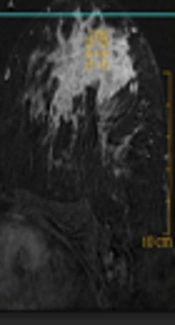
The most prevalent features of the benign lesions were a regional distribution (60.0%) and heterogeneous pattern (60.0%), and the most prevalent features of the malignant lesions were a linear distribution (53.4%; Figure 1), heterogeneous pattern (45.2%), segmental distribution (41.1%), and clumped pattern (31.5%; Figure 2). The frequency of malignancy was significantly higher for lesions with a linear (P = 0.005) and segmental (P = 0.011) distribution, whereas the frequency of benign behavior was significantly higher in lesions with focal (P = 0.004) and regional (P < 0.001) distribution. Although all NME lesions with a clustered ring pattern (Figure 3) were malignant, the distribution of NME with an internal enhancement pattern did not differ significantly between benign and malignant lesions (Table 1).

Figure 1.
A 52-year-old woman with A, invasive ductal carcinoma in the upper inner quadrant of right breast (arrow); B, The axial post-contrast subtracted image shows heterogeneous linear enhancement (arrows) in the same quadrant as the index cancer. The surgical biopsy revealed ductal carcinoma in situ.

Figure 2.
A 69-year-old woman with A, invasive ductal carcinoma in the upper outer quadrant of left breast (arrows); B, The axial post-contrast subtracted image depicts segmental clumped enhancement (arrows) in the same quadrant as the index cancer. The surgical biopsy revealed ductal carcinoma in situ.

Figure 3.
A 47-year-old woman with A, invasive ductal carcinoma in the right breast (arrow); B, C. The axial post-contrast subtracted consecutive images demonstrate focal clustered ring enhancement (arrow) in the contralateral breast. The surgical biopsy revealed ductal carcinoma in situ.
Table 2 lists the sensitivity, specificity, PPV, and NPV according to the NME distribution and internal enhancement pattern. The distribution patterns with high specificity were linear (86.7%) and segmental (93.3%) distributions, and the internal enhancement patterns with high specificity were clumped (92.0%) and clustered ring (100.0%) enhancement. The features with high PPV for malignancy were segmental distribution (96.8%, P = 0.011) and clustered ring enhancement (100.0%, P = 0.598).
Table 2.
Estimated Sensitivity, Specificity, Positive and Negative Predictive Values, and Positive and Negative Likelihood Ratios of MRI Features in Prediction of Malignancya
| Sensitivity | Specificity | PPV | NPV | PLR | NLR | |
|---|---|---|---|---|---|---|
| Focal | 0.0 (0.0 - 6.2) | 80.0 (51.4 - 94.7) | 0.0 (0.0 - 69.0) | 14.1 (7.8 - 23.8) | 0 | 1.25 (1.21 - 1.29) |
| linear | 53.4 (41.4 - 65.0) | 86.7 (58.4 - 97.7) | 95.1 (82.2 - 99.2) | 27.7 (16.1 - 42.9) | 4.00 (1.18 - 14.82) | 0.54 (0.41 - 0.70) |
| segmental | 41.1 (29.9 - 53.2) | 93.3 (66.0 - 99.7) | 96.8 (81.5 - 99.8) | 24.6 (14.5 - 38.0) | 6.16 (0.91 - 41.77) | 0.63 (0.52 - 0.77) |
| regional | 5.5 (1.8 - 14.2) | 40.0 (17.5 - 67.1) | 30.8 (10.4 - 61.1) | 8.0 (3.3 - 17.2) | 0.09 (0.03 - 0.26) | 2.36 (1.84 - 3.04) |
| homogeneous | 13.7 (7.1 - 24.2) | 73.3 (44.8 - 91.1) | 71.4 (42.0 - 90.4) | 14.9 (9.0 - 25.5) | 0.51 (0.19 - 1.42) | 1.18 (1.02 - 1.35) |
| heterogeneous | 45.2 (33.7 - 57.2) | 40.0 (33.7 - 57.2) | 78.6 (62.8 - 89.2) | 13.0 (5.4 - 27.0) | 0.75 (0.46 - 1.22) | 1.37 (0.91 - 2.05) |
| clumped | 31.5 (21.4 - 43.6) | 86.7 (58.4 - 97.7) | 92.0 (72.5 - 98.6) | 20.6 (11.9 - 33.0) | 2.36 (0.62 - 8.97) | 0.79 (0.66 - 0.94) |
| clustered ring | 9.6 (4.3 - 19.3) | 100.0 (74.7 - 100.0) | 100.0 (56.1 - 100.0) | 18.5 (11.1 - 29.1) | ---- | 0.90 (0.84 - 0.97) |
| asymmetry | 100.0 (93.8 - 100.0) | 20.0 (5.3 - 48.6) | 85.9 (76.2 - 92.2) | 100.0 (31.0 - 100.0) | 1.25 (0.97 - 1.61) | 0 |
aData are presented as percent(95% Confidence Interval).
Symmetric lesions were found in three patients, and all three lesions were diagnosed as benign (Table 1). The presence or absence of symmetry differed significantly between malignant and benign lesions (P = 0.004). Asymmetry demonstrated a high PPV for malignancy of 85.9% (Table 2).
NME lesions were found most frequently in the same quadrant of the ipsilateral breast as the index cancer (Table 1). NME lesions located in the same quadrant as the index cancer were significantly more likely to be malignant (P = 0.006), and NME lesions in the contralateral breast were more likely benign (P = 0.015).
Of 88 NME lesions, 6.8% had a BI-RADS category 3 assessment, 62.5% had a BI-RADS category 4 assessment, and 30.7% had a BI-RADS category 5 assessment on the basis of MRI findings. Of the six lesions with a BI-RADS category 3 assessment, five were proven benign and one was malignant, yielding a PPV of 83.3% (95% CI: 36.5-99.1%). Of the 55 lesions with a BI-RADS category 4 assessment, 45 malignancies were diagnosed, yielding a PPV of 81.8% (95% CI: 68.6-90.5%). Of the 27 lesions with a BI-RADS category 5 assessment, all lesions were proven malignant, yielding a PPV of 100% (95% CI: 84.5-100%).
4.3. Binary Logistic Regression Analysis
Of the MR features analyzed in the logistic regression model, linear (odds ratio = 66.4; 95% CI, 5.66-779.68; P = 0.001) and segmental (odds ratio = 35.1; 95% CI, 3.01-411.10; P = 0.005) patterns were the only significant predictors of malignancy. None of the internal enhancement patterns or locations demonstrated any statistically significant association with benign or malignant lesions.
5. Discussion
It is well known that breast cancer can be multifocal or multicentric in the ipsilateral and even in the contralateral breast to the index cancer. As a result, MRI has become an essential imaging tool for preoperative assessment in patients diagnosed with breast cancer. MRI can identify additional cancer foci that would otherwise remain undetected by clinical assessment combined with mammography or ultrasound (2, 3, 8, 9). It is unclear whether the detection of additional malignant foci improves patient outcomes, but identification of these additional lesions can help in the selection of appropriate patients for breast conserving surgery or local excision. In a study conducted by Houssami et al. (3), some patients underwent a more extensive surgery due to MRI results: the conversion rate from a wide local excision to mastectomy was 8.1%, and the conversion rate from a wide local excision to more extensive surgery (such as an additional or wider excision) was 11.3%.
It is common to find additional lesions in the form of NME on preoperative MRI. Liberman et al. (6) found that NME lesions comprised 32% of additional lesions in the ipsilateral breast, and in another study, the same investigators reported that NME comprised 33% of the additional lesions in the contralateral breast (7). The malignant potential of additional NME lesions should be elucidated because their malignant behavior can alter the course of treatment. Although several studies have characterized the MRI features of NME in differentiating malignant and benign lesions (6, 7, 11-17, 19-25), standardized interpretative criteria based on the BI-RADS MRI lexicon for NME do not exist. Our study focused on additional NME lesions identified during preoperative MRI, a scenario occasionally encountered in the clinical setting.
Our findings demonstrated that linear and segmental distribution patterns were the strongest indicators of malignancy. Linear and segmental distribution patterns were also among the most frequent morphologic findings in malignant lesions and showed high PPVs for malignancy of 95.1% and 96.8%, respectively.
Our PPV for the linear distribution pattern is much higher than rates in previously published data. Liberman et al. (13) reported that the overall PPV for linear- and branching-ductal patterns was 26%. Morakkabati-Spitz et al. (24) found a 34% PPV for linear and segmental enhancement. Wilhelm et al. (22) reported a 39.7% and 36.7% PPV for linear and ductal enhancement, respectively. Because “ductal” enhancement is reclassified as “linear” in the updated BI-RADS lexicon, we surmise that the previous PPV for “ductal” enhancement contributes to the high PPV for “linear” enhancement in the current data.
Clustered ring enhancement was added as a descriptor in the 2013 BI-RADS lexicon for MRI. In our study, all NME lesions showing clustered ring enhancement were diagnosed as malignant, which is consistent with findings by Tozaki et al. (20). However, the frequency of cluster ring enhancement differed significantly between benign and malignant lesions, and was not a significant predictor of malignancy in our study. This likely reflects the considerable size difference between benign and malignant lesions, which is discussed in the study limitations below.
Asymmetry was associated with an 85.9% likelihood of malignancy. This is comparable to the 75% PPV reported by Wilhelm et al. (22) and was unsurprising since asymmetry is usually considered a feature highly suspicious of malignancy.
In this study, the malignant rate of NME lesions was considerably high. Since we focused on additional NME lesions identified on preoperative imaging in newly diagnosed breast cancer, and since breast cancer can be multifocal and multicentric, we expected our malignancy rate to be higher than rates in other NME studies that include MRI performed for screening or other clinical purposes. Also, 95.9% of malignant lesions were confirmed as DCIS, which mirrors the fact that DCIS is commonly present in conjunction with invasive ductal carcinoma and that it frequently appears as NME.
We should note a few limitations of our study. First, it was conducted retrospectively, and second, the size difference between malignant and benign lesions was large and may have caused statistical selection bias. Besides the reasons mentioned above, most of the additional lesions considered benign were not pathologically diagnosed (though most of them were stable or disappeared on follow-up breast MRI). Third, we did not evaluate the kinetic features of additional NME lesions in this study. Further studies that include a kinetic analysis may have diagnostic benefit in the evaluation of NME lesions.
In conclusion, malignancy may be suspected when additional NME lesions with linear, segmental, clumped, or clustered ring enhancement and asymmetry are encountered in the same quadrant of the ipsilateral breast to the index cancer on preoperative 3T DCE-MRI. Percutaneous biopsy or wide surgical excision should be considered in these cases to potentially diagnosis multiple occult breast cancers.