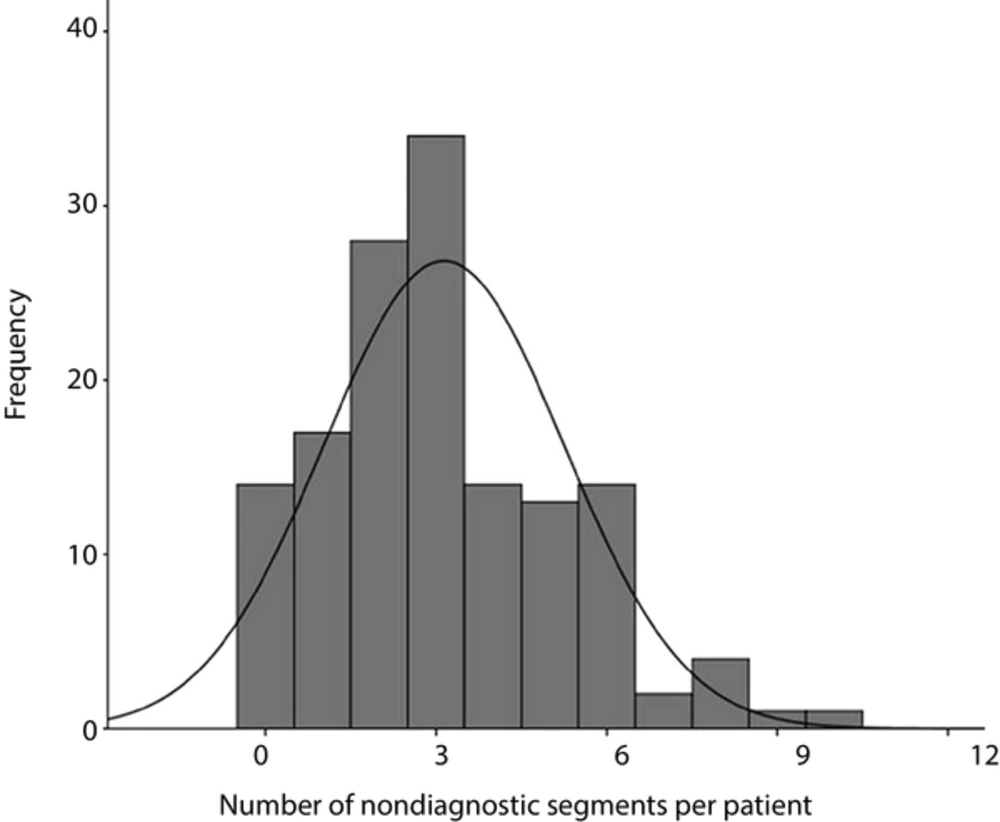
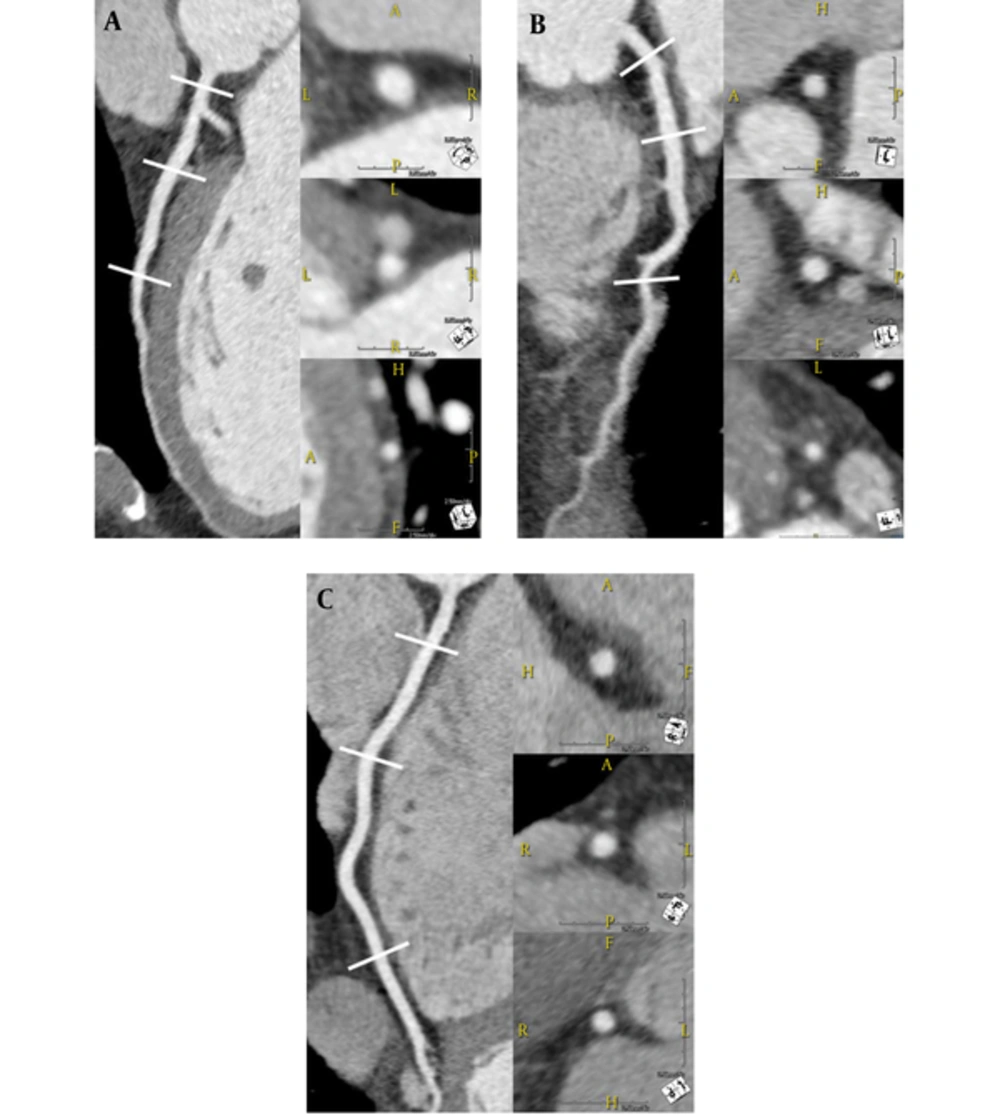
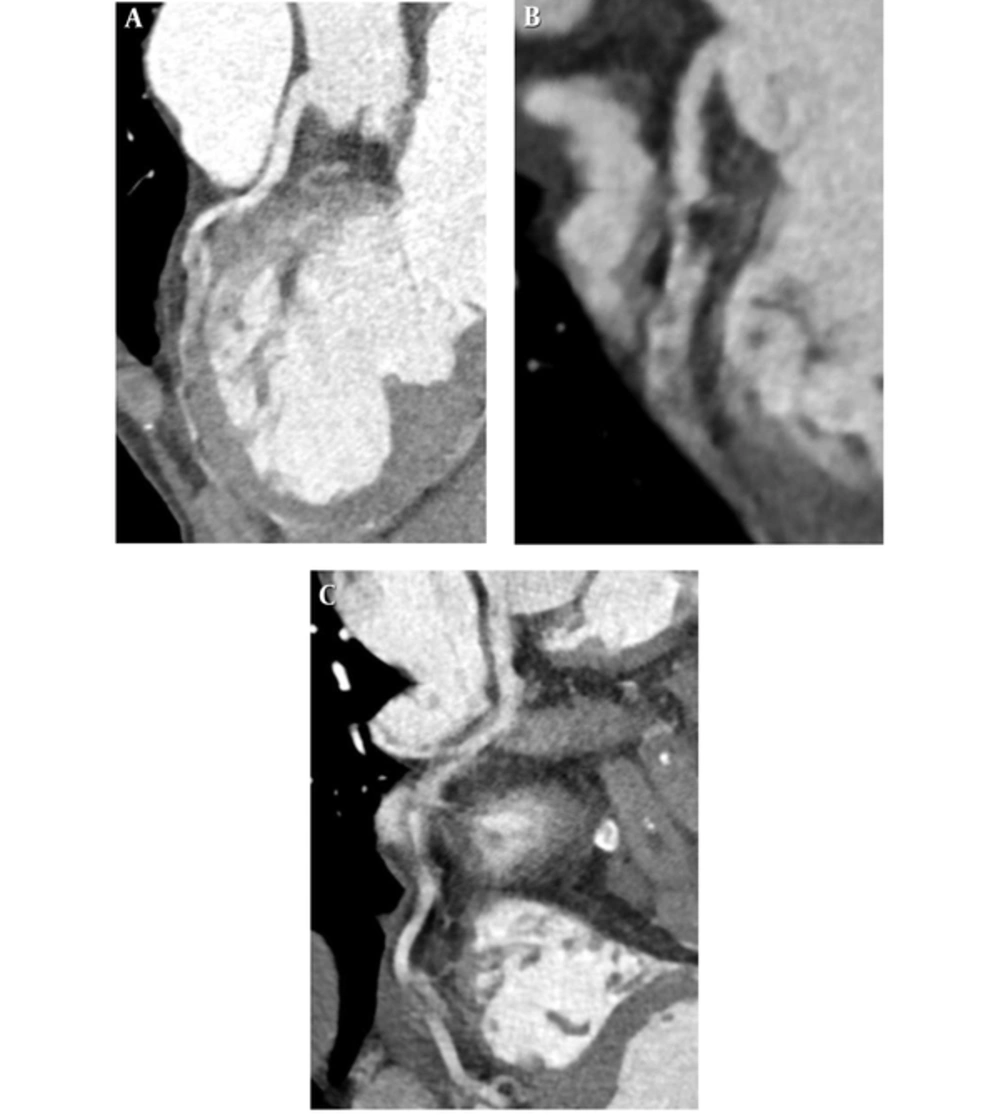
Non-ECG gated, low pitch CT is well known to be insufficient for evaluating the ascending aorta and coronary artery due to the cardiac motion artifact (
19). Our study demonstrated that the ascending aorta, LMCA and LAD exhibited relatively good diagnostic image qualities compared to LCx and RCA in high pitch, dual source CT aortography. Furthermore, this technique can be useful to evaluate the coronary ostial involvement in patients with ascending aortic dissection.
Prospectively ECG-triggered, high-pitch mode (flash mode) can decrease the estimated radiation dose compared to low pitch mode (
19). The high table speed at the pitch of 3.2 is an effective method for achieving entire aorta examination in a single session without ECG synchronization. Furthermore, the high-pitch helical acquisition mode in the dual-source CT enables the gapless image reconstruction. The transitions between sequential images are smooth, so misalignment or stair-step artifacts do not occur. A previous report demonstrated that 100 kVp is sufficient for obtaining the diagnostic image quality of the coronary arteries in patients with low body mass index (BMI) or low weight (
10). We excluded the patients with body mass index (BMI) of higher than 30. We could apply 100 kVp to reduce the radiation dose. The radiation dose of CT aortography was measured as 4.1 mSv in our study.
Theoretically, cardiac motion artifacts can be reduced by fast scanning, ECG-gating, or postprocessing of the scan. Our study demonstrated that most patients exhibited no motion artifact in the ascending aorta. Only one patient showed a respiratory motion artifact in the ascending aorta level, thus the ascending aorta and LMCA exhibited poor image qualities. It has been reported that non-ECG gated, high-pitch CT can provide motion-free aortic imaging in the ascending aorta (
11,
20). Furthermore, the evaluation of proximal coronary artery in patients with ascending aortic dissection is important to assess the coronary involvement of dissection flap or the coronary ostium originated from true or false lumen. We found that the majority of patients showed the diagnostic image quality in the ostia of LMCA and RCA. Hence, we expected that high-pitch CT angiography (CTA), compared to conventional low pitch CT, could provide the good image quality to evaluate the coronary artery ostial involvement in patients with ascending aortic dissection without additional ECG-gated coronary CT angiography.
High pitch, CT aortography provides good contrast enhancement and objective image quality of the coronary artery. Our study demonstrated a good CNR and low image noise in the coronary artery. Previous studies reported that good contrast enhancement in the coronary artery can be obtained in high-pitch dual-source CTA (
8,
20). On the other hand, the subjective image quality is not good in high-pitch CT aortography. Our study demonstrated that the LMCA and LAD were less affected by motion artifacts than LCx and RCA. The cause of this phenomenon has been well documented in early studies of coronary artery imaging using electron beam CT. Previous studies demonstrated that motion velocity of the coronary artery is highest in RCA followed by LCx and LAD (
21,
22). Furthermore, the motion of LAD exhibited no significant differences throughout the cardiac cycle, but the motions of LCx and RCA vary significantly throughout the cardiac cycle in patients with heart rates < 80 beats/min (
22). The motion free, cardiac phase was late-systole and mid-diastolic phase in patients with heart rate < 80 beats/min, but this phase was shortened in the patients with heart rate > 80 beats/min (
22). The similar result was obtained in the previous study using third generation dual source CT (
19). These results indicate that non-ECG gated CT does not guarantee the acquisition of motion-free imaging of the whole coronary artery even in high-pitch mode. The majority of patients had at least one segment with non-diagnostic image quality in our study. We found that approximately three segments per patient were of non-diagnostic image quality. In contrast, non-ECG gated, high-pitch CT is sufficient for obtaining the diagnostic coronary artery imaging in LMCA and LAD. The CAD in LMCA and proximal LAD are clinically important because significant stenosis in the LMCA and proximal LAD, compared to the other coronary segments, are associated with poor prognosis for cardiovascular event (
23,
24).
We also analyzed the subjective image qualities in per-segment and per-patient analyses according to four levels. The subjective image qualities in our study were poor compared with those of a previous study, using ECG-gated high-pitch dual-source coronary CT in patients with heart rate > 70 beats/min (
25), even though we enrolled the patients with heart rate < 80 beats/min. Another study analyzed the diagnostic image qualities using non-ECG gated high-pitch dual-source CT in patients with high heart rates (mean heart rate (MHR) = 86 beats/min). Compared with our results, the diagnostic image qualities in the per-segment analysis were similar at the 4-segment level (88% vs. 84%) and 7-segment level (75% vs. 75%) but decreased at the 10-segment level (61% vs. 73%) and 16-segment level (48% vs. 73%) (
16). Furthermore, the diagnostic image qualities in the per-segment analysis were similar at the 4-segment level (67% vs. 60%) and 7-segment level (23% vs. 23%) but decreased at the 10-segment level (3% vs. 13%) and 16-segment level (0% vs. 9%) (
16). These results suggest that the image qualities were not hampered at the proximal and mid-coronary segment levels but were worsened at the distal coronary segments and branch vessel in patients with high heart rate. Therefore, additional invasive coronary angiography or ECG-gated, coronary CT angiography is needed to evaluate the distal run-off vessel of obstructive CAD, especially for the patients requiring coronary artery bypass graft.
The study limitations are as follows. First, the high-pitch CT aortography was performed not for CAD evaluation but for aortic disease evaluation. The diagnostic performance of coronary CT was not verified with invasive coronary angiography. Additionally, beta-blockers or nitroglycerin were not administered in this study. Additional studies are needed to evaluate the diagnostic performance of high-pitch CT aortography. Second, our study only focused on the motion artifact rather than calcification regarding subjective image quality. Calcification is a well-known factor that reduces the quality of images of the coronary artery (
26). Third, the heart rates were measured before CT scan, so the heart rates could have been different during the CT scans. Fourth, we selected the patients with low heart rate and low to moderate BMI. Therefore, the image quality was hampered in case of patients with high heart rate or high BMI.
In conclusion, non-ECG gated, high-pitch dual-source CT can be useful to evaluate the coronary artery ostial involvement in patients with aortic dissection. LMCA and LAD were imaged with relatively good diagnostic quality compared with LCx and RCA.