A 50-year-old male patient with fever, fatigue, cough and diarrhea complaints, and no known history of chronic diseases was referred to our hospital by ambulance on March 30, 2020 following his first positive RT-PCR test performed on March 28, 2020. On admission to the hospital, routine laboratory blood work, d-dimer, and serum procalcitonin levels were within normal limits except for mild anemia (Hemoglobin: 12.3 gr/dl [14.1 - 18.1]) and elevated C-reactive protein (CRP) levels (CRP: 131.4 mg/l). Blood oxygen saturation (SpO2) at admission was 89%.
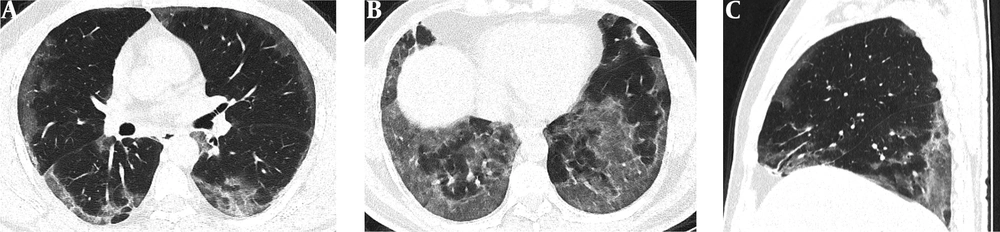
Serial chest-CT examinations were performed using a 64-channel multidetector CT scanner (Somatom go.Up, Siemens Healthineers, Germany) without intravenous contrast medium. CT imaging protocol was as follows: 110 kVp with automatic tube current modulation, slice thickness 1 mm, and high-spatial-frequency reconstruction algorithm. Initial chest CT performed on the day of admission revealed ground-glass opacities (GGOs) in subpleural and peripheral areas of bilateral upper lobes, as well as GGOs substantially covering the basal segments of bilateral lower lobes and accompanying subpleural curvilinear lines (
Figure 1). 3D-CT volumetry was performed to measure total lung volume (TLV) (TLV: 4169 cm
3, right lung volume: 1981 cm
3, left lung volume: 2188 cm
3). The patient was put on a combination treatment of azithromycin, hydroxychloroquine, and oseltamivir. SpO
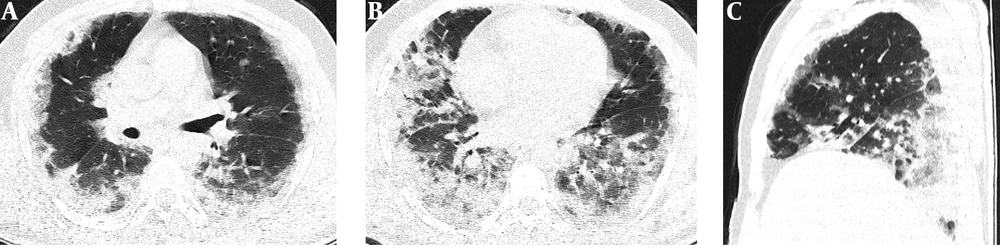
2 gradually decreased to 84% on day 4, and an oxygen mask with a reservoir bag was utilized. Enoxaparin sodium due to increased d-dimer levels, favipiravir, and piperacillin-tazobactam were added to the treatment regimen. The patient tested negative using PT-PCR on day 5. The second chest HRCT scan performed on the same day demonstrated the progression of pulmonary infiltrations and the transformation of GGOs into consolidative opacities for the most part (
Figure 2). TLV was measured to be 2128 cm
3 (right lung volume: 924 cm
3, left lung volume: 1204 cm
3) on the then-current scan. There is a significant volume loss compared to the first CT. The patient was admitted to the intensive care unit due to the progression of CT imaging findings. At that time, SpO
2 was around 84-86%. High-flow oxygen therapy, non-invasive ventilation, intermittent prone positioning, a single administration of intravenous immunoglobulin (IVIG) and cytokine adsorption were applied. The patient was not intubated, and SpO
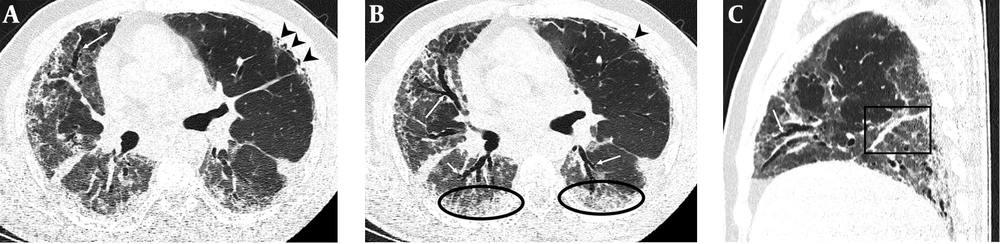
2 recovered to 95%. On day 30, he was discharged from the intensive care unit to ward. Due to persistent effort dyspnea and cough symptoms, the patient underwent a third chest HRCT scan on day 37 after admission. HRCT revealed subpleural reticular opacities with GGO’s that increase from the apex to the bases of the lungs, traction bronchiectasis and honeycombing appearance with decreased lung volumes and, interface sign-on fissures (
Figure 3). TLV was measured to be 2433 cm
3 (right lung capacity: 1016 cm
3, left lung capacity: 1417 cm
3. Lung volume increases compared to the second CT, but there is significant volume loss compared to the first CT. All these CT findings suggested UIP-type lung fibrosis. On day 43, the patient’s SpO
2 was 98% with spontaneous breathing and there was only minimal cough symptom. A repeat RT-PCR was negative, and the patient was discharged on the same day.