


1. Background
2. Patients and Methods
2.1. Patients
2.2. CT Technique
2.3. Image Analysis
2.4. Pathologic Analysis
3. Results
| Small Cell NEC (n = 10) | Large Cell NEC (n = 22) | Total NEC (n = 32) | |
|---|---|---|---|
| Morphology | |||
| Ulcerofungating | 7 (70%) | 13 (59%) | 20 (63%) |
| Ulceroinfiltrative | 3 (30%) | 9 (41%) | 12 (37%) |
| Polypoid | 0 (0%) | 0 (0%) | 0 (0%) |
| Size (cm) | |||
| 1 - 5 | 0 (0%) | 0 (0%) | 0 (0%) |
| 5 - 10 | 9 (90%) | 20 (91%) | 29 (91%) |
| > 10 | 1 (10%) | 2 (9%) | 3 (9%) |
| Low attenuation within mass | 5 (50%) | 13 (59%) | 18 (56%) |
| Low attenuation lymph nodes | 4 (40%) | 9 (41%) | 13 (41%) |
| Peritumoral infiltration | 0 (0%) | 2 (9%) | 2 (6%) |
| Liver metastasis (initial / follow up) | 2 (20%) /1 (10%) | 4 (18%) /2 (9%) | 6 (19%) /3 (9%) |
| Peritoneal carcinomatosis | 1 (10%) | 1 (5%) | 2 (6%) |
Abbreviation: NEC, Neuroendocrine carcinoma
aValues are expressed as No (%)
3.1. CT Findings
3.2. Pathologic Findings
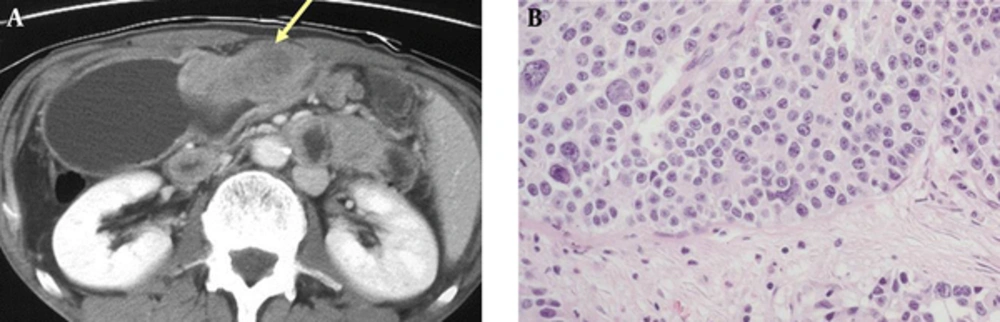
A 59-year-old man with large cell neuroendocrine carcinoma in the gastric antrum and body. A, Equilibrium phase CT scan shows an ulcerofungating mass (arrow) in the gastric body with moderate heterogeneous enhancement. B, Photomicrograph of a histopathologic section shows large polygonal tumor cells with abundant eosinophilic cytoplasm, coarsely granular chromatin, and prominent nucleoli (H & E, x 100).
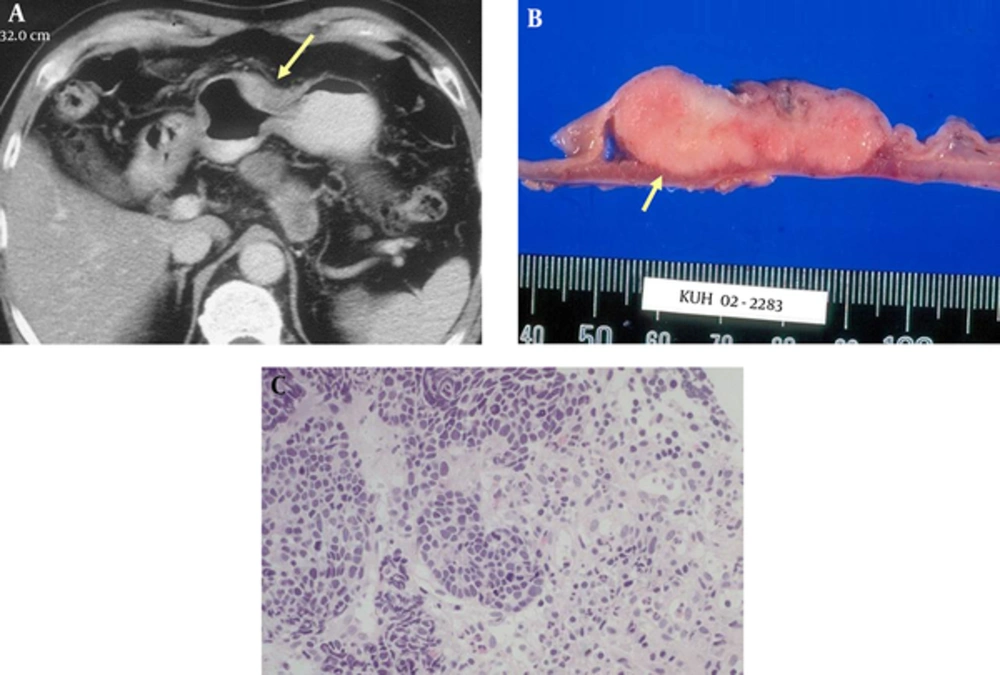
A 77-year-old man with small cell neuroendocrine carcinoma in the gastric antrum. A, Equilibrium phase CT scan shows an ulceroinfiltrative mass (arrow) with perigastric fat infiltration. B, Cut surface shows a well-demarcated solid pinkish tumor with extension to the muscle proper (arrow). C, Histopathologic section shows small tumor cells with scant cytoplasm and finely granular homogeneous chromatin without nucleoli (H & E, x 100).
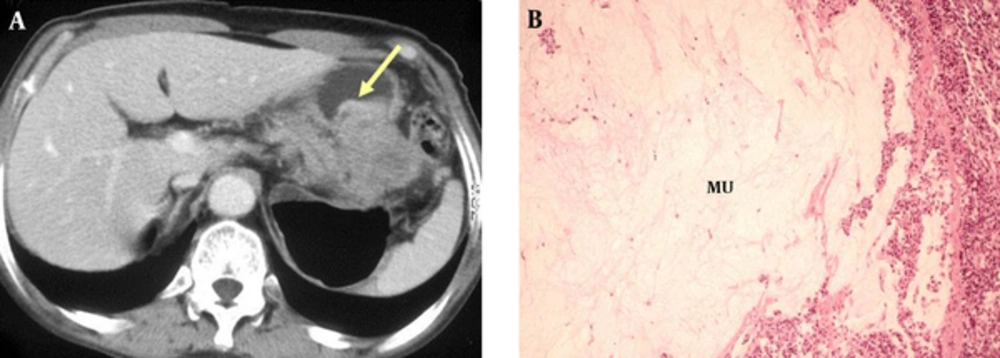
A 79-year-old man with neuroendocrine carcinoma in the gastric body. A, Equilibrium phase CT scan shows an ulcerofungating mass, particularly in the low-attenuating outer layer. The thickening of the high-attenuating inner layer (arrow) is irregular. B, Photomicrograph of histopathologic section shows large mucin pools (Mu) mainly in the submucosal and proper muscle layers (H & E, x 100).
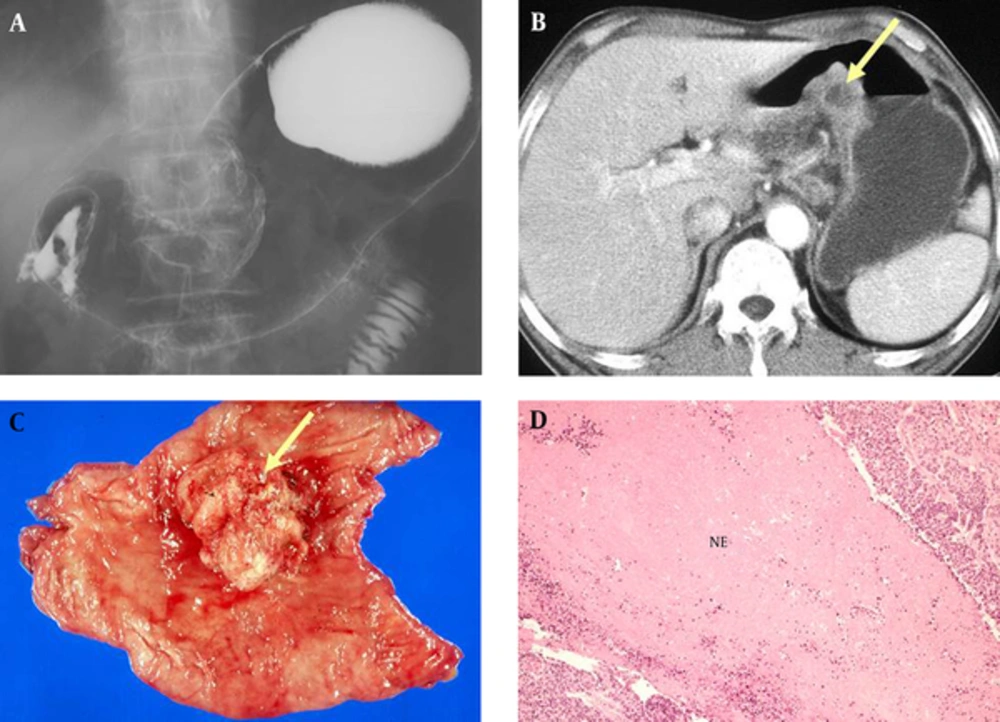
A 67-year-old man with neuroendocrine carcinoma. A, Double contrast upper gastrointestinal study shows a large irregular ulcerofungating mass in the lesser curvature of gastric angle. B, Early phase CT shows a polypoid mass with internal low attenuation (arrow). C, Resected specimen shows a large polypoid tumor with surface ulceration (arrow). D, Histopathologic section shows extensive tumoral necrosis (NE), mainly in the submucosal and proper muscle layers (H & E, x 100).
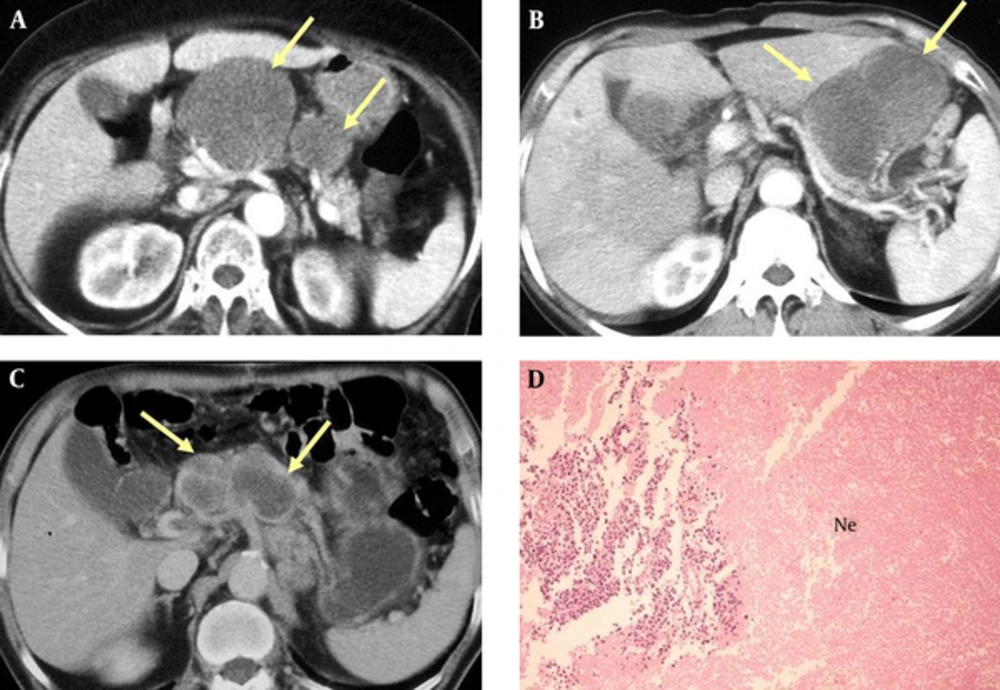
Three different patients with neuroendocrine carcinoma of the stomach. A - C, CT scan shows multiple large low attenuation lymph nodes (arrows) in the gastrohepatic ligament and celiac axis areas. The primary gastric mass is not shown on this image. D, Photomicrograph of histopathologic section shows massive tumoral necrosis (Ne) within enlarged metastatic lymph nodes (H & E, x 100).
