


1. Background
2. Objectives
3. Patients and Methods
3.1. Patients
| Case | Gender | Age | Diagnosis | Treatment | Type of filter | DOI | OT, min |
|---|---|---|---|---|---|---|---|
| 1 | Male | 65y | IFVE, PE, Cockett syndrome | PTA, CDT, iliac stent | OptEase | 12d | 20 |
| 2 | Male | 63y | IFVE, PE | PTA, CDT | OptEase | 14d | 25 |
| 3 | Female | 58y | IFVE, PE | PTA, CDT | OptEase | 16d | 17 |
| 4 | Male | 70y | IVC and iliac thrombosis | CDT | Celect | 60d | 25 |
| 5 | Male | 75y | IFVE | PTA, CDT | Celect | 56d | 25 |
| 6 | Female | 64y | Femoral vein thrombosis | Resection of pelvic mass | Celect | 35d | 30 |
| 7 | Male | 67y | IFVE | PTA, CDT | Celect | 60d | 25 |
Abbreviations: CDT, catheter-directed thrombolysis; d, days; DOI, duration of implantation; IFVE, iliac and femoral vein thrombosis; IVC, inferior vena cava; OT, operation time; PE, pulmonary embolism; PTA, percutaneous transluminal angioplasty
3.2. Methods
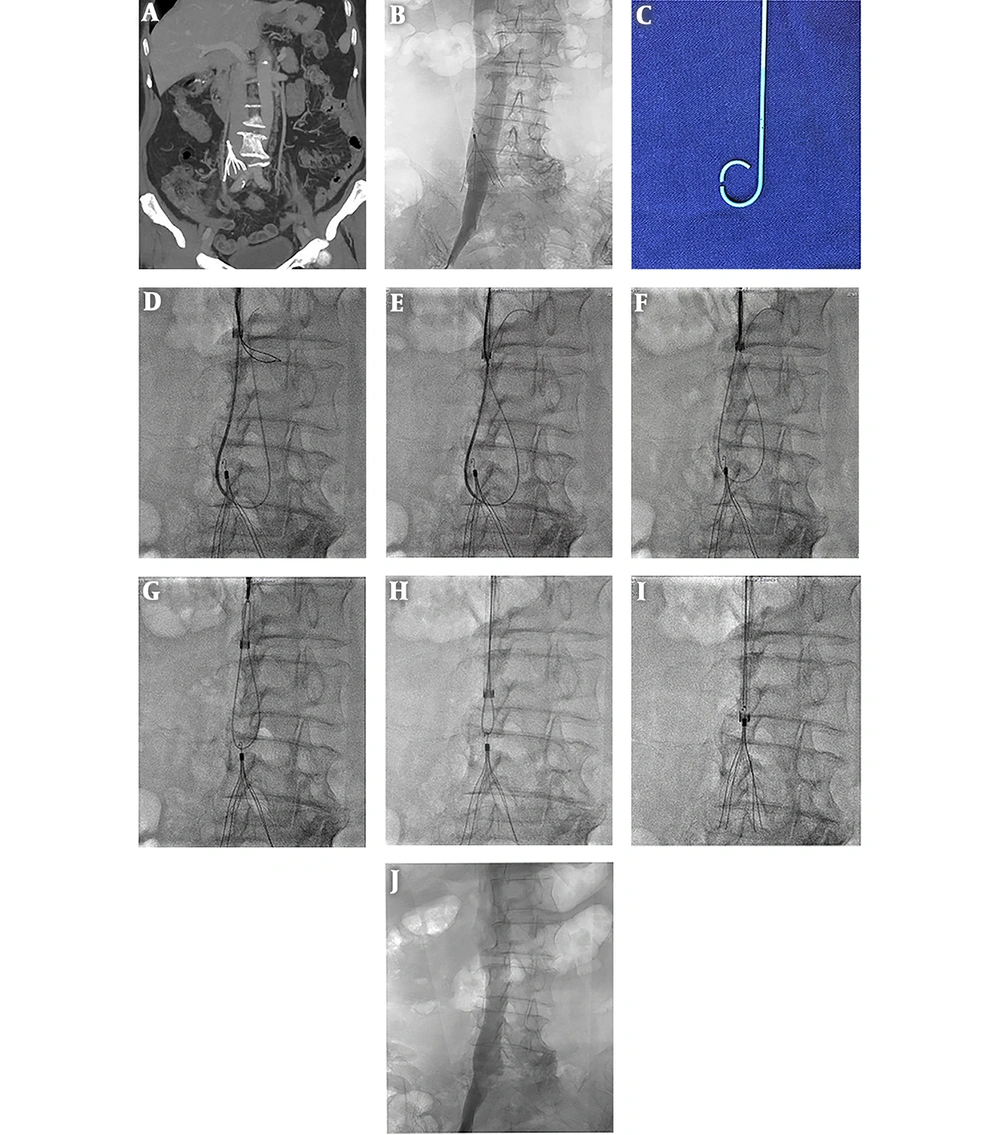
A, Preoperative CT angiography revealed tilt filter with embedded hook. B, The venogram confirmed that the filter tilted severely and there was an interstice between the filter neck and the inferior vena cava (IVC) wall. C, A 5F pigtail catheter was remade to be fishhook-like by cutting off the end. D, The soft guide wire was directed through the interstice of the filter neck and the IVC wall and advanced back into the snare. E, The leading end of the guide wire was snared by the snare and vertebral catheter. F, The guide wire was withdrawn slowly to confirm that the hook was snared. G, The leading end of the guide wire was withdrawn into the sheath. H, Cranially directed tension was applied to the trailing end and the leading end of the guide wire. I, The sheath was advanced over the wire-loop to collapse the filter. J, Completion angiogram showed patent IVC.
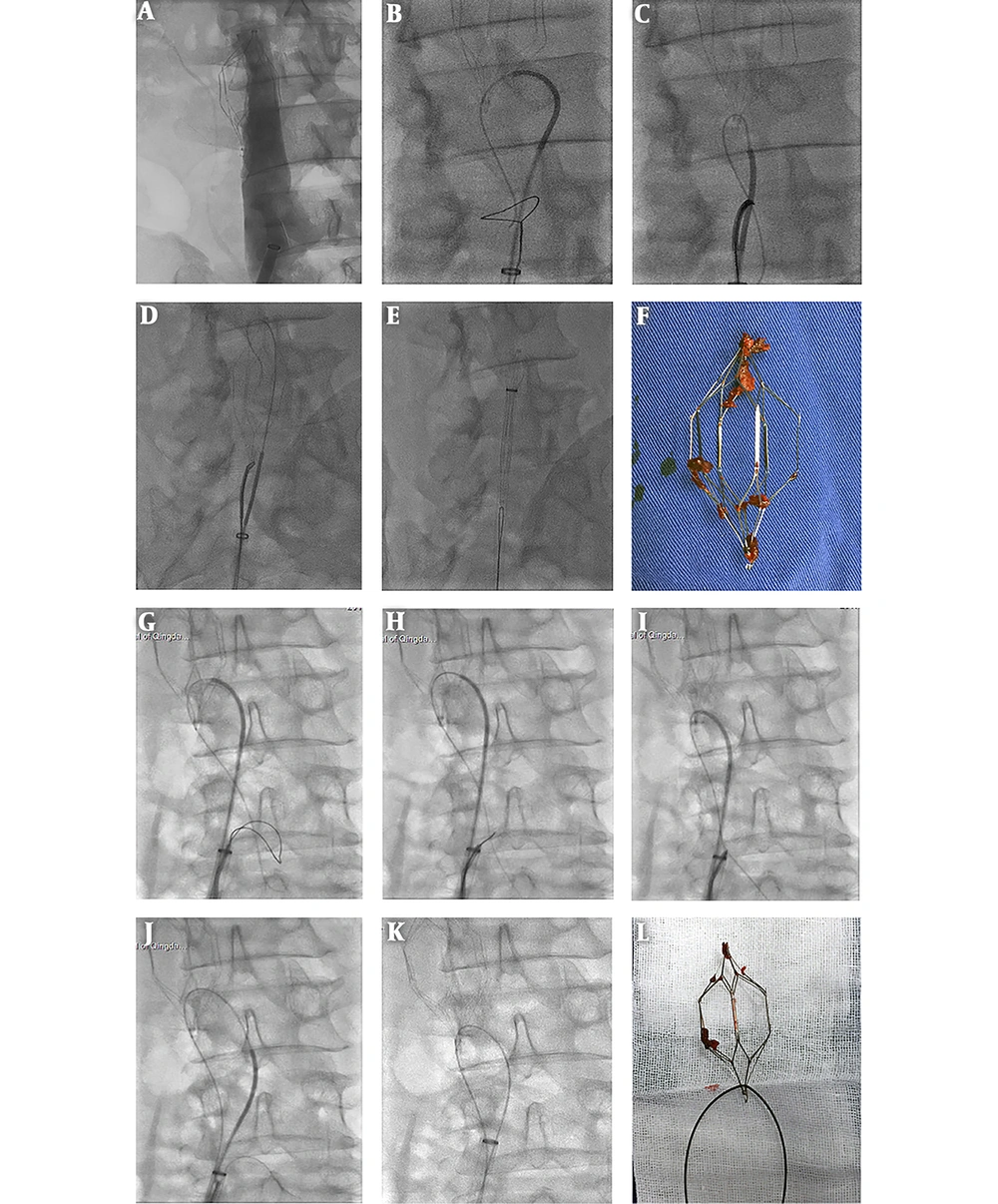
A, The venogram confirmed that the filter hook was embedded in the cava wall, and there was no interstice between the filter hook and the cava wall. B, The homemade pigtail catheter guided the 0.035-inch-long soft guide wire to pass through the interstice of the filter struts and advance back into the snare. C, The leading end of the guide wire was snared to form a loop and stretched the filter hook away from the cava wall. D, The hook was snared by the snare and 5F vertebral catheter. E, The long sheath was advanced over the catheter and the snare to collapse the filter. F, An organized thrombus and hyperplastic intima adhered to the filter. G, The homemade pigtail catheter guided the 0.035-inch-long soft guide wire to pass through the interstice of the filter struts and advance back into the snare. H, The leading end of the guide wire was snared by the snare and vertebral catheter. I, The guide wire was withdrawn slowly to form a wire-loop and confirm that the hook was snared. J, The leading end of the guide wire was withdrawn into the sheath. K, The trailing end and the leading end of the guide wire were stretched simultaneously and the sheath was advanced over the wire-loop. L, The filter was retrieved directly by the wire-loop and organized thrombus and hyperplastic intima adhered to the filter.


