Radiographers play a central role in acquiring high-quality mammographic images through not only quality control, but also appropriate breast compression and positioning (
6). The current study aimed to explore the radiographers’ knowledge of image quality assessment tools and to understand the current challenges and difficulties in daily practice. Radiographers assessing mammographic images need to comply with the guidelines established to ensure standardization in clinical practice (
10,
11). For this purpose, radiological organizations use different assessment methods, which include criteria for both positioning and image analysis (
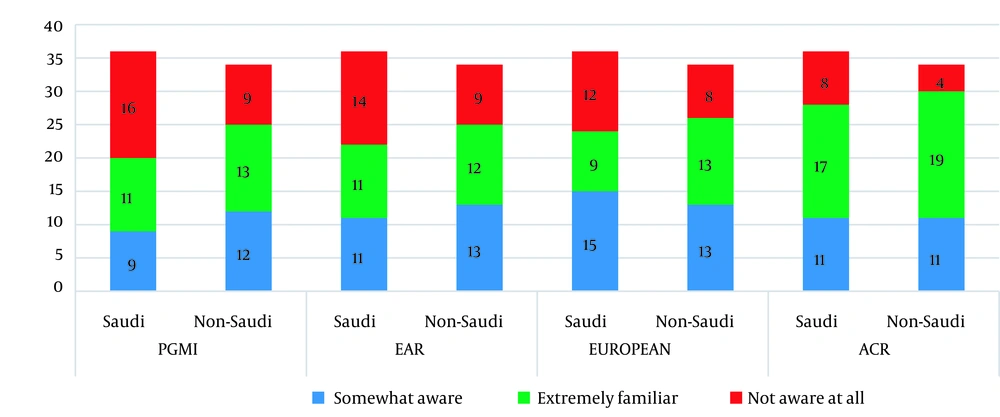
11). Notably, the present results showed the acceptable level of radiographers’ knowledge about the ACR tool (52%), but not other evaluation methods (
Figure 1). However, given the small sample size of this study, larger and more representative studies are required to accurately measure their level of knowledge.
The quality of a mammogram is greatly influenced by breast positioning, which determines the amount of breast tissue included in the image (
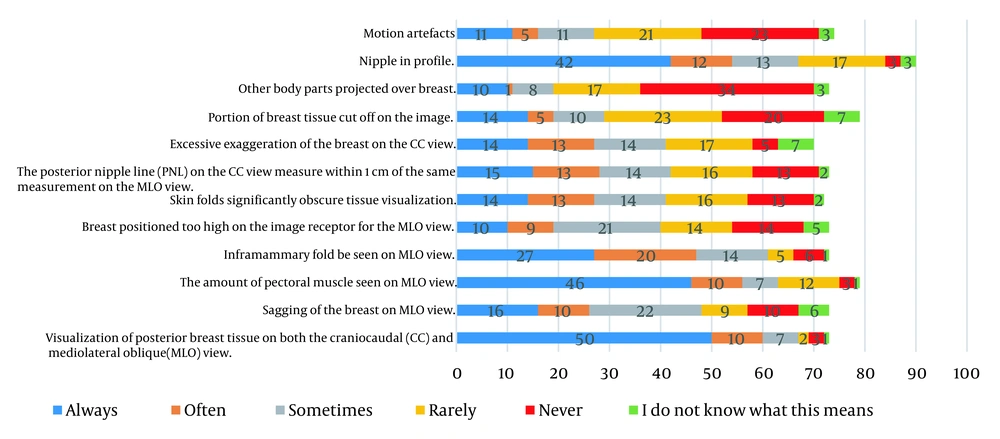
10). One of the most widely used methods for assessing the positioning quality of images is the 12-item ACR tool (
Figure 2). The present findings showed that posterior breast tissue visualization was the most frequently used item on both CC and MLO views, followed by the pectoral muscle volume on the MLO view and nipple in profile. Although these items are important, a comprehensive positioning assessment, including all ACR elements, is necessary. For instance, one of the most important indicators of mammographic image quality on the MLO view is the measurement of PNL. Based on the ACR tool, images are considered acceptable when PNL is seen at the level of or above the inferior aspect of the pectoral muscle (
9). However, the present results showed that only 38% of the radiographers used the PNL for assessing the image quality. For comparison, 71% of Australian radiographers used the PNL in the clinical setting (
9).
Moreover, other important positioning indicators, such as projection of other body parts over the breast, motion artifacts (60%), and cutoff breast tissue portions from the image (70%), were rarely or never applied (
Figure 2). This could be attributed to the design of the current cohort, in which 52% of the participants were familiar with the ACR tool (
Figure 1); however, further studies with a larger sample size are recommended to validate our findings.
Although today, digital technologies can automatically handle the majority of software and hardware factors, positioning is still highly dependent on the radiographer's experience (
5). Consistent with previous reports (
5,
10,
11), the present results indicated that, irrespective to the radiographer’s nationality, positioning was the main cause of repeat mammography in daily practice (
Table 4). The second leading cause of repeat mammography was image artifact, which can be explained by the fact that only 15% of the participants had always used motion artifact to evaluate a mammogram based on the ACR image quality standards (
Figure 1). In contrast, a previous study reported that blurred mammograms and noise were the main reasons for repeat procedures (
6); however, they were less frequently cited in the current study. Overall, more attention must be paid to repeat imaging owing to its association with increased patient anxiety, cost, and workflow issues, besides unwanted radiation exposure.
The current study found that breast compression was the main patient positioning challenge for Saudi radiographers, while it was ranked the third by non-Saudi radiographers (
Table 5). In this study, breast compression was the third most important reason for repeat mammography (
Table 4). Breast compression has been shown to not only affect the image quality and radiation dose, but also women’s experience of pain/discomfort (
5). A recent study showed that 88% (n = 140) of European radiographers found compression to be a challenging task, especially during painful examinations (
6). In previous research, variations in breast compression have been reported, which can be largely related to the absence of or differences in guidelines/recommendations for optimal compression force. Also, these variations may be related to the pain threshold of women, uncertainties or inaccuracies in estimating the pressure applied to the breast, radiographer’s sensitivity to pain expression, and radiographer’s perspective of a good compression (
6).
Another important challenge encountered in daily practice by radiographers was related to the positioning of wheelchair-bound patients (
Table 5). This challenge was ranked the first by non-Saudi radiographers and the second by Saudi radiographers. Therefore, besides anatomical knowledge and positioning skills, the patients’ individual needs (e.g., special needs of patients with physical disabilities) should be also incorporated into the radiographer’s continuing education.
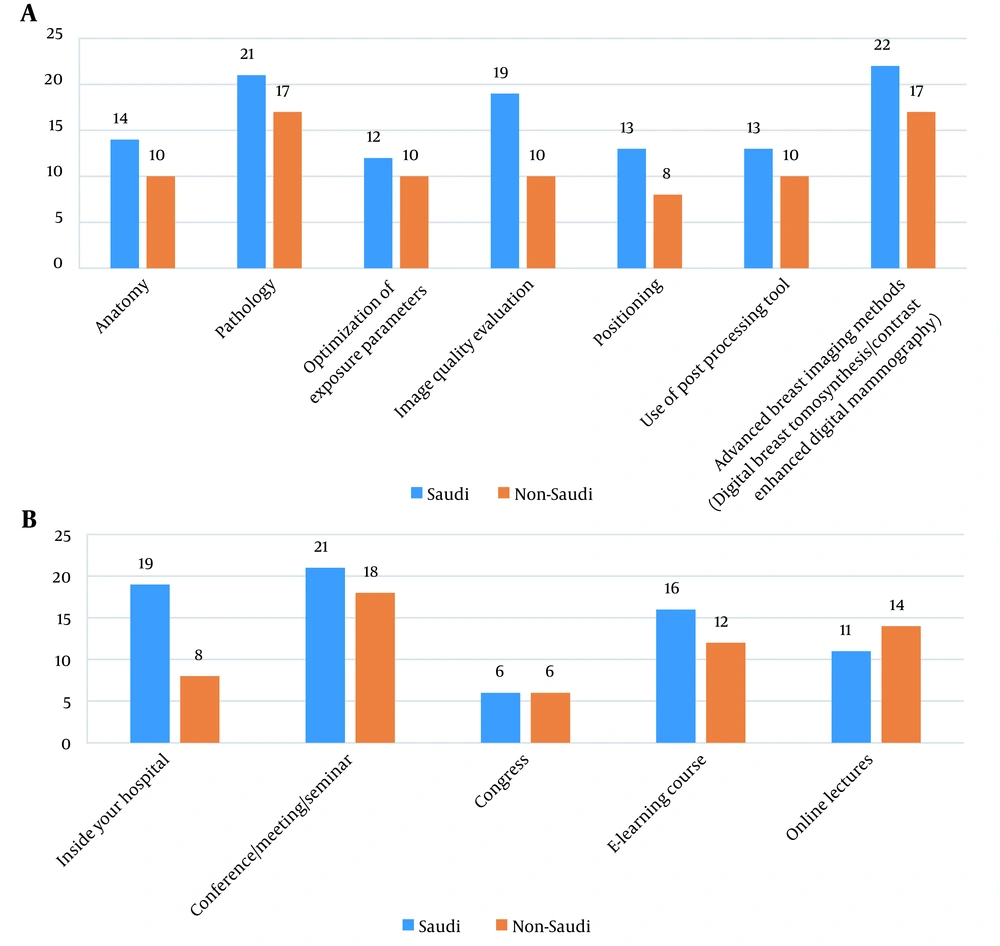
According to the present results, the majority of the participants expressed their interest in developing their knowledge of advanced breast imaging methods, followed by pathology and image quality evaluation. In the design of future educational and training courses, the needs of mammographers should be considered by professional bodies in the workplace. Additionally, in an integrative review of studies on European mammographers, all studies identified the need for further training over a wide range of contents or issues to provide mammography services at higher quality and improve clinical practice (
5).
To the best of our knowledge, there is no specific continuing professional development (CPD) program for radiographers working in mammography units in Saudi Arabia. However, a study in the Netherlands showed that despite mandatory CPD programs every three years, the positioning quality decreased compared to initial courses (
6). This study stressed the need for setting individual targets, continuous monitoring, and more frequent training, if necessary, to maintain the mammographic positioning skills up-to-date.
According to previous studies, less attention has been paid to mammography training and education compared to other imaging modalities, which might compromise advances in this field (
5). However, the European Reference Organization for Quality Assured Breast Screening and Diagnostic Services (EUREF) guidelines recommend that radiographers working in mammography units attend 40 hours of CPD training per year to improve their basic skills and stay up-to-date (
5). Australia has also established the Breast Imaging Clinical Education Program (BICEP), which is a CPD program intended for diagnostic radiographers performing breast imaging. This program provides mammography certification for radiographers with experience of breast imaging for three years (
12). Therefore, establishing a mammography certification program is vital in Saudi Arabia to improve the mammographers’ skills.
Some limitations of the present study need to be addressed. First, the small sample size certainly limited the validity of the results, highlighting the need for larger, well-designed studies with sufficient statistical power. However, our study sample size was similar to that of the study by Richli Meystre et al. (
6) and even exceeded that of the study by Abuzaid et al. (
13).
In conclusion, this pilot study highlighted the importance of developing in-house training courses for radiographers, with the involvement of radiologists, to focus on positioning, image quality evaluation, breast compression, and patient-centered needs for improving clinical practice standards. Given the scarcity of local studies on radiographers’ needs in Saudi Arabia, the present study can offer several avenues for future research.