


1. Background
2. Objectives
3. Patients and Methods
3.1. Patients
3.2. CT Scans
3.3. 18F-FDG-PET/CT Imaging
3.4. Image Analysis
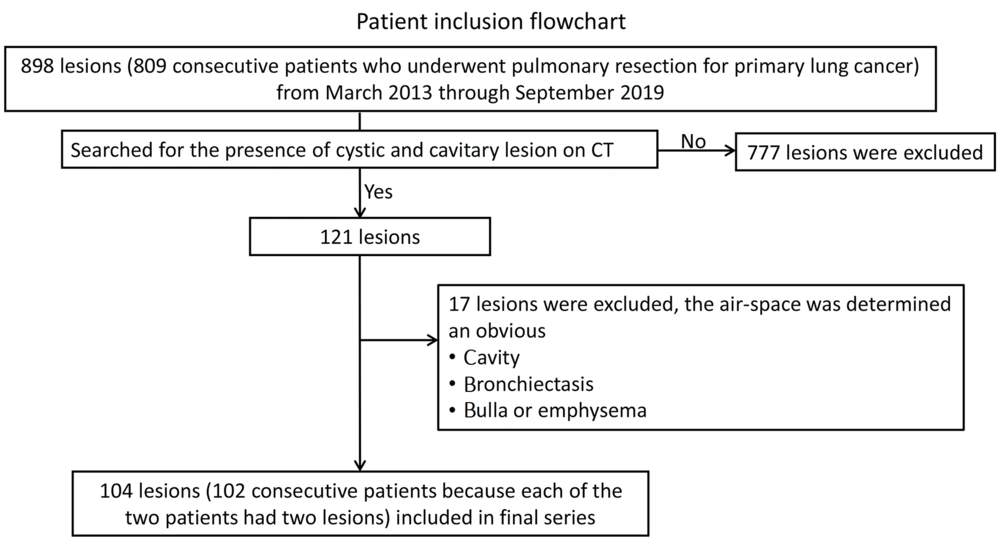
The flowchart of patient enrollment
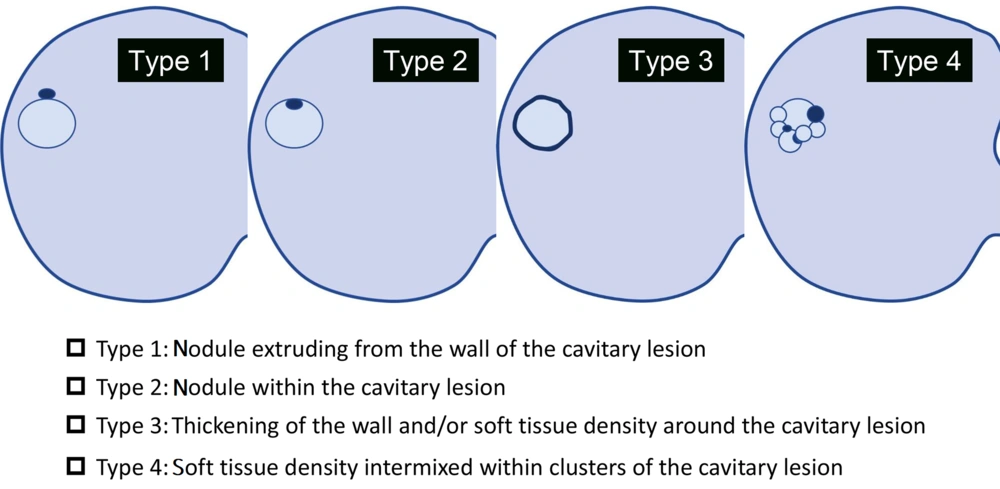
Morphological patterns of cystic and cavitary lesions. The image shows the morphological patterns of cystic and cavitary lung cancer (CCLC), classified into four types as proposed by Mascalchi et al. (5) (type 1, nodule extruding the wall of cavitary lesion; type 2, nodule within the cavitary lesion; type 3, thickening of the wall and/or soft tissue density around the cavitary lesion; and type 4, a soft-tissue-density structure intermixed within clusters of cavitary lesion).
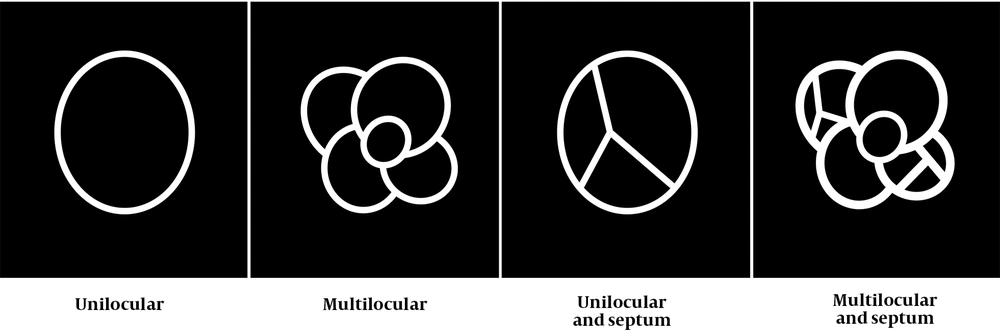
Loculation patterns, including the presence of septum. The loculation patterns for cystic and cavitary lung cancer (CCLC) are classified into four types according to a study by Fintelmann et al. (4), while considering the presence of septum: Unilocular; multilocular; unilocular with a septum; and multilocular with a septum (MS).
3.5. Statistical Analysis
4. Results
4.1. Description of CT Findings
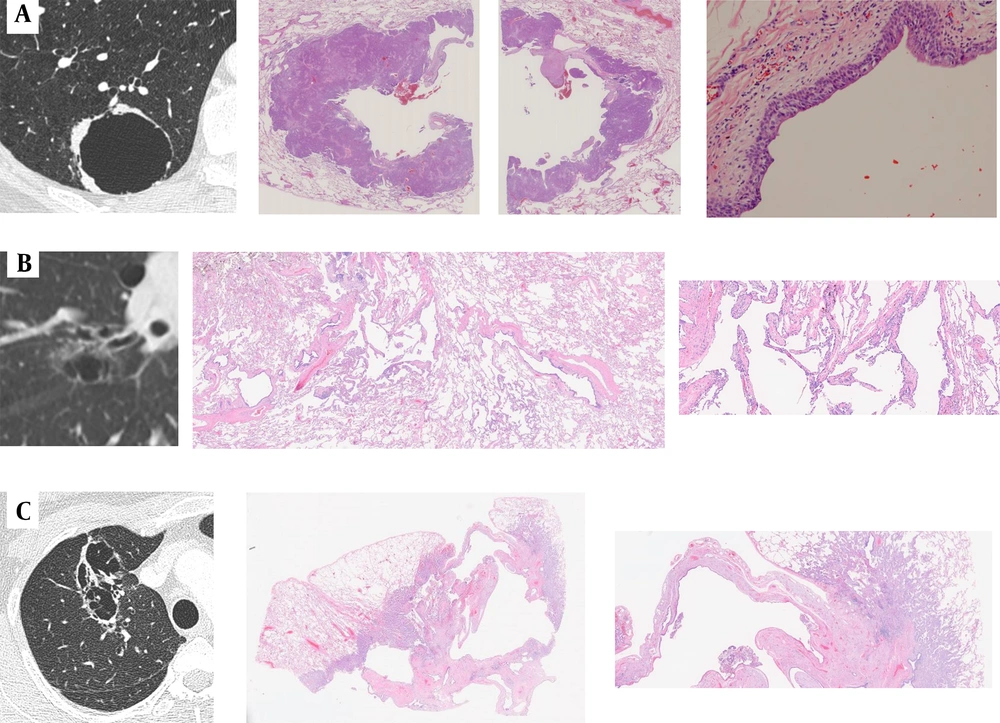
A, A 66-year-old man with cystic and cavitary lung cancer (CCLC). The CT scan shows a type 3, unilocular pattern with irregular wall thickening. A histopathological diagnosis of squamous cell carcinoma (SCC) is made. The low-power histological image shows a cystic airspace without septa; B, A 75-year-old man with CCLC. The CT scan shows a type 1, unilocular with septum pattern with subtle ground glass opacity (GGO). A histopathological diagnosis of adenocarcinoma (AD) in situ is made. The low-power histological image shows a cystic airspace with a septum, the alveolar walls of which are more fibrously thickened than those of typical AD in situ; C, A 52-year-old woman with CCLC. The CT scan shows a type 4, multilocular with septum pattern with subtle GGO. A histopathological diagnosis of invasive AD is made. The low-power histological image shows a cystic airspace with a multilocular pattern and septa, which are dilated bronchi and blood vessels. The histopathological findings suggest that the bronchi may be dilated against a relatively large bronchus packed by the tumor, and the bronchovascular bundle in the cavity-like area may be dilated with fibrous thickening, showing a septum-like structure.
![The CT scans and corresponding fluorodeoxyglucose positron emission tomography (FDG-PET) images of cystic and cavitary lung cancer (CCLC). Top row: A, An 80-year-old man with minimally invasive adenocarcinoma (AD); the FDG-PET scan shows absent uptake (maximum standardized uptake value [SUV<sub>max</sub>] = 0). Middle row: B, A 60-year-old man with invasive AD; the FDG-PET scan shows moderate uptake (SUV<sub>max</sub> = 1.24). Bottom row: C, A 68-year-old woman with squamous cell carcinoma (SCC); the FDG-PET scan shows marked uptake (SUV<sub>max</sub> = 8.61).](https://brieflands.com/journals/ijradiology/articles/130478/figures/iranjradiol-130478-g004-F5-preview.webp "The CT scans and corresponding fluorodeoxyglucose positron emission tomography (FDG-PET) images of cystic and cavitary lung cancer (CCLC). Top row: A, An 80-year-old man with minimally invasive adenocarcinoma (AD); the FDG-PET scan shows absent uptake (maximum standardized uptake value [SUV<sub>max</sub>] = 0). Middle row: B, A 60-year-old man with invasive AD; the FDG-PET scan shows moderate uptake (SUV<sub>max</sub> = 1.24). Bottom row: C, A 68-year-old woman with squamous cell carcinoma (SCC); the FDG-PET scan shows marked uptake (SUV<sub>max</sub> = 8.61).")
The CT scans and corresponding fluorodeoxyglucose positron emission tomography (FDG-PET) images of cystic and cavitary lung cancer (CCLC). Top row: A, An 80-year-old man with minimally invasive adenocarcinoma (AD); the FDG-PET scan shows absent uptake (maximum standardized uptake value [SUVmax] = 0). Middle row: B, A 60-year-old man with invasive AD; the FDG-PET scan shows moderate uptake (SUVmax = 1.24). Bottom row: C, A 68-year-old woman with squamous cell carcinoma (SCC); the FDG-PET scan shows marked uptake (SUVmax = 8.61).
| CT findings | No. (%) (total = 104) | κ |
|---|---|---|
| Consistency | 0.75 | |
| Solid | 42 (40.4) | 0.86 |
| Non-solid | 8 (7.7) | 0.53 |
| Partly solid | 54 (51.9) | 0.73 |
| GGO | 62 (59.6) | 0.86 |
| Morphological patterns of CCLC | 0.58 | |
| Type 1 a | 29 (27.9) | 0.63 |
| Type 2 b | 1 (1.0) | N.A. |
| Type 3 c | 36 (34.5) | 0.54 |
| Type 4 d | 38 (36.6) | 0.59 |
| Loculation pattern | 0.64 | |
| Unilocular pattern | 10 (9.6) | 0.67 |
| Multilocular pattern | 7 (6.7) | 0.56 |
| Unilocular with a septum pattern | 28 (26.9) | 0.54 |
| MS pattern | 59 (56.8) | 0.74 |
Abbreviations: CT, computed tomography; CCLC, cystic and cavitary lung cancer; GGO, ground glass opacity; κ, kappa coefficient (inter-observer); N.A., not applicable; MS, multilocular with a septum pattern.
a Nodule extruding the wall of cavitary lesion
b Nodule within the cavitary lesion
c Thickening of the wall and/or soft tissue density around the cavitary lesion
d A soft-tissue-density structure intermixed within clusters of the cavitary lesion
| Clinical characteristics of patients | Number of patients | P-value | |
|---|---|---|---|
| AD (n = 85) | SCC (n = 19) | ||
| Sex | 0.328 | ||
| Male | 65 (76.5) | 16 (84.2) | |
| Female | 20 (23.5) | 3 (15.8) | |
| Age | 69.0 (65.0 - 76.0) | 70.0 (68.0 - 73.0) | 0.347 |
| CT findings | |||
| Tumor size | 24.8 (20.6 - 35.9) | 23.9 (16.7 - 40.9) | 0.873 |
| Airspace size | 12.7 (10.3 - 20.8) | 12.7 (7.4 - 22.4) | 0.696 |
| GGO | 60 (70.6) | 2 (10.5) | < 0.001* |
| Morphological patterns of cystic and cavitary lesions | 0.016 * | ||
| Type 1 b | 21 (24.7) | 8 (42.1) | |
| Type 2 c | 1 (1.2) | 0 (0.0) | |
| Type 3 d | 26 (30.6) | 10 (52.6) | |
| Type 4 e | 37 (43.5) | 1 (5.3) | |
| Loculation | < 0.05 * | ||
| Unilocular pattern | 6 (7.1) | 4 (21.1) | |
| Multilocular pattern | 6 (7.1) | 1 (5.3) | |
| Unilocular with a septum pattern | 20 (23.4) | 8 (42.1) | |
| MS pattern | 53 (62.4) | 6 (31.6) | |
Abbreviations: CCLC, Cystic and cavitary lung cancer; AD, adenocarcinoma; SCC, squamous cell carcinoma; GGO, ground glass opacity; MS, multilocular with a septum pattern.
a Values are expressed as No. (%) or median (interquartile ranges).
b Nodule extruding the wall of the cavitary lesion
c Nodule within the cavitary lesion
d Thickening of the wall and/or soft tissue density around the cavitary lesion
e A soft-tissue-density structure intermixed within clusters of the cavitary lesion


