Fulltext
The body of the article can be found in the PDF file.
Journal of Medical Education for Future Demands
Former Title: Journal of Medical Education | The Official Journal of School of Medical Education and Learning Technologies
Authors
Background: To evaluate the effectiveness of the present educational programs in terms of students' achieving problem solving, decision making and critical thinking skills, reliable, valid and standard instrument are needed.Purposes: To Investigate the Reliability, validity and Norm of CCTST Form.B .The California Critical Thinking Skills Test contain 34 multi-choice questions with a correct answer in the jive Critical Thinking (CT) cognitive skills domain.Methods: The translated CCTST Form.B were given t0405 BSN nursing students ojNursing Faculties located in Tehran (Tehran, Iran and Shahid Beheshti Universities)that were selected in the through random sampling. In order to determine the face and content validity the test was translated and edited by Persian and English language professor and researchers. it was also confirmed by judgments of a panel of medical education experts and psychology professor's. CCTST reliability was determined with internal consistency and use of KR-20. The construct validity of the test was investigated with factor analysis and internal consistency and group difference.Results: The test coefficien for reliablity was 0.62. Factor Analysis indicated that CCTST has been formed from 5 factor (element) namely: Analysis, Evaluation, lriference, Inductive and Deductive Reasoning. Internal consistency method shows that All subscales have been high and positive correlation with total test score. Group difference method between nursing and philosophy students (n=50) indicated that there is meaningfUl difference between nursing and philosophy students scores (t=-4.95,p=0.OOO1). Scores percentile norm also show that percentile offifty scores related to 11 raw score and 95, 5 percentiles are related to 17 and 6 raw score ordinary.Conclusions: The Results revealed that the questions test is sufficiently reliable as a research tool, and all subscales measure a single construct (Critical Thinking) and are able to distinguished the persons with different level's CT.
© 2003, Author(s). This open-access article is available under the Creative Commons Attribution 4.0 (CC BY 4.0) International License (https://creativecommons.org/licenses/by/4.0/), which allows for unrestricted use, distribution, and reproduction in any medium, provided that the original work is properly cited.
Gupta K, Iranfar S, Iranfar K, Mehraban B, Montazeri N. Validly and Reliability of California Critical Thinking Disposition Inventory (CCTDI) in Kermanshah University of Medical Sciences. Educ Res Med Sci. 2012;1(1):e77064. doi:
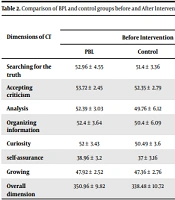
Kazemi N, Beigmoradi S, Farmitani Z, Ghorbani F, Jamalinasab A, et al. The Effect of Problem-Solving-Based Learning on Critical Thinking Skills of Nursing Students. J Health Rep Technol. 2022;8(4):e133327. doi: https://doi.org/10.5812/jhrt-133327
Babamohamdi H, Khalili H. Comparison Of Critical Thinking Skills In Students Of Nursing In Continuous And Interrupted Bs Sections Of Semnan University Of Medical Sciences. J Med Edu. 2005;6(2):e105162. doi: https://doi.org/10.22037/jme.v6i2.770
Khalaj M, Pakpour A, Mohammadi Zeidi I. Validity and reliability of a Persian version of nursing students’ competence scale in spiritual care. J Inflamm Dis. 2024;17(2):e155758. doi:
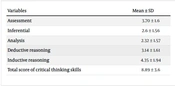
Khazaei MR, Niromand E, Shahsavari A, Sepahi V. Evaluation of Critical Thinking Skills in Medical Students of Kermanshah University of Medical Sciences. Educ Res Med Sci. 2023;12(1):e139394. doi: https://doi.org/10.5812/erms-139394
Last Update: 1 month ago
Last Update: 1 month ago
Last Update: 1 month ago
Last Update: 2 days ago