


1. Background
The World Health Organization (WHO) declared the coronavirus disease 2019 (COVID-19) as a global pandemic in early 2020 (1). The government of India announced a total lockdown across the country as a part of its efforts to control the disease spread. The restrictions came into force at the midnight on 24th March 2020 (2). As a result of this lockdown, any kind of gathering was prohibited for the fear of the spread of infection. Many of the scientific meetings had to be canceled (3, 4). Later, the Indian government allowed a gathering of 50 people at weddings and 20 people at funerals. There were no recommendations for academic scientific meetings by the government (5). Lockdown raised challenges for medical education (6-10). Physical meetings, if planned had to be conducted with precautions, such as social distancing, hand sanitization, and masks. Despite these precautions, there is a high risk of infections in the case of physical meetings. There was fear among the doctor's community (11). The benefits of E-learning tools are discussed in the literature.6 Therefore, the scientific community resorted to virtual meetings, which had varied responses among the medical community. We have documented the responses of physicians for these meetings, which may help policy-makers to improve the organization of these meetings.
2. Objectives
The primary objective of this survey was to determine doctors’ preferred platform for scientific meetings (virtual versus physical meetings with social distancing and using face masks).
We also studied the association between their preference and various factors, like age, gender, seniority, type of practice, and specialty. The reasons for their preferred meeting and their preferred platform for future scientific meetings once the COVID 19 pandemic is over, were also assessed.
3. Methods
We did a cross-sectional web-based survey using google forms. The study was approved by the Institutional Ethics Committee (IEC) of the author’s affiliated institution. Participation in the survey was voluntary. The survey was anonymized and contained no identifying information. The invitation to participate was circulated to multiple physician groups on social media through WhatsApp in December 2020 during the COVID-19 pandemic in Puducherry, India. Those who voluntarily liked to participate in the survey were included. Since there are no previous studies on this topic, we assumed that 70% of doctors will prefer virtual meetings in the present scenario based on our interactions with medical colleagues and friends. The total sample size of 304 was considered with a 5% precision and a confidence level of 95%.
We developed an English questionnaire and validated it by applying the same to 25 doctors, which were not included in the analyses. The final questionnaire consisted of seventeen validated questions (Table 1). The survey was open for 72 hours. The participants could submit the response only once. The fourteen questions were mandatory, which were star marked, and the software ensured the form was not submitted until mandatory questions were answered. We inquired the participants about their preferred meeting platform, and whether there is a difference in understanding of the subject, interaction, distractibility, duration of time needed, expenses, and convenience between the two platforms.
Table 1.Questionnaire
| S. No. | Questions | Answer Options (Choose One Answer) | |||||
|---|---|---|---|---|---|---|---|
| A | B | C | D | E | F | ||
| 1 | Type of practice | Medical college | Private practice | Medical students | Others | ||
| 2 | Age group in years | 21 - 30 | 31 - 40 | 41 - 50 | 51 - 60 | 61 - 70 | > 70 |
| 3 | Gender | Male | Female | ||||
| 4 | Designation | Assistant professor | Associate professor | Additional professor | Professor | SR | JR |
| 5 | Specialty (please mention) | ||||||
| 6 | Would you like to attend a physical or virtual meeting? | Virtual | Physical | NPE | |||
| 7 | You are opting for virtual meeting because of | Fear of transmission of COVID 19 | Time-saving | Nil expense | Convenience | Other reason (please specify) | |
| 8 | You are opting for the physical meeting because of | A better understanding of the subject | Better interaction | Not well versed with virtual platform | Other reason (please specify) | ||
| 9 | Understanding of subject is better in | Virtual | Physical | NPE | |||
| 10 | Interaction or questioning of subject is better in | Virtual | Physical | NPE | |||
| 11 | Distractions are more in | Virtual | Physical | NPE | |||
| 12 | Which is more time saving | Virtual | Physical | NPE | |||
| 13 | Monetary expense is less in | Virtual | Physical | NPE | |||
| 14 | Overall convenience is more in | Virtual | Physical | NPE | |||
| 15 | Social Interaction amongst peers is better in | Virtual | Physical | NPE | |||
| 16 | How would you like future scientific meetings to be after COVID 19 is over? | Virtual | Physical | NPE | |||
| 17 | Suggestions if any | ||||||
Abbreviations: NPE, no problem with either; SR, senior resident; JR, junior resident.
Data were saved in Excel sheets directly from the Google forms and analyzed using SPSS 19. Descriptive statistics were used to analyze demographic data. The chi-square and Fischer’s extract tests were used for establishing the association between the variables. A P-value < 0.05 was considered statistically significant. We categorized the age < 50 and > 50 and analyzed the preferred meeting during the COVID-19 pandemic and future meetings. Medical college doctors were categorized into senior rank (professors), mid-rank (additional, associate, and assistant professor), and junior rank (senior residents and junior residents) and analyzed for the preferred meeting. Specialties were categorized into super specialty, broad specialty, and non-specialty, and analyzed for the preferred meeting during COVID-19 pandemic and future meetings.
4. Results
We received 314 responses. Most of the responders (134, 42.7%) aged 41 to 50 years. One hundred and eighty-two (58.0%) participants were male. One hundred and eighty-four (58.6%) responders worked at medical colleges, of whom 68 cases (21.7%) were senior cadre (professor). The baseline characteristics of the participants are given in Table 2.
Table 2.Demographic Characteristics of the Participants (N-314)
| Parameter | No. (%) |
|---|---|
| Age distribution (y) | |
| 21 - 30 | 26 (8.3) |
| 31 - 40 | 101 (32.2) |
| 41 - 50 | 134 (42.7) |
| 51 - 60 | 34 (10.8) |
| 61 - 70 | 16 (5.1) |
| > 70 | 03 (1.0) |
| Gender | |
| Male | 182 (58.0) |
| Female | 132 (42.0) |
| Type of practice | |
| Medical college | 184 (58.6) |
| Private practice, private or trust hospital | 130 (41.4) |
| Seniority | |
| Senior (professors) | 88 (28.0) |
| Mid rank (additional, associate, and assistant professor) | 75 (23.9) |
| Junior rank (senior residents and junior residents) | 40 (12.7) |
| Others (private practice or private or trust hospital) | 111 (35.4) |
Abbreviation: No., number of respondents.
In the current scenario, 154 (49%) doctors preferred virtual meetings, 85 (27%) physical meetings, and 75 (23.9%) were fine with both (Table 3). The convenience (103, 44.2%) was by far the most important reason for preferring a virtual meeting, followed by fear of getting COVID-19 (80, 34.3%). The most important reason for preferring physical meetings was better interaction reported by 145 cases (78%) followed by a better understanding of the subject (31, 16.7%) (Figure 1).
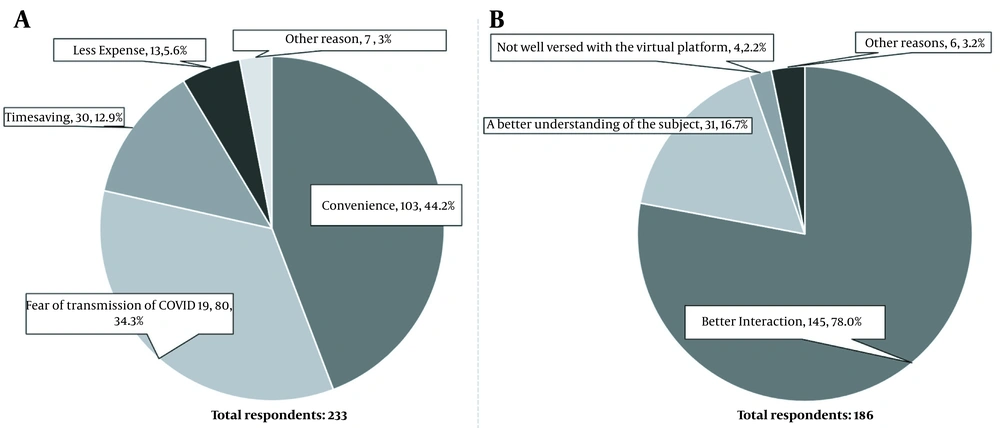
Figure 1.
Reasons for preferring meetings. A, virtual meetings; B, physical meetings.
The responses to the doctor’s preferred platform for the scientific meeting and related questions are shown in Table 3. The physical platform was preferred for future scientific meetings (144, 45.9%), followed by virtual (78, 24.8%) and no problem with either (92, 29.3%).
Table 3.Question and the Responses Related to the Platform for Scientific Meetings (N = 314)
| S. No. | Question | Virtual; No. (%) | Physical; No. (%) | No Problem with Either; No. (%) |
|---|---|---|---|---|
| 1 | Preferred meeting | 154 (49.0) | 85 (27.1) | 75 (23.9) |
| 2 | Understanding of subject is better in | 41 (13.1) | 146 (46.5) | 127 (40.4) |
| 3 | Interaction or questioning better in | 44 (14.0) | 200 (63.7) | 70 (22.3) |
| 4 | Distractions more in | 187 (59.6) | 81 (25.8) | 46 (14.6) |
| 5 | More time saving | 278 (88.5) | 18 (05.7) | 18 (5.7) |
| 6 | Monetary expense less in | 289 (92.0) | 14 (04.5) | 11 (03.5) |
| 7 | Social interaction better in | 21 (06.1) | 274 (87.3) | 19 (6.7) |
| 8 | Overall convenience | 220 (70.1) | 68 (21.7) | 26 (08.3) |
| 9 | Future scientific meeting | 78 (24.8) | 144 (45.9) | 92 (29.3) |
Abbreviations: N, total number of respondents; No., number of respondents.
We did not find any statistical difference in preferences of meeting in terms of age, gender, type of practice, and seniority during the pandemic. However, a significantly higher number of doctors practicing super-specialty (P = 0.005) and private practitioners (P = 0.027) preferred virtual meetings over physical meetings (Table 4).
Table 4.Preference of Scientific Meeting According to Demographic Characteristics a
| Demographic Characteristics | Preference of Meeting During COVID Pandemic | Preference for Future Scientific Meetings | ||||
|---|---|---|---|---|---|---|
| Virtual Meeting | Physical Meeting | P-Value | Virtual Meeting | Physical Meeting | P-Value | |
| Age (y) | 0.059 | |||||
| < 50 | 126 (63.3) | 73 (36.7) | 0.473 | 70 (37.8) | 115 (62.2) | |
| > 50 | 28 (70.0) | 12 (30.0) | 8 (21.6) | 29 (78.4) | ||
| Gender | 0.196 | |||||
| Male | 81 (59.6) | 55 (40.4) | 0.077 | 42 (31.6) | 91 (68.4) | |
| Female | 73 (70.9) | 30 (29.1) | 36 (40.4) | 53 (59.6) | ||
| Seniority rank faculty | 0.057 | |||||
| Senior rank | 39 (58.2) | 28 (41.8) | 0.120 | 15 (25.9) | 43 (74.1) | |
| Mid rank | 42 (75.0) | 14 (25.0) | 17 (34.0) | 33 (66.0) | ||
| Junior | 17 (53.1) | 15 (46.9) | 8 (25.8) | 23 (74.2) | ||
| Other | 56 (66.7) | 28 (33.3) | 38 (45.8) | 45 (54.2) | ||
| Type of practice | 0.002 | |||||
| Medical college | 88 (59.1) | 61 (40.9) | 0.027 | 35 (26.5) | 97 (73.5) | |
| Private practice | 66 (73.3) | 24 (26.7) | 43 (47.8) | 47 (52.2) | ||
| Specialty | 0.005 | |||||
| Super specialty | 68 (75.6) | 22 (24.4) | 0.005 | 38 (46.9) | 43 (53.1) | |
| Broad specialty | 82 (56.9) | 62 (43.1) | 37 (27.4) | 98 (72.6) | ||
a Values are expressed as No. (%).
All age groups preferred physical meetings in the future; however, it was preferred to a large extent by doctors more than 50 years (P = 0.059). A significant number of doctors practicing broad specialty (P = 0.005) and those who worked at medical college (P = 0.002) preferred physical meetings over virtual (Table 4).
5. Discussion
Scientific meetings are a platform where students, researchers, doctors, thought leaders, organizations, and even policymakers meet and exchange their ideas, research, and findings. Conferences help the attendees to share their research, develop a reputation as an expert in their fields, keep them updated, get practical advice, and build a network with their peers (12, 13). Many of the scientific meetings and conferences had to be canceled as WHO declared COVID-19 a pandemic in early 2020. Later, the gathering of a limited number of people was permitted as the situation improved (1, 2). As the physical meetings were not being held, there was a sudden surge in scientific webinars. They turned out to be a safe alternative to physical meetings to keep our professional engagements and continue our learning. Multiple conferences were switched from an on-site to an online meeting format and met most of the goals of a “conventional” medical conference; however, it was challenging in the initiating periods. Many national and international conferences went virtual along with YouTube streaming.
The medical community is now left with two options: virtual meetings or physical meetings with social distancing and using face masks. Around half of the surveyed doctors (154; 49%) preferred virtual meetings over physical meetings in the scenario of COVID-19. A further 75 cases (24%) were fine with either format.
Most (295, 94%) of responders were less than 60 years of age (Table 2), and only 19 cases (6%) were older. It is possible that the doctors older than 60 years were less tech-savvy and were not part of various social groups and platforms where this questionnaire was circulated, and hence, could not participate in the survey. There could have been an additional selection bias as most of the primary contacts of the investigator belonged to the 41 to 50 age group.
Convenience (103, 44.2%) was the most important reason for preferring a virtual meet, even more, important than fear of getting COVID-19 (80, 34.3%). One of the participants described it as “better visuals and audio with the comfort of home”. Time and money also played an important role in the choice of virtual meeting. The virtual meeting has almost nil expense as there is no travel or stays involved. One of the participants said that “I prefer the virtual meet as with one click you can attend meetings in any area, states, or the country, in a day, which is not possible physically”. Hence, overall convenience for the virtual meeting was voted by 220 participants (70.1%), which turned out to be the most important reason for choosing virtual meetings in the future, as well (Figure 1).
Among those who preferred physical meeting, the most common (148, 78%) reason for preferring it was better interaction followed by a better understanding of the subject (31, 16.7%). Only a few respondents (4, 2.2%) felt they were not well versed with virtual platforms (Figure 1). Socialization is part of being human. Scientific meetings are not only academic gatherings but also serve as socialization and interactive platforms. Most participants (274, 87.3%) believed that physical meetings are a better platform for social interaction (Figure 1). In addition to being an academic platform, the physical meeting also provides a chance for meeting old friends, outing, and enjoying new food. Too many distractions during the virtual meeting were also cited as one of the reasons for preferring physical meetings.
However, 127 cases (40.4%) had no problem in the understanding of the subject, whether it was the physical or virtual meeting; 146 cases (46.5%) voted that it is better in the physical meetings (Table 3). As per our expectation, if a person is good technically, the type of meeting should not affect understanding.
Most (200, 63.7%) doctors felt that interaction or questioning was better with physical meetings (Table 3). Few participants mentioned that physical meetings provided them with an opportunity to interact with the experts during break time.
Many respondents (187, 59.6%) reported higher distractions during virtual meetings (Table 3). Attending the meeting from home or the workplace means multitasking, which leads to more distractions. We think that physical meetings provide a "classroom environment" i.e., a group of people sitting at a dedicated time and place with the purpose of learning, which is more conducive for learning. Another main problem experienced during the virtual meeting was poor internet connectivity.
We expected older doctors to prefer physical meetings and have difficulties with the virtual platform due to the technical aspects involved. But both the groups preferred virtual meetings, and we did not find any significant difference in preference of type meeting between the doctors aged more than 50 years and less than 50 years during the pandemic. Similarly, most doctors preferred a virtual platform over a physical one, irrespective of their seniority. We feel that the disadvantage of technical intricacy might have been balanced by the advantage of the ability to attend the meeting from home or the workplace. The increased risk of getting infected and a poor prognosis of COVID-19 with age would have acted as a further deterrent. However, after the pandemic, doctors over 50 years of age favored a physical meeting (P = 0.059, chi-square test) (Table 4).
The private practitioners (P = 0.027, Fischer’s exact test) and super-specialist doctors (P = 0.005, Fischer’s exact test) preferred the virtual platform more than those in teaching institutes and broad specialty during the pandemic, which could be due to their more time constraints. Even in future meetings though they preferred physical meetings but had significantly less preference for physical meetings than teaching and broad specialty doctors (P = 0.002, Fischer’s exact test). Those practicing in teaching institutes and medical students are more academically oriented and prefer physical meetings once the pandemic was over; the important reasons may be better interaction and understanding of the subject in physical meetings (Table 4).
Although virtual meetings were most preferred in the current scenario, 45.9 % of the participants said that they would prefer physical meetings once the COVID-19 scenario is over. Despite approximately 50% of doctors preferring virtual meetings because of convenience and less expense, virtual scientific meetings are far from becoming permanent. Physical meetings are going to stay, as social interaction is an important part of being human.
We received a few interesting suggestions “Future meetings should have an option of attending and presenting virtually even if a physical meeting is organized”, “I would like to have few physical and mostly virtual meets”, “Right mix of physical and virtual will do good”, and “A mix of both will be the norm”. All these comments supported a new model called the “hybrid model”. Unfortunately, we did not ask the participants about their preference for “hybrid meetings," where participants would have the option to attend either physically or virtually. Such hybrid meetings would enable delegates to attend many more meetings and select the ones they want to attend physically. Conversely, such meetings would increase the number of participants in the conferences, leading to benefitting the organizers as well. Buch et al. also suggested that e-learning should be incorporated with the traditional classroom in the future for an optimal educational environment, which can be extended to scientific meetings and conferences (6). COVID‑19 pandemic has changed the way scientific meetings were held. We need a balance somewhere, and hybrid meetings may serve the purpose. We need to work out how to polish the edges of this tool.
5.1. Limitations
As the questionnaire was circulated via mobile using WhatsApp, the study is prone to selection bias as the primary responders were those who were in the contact list of the primary investigator. Furthermore, our study was limited to the Indian subcontinent. During the analysis of the result, we felt that we could have put the questions about "hybrid meeting". We could not analyze this aspect due to our omission, and we feel that this aspect should be investigated further.
5.2. Conclusions
Scientific meetings have been affected worldwide by the COVID-19 pandemic. Most doctors preferred virtual meetings during the pandemic. The super-specialist and private practitioners preferred virtual meetings during the pandemic and even in the future. Hence, the virtual platform should stay as the most important reason was the convenience. All age groups preferred physical meetings in the future, but it was preferred more by doctors more than 50 years of age and broad specialty and medical college doctors. The COVID- 19 has exposed doctors to the virtual platform of learning. Our study sheds light on the medical community’s preferences in this regard and implies that we should seriously think about and investigate the “hybrid platform”. Such a choice would enable participants to attend many more programs than they usually can.
