


1. Context
Bread is known as one of the first prepared main foods and energy sources consumed by humans (1). On average, Europeans consume 59 kg of bread per capita per year. The rate of bread consumption has been stable in recent years, based on the International Association of plant bakers bread market (AIBI) (2015) (2). Bread is an essential food in the Iranian diet, providing approximately 48% of daily calories and meeting 27% of daily protein requirements (3). The bread consumption of each person in Iran’s rural and urban populations is 122 and 113 kg/year, respectively (4), which is 4.5 times higher than the global average (5).
The main ingredients of bread include wheat flour, water, yeast or sourdough, and salt. Other ingredients, such as oil, sugar, milk, emulsifiers, and hydrocolloids, may be added to the bread formulation to improve its physicochemical properties. Generally, wheat flour is the main component of bread formulations worldwide. However, drought and the ensuing shortage of water sources for producing adequate amounts of wheat, besides population growth, low-quality bakery products, and high wastage, are among the primary challenges of the bakery industry (6). Various seed flours, minerals, vitamins, proteins, and dietary fibers have been incorporated into wheat bread to address these challenges and improve the nutritional value of bread (7).
Quinoa (Chenopodium quinoa) is a flowering plant that belongs to the amaranth family. Bolivia and Peru are currently the two most important producers of quinoa (8-10). These two countries, along with the United States, are the main consumers of this pseudo-grain, with a combined share of 71% of global consumption (11). Nonetheless, this plant is currently produced in over 70 countries, including many European countries (9, 12). Quinoa has a higher protein content than most cereals, with an equal distribution of crucial amino acids, making it comparable to milk protein in terms of biological value. It is also superior to most common cereals regarding the lipid content, protein content, dietary fibers, vitamins B1, B2, B6, C, and E, and minerals, including calcium, phosphorus, iron, and zinc. Another advantage of this pseudocereal is its gluten-free composition, allowing for a broader selection of more nutritious and acceptable food products for individuals with celiac disease (13, 14). Accordingly, in recent years, the addition of quinoa flour to bread has gained considerable attention worldwide.
Despite the numerous advantages of quinoa seeds, they are not yet widely included in the food baskets of some countries, including Iran, due to our insufficient knowledge about their benefits, high cost, cultivation limitations, and lack of evidence-based interventions. Therefore, in this systematic review, we aimed to provide evidence on the nutritional effects of adding quinoa to wheat bread for policymakers.
2. Evidence Acquisition
2.1. Search Strategy
The population, intervention, comparator, and outcomes (PICO) framework was used to gather relevant information according to the objectives of the study. The population (P) included in vivo, in vitro, and human studies on bread, and the intervention (I) involved the addition of quinoa flour to bread. Quinoa bread was compared (C) with wheat bread in these studies, and the outcomes (O) included the nutritional and biochemical properties of quinoa bread in each study.
Electronic databases, including PubMed, Scopus, Web of Science, and Google Scholar (50 pages), were systematically searched. Keywords were obtained from the MeSh thesaurus and the manuscripts of related articles. The following combinations of keywords, including “Chenopodium quinoa”, “Quinoa”, and “bread”, were used to extract relevant articles: “Chenopodium quinoa” OR “Quinoa” AND “Bread”. All original and review articles written in English language, which were published before March 2022, were selected; no gray literature was cited. Additionally, the reference lists of relevant review publications were reviewed to find studies that were not extracted through the electronic database search. The assessment of articles was carried out according to the preferred reporting items for systematic reviews and meta-analyses (PRISMA) guidelines.
Articles evaluating the biochemical properties and nutritional value of bread containing quinoa flour were included in this review. The studied biochemical properties consisted of protein, carbohydrate, fat, micronutrient, and fiber contents, antioxidant activity indices, and glycemic index (GI). The exclusion criteria were as follows: (1) qualitative studies, commentaries, letters to the editor, editorials, conference abstracts, books, articles without a full-text manuscript, and non-English reports and papers; (2) evaluation of food products other than bread (e.g., cookies and cakes); (3) evaluation of quinoa leaves or quinoa bran; (4) assessment of rheological, physical (e.g., texture, specific volume, aroma/odor, color, and moisture), sensory, or technological characteristics of quinoa bread; (5) non-comparative studies or comparison of quinoa bread with cereals other than wheat; and (6) study cereal mixtures other than quinoa.
2.2. Article Screening and Data Extraction
The authors independently conducted the search and screening (Sh. M. and R. F.), study selection (K.P. Sh. M., and R. F.), quality assessment (K. P., H. S., and Gh. M.), and data extraction (Sh. M. and R.F). Conflicts among experts were resolved by reaching consensus; if they were not resolved, a third expert’s opinion was sought (K. P.). The following characteristics of the selected articles were reviewed: authors and year of publication, country, study design, interventions, and percentage of the added quinoa flour. First, the titles and abstracts of extracted articles were independently screened by two authors based on the inclusion and exclusion criteria. Meanwhile, studies that did not meet the requirements were excluded. In a secondary screening, the full-texts of articles were assessed according to the inclusion criteria.
3. Results
3.1. Literature Search and Study Selection
An initial systematic search was conducted in databases, including PubMed, Scopus, Web of Science (WOS), and Google Scholar, yielding 159 articles. Finally, 11 articles were found to be eligible by analyzing the nutritional value and biochemical properties of added quinoa to bread compared to wheat bread. Figure 1 presents the findings of the search and selection processes in each step of this review.
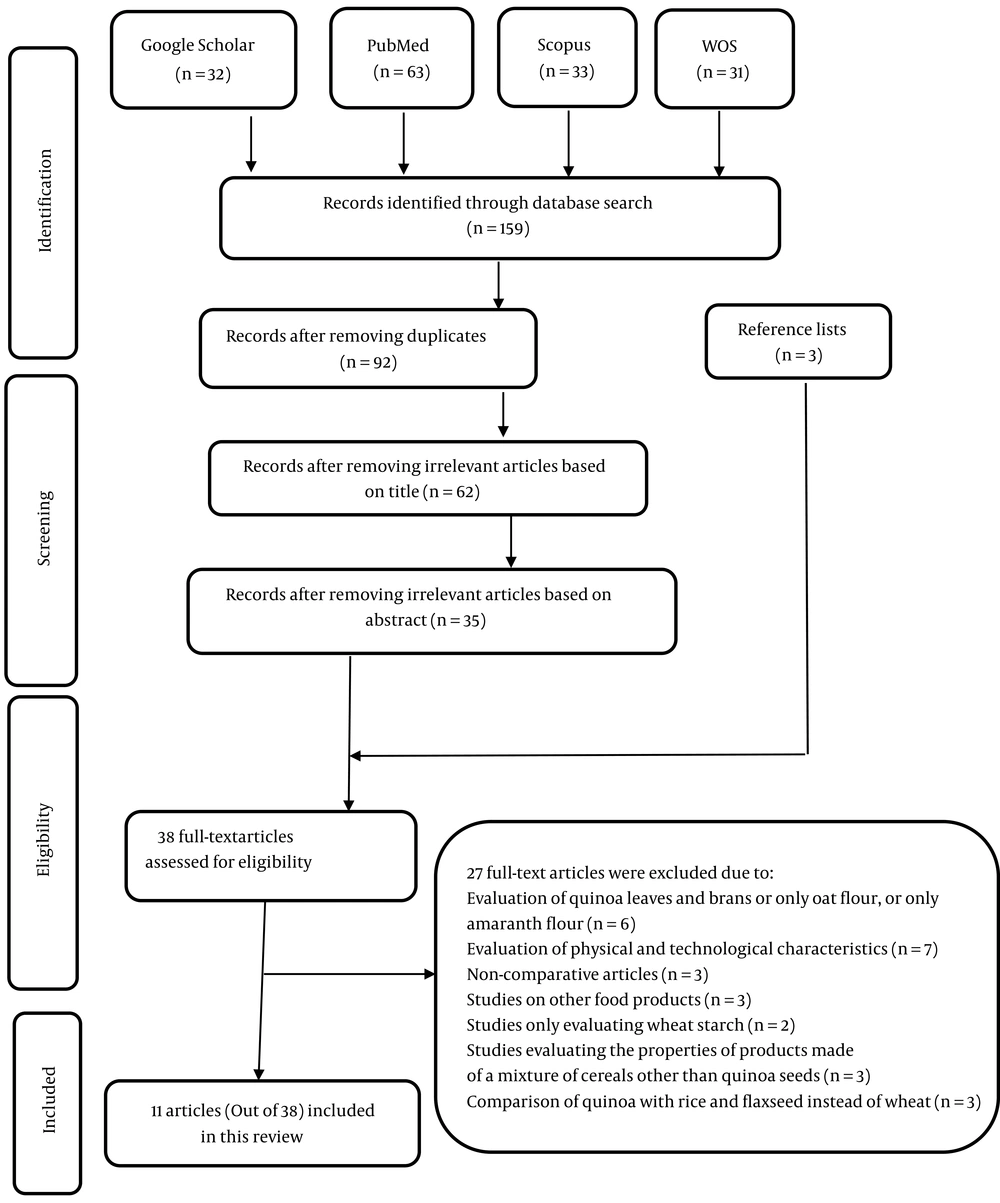
Figure 1.
The flow diagram of the literature search and selection criteria adapted from the preferred reporting items for systematic reviews and meta-analyses (PRISMA)
3.2. Characteristics of Included Studies
The characteristics of the included studies are presented in Table 1. The majority of studies were experimental (n = 10), with one study designed as a randomized controlled trial (RCT) and a crossover study (15). Four studies were conducted in Spain (16-19), two in Italy (20, 21), and one in China (22), Egypt (23), Iran (24), Poland/Ukraine (25), and the United Kingdom (15). The percentage of quinoa added to bread was 5% to 100% in different studies. One in vitro study used bread with 100% quinoa flour (21), one added 50% quinoa flour (16), four studies added 25% quinoa flour (16-19), two studies added 20% quinoa flour (15, 23), and other studies added less than 20% quinoa flour (22, 24, 25).
Table 1.The Characteristics of Evaluated Studies on the Addition of Quinoa to Wheat Bread in This Systematic Review
| First Author (y) | Country | Study Design | Percentage of Added Quinoa; No. (%) | Comparable Product |
|---|---|---|---|---|
| Berti et al. (2004) (20) | Italy | Experimental (in vivo) | ND* | White wheat bread |
| Wolter et al. (2013) (21) | Italy | Experimental (in vitro) | 100 | Wheat bread |
| Iglesias-Puiga et al. (2015) (16) | Spain | Comparative experimental | 25 and 50 | Wheat bread |
| Laparra and Haros (2016) (18) | Spain | Controlled experimental | 25 | Wheat bread |
| Laparra and Haros (2018) (19) | Spain | Experimental | 25 | Wheat bread |
| Li et al. (2018) (15) | United Kingdom | RCT-crossover | 20 | Wheat bread |
| Nasehi et al. (2018) (24) | Iran | Experimental | 9.10 | Wheat bread |
| Xu et al. (2019) (22) | China | Experimental | 5, 10 and 15 | Wheat bread |
| Ballester-Sánchez et al. (2019) (17) | Spain | Experimental | 25 | Wheat flour |
| Kurek and Sokolova (2020) (25) | Poland and Ukraine | Experimental | 5.41 | Wheat flour |
| El-Said et al. (2021) (23) | Egypt | Experimental | 20 | Wheat flour |
Abbreviation: ND, not determined.
3.3. Nutritional and Biochemical Properties
The nutritional properties of bread, such as protein, fat, and fiber contents, antioxidant activity, and GI, are shown in detail in Table 2. Five studies reported the protein, fat, and fiber contents of quinoa-wheat bread compared to wheat bread (15, 16, 23-25). Three studies (16, 23, 25) reported higher protein, fat, and fiber content in quinoa-wheat bread compared to wheat bread. However, in the study by Nasehi et al., the fiber content was not significantly different between different types of bread (24). Also, in the study by Iglesias-Puig et al., the protein content, unlike the fiber content, was not significantly higher in quinoa bread compared to wheat bread (16).
The micronutrient content of bread was reported in four studies (16, 18, 23, 24). The iron (23, 24), calcium (23, 24), copper (24), and magnesium (24) contents were significantly higher in quinoa-wheat bread as compared to wheat bread. Moreover, the main antioxidant activity indices were defined as total phenolic content (TPC) and total antioxidant activity in relevant studies. Other indices included radical scavenging capacity, α-diphenyl-β-picrylhydrazyl (DPPH) free radical scavenging method, hydroxyl radical (HO•) scavenging capacity, extractable polyphenol fraction (EPF), hydrolyzable polyphenol fraction (HPF). Both total polyphenolic content and total antioxidant activity were higher in quinoa-added bread (15, 17, 22).
On the other hand, the GI findings were found to be controversial. Among the included studies, five reported the GI results (19-23), two reported the carbohydrate content (15, 25), and one assessed the postprandial blood glucose after the consumption of quinoa-wheat bread compared to wheat bread (15). Three studies found that quinoa-wheat bread had a similar or higher GI compared to wheat bread (19-21). Two studies reported decreased GI by incorporating quinoa compared to wheat bread (22, 23), while one study reported a reduction in postprandial blood glucose after quinoa consumption (15).
Table 2.The Protein, Fat, Micronutrient, and Fiber Contents, Antioxidant Activity, and Glycemic Index (GI) of Quinoa-Wheat Bread in Comparison to Quinoa-Free Bread a
| Authors (y) | Protein Content g/100 g | Fat Content g/100 g | Micronutrient Content mg/100 g | Antioxidant Activity | Fiber Content g/100 g | Glycemic Index (GI) and Carbohydrate Content | Conclusions and Recommendations |
|---|---|---|---|---|---|---|---|
| Berti et al. (2004) (20) | ND | ND | ND | ND | ND | 186 (100) | Quinoa bread had a higher GI with a 50-g carbohydrate content. |
| Wolter et al. (2013) (21) | ND | ND | ND | ND | ND | 95 ± 2 (100) | There was no significant difference in terms of GI between quinoa-wheat bread and wheat bread. |
| Iglesias-Puiga et al. (2015) (16) | 25% Quinoa: 12.31 ± 0.01 50% Quinoa: 12.24 ± 0.02 (13.60 ± 0.00) | 25% Quinoa: 1.04 ± 0.02 50% Quinoa: 1.90 ± 0.03 (0.86 ± 0.02) g/100 g | Ca content: 25% Quinoa: 40.5 ± 0.7 50% Quinoa: 128.2 ± 0.8 (35.0 ± 0.8) Fe content: 25% Quinoa: 2.5 ± 0.1 50% Quinoa: 3.4 ± 0.0 (1.7 ± 0.1) Zn content: 25% Quinoa: 2.7 ± 0.1 50% Quinoa: 4.8 ± 0.2 (2.3 ± 0.8) | ND | 25% Quinoa: 6.3 ± 0.1 50% Quinoa: 7.2 ± 0.2 (5.5 ± 0.2) | ND | Protein, lipid, total fiber, and Fe contents were significantly different between 25% and 50% quinoa bread and the control bread. The Ca and Zn contents were not significantly different between the control and 25% quinoa bread, while a significant difference was found between 50% quinoa bread and the control. |
| Laparra and Haros (2016) (18) | ND | ND | Fe content (µmol/g): 0.61 ± 0.01 (0.67 ± 0.03) | ND | ND | ND | No significant difference was found regarding the iron content. |
| Laparra and Haros (2018) (19) | ND | ND | ND | ND | ND | 97.3 ± 2.6 (Whole wheat flour: 88.9 ± 4.0) (White wheat bread: 97.2 ± 4.1 ( | The GI was significantly higher in quinoa-wheat bread compared to whole wheat bread, but there was no significant difference between the quinoa-wheat bread and white wheat bread. |
| Li et al. (2018) (15) | 14.04 (12.63) | 2.73 (1.66) | ND | TPC: 1.11 mg GAE/g (0.77) | 6.52 (3.60) | Carbohydrate content: 72.64 (77.05) Significantly lower postprandial blood glucose at 105, 120, and 135 minutes after quinoa consumption | The protein, lipid, total fiber, and total phenolic contents increased by adding quinoa, while the postprandial glucose level decreased. |
| Nasehi et al. (2018) (24) | ND | ND | Fe content: 4.62 ± 0.03 (4.24 ± 0.03) Zn content: 9.50 ± 0.04 (2.42 ± 0.02) Ca content: 44.22 ± 0.05 (34.36 ± 0.04) Cu content: 12.61 ± 0.05 (2.24 ± 0.06) Mn content: 7.80 ± 0.0 (3.36 ± 0.3) | ND | No significant difference (P >: 0.05) | ND | The micronutrient content was higher in quinoa bread compared to wheat bread. |
| Xu et al. (2019) (22) | ND | ND | ND | TPC (mg GAE/g) 15% Quinoa: 1.01 (0.63) | ND | 5% Quinoa: 88.99 ± 0.83 10% Quinoa: 83.84 ± 1.19 15% Quinoa: 79.05 ± 0.31 (94.40) | The eGI decreased, while the antioxidant activity significantly increased by increasing the quinoa percentage of bread (P < 0.05). |
| Ballester-Sánchez et al. (2019) (17) | ND | ND | ND | A significantly higher phenolic content of black quinoa (1.3 folds) (P < 0.01) Total antioxidant activity: White quinoa: 20.70 ± 0.26 Red quinoa: 24.12 ± 2.99 Black quinoa: 23.43 ± 0.12 (18.93 ± 0.24) | ND | ND | The phenolic content of black quinoa and the antioxidant activity of red and black quinoa were significantly higher than wheat bread. |
| Kurek and Sokolova (2020) (25) | 14.1 (9.1) | 6.1 (1.9) | ND | ND | 7.1 (2.9) | Carbohydrate content: 64.2 (68.2) | The protein, lipid, and fiber contents were higher in optimized quinoa bread compared to wheat bread. |
| El-Said et al. (2021) (23) | 15.05 ± 0.01 (12.92 ± 0.01) | 2.42 ± 0.03 (1.41 ± 0.00) | Fe content: 1.71 (1.07) Zn content: 1.02 (0.74) Ca: 8.82 (7.41) | ND | 1.80 ± 0.02 (0.71 ± 0.01) | 78.72 ± 0.03 (83.38 ± 0.01) | The protein content, fat content, fiber content, and all minerals were significantly higher in quinoa-wheat bread, while the carbohydrate content was significantly lower. |
Abbreviations: Zn, zinc; Ca, calcium; Fe, iron; Cu, copper; Mn, magnesium; eGI, estimated glycemic index; mg GAE, mg of gallic acid equivalents, ND, Not determined; TPC, total phenolic content.
a Quinoa-wheat bread (control bread)
4. Discussion
In the present study, we reviewed 11 articles comparing the nutritional value of quinoa-wheat bread with wheat bread. The results revealed that the addition of different amounts of this pseudocereal to wheat bread increased the protein, fat, fiber, and micronutrient contents of the bread and improved its antioxidant capacity; however, the GI findings were not conclusive.
4.1. Nutritional Value
Nearly all reviewed studies reported the higher protein content of quinoa-wheat bread compared to wheat bread. Quinoa is known to have an excellent protein content owing to the balanced presence of essential amino acids (EAAs), which are needed for growth and maintenance of development, in addition to adequate bioavailability (26). Therefore, enrichment of bread, as a staple food, with quinoa can provide a high-quality protein source to meet daily requirements. Lysine, histidine, and methionine, as the main limiting amino acids in typical cereals, are notably abundant in quinoa protein (26). Besides, quinoa contains more EAAs than wheat (27). According to the Food and Agriculture Organization (FAO)/World Health Organization (WHO) recommendations, quinoa can meet more than 150% of schoolchildren's daily requirements and more than 200% of adults’ daily requirements for EAAs due to the absence of EAA deficiency (12).
In the present study, all reviewed articles, except one, reported a higher fiber content in quinoa-wheat bread compared to wheat bread (24). The conflicting results are not related to the percentage of added fiber since the article with the lowest quinoa content (5%) reported a higher fiber content in quinoa bread in comparison to wheat bread (25). The 2015 - 2020 Dietary Guidelines for Americans identified fiber as a significant nutrient that should be taken into consideration due to its public health importance (28). Evidence suggests that low-fiber Western diets increase the risk of chronic diseases, inflammation, and other health problems, mainly by raising the risk of colonic microbiota dysbiosis associated with disorders of the immune, cardiometabolic, and energy regulatory systems (29). Moreover, a higher fiber content increases satiety and improves weight control (30). According to a previous report, the usual fiber intake has recently decreased to about half the recommended level (29). Generally, quinoa seed has a total dietary fiber content of 7 - 10%. Although it may have a similar content to other cereals, the structure of its monosaccharide subunits mostly resembles that of fruits, vegetables, and legumes (31).
In all four studies examining the fat content of quinoa bread, it was found that quinoa has a higher fat content than wheat bread. Compared to wheat which has a moderate lipid content (2.5 g/100 g of edible part), quinoa is assumed to have a higher average lipid composition (6.1 g/100 g), making it a suitable oilseed crop alternative (31). Quinoa is also high in vitamin E, essential fatty acids (e.g., linoleic acid), and polyunsaturated fatty acids, all of which are associated with a reduction in the risk of cardiovascular diseases (14). The majority of fatty acids in quinoa are monounsaturated (27%) and polyunsaturated (55%), whereas saturated fatty acids comprise only 12% of all fatty acids. The total unsaturated fatty acid content of quinoa seeds is estimated at 82%, which is comparable to that of yellow maize grain (73%); it is also 1.5 times greater than that of durum wheat (31).
In this regard, Song et al. administered different amounts of quinoa in a high-fat diet to rats to assess their effects on nonalcoholic fatty liver disease. They concluded that both lower and higher quantities of quinoa could effectively regulate the lipid profile, control the body weight, and mitigate oxidative stress; besides, a high quantity of quinoa upregulated genes related to lipid metabolism (32). Moreover, in a study by Li et al. , after four weeks of quinoa bread consumption, the level of low-density lipoprotein-cholesterol (LDL-C) was found to be significantly lower than the baseline; however, there was no significant difference between the quinoa and control groups (15).
Evidence suggests the efficacy of a low-GI diet in protecting against non-communicable diseases, such as type 2 diabetes, coronary heart disease, and colorectal, breast, and bladder cancers, all of which are positively correlated with the dietary GI (33). Two of the evaluated studies measured the carbohydrate content of bread, both reporting the lower carbohydrate content of quinoa-added bread (15, 25). Despite the lower carbohydrate content and higher protein and fiber content of quinoa bread, the GI results were inconclusive. In this regard, a systematic review and meta-analysis showed that gluten-free bread, including quinoa bread, generally has a high GI, regardless of the formula (34). According to some previous studies, using resistant starches and fructans, as well as ingredients with higher dietary fiber and protein contents, may reduce the GI of bread (34).
Among all evaluated studies, there was only one RCT in accordance with our study objectives, where postprandial blood glucose was significantly lower at 105, 120, and 135 minutes after the consumption of quinoa bread (15). Future RCTs can better determine the effects of quinoa on blood glucose. Except for the study by Lappara and Haros (18), all three other studies comparing the micronutrient contents of quinoa and wheat bread reported higher amounts of minerals, including calcium, zinc, magnesium, copper, and iron, in quinoa-wheat bread. Generally, minerals are essential elements, as they are not synthesized in the human body; therefore, bread with a higher mineral content can better provide the recommended daily intake. Moreover, the bioavailable forms of calcium, magnesium, and potassium in quinoa are considered to be sufficient for a balanced diet (31).
The United States Department of Agriculture (USDA) National Nutrient Database shows that quinoa has a higher total mineral content than wheat (2.4% vs. 1.8%) (35). In our literature review, studies reported the higher antioxidant capacity and TPC of quinoa-wheat bread in comparison to wheat bread. Some of the many health benefits of quinoa include the inhibition of oxidases, termination of radical chain reactions, stabilization of free radicals, and acting as reducers. They may also scavenge free radicals and chelate metal ions, which are cofactors of enzymes initiating oxidative processes (31). Additionally, they exhibit various biological effects, including anti-inflammatory, anti-cancer, antidiabetic, anti-obesity, and cardioprotective effects (36).
In the study by Xu et al., despite the reduced antioxidant properties of bread compared to dough, the addition of quinoa improved the antioxidant activity of bread compared to whole wheat bread (22). Moreover, in the study by Li et al., the phenolic content increased by adding quinoa to bread; however, the plasma antioxidant capacity was not affected (15). The polyphenol content of red and black quinoa was almost twice as high as wheat; its antioxidant activity was also higher than wheat (up to 4.7 times) (17). Overall, due to the increased ability to scavenge free radicals, quinoa-wheat bread is predicted to have health-promoting benefits in preventing degenerative and non-communicable diseases.
4.2. Economic and Contextual Considerations
The FAO has introduced quinoa as one of the crops that can provide food security in the 21st century (37). Despite the mentioned nutritional values, quinoa did not receive particular attention until two decades ago when it was found that quinoa is resistant to different ecological conditions. The adaptability of quinoa grabbed the attention of countries with hot and arid climates at risk of water crisis, such as Italy, Greece, Spain, Morocco, and Egypt (38).
Salinity tolerance can be regarded as a practical criterion for selecting salt-resistant crops, as it is a heritable characteristic of polygenic traits linked to a complicated genetic background (39). A study conducted in Egypt on the economic aspects of quinoa cultivation introduced it as a vital crop supplement for wheat. It could bridge the food gap in Egypt due to its potential cultivation in desert areas, requiring only small amounts of frost and rainwater (40). Generally, quinoa is a cost-effective crop with more advantages than costs; the return on investment is roughly estimated at 1.19 pounds. Besides, it has a positive impact on domestic income due to the growth of added net value (40). Another economic benefit of reliance on quinoa is reducing the cost of importing wheat abroad. Concerning the mentioned issues, quinoa should be cultivated in countries with low rainfall rates and drought, such as Iran.
On the other hand, pseudocereals can be potentially used in the bakery industry. However, they cannot replace main cereals, as they consist of substances that are responsible for the unfavorable organoleptic and technical properties of foods (41). The undesirable components of anti-nutritional factors, such as saponins that cause a bitter flavor in food may be eliminated by processing. Other anti-nutritional compounds of seeds include phytates, tannins, and protease inhibitors (42). Finally, quinoa-wheat bread should be culturally acceptable in a population before being introduced. Overall, appearance (shape, crust color, nuance, brightness, and uniformity), crust texture, crumb texture, aroma/odor of crust and crumb, and aroma/taste of crust and crumb are the main characteristics of bread, which make it acceptable to a population.
4.3. Limitations and Recommendations
This study had some limitations. First, bread undergoes different baking processes, using different ingredients and different quantities of bran, which were not addressed in some of the included studies. Second, only English papers were included in this review because quinoa is native to Latin countries, and articles published in the Latin language and in local journals are not easily or fully accessible. It is recommended to conduct further RCTs and longitudinal studies to assess the effects of quinoa on health and diseases. Finally, the cost benefits, as well as the advantages and disadvantages of adding quinoa to bread, should be considered in future studies.
4.4. Conclusions
Based on the results, the addition of quinoa to bread could promote the health benefits of bread by increasing the protein, lipid, fiber, and micronutrient contents.

