
1. Background
The number of therapeutic and diagnostic interventions done outside the operating room has increased in recent years. Issues such as sedation and inertia are especially needed to succeed in these procedures (1). Sedation has always been a critical part of endoscopy. The goal of sedation in endoscopy is to increase patient comfort, improve the procedure, and increase patient satisfaction (2). Many drugs are used alone or in combination to induce sedation during endoscopic procedures or outpatient interventions, including benzodiazepines with or without opiate and alpha-2 adrenoceptor agonists (such as dexmedetomidine, propofol, and ketamine) (3, 4). Midazolam is a hydrochloric acid benzodiazepine with a central nervous system (CNS) suppressant effect, whose effect is CNS dose-dependent (5). Midazolam is frequently used for sedation. This drug has an immediate effect on onset and recovery (6). Using high doses causes sedation and severe sleepiness (7). Dexmedetomidine is a selective agonist for alpha-2 adrenoceptors with sedation, anti-anxiety, and analgesic effects (8-10). Therefore, this drug has the least effect on patient’s respiration; it has been used as a sedative drug in intensive care units (ICUs) (11-13). The sedation, anti-anxiety, and anti-hypertensive effects of dexmedetomidine are induced by central stimulation of alpha-2 adrenoceptors and type I imidazoline receptors (5, 14-). The analgesic effects of dexmedetomidine have been reportedly attributed to the activation of alpha-2B adrenoceptors in the posterior horn of the spinal cord and an inhibitory effect on the release of the P compound (5, 17). In adults, the administration of dexmedetomidine begins with an initial increase in blood pressure and reflex bradycardia and continues with a lower blood pressure and heart rate lower than the initial state (18, 19).
2. Objectives
The present study aimed to compare the sedation, analgesic, and hemodynamic effects of dexmedetomidine and midazolam, as well as the occurrence of nausea and vomiting, between patients undergoing gastrointestinal endosonography outside the operating room. The main objective was to reach a new combination of these drugs to induce a greater level of relaxation in those patients outside the operating room.
3. Methods
After obtaining approval from the Ethics Committee of Jundishapur University of Medical Sciences, Ahvaz (code: IR.AJUMS.REC.1398.002), 126 patients (age range, 18 - 65 years old) admitted to the Endoscopy Ward of Imam Khomeini Hospital, Ahvaz, Iran, from April 2015 to March 2016 as candidates of gastrointestinal endosonography process were selected according to the classification of American Society of Anesthesiologists (ASA) physical status I - II as the inclusion criteria. This study was also registered on the Iranian Registry of Clinical Trials website (code: IRCT20190417043295N1). In this randomized, double-blind clinical trial, a total of 126 patients were randomly divided into 2 groups (n = 63 in each group) using odd and even numbers according to the number of the medical record.
At the beginning of the patients’ admission, written informed consent was obtained prior to their participation in the study, and data were collected from patients’ medical records. The exclusion criteria were patients with drug allergy, age less than 18 or over 65 years old, renal or hepatic failure, chronic pain syndromes, unwillingness to participate in the study, cardiovascular diseases, respiratory, metabolic, and neurological disorders, difficulties in the airway, ASA physical status III or IV, and contraindication of dexmedetomidine, midazolam, propofol, or fentanyl. After connecting the monitoring facilities to the patients in both groups, vital signs, including systolic and diastolic blood pressure, heart rate, and oxygen saturation (SpO2), were measured and recorded in the form of information. Then, systolic and diastolic blood pressure, heart rate, apnea, and arterial oxygen saturation (SaO2) were measured from this time to the end of the procedure every 5 minutes.
In the dexmedetomidine group, 1 μg/kg infusion of dexmedetomidine (Hospira Co, America) for 20 minutes and 0.5 mg/kg of propofol (Dongkook Co, South Korea) in a single dose with fentanyl (Caspian Co, Iran) at a dose of 1 μg/kg were administered before starting the procedure. In the midazolam group, 0.33 mg/kg of midazolam (Exir Co, Iran) and 0.5 mg/kg of propofol (Dongkook Co, South Korea) in a single dose with fentanyl (Caspian Co, Iran) at a dose of 1 μg/kg were injected before starting the procedure.
To make the study double-blind, the patient’s degree of relaxation according to the Ramsay Sedation Scale (RSS) was recorded during the procedure by another trained person who did not know the prescribing drugs. Regarding the RSS scores, 4 or 5 was the desirable tranquilizer, and a score below 4 was considered inadequate sedation (necessary to administer additional doses of propofol). If inadequate patient sedation was seen, a dose of 0.5 mg/kg of bolus propofol was prescribed, and, if necessary, this dose was repeated every 60 seconds.
3.1. Ramsay Sedation Scale
(1) Completely awake and anxious.
(2) Quiet and calm with enough cooperation.
(3) Sleeps and wakes up with a language command.
(4) Sleeping and waking up with mild excitement but heavily responds to painful stimuli.
(5) Slow reaction to painful stimuli.
(6) No response to painful stimuli (20).
Four ranking scores evaluated patients’ pain during the procedure based on the patient’s response to the (Ambesh score) questions:
(1) Painless: Negative answer to questions about pain.
(2) Mild: A positive response to questions about pain, but without any apparent symptoms.
(3) Moderate: Positive answer to questions about pain and the appearance of symptoms or complaints of pain.
Severe: The patient complains of pain with frown or discomfort or by hand or fear. A score of more than 1 was considered pain, and a score of 1 was considered a lack of pain (21). Nausea and vomiting were recorded from the end of the procedure until the patient was discharged from the recovery room. As nausea is a symptom expressed by the person himself, the Visual Analogue Scale (VAS) was used to measure and evaluate nausea. The scale is scored from 0 (no nausea) to 10 (severe nausea). The patient was asked to show the severity of her nausea between 0 and 10 (0, no nausea; 1 to 3, mild nausea; 4 to 7, moderate nausea; 8 to 10, severe nausea) (22).
Given the ethical considerations, if a patient complained of moderate or severe nausea and vomiting due to 0.1 to 0.15 mg per kg of body weight of ondansetron, it was reduced to a maximum of 4 mg (23).
From the time the procedure was completed until the patient’s alertness and appropriate response to the questions, recovery was considered (every 30 seconds of recovery was investigated). A duration of less than 5 minutes was a fast recovery, between 5 - 10 minutes was an average recovery, and more than 10 minutes was a slow recovery (24).
SPSS version 20 (SPSS Inc, Chicago, IL, USA) was used to analyze the data. Mean and SD were used in quantitative variables to describe the data, and frequency and percentage were used for qualitative variables. The Mann-Whitney U test, t-test, or repeated measures test were used to compare the quantitative data between the 2 groups. The chi-square test was used to analyze the qualitative data.
4. Results
In the dexmedetomidine group, 46% were men and 54% were women. In the midazolam group, 47.6% were men and 52.4% were women. The chi-square test was used to compare the 2 groups, and the level of significance was 0.85, indicating no significant difference between the groups. In addition, age, weight, height, duration of anesthesia, and procedure time were compared between the 2 groups using the t-test; there was no significant difference between the 2 groups (P > 0.05; Table 1). The chi-square test was used to compare the recovery time. A significant level of 0.26 was obtained that showed no significant difference between all groups according to the duration of recovery, and they were fully alert. The 2 groups were statistically similar. In addition, the number of patients requiring propofol injection during the procedure to maintain calmness was statistically significant between the 2 groups, and 8 patients in the dexmedetomidine group and 34 in the midazolam group received propofol (Table 1).
Table 1.
Comparison of Demographic and Clinical Information of Patients During the Operation
| Variables | Dexmedetomidine (N = 63) (%) | Midazolam (N = 63) (%) | P-Value |
|---|---|---|---|
| Age (y) | 52.46 ± 62.16 | 51.76 ± 12.05 | 0.29 |
| Gender | 0.85 | ||
| Female | 34 (54) | 33 (52.4) | |
| Male | 29 (46) | 30 (47.6) | |
| Weight (kg) | 68.81 ± 11.78 | 70.13 ± 9.01 | 0.48 |
| Height (cm) | 169.23 ± 16.42 | 173.31 ± 17.54 | 0.59 |
| Duration of anesthesia | 24.83 ± 5.87 | 25.62 ± 5.20 | 0.42 |
| Duration of procedure | 20.94 ± 5.29 | 21.67 ± 5.10 | 0.43 |
| Duration of recovery (min) | 0.26 | ||
| < 5 | 26 (41.3) | 34 (54) | |
| 5 - 10 | 34 (54) | 28 (44.4) | |
| > 10 | 3 (4.7) | 1 (1.6) | |
| Received propofol | 8 (12.70) | 34 (54) | 0.002 |
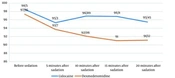
The studied hemodynamic variables were arterial pressure, heart rate, and SaO2. Mean arterial pressure (MAP) changes in the 2 groups were examined at 4 different times (Table 2). The t-test was used to compare the mean arterial blood pressure between the 2 groups at different times. Mean arterial pressure at all times was similar between the groups, and there were no statistically significant differences between the 2 groups (P > 0.05). A comparison of heart rate values showed no significant differences between the 2 groups at different times, and heart rate changes were similar in the 2 groups (P > 0.05). The t test was used to compare SaO2 between the 2 groups at different times. The 2 groups showed no significant difference in the levels of SaO2 before starting the procedure and 10 and 15 minutes after the start of the procedure (P > 0.05). Arterial oxygen saturation was only significantly different 5 minutes after the start of the procedure between the 2 groups; thus, the dexmedetomidine group showed a significantly higher value than the midazolam group (P < 0.05).
Table 2.
Comparison of the Hemodynamic Status Before and During the Procedure Between the 2 Groups
| Variables | Dexmedetomidine (N = 63) | Midazolam (N = 63) | P-Value |
|---|---|---|---|
| MAP | |||
| Before the procedure | 106.56 ± 15.55 | 108.43 ± 13.70 | 0.47 |
| 5 min | 103.03 ± 14.14 | 97.10 ± 10.22 | 0.80 |
| 10 min | 101.14 ± 13.13 | 93.43 ± 9.26 | 0.14 |
| 15 min | 99.71 ± 12.70 | 91.76 ± 8.49 | 0.31 |
| Heart rate | |||
| Before the procedure | 89.75 ± 14.35 | 92.90 ± 15.56 | 0.12 |
| 5 min | 83.97 ± 15.41 | 83.21 ± 15.42 | 0.78 |
| 10 min | 83.46 ± 13.25 | 80.08 ± 13.65 | 0.16 |
| 15 min | 82.83 ± 13.37 | 78.73 ± 12.19 | 0.07 |
| SpO2 | |||
| Before the procedure | 98.60 ± 0.66 | 98.65 ± 0.70 | 0.69 |
| 5 min | 98.24 ± 1.38 | 97.08 ± 2.74 | 0.02 |
| 10 min | 98.17 ± 1.41 | 98.95 ± 1.64 | 0.41 |
| 15 min | 98.27 ± 1.36 | 98.17 ± 1.35 | 0.69 |
Abbreviations: MAP, mean arterial pressure; SpO2, oxygen saturation.
The pain scores reported by the patients during the procedure were compared between the 2 groups (Table 3). None of the patients had moderate to severe levels of pain. In the dexmedetomidine group, 62 patients had no pain at all, and only 1 patient had mild pain. In the midazolam group, 61 patients had no pain at all, and only 2 patients had mild pain. No significant differences were found in pain between the 2 groups (P > 0.05).
Table 3.
Comparison of Complications During and After the Procedure between the 2 Groups and Satisfaction of Patients and Endoscopic Specialist
| Variables | Dexmedetomidine (N = 63) (%) | Midazolam (N = 63) (%) | P-Value |
|---|---|---|---|
| Pain | 0.79 | ||
| Painless | 62 (98.4) | 61 (96.8) | |
| Mild | 1 (1.6) | 2 (3.2) | |
| Moderate | 0 | 0 | |
| Severe | 0 | 0 | |
| Nausea | 0.58 | ||
| No | 44 (70) | 40 (63.5) | |
| Mild | 12 (19) | 15 (23.8) | |
| Moderate | 4 (6.3) | 6 (9.5) | |
| Severe | 3 (4.7) | 2 (3.2) | |
| Vomit | 2 (3.2) | 1 (1.6) | 0.55 |
| Apnea | 0 | 0 | - |
| Patient satisfaction | 8.05 ± 1.26 | 7.89 ± 1.39 | 0.74 |
| Endoscopic specialist satisfaction | 8.11 ± 1.42 | 7.03 ± 1.18 | 0.04 |
The complications examined in the study were nausea, vomiting, and apnea during the procedure. Our results showed that 30% of patients in the dexmedetomidine group and 36.5% of patients in the midazolam group experienced nausea during the study; these were statistically significant between the groups, with no significant differences (P = 0.58). In both groups, there were only 2 cases with dyspnea (1 case in each group), and we had no apnea cases in both groups. Regarding the occurrence of these complications, there was no difference between the 2 groups (P > 0.05). Patients’ and endoscopy specialists’ satisfaction levels were compared; in the dexmedetomidine group, patients had more satisfaction with the endoscopic procedure (P = 0.04; Table 2).
Furthermore, 87.3% of the patients in the dexmedetomidine group had a sedation level of 5 and 6 (which is a desirable sedation rate), but in the midazolam group, 46% of the patients had proper sedation, and the difference between the 2 groups was statistically significant. The dexmedetomidine group had better sedation during the procedure than the midazolam group (P < 0.05).
5. Discussion
Endoscopic techniques have a critical and significant role in the diagnosis and treatment of diseases. As this procedure is done orally using an endoscope, it can be very painful and, to some extent, impossible in many patients without the use of sedative and analgesic drugs. To prevent coughing, gag reflex, nausea, and vomiting, sedative medications are recommended for the patient (6, 25). Accordingly, we tried to compare the effects of dexmedetomidine and midazolam on patients undergoing gastrointestinal endosurgery to find a more appropriate drug combination for the relaxation of patients outside the operating room.
The results showed that the dexmedetomidine group had a better degree of relaxation during the procedure than the midazolam group, and SpO2 was higher in arterial blood 5 minutes after the start of the procedure. Wu et al. obtained a similar result in patients undergoing endoscopy of the upper gastrointestinal tract, showing better sedation and higher blood saturation. It seems that higher levels of blood saturation in these studies can be related to the difference in the effect of these 2 drugs on the respiratory system of patients (20). Moreover, previous studies have shown that dexmedetomidine is highly reluctant to bind to alpha-2 adrenoceptors and is very close to γ-aminobutyric acid (GABA) receptors. Dexmedetomidine is more protective in avoiding decreased blood saturation compared to benzodiazepines (such as midazolam), but midazolam is more protective in respiratory depression compared to dexmedetomidine (26, 27). Contrary to the results of the study, Kilic et al. showed that dexmedetomidine and midazolam provide a similar relaxation effect during endoscopic retrograde cholangiopancreatography (ERCP), showing no difference between the groups. In their study, they used dexmedetomidine and midazolam to reach proper maintenance and sedation levels, but in our study, we used dexmedetomidine and midazolam only at the onset of ossification. In addition, if needed, we used propofol very short duration of action; thus, we were able to prevent prolonged recovery time in the midazolam group; however, in the study by Kilic et al., patients in the midazolam group experienced a significantly longer recovery time. Furthermore, they observed a significant decrease in heart rate in the dexmedetomidine group. Nevertheless, in the study, it seems that the long-term use of dexmedetomidine led to a significant reduction in heart rate (28). In a long-term study of ICU patients, Riker et al. indicated that bradycardia was more frequent in the dexmedetomidine group (42.2%) than in the midazolam group (18%) (29).
Delmade and Parikh conducted a prospective study on patients referred to the ear, nose, and throat (ENT) service. They used anxiolytic anesthetic monitoring of dexmedetomidine and midazolam alone, showing no difference in the degree of relaxation between the groups in contrast to our study (30). Upper gastrointestinal endoscopy is a common procedure, which may have an unpleasant and painful experience for patients. In some previous studies, only local anesthesia was used to reduce the cost and risk of sedation, which was not likely to be tolerated by patients and caused dissatisfaction among patients and endoscopic specialists (31, 32). In new methods, sedative drugs (such as propofol, midazolam, and dexmedetomidine) are used to calm down during different procedures, and it is recommended to use medications with fewer side effects for sedation in the endoscopy producer. Our results showed no differences between the 2 groups in terms of pain. Peng et al. (33) found no significant differences in pain during and after surgery in a similar study in patients undergoing lumbar disc surgery using sedation. In the present study, we used the same amount of fentanyl for the 2 groups at the beginning of the study because of the short duration of the procedure. We used propofol during the procedure to maintain sedation, and the amount of propofol needed was significantly lower in the dexmedetomidine group than in the midazolam group. However, if there was a need for long surgery, fentanyl was used to control pain during and after surgery.
The non-significance of the pain score can be justified due to receiving fentanyl in both groups. Receiving dexmedetomidine even intradermally reduces anxiety by affecting the locus coeruleus region of the CNS (12, 33).
In conclusion, in the studies with no differences in pain, different methods (such as the administration of narcotic drugs [such as fentanyl and meperidine], administration of topical anesthetic with epinephrine, etc.) have been commonly used (30, 33). In our study, because of the short duration of the procedure and the administration of fentanyl intravenously, there was no need for re-administration of analgesic drugs during the procedure, and patients in both groups experienced similar experiences.
In the present study, at the end of the procedure, the level of satisfaction of the endoscopic expert and patients was evaluated. The level of satisfaction of the endoscopic specialist significantly decreased in the dexmedetomidine group due to less reflux stimulation and abrupt movements of the patients during the procedure due to proper relaxation. However, the satisfaction of patients in the 2 groups did not differ significantly in our study, which may be due to the anti-anxiety effects of both drugs and the lack of pain during the procedure in most patients. In a similar study, Kilic et al. reported that the use of dexmedetomidine to induce and maintain the erection of patients who were ERCP candidates favored endoscopic specialists (28). Demiraran et al. and Sethi et al. reported similar results with expert satisfaction (6, 34). In line with our study, Peng et al. reported that the satisfaction of patients with sedation was similar to that of dexmedetomidine or midazolam. Moreover, it seems that the use of fentanyl with sedation drugs (such as this study) and especially the administration of lidocaine topically in all the studied patients resulted in relative satisfaction of patients in the 2 groups, and no difference was observed between the 2 groups (33). In our study, no complications (such as apnea) were observed during and after the procedure. None of the patients experienced nausea in the 2 groups, and few patients in both groups experienced vomiting, seen between the 2 groups in terms of occurrence. There were no significant differences in any of the complications. Peng et al. witnessed the incidence of complications during and after induction of sedation. According to the results of our study, respiratory depression was not seen in any of the patients; among 120 patients studied, only 5 patients in the dexmedetomidine group and 8 patients in the midazolam group experienced nausea and vomiting; the difference was not significant (33). Kilic et al. also did not observe the incidence of vomiting and hemodynamic complications (such as bradycardia and hypotension) between the groups receiving midazolam and dexmedetomidine (28) in the treatment of patients receiving sedation for the reverse endoscopic procedure of biliary and pancreatic ducts.
5.1. Conclusions
The use of dexmedetomidine instead of midazolam is better for the patients undergoing endosonography in the gastrointestinal tract, whereas the level and occurrence of pain during the procedure and the occurrence of endoscopic complications are similar between the 2 groups.