
1. Background
Since December 18 to December 29, 2019, five patients with symptoms of acute respiratory syndrome were hospitalized Akhtar and Imam Hossein hospitals, one of whom died (1). Until January 2, 2020, the results of the coronavirus disease 2019 (COVID-19) test were positive for 41 hospitalized patients, about half of whom had diabetes, hypertension, and cardiovascular diseases (2). On January 30, the World Health Organization (WHO) declared COVID-19 pandemic a serious health hazard (3). In February, the virus spread to most parts of the world. In Iran, the first death due to the virus was reported in late February 2017 in Qom (4). WHO declared the outbreak of COVID-19 as a public health emergency of global concern (5). The fast-spreading nature of this virus and the lack of knowledge about it have increased the virus-related fears (6). Fatalities due to COVID-19 appear to be concentrated in vulnerable populations, such as the elderly and those with underlying chronic diseases (7).
Catastrophizing is a negative cognitive-emotional process that includes components of magnification, helplessness, and rumination. The degree of catastrophizing is one of the most important predictors of pain treatment outcomes and a key variable in behavioral cognition approaches and fear-avoidance model (8). An individual’s attitudes and beliefs, as well as sources and methods of coping with the pain, affect how s/he reports pain (9). Pain catastrophizing has a significant effect on pain experiences, and it is one of the small dimensions of pain adaptation with strong and lasting relationships with pain experience. The most important effect of catastrophizing on chronic pain is that patients with pain receive an assessment of pain that may make them more alert to painful or threatening feelings and fear of experiencing painful feelings in the future (10).
Fathi showed that physical and mental function is further disturbed by the expectation of pain (11). The developed bio-psychosocial view not only addresses pain complaints and the associated physical results but also many psychological symptoms that can contribute to the development of chronic pain, the persistence of pain symptoms, and response to medical treatment (8). Studies have shown that psychological variables such as attitudes, anxiety, and depression, instead of biomedical factors, should be considered both physically and psychologically. For most patients, the experience of pain is a disgusting experience. As a result, experiencing pain in the future stimulates fear, anxiety, and adaptation (12). Most studies have found that anxiety affects pain (13). It is known that the level of experienced pain is influenced by several factors, such as depression, stress, anxiety, pain catastrophizing, and insomnia. Patients are informed about the severe postoperative pain that may occur, and this may induce anxiety (14). Studies also suggest pain-related anxiety as one of the most important variables contributing to the development and persistence of pain (15).
Depression and anxiety are strongly related to each other, and often these two disorders are experienced together. Anxiety is one of the most important psychological factors in cardiovascular patients, with a prevalence of up to 50% in patients with myocardial infarction (16). In this regard, in a study found a correlation between anxiety and depression (17).
2. Objectives
In patients with COVID-19, pain catastrophizing is higher due to the unknown nature of disease and different effects it has on different people and ages, which may affect other psychological characteristics such as depression and pain anxiety. Therefore, this study was conducted to investigate the relationship between depression and pain anxiety with pain catastrophizing in patients with COVID-19.
3. Methods
In this descriptive-correlational study, we included 180 eligible COVID-19 patients hospitalized in Akhtar and Imam Hossein hospitals in Tehran, Iran from March 2019 to April 2020. The inclusion criteria were being in the age range of 25 - 75 years, being a COVID-19 case, and holding at least a high school diploma.
The Ethics Committee of Shahid Beheshti University of Medical Sciences approved the study protocol (code: IR.SBMU.RETECH.REC.1399.1355). Based on the criteria related to observance of the minimum ratio of the number of predictors and samples required for each predictor and at least 10-30 individuals per predictor, considering four predictors (rumination, helplessness, magnification, and pain catastrophizing) and two criteria (depression and pain anxiety), the sample size was considered as 180 individuals (30 for each). After explaining the title and objectives of the study to the patients, they were asked to complete an informed consent form. They were also assured that all patient information would be kept confidential. Then, all participants completed three questionnaires, including Pain Catastrophizing Scale (PCS), Pain Anxiety Symptoms Scale (PASS), and Beck’s Depression Inventory (BDI).
3.1. Pain Catastrophizing Scale
This questionnaire was developed by Sullivan et al. (18), and it assesses different dimensions of pain and the effect mechanism of catastrophizing. This 13-item scale has three subscales of rumination, magnification, and helplessness, which assess negative pain-related thoughts. The response scale is a 5-point Likert scale, where a lower score indicates less catastrophizing. The total score is obtained from adding responses given to each of 13 items between 0 and 52. In a study by Akbari et al. (19), Cronbach’s alpha was reported to be 0.65 for rumination subscale, 0.53 for magnification subscale, 0.81 for helplessness subscale, and 0.84 for the total score of the scale.
3.2. Pain Anxiety Symptoms Scale
This scale is a self-report tool for anxiety and pain-related fear reactions developed by McCracken (1992). It assesses symptoms of pain-related anxiety, including three subscales of pain relief related escape and avoidance behavior symptoms, fearful assessment of pain, and pain-related physiological anxiety symptoms (20). The brief form of this scale consists of 20 items developed by McCracken and Dhingra (21), and it is based on the 40-item main scale on pain anxiety symptoms. The range of the brief form scores is between 0 and 100, and the subjects should answer questions in a range from 0 (never) to 5 (always). A total score and three subscale scores are obtained; the total score is generally related to many aspects of patients’ performance, and three subscales are used for predicting different aspects of patients’ performance. The score ranges are as follows: avoidance (0 - 35), fearful assessment (0 - 40), physiological response (0 - 25), and total score (0 - 100).
3.3. Beck's Depression Inventory
This questionnaire was published by Khledian et al. is one of the most common tools for measuring depression. It consists of 21 four-choice questions and has an acceptable validity. The average homogeneity coefficient of was reported to be 0.86. Internal consistency coefficient was 0.78, and retest reliability was 0.73 (22). In a study, total reliability of depression using Cronbach’s alpha coefficient was reported to be 0.87 (23).
After data collection, mean, standard deviation, and frequency were used to classify and summarize the data. For data analysis, Kolmogorov-Smirnov test was used to investigate normality of data distribution. Pearson correlation coefficient was used to determine two-way correlations between variables, and regression test was used. All analyses were performed at 95% confidence level using the SPSS software version 22.
4. Results
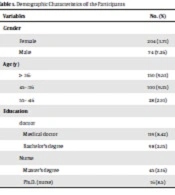
In the present study, 146 (81%) subjects were female, and 34 (21%) were male. Also, most of the subjects (n = 74; 41.1%) had a high school diploma, and 154 (85.5%) participants were married. The mean age of the subjects was 48.65 years (standard deviation: 14.5 years). Table 1 shows the descriptive statistics and two-way correlation coefficients between the research variables. The total pain catastrophizing score of patients (44.55 ± 5.45) was in the above average range (P < 0.001, t = 7.85). In addition, the total scores of pain anxiety and depression were 75.44 ± 9.45 and 72.54 ± 5.46, respectively. In addition, based on Pearson correlation coefficient, the relationship of pain anxiety and depression with pain catastrophizing was significant and positive. Also, a significant positive relationship was found between rumination, magnification, and helplessness (P < 0.001) subscales with pain anxiety and depression (P < 0.001) (Table 1)
Table 1.
Internal Consistency of Tools, Descriptive Statistics, and Interactions Between Research Variables a
| Variables | Mean ± SD | 1 | 2 | 3 | 4 | 5 |
|---|---|---|---|---|---|---|
| Rumination | 12.25 ± 4.34 | - | ||||
| Magnification | 13.64 ± 2.25 | ***0.75 | - | |||
| Helplessness | 19.58 ± 3.74 | ***0.73 | ***0.78 | - | ||
| Pain catastrophizing | 44.55 ± 5.45 | ***0.76 | ***0.79 | ***0.78 | - | |
| Pain anxiety | 75.44 ± 9.45 | ***0.35 | **0.29 | **0.32 | ***0.44 | - |
| Depression | 72.54 ± 5.46 | ***0.38 | **0.34 | **0.36 | ***0.28 | ***0.39 |
a *P < 0.05, **P < 0.01, ***P < 0.001
To investigate the capability and power of pain catastrophizing dimensions in explaining the pain anxiety and depression, two multivariate regression models were performed (Table 2).
Table 2.
Summary Results of Multivariate Regression Model to Explain Pain Anxiety and Depression Based on Pain Catastrophizing and Its Dimensions a
| Model-predictors | F | R | R2 | B (SE) | β | t |
|---|---|---|---|---|---|---|
| Model 1: Pain anxiety | **5.331 | 0.285 | 0.151 | |||
| Constant value | 3.284 (4.89) | 0.663 | ||||
| Rumination | 0.7 (0.177) | 0.286 | ***3.993 | |||
| Magnification | 0.88 (0.41) | 0.34 | ***2.14 | |||
| Helplessness | 0.42 (0.18) | 0.28 | ***2.34 | |||
| Model 2: Depression | **4.262 | 0.257 | 0.136 | |||
| Constant value | 8.592 (5.869) | 1.464 | ||||
| Rumination | 0.721 (0.212) | 0.246 | ***3.404 | |||
| Magnification | 0.94 (0.24) | 0.41 | ***2.11 | |||
| Helplessness | 5.42 (1.41) | 0.41 | ***2.68 |
a *P < 0.05, **P < 0.01, ***P < 0.001
In the first model, pain anxiety regression model based on the dimensions of pain catastrophizing was statistically significant (R² = 0.151, P < 0.001, F = 5.331), so that rumination (P < 0.001, t = 3.933, β = 0.286), magnification (P < 0.001, t = 2.14, β = 0.34), and helplessness (P < 0.001, t = 2.34, β = 0.28) were capable to predict pain anxiety and explain 15.1% of changes in pain anxiety.
In the second model, the depression regression model based on the dimensions of pain catastrophizing was statistically significant (R2 = 0.136, P < 0.001, F = 4.262), so that rumination (P < 0.001, t = 3.404, β = 0.246), magnification (P < 0.001, t = 2.11, β = 0.41) and helplessness (P < 0.001, t = 2.68, β = 0.41) were capable to predict the patients’ depression and explain 13.6% of depressive changes.
5. Discussion
This study aimed to investigate the relationship between pain depression and anxiety with pain catastrophizing in patients with COVID-19. For this purpose, two-way and multivariate relationships of depression and pain anxiety with pain catastrophizing were investigated using Pearson correlation coefficient and multivariate regression model. The study results showed a positive and significant relationship of dimensions of rumination, magnification, and helplessness with total score of pain catastrophizing, as well as moderate to severe dimensions and total pain anxiety and depression in patients with COVID-19. This means that high pain catastrophizing is associated with high pain anxiety and depression in patients with COVID-19. Then, two regression models were used to address the following questions: “Which pain catastrophizing dimensions have a greater effect on explaining the pain anxiety and depression?”
The results showed that the roles of all the three subscales of rumination, helplessness, and magnification were significant in explaining pain anxiety and pain depression. In addition, pain anxiety (15.1%) and depression (13.6%) could be explained based on rumination, magnification, and helplessness. Our results regarding the relationship between pain catastrophizing and pain anxiety were consistent with the studies by Granot and Ferber (24), Barabady et al. (25), Dehghan et al. (26), Tabriz et al. (27), and Margaretten et al. (28). For example, Granot and Ferber (24) showed that PCS could predict postoperative anxiety levels. Barabady et al. (25) also found that pain was positively associated with catastrophizing. Explaining these results, it can be said that the more severe the patient understands the pain, the higher the patient’s anxiety, fear, and worry. The high mortality rate of patients with COVID-19, along with its worldwide prevalence caused these patients to show higher catastrophizing and increased anxiety.
Our results regarding the relationship between pain catastrophizing and depression are consistent with the results of Dehghan et al. (26) and Margaretten et al. (28). Previous evidence supports that the introduction of pretreatment with melatonin or gabapentin reduces pain and disability (29).
Among the research limitations, we can mention the mental and psychological conditions of patients, that affected the response, and using a convenience sampling method.