
1. Background
On January 30, 2020, the World Health Organization (WHO) issued a statement announcing the COVID-19 outbreak as a public health emergency not only for China but also for the whole world (1). Various studies have confirmed the psychological effects of implementing control and management plans against coronavirus, quarantine conditions, observance of social distance, and fear of being infected and infecting others (2-5).
One of the most important consequences of the coronavirus outbreak is the development of social anxiety around the world. The lack of any definitive treatment or prevention and the prediction of some epidemiologists that at least 60% of the population is infected with this disease are the sources of anxiety in this regard (6). Fear and anxiety due to possible infection are destructive and can lead to mental disorders and stress in people. Long-term stress is destructive, weakens the immune system, and reduces the body’s ability to fight diseases such as COVID-19 (7).
The occupational nature of hospital staff and human relations and empathy with patients and their companions have created many responsibilities for these people, which can cause anxiety (6, 8). In a study by Huang and Zhao in 2020, anxiety was higher among healthcare workers than in others (9).
Al-Rabiaah et al. showed a high level of anxiety about the Middle East respiratory syndrome (MERS) among medical students in Saudi Arabia (10). Pappa et al. reported moderate to severe anxiety among healthcare workers during the coronavirus outbreak (11). Further, Lai et al.’s study on physicians and hospital nurses in Wuhan, China, during the COVID-19 outbreak showed that healthcare workers experienced a high degree of anxiety (12). Another study by Poon on healthcare workers in Hong Kong during the severe acute respiratory syndrome (SARS) epidemic indicated that employees had high levels of anxiety (13).
Based on the above discussion, it seems that doctors and nurses working in the COVID-19 wards continue their professional activities in the face of many stressors in the workplace. In the current high-risk situation, it seems necessary to maintain the healthcare force and keep them healthy as guardians of the health and well-being of other people in society. In this regard, measuring the level of anxiety of these people and its relationship with coping styles can be helpful as an effective step to maintain and enhance their mental health. Due to the emergence of coronavirus, there is no coherent information about the level of anxiety in children and adaptive styles in physicians and nurses.
This study was conducted to investigate the relationship between COVID-19-induced anxiety and coping styles in doctors and nurses working in the COVID-19 wards in hospitals affiliated with Kermanshah University of Medical Sciences. This study seeks to answer the question of whether there is a relationship between coronary anxiety and stress coping styles in physicians and nurses working in COVID-19 wards.
2. Objectives
The present study seeks to answer the hypothesis of a relationship between coronary artery anxiety and coping styles in physicians and nurses working in COVID-19 wards.
3. Materials
3.1. Study Design
This correlational, descriptive, cross-sectional study was conducted from February 2020 to August 2021.
3.2. Samples and Sampling Method
The study population included the medical staff (doctors, nurses) working in the COVID-19 wards of hospitals of Kermanshah University of Medical Sciences. The sample size was calculated using Cochran’s formula. From about 1050 personnel (doctors and nurses), 278 were examined based on Cochran’s formula. Sampling in this study is simple random.
The inclusion criteria were willingness to participate in the study, not being treated for psychiatric illnesses, not taking psychiatric medications, and lack of psychological events such as divorce and death of loved ones in the past three months in the COVID-19 wards. The exclusion criterion was the non-completion of questionnaires by the staff.
3.3. Research Tools
Data collection tools were a demographic information questionnaire, Corona Disease Anxiety Scale (CDAS), and Lazarus-Folkman’s Ways of Coping Questionnaire (WCQ). Demographic questionnaire in this study includes gender, age, work experience and level of education, which was completed based on the information of the samples. Lazarus (1993) as cited in Rahimian and Dasht Bozorgi reported the internal consistency of the scales from 0.66 to 0.79 for each coping skill (7). The validity and reliability of Lazarus-Folkman’s Questionnaire have also been examined in national studies. Rostami et al. reported a Cronbach’s alpha value of 0.87 for this scale (14). The WCQ (Lazarus and Folkman, 1985) consists of 66 items that vary from 0 to 3 based on the Likert scale (I do not use = 0, I use to some extent = 1, I use most of the time = 2, I use a lot = 3).
Several studies have provided clear support for the WCQ as a tool that measures both problem-oriented and emotion-oriented functions and distinguishes changes in coping with different and certain confrontations. This questionnaire evaluates 8 coping styles (seeking social support, responsibility, planful problem-solving, reappraisal, coping, distancing, avoidance, and self-control), which are ultimately divided into two general problem-oriented skills (seeking social support, responsibility, planful problem-solving, and positive reappraisal) and emotion-oriented skills (confrontative, avoidance, escape-avoidance, and self-control).
The Lazarus Coping Strategies Questionnaire is scored in both raw and relative ways. Raw scores describe the coping effort for each of the eight types of coping and the sum of the subject's responses to the constituents of the scale. Relative scores describe the proportion of effort made in each encounter. In both scoring methods, people respond to each item on a Likert-scale four-choice scale that shows the frequency of each strategy as follows: Zero “I did not use" indicator, one “I used very little" indicator, two indicators “I used to some extent" and three indicators “I used a lot". Scoring is based on a 4-point Likert scale (from 1 to 4). Achieving higher scores in each style indicates that more participants use that style, and vice versa.
The CDAS was developed and validated by Alipour et al. to measure COVID-19-induced anxiety in Iran (15). The final version of this tool has 18 items and 2 components. Items 1 to 9 measure psychological symptoms and items 10 to 18 measure physical symptoms. The reliability of this instrument by Cronbach’s alpha was obtained to be 0.87 for the first factor, 0.86 for the second factor, and 0.91 for the whole questionnaire. Its validity has also been confirmed using exploratory and confirmatory factor analyses. In this study, the reliability index by Cronbach’s alpha was 0.82. This instrument is scored on a four-point Likert range (never: 0 to always: 3), the lowest and highest scores are 0 and 54, respectively. A high score indicates a higher level of anxiety.
3.4. Data Collections Methods
After obtaining permission from the managers of Imam Reza (AS), Golestan, and Farabi hospitals, the researcher attended the research environment and explained the goals, importance, and necessity of the research after introducing himself to the staff. Then, the questionnaire was given to the participants. If desired, an informed consent form was completed for each person who met the inclusion criteria.
3.5. Data Analysis
Data were fed into SPSS-20 statistical software and analyzed by descriptive and analytical statistics. Descriptive statistics, including mean, standard deviation, frequency, and relative frequency, were used to analyze the data, and one-dimensional and two-dimensional tables were used to display the results. Kolmogorov-Smirnov test was used to evaluate the normality of the data.
Analytical statistics, including the Pearson correlation coefficient, were also used. Pearson correlation coefficient test was used to examine the relationship between coronary anxiety and components of coping styles. The significance level was set at < 0.05.
3.6. Ethical Considerations
The study was approved by the Ethics Committee of the Islamic Azad University, Kermanshah Branch, with the code IR.KUMS.REC.1400.215. Informed written consent was obtained from all participants, they were assured that their personal information would be kept confidential.
4. Results
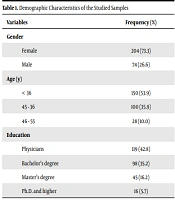
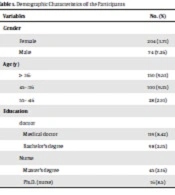
Out of 278 participants, 159 (57.1%) were nurses and 119 (42.8%) were doctors. Of them, 204 (73.3%) were female and 74 (26.6%) were male. The highest age range was < 36 years (53.9%) (n = 150). The highest educational level of nurses (16.2%, n = 98) was a bachelor’s degree (Table 1).
Table 1.
Demographic Characteristics of the Participants
| Variables | No. (%) |
|---|---|
| Gender | |
| Female | 204 (3.73) |
| Male | 74 (7.26) |
| Age (y) | |
| > 36 | 150 (9.53) |
| 45 - 36 | 100 (9.35) |
| 55 - 46 | 28 (2.10) |
| Education | |
| Doctor | |
| Medical doctor | 119 (8.42) |
| Bachelor’s degree | 98 (2.35) |
| Nurse | |
| Master’s degree | 45 (2.16) |
| Ph.D. (nurse) | 16 (8.5) |
The scores of the eight subscales of coping styles in the medical staff showed the highest score for planful problem-solving (17.9 ± 4.4) and the lowest score for the social support subscale (11.5 ± 4.1) (Table 2).
Table 2.
Mean Scores of Coping Styles Among Participants
| Coping Styles | Mean ± SD |
|---|---|
| Seeking social support | 1.4 ± 11.5 |
| Responsibility | 4.2 ± 11.6 |
| Planful problem-solving | 4.4 ± 9.17 |
| Reappraisal | 3.4 ± 2.14 |
| Confrontative | 3.4 ± 6.8 |
| Avoidance | 3.2 ± 6.8 |
| Self-control | 2.4 ± 9.9 |
| Escape-avoidance | 1.5 ± 8.9 |
The results of the CDAS showed the mean score of COVID-19-induced anxiety in doctors and nurses was 37.07 ± 4.8, which is a moderate level. The results of the Kolmogorov-Smirnov test indicated the data of COVID-19-induced anxiety followed a normal distribution; therefore, the Pearson correlation test was used to examine the above correlation.
Table 3.
Correlation Matrix of COVID-19-induced Anxiety and Components of Coping Styles
| Coping Styles | 1. Seeking Social Support | 2. Responsibility | 3. Planful Problem-Solving | 4. Reappraisal | 5. Confrontative | 6. Avoidance | 7. Self-control | 8. Escape-Avoidance |
|---|---|---|---|---|---|---|---|---|
| COVID-19-induced anxiety | ||||||||
| r | -0.74 | -0.64 | -0.89 | -0.58 | 0.69 | 0.63 | 0.73 | 0.84 |
| P-Value | 0.023 | 0.041 | 0.032 | 0.104 | 0.213 | 0.032 | 0.321 | 0.012 |
As shown in Table 3, a significantly inverse correlation was observed between COVID-19-induced anxiety and problem-oriented coping style components, including social support (r = -0.74, P = 0.023), responsibility (r = -0.64, P = 0.041), and planful problem-solving (r = -0.89, P = 0.032). Moreover, a significantly positive correlation was reported between COVID-19-induced anxiety and the emotion-oriented coping style components, including avoidance (r = 0.63, P = 0.032) and escape-avoidance (r = 0.84, P = 0.012).
5. Discussion
Anxiety is one of the most common psychological disorders, the body’s natural response to stressful conditions, and a threat to human health. Further, healthcare workers are at the forefront of fighting diseases. Therefore, this study was aimed to investigate the relationship between COVID-19-induced anxiety and coping styles in doctors and nurses working in COVID-19 wards.
The results showed that the COVID-19-induced anxiety was at a moderate level in employees, and the application of problem-oriented coping styles was significantly inversely correlated with anxiety among the personnel. The highest score in coping styles was related to planful problem-solving, which indicates that personnel often use efficient and adaptive coping styles. This might be due to using the experiences of other staff, collecting information, and consulting with more work experienced staff. Therefore, the research hypothesis was confirmed. The use of efficient (problem-oriented) coping styles reduces anxiety in staff, but inefficient (emotion-oriented) coping styles not only do not control anxiety but also act as a factor affecting anxiety and have a positive correlation with the personnel’s anxiety.
Zhang et al. showed that the prevalence of anxiety in hospital staff was 42.8% (16). The prevalence of anxiety is slightly higher in Chinese hospital staff than in those in Iran, which may be due to the breakout of the COVID-19 epidemic in China. Differences in organizational conditions, work environment, and medical communities can be other reasons for this difference. Consistent with the results of Asadi, Pappa, and Huang, the staff of COVID-19 wards underwent an average level of anxiety in the present study (6, 11, 17).
Among the components of coping styles, social support (r = -0.74, P = 0.023), responsibility (r = -0.64, P = 0.041), deliberate problem solving (r = (0.089, P = 0.032) An inverse and significant relationship was observed between problem-oriented coping style and coronary anxiety. Also, a positive and significant relationship was reported between the components of avoidance (r = 0.63, P = 0.032) and escape and avoidance (r = 0.84, P = 0.012) of emotion-oriented coping style with coronary anxiety.
The results of the present study were in line with those of Krok and Zarzycka in 2020. They reported that coping styles significantly improved the mental and emotional conditions of employees. Employees who used the problem-oriented coping style during the COVID-19 pandemic had better psychological conditions (18). The improved psychological status of patients might be due to the application of problem-solving mechanisms and correct decision-making.
In line with the study of Hirokawa et al. in 2002, the results showed that participants with emotion-oriented behavioral patterns had a higher blink rate, anxiety, and restlessness (19). The results are in line with those of Kakabraei et al. They reported a significantly negative correlation between problem-oriented coping styles and academic stressors, and a significantly positive correlation between emotion-oriented coping styles and academic stressors (20).
Emotion-oriented coping styles had a significantly positive correlation and problem-oriented coping styles had a significantly negative correlation with employees’ increased anxiety. Shaping, strengthening, and reconstructing coping styles in people based on their needs and mental conditions can improve the mental health of doctors and nurses. Further research is suggested to study the coping styles among the medical staff of different wards and medical assistants of different academic levels and specialties. Holding training and retraining courses on coping style skills can also be helpful.
In line with the results of Wang and Wang’s study in China, the results of the present study indicated that coping styles significantly reduced psychological anxiety (anxiety, depression, and low self-esteem) as doctors who adopted problem-oriented coping styles experienced lower levels of psychological distress (21).
The results of the present study were in agreement with those of Domaradzka and Fajkowska’s study in 2018 on the effect of coping strategies on controlling anxiety and depression. The results showed that the use of effective coping styles was negatively associated with anxiety and depression (22).
In 2017, Hashemi Razini et al. showed that avoidance and emotion-oriented coping strategies had a significantly negative correlation with death anxiety in the elderly, but the problem-oriented coping strategies had a significantly positive correlation with death anxiety, i.e. the elderly who used avoidance and emotion-oriented strategies coped more compatibly with the ambiguous nature of death (23). The results of the present study were not in line with those of Hashemi Razini et al., which might be because any confrontation and problem-oriented thinking about death cause stress and anxiety in the elderly.
5.1. Limitations
In the present study, the data collection method was self-report, which may have affected the responses. The psychological conditions of the participants while completing the questionnaire may have affected the results as well. Another limitation is related to the nature of cross-sectional studies, and therefore, it is not possible to determine the cause and effect relationships between study variables.
5.2. Conclusions
According to the results of the present study, coronary anxiety in employees was estimated to be moderate. Emotion-oriented coping styles had a significantly positive correlation and problem-oriented coping styles had a significantly negative correlation with anxiety among doctors and nurses. Shaping, strengthening, and reconstructing coping styles in people, depending on their needs and mental conditions, can improve the mental health of doctors and nurses. Further research is suggested to study the coping styles in the medical staff of different departments and the application of coping styles in medical assistants in different educational levels and specialties. Holding training courses and retraining courses on coping style skills can also be helpful.