1. Introduction
Hemolytic anemia can be single or multifactorial, although its most common cause in patients with prosthetic heart valves is mechanical causes (1). In a small number of articles, less common causes have also been suggested, including immunological hemolytic disorders (alloimmune and autoimmune). One form of immunological hemolytic anemia is hemolysis due to blood incompatibilities. In this case report, we presented a case with a previously undiagnosed rare blood group (positive antibody anti-E, anti-c, anti-Kell) who had undergone reoperation of mitral valve replacement (MVR).
2. Case Presentation
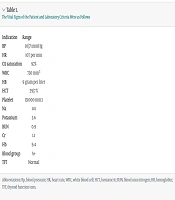
A 59-year-old woman who had undergone MVR surgery due to severe mitral valve insufficiency presented for redo MVR as a result of severe dysfunction of her prosthetic mitral valve, which was implemented 10 years ago. During reoperation, the patient developed symptoms of hemolysis, followed by a decrease in hemoglobin level. The severity of symptoms caused acute renal failure and subsequent need for two sessions of urgent-start hemodialysis. Due to severe mitral valve dysfunction and given that the patient had received packed red blood cell (PRBC), hemolysis was attributed to mechanical factors, and thus no specific diagnostic measures were taken. It should be noted that the patient had not received any blood transfusion during the time interval between reoperation and referral to our center. The patient was reported to be weak and lethargic about 1 month ago and was admitted to the hospital due to an exacerbation of symptoms. The results of preliminary tests are presented in Tables 1 and 2.
Table 1.
Complete Blood Cell Count and Coagulation Test
| Hb (g\dL) | HCT (%) | RBC (106\mm3) | WBC (cell\mm3) | PLT (103\mm3) | MCHC (g\dL) | MCV (fl) | MCH (pg) | PT (sec) | PTT (sec) | INR |
|---|---|---|---|---|---|---|---|---|---|---|
| 6.3 | 19.7 | 2.27 | 3700 | 235000 | 32 | 86.8 | 27.8 | 15.8 | 54.4 | 1.2 |
Abbreviations: Hb, hemoglobin; HCT, hematocrit; RBC, red blood cell; WBC, white blood cell; PLT, platelet; MCHC, mean corpuscular hemoglobin concentration; MCV, mean corpuscular volume; PT, prothrombin time; PTT, partial thromboplastin time; INR, international normalized ratio.
Table 2.
Biochemistry/Renal and Liver Function Test
| Na (mEq/L) | K (mEq/L) | BUN (mg/dL) | Cr (mg/dL) | Uric Acid (mg/dL) | LDH (IU\L) | AST (IU\L) | ALT (IU\L) | Alph (IU\L) | Bill (total) | Bill (direct) | Bill (indirect) |
|---|---|---|---|---|---|---|---|---|---|---|---|
| 140 | 4 | 86 | 1.3 | 9.1 | 3418 | 64 | 46 | 230 | 9.6 | 2.4 | 7.5 |
Abbreviations: Na, sodium; K, potassium; BUN, blood urea nitrogen; Cr, creatinine; LDH, lactate dehydrogenase; AST, aminotransferase test; ALT, alanine aminotransferase test; Alph, Alkaline phosphatase.
Regarding the reported hemoglobin (Hb) level, the patient was a candidate for blood transfusion. As soon as the transfusion of the first unit of blood was initiated, and given that the patient was being transfused with ABO and Rh (D) matched, crossmatch compatible blood, she developed fever, headache, chills, back pain, and urine discoloration. Therefore, blood transfusion was immediately stopped, and therapeutic measures were taken along with complementary lab tests, including aerobic and anaerobic blood culture, blood smear, antibody screening test, and Coombs and Coombs Wright tests. The antibody screening test was positive for anti-E, anti-c, and anti-Kell. Before surgery in this center and to correct anemia, the patient was transfused with 3 units of PRBC (checked in terms of ABO and Rh [D] compatible, c-negative, E-negative, Kell-negative Leuko-reduced RBC through AHG technique), and the Hb level was raised from 6.3 to 10.5. During surgery and considering the clinical condition of the patient postoperatively, 3 more units of PRBC with the above-mentioned features were transfused. The Hb level was acceptable due to perioperative measures. After surgical tricuspid valve (TV) repair, aortic valve replacement (AVR)/MVR, the patient was transferred to the intensive care unit (ICU) and extubated on the second day after surgery. Postoperative lab tests revealed no evidence of hemolysis, and the Hb level was acceptable. However, after 3 weeks of ICU admission, the patient developed sepsis and was expired due to its complications––not due to blood transfusion.
3. Discussion
Hemolytic anemia can be due to congenital or acquired causes. In patients with prosthetic heart valves, mechanical trauma to RBCs is the primary cause of hemolysis (2). Turbulence blood flow from the center or periphery of the prosthetic valve is the main mechanism of trauma caused by severe shearing forces to the RBC; therefore, any factor that increases the turbulence flow at the valve surface can increase the risk of hemolysis (3, 4).
Hemolytic anemia can be single or multifactorial, although its most common cause in patients with prosthetic heart valves is mechanical causes (1). In a small number of articles, less common causes have also been suggested, including immunological hemolytic disorders (alloimmune and autoimmune). One form of immunological hemolytic anemia is hemolysis due to blood incompatibilities. Currently, different blood group systems have been identified in humans (including ABO, Rh, Kell, Duffy, Kidd, and MNS), the most distinguished of which is the ABO antigen system and the most important of which is Rh. Besides, there are additional antigens, such as E and c, which closely control the expression of these antigens on chromosome 1 (5). Each of these antigens can result in transfusion-induced alloimmune hemolytic reactions that may sometimes have devastating consequences. The most common antigen that causes this reaction is the D antigen. In particular, Kell, E, and c antigens are the infrequent causes of transfusion-induced hemolytic reactions (6). Our searches in MEDLINE, PubMed, and Google scholar databases did not reveal any case of simultaneous association of anti-E, anti-c, and anti-Kell antibodies, and in particular, an association of this type of incompatibility with heart valve prosthesis in adult patients. However, sporadic blood incompatibilities with these antigens have been reported, Azarfarin and Alizadeh reported a 49-year-old female with an A2B blood group undergoing cardiopulmonary bypass graft surgery that was successfully managed with acute normovolemic hemodilution without hemolytic reactions (7).
3.1. Conclusions
This case report emphasizes the importance of paying close attention to hemolytic transfusion reactions in patients who are at risk of hemolysis, such as those with impaired prosthetic heart valves, because blood incompatibility is a cause for exacerbation of hemolysis and subsequent adverse complications. As the processing of compatible blood products for rare blood groups is difficult and expensive, alternative blood transfusion methods, including autologous blood, should be considered. In the case that autologous blood is not available, using washed blood products is recommended.