
1. Background
Laryngoscopy and endotracheal intubation can increase heart rate and blood pressure, irregular heartbeat, catecholamines, myocardial oxygen demand, myocardial ischemia, and increased intracerebral pressure in susceptible individuals (1).
These changes are well tolerated in patients without cardiac problems, but in patients with cardiovascular problems and high blood pressure, especially uncontrolled, they can cause many complications (including ischemia) and cardiac dysrhythmias (2, 3).
The rapid sequence intubation (RSI) method is the cornerstone of modern airway management and includes the preparation of equipment and drugs, supplemental oxygenation, induction, muscle paralysis with a muscle relaxant, endotracheal placement, and postintubation supportive therapies (4). RSI is the standard method of airway control in emergency patients (5). In this method, medication is used to reduce the complications of gluten stimulation during laryngoscopy. One of these complications is the possibility of cardiac dysrhythmia. Increasing the length of the modified QT interval, which indicates the potential for ventricular dysrhythmias, may be associated with developing dangerous ventricular dysrhythmias, torsade du point at the top (6). Various mechanisms have been mentioned to prolong this interval. One of the above mechanisms is the increase of sympathetic tone, which during laryngoscopy also increases the probability of prolongation of QT interval with increasing sympathetic stimulation (7). Drugs such as fentanyl or remifentanil can be used to improve this problem. These drugs can reduce sympathetic tone, and this reduction has a protective role against dysrhythmias caused by QT elongation (8). Both fentanyl and remifentanil are widely used in RSI, but a few studies have compared the effects of these agents on the QT interval.
These studies are all on patients who are candidates for intubation in the operating room, and no study has been performed on emergency patients.
2. Objectives
Due to the lack of studies on emergency patients in this domain and the small number of studies in this field in general, a study was designed to compare the effect of fentanyl and remifentanil on the QTc interval in patients undergoing RSI.
3. Methods
This is a double-blinded randomized clinical trial performed from 2019 April 21 to 2019 October 23 in the emergency medicine department of Imam Reza General Hospital Tabriz, Iran. The authors confirm that this intervention's ongoing and related trials are registered. Randomization was done using a table of randomization numbers. The sample size was 25 samples in each group.
3.1. Study Population
For this purpose, 50 patients who were candidates for RSI in the emergency department were selected and divided into two groups.
The inclusion criteria were patients older than 18 who needed rapid sequence intubation for airway management. Patients with a history of cardiovascular disease, diabetes mellitus, chronic hypertension, intracranial injury, drug poisoning, and chronic medication use were excluded.
3.2. Study Design
Before starting the RSI process, a baseline ECG was obtained from the patient, and then one group of patients randomly received 2 μg/kg fentanyl, and the other group received 1 μg/kg remifentanil. Other intubation drugs, including lidocaine, etomidate, and succinylcholine, were injected into both groups. Immediately after drug injection and immediately after laryngoscopy, ECG was obtained, and the QT interval was calculated manually based on ECG traces. Corrected QT (QTc) was also calculated in all patients using the Bazett formula: QTc = QT/√RR. The ECG device was the same.
In the first group, 25 patients requiring rapid intubation received 1 mg/kg lidocaine and two mcg/kg fentanyl 5 minutes before laryngoscopy. Three minutes later, 0.2 mg/kg of etomidate and 1.5 mg/kg of succinylcholine were injected, and laryngoscopy and intubation were performed 90 seconds later. All patients underwent a 12-lead ECG one minute after the lidocaine and fentanyl injection before starting the drug injection.
In the second group, 25 patients requiring rapid intubation received 1 mg/kg lidocaine and one mcg/kg remifentanil 5 minutes before laryngoscopy. Three minutes later, 0.2 mg/kg of etomidate and 1.5 mg/kg of succinylcholine were injected, and laryngoscopy and intubation were performed 90 seconds later.
In both groups, the mean QTc in the three ECGs, the shortest QT interval, the longest QT interval, and the QT interval dispersion in the obtained ECGs were calculated. Then the results of each group before and after drug injection and the results of the two groups were compared.
The nurse who administered the drugs and the investigator who analyzed the ECG traces were blind to the group of enrolled patients.
Figure 1 shows a flow chart of the measurements of these parameters.
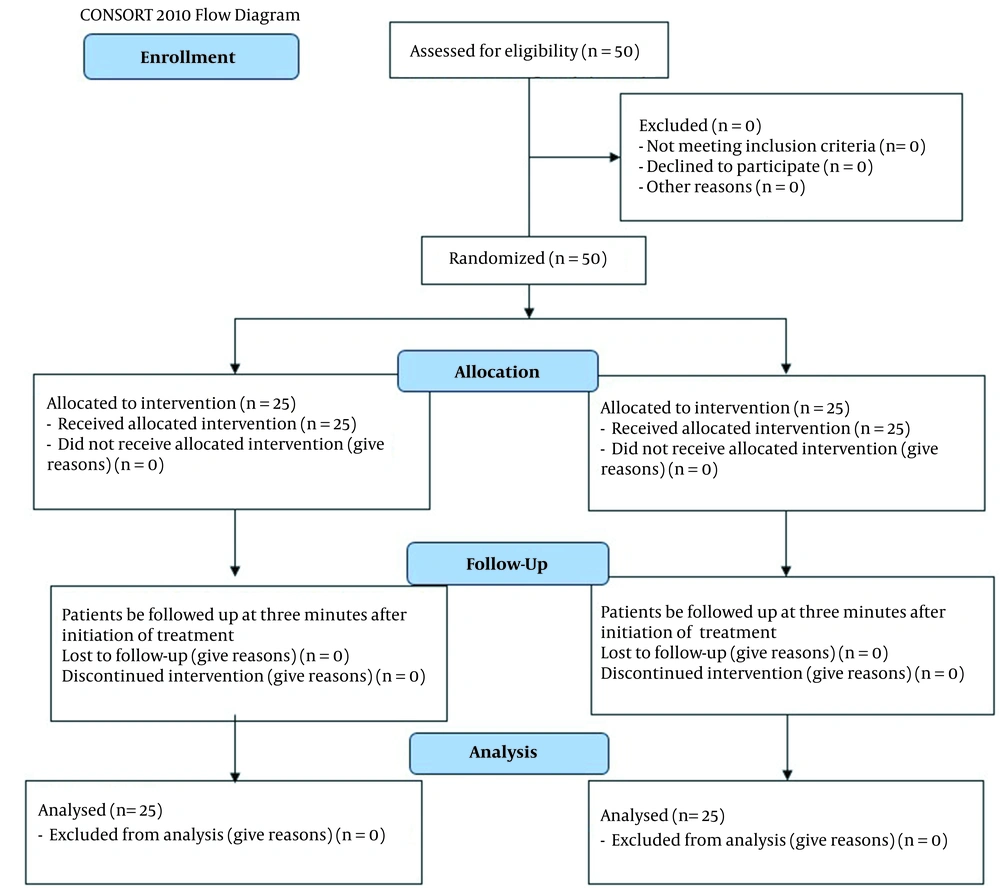
Figure 1.
Flow chart of the study
3.3. Analysis
Data were analyzed using SPSS 22.0.0 (IBM® Microsoft L.T.D., Chicago) software. Kolmogorov-Smirnov test and skewness and kurtosis indexes were used to test the normality of data distribution. The results were reported in frequency (percent) and mean ± standard. Other inferential statistical methods such as independent samples t-test, Paired samples t-test, and repeated measures analysis of variance (Repeated Measurements) were used to analyze the data. P < 0.05 was considered a statistically significant level.
3.4. Ethics
This study was approved by the regional ethics committee with No. IR.TBZMED.REC.1397.921 and registered in IRCT with IRCT registration number: IRCT20090923002496N12
4. Results
In this study, 50 patients were referred to the emergency department. The mean age of patients in the Fentanyl group was 60.08 ± 15.81 years, with a minimum age of 31 years and a maximum age of 90 years. The mean age of patients receiving remifentanil was 61.16 ± 18.68 years, with a minimum age of 24 years and a maximum age of 87 years. There was no statistically significant difference in age between the two groups (P = 0.826).
Nineteen (76%) patients in the fentanyl group were male, and six (24%) were female. Eighteen (72%) of the patients receiving remifentanil were male, and seven (28%) were female. There was no significant difference in terms of the sex distribution between the two groups of patients (P = 0.747).
The means and standard deviations of the QT interval measured 5 minutes before laryngoscopy, 1 minute after injection, and immediately after laryngoscopy are grouped in Table 1. There was no statistically significant difference in any measurements between the two groups receiving fentanyl and remifentanil (P = 0.219, P = 0.181, and P = 0.368, respectively) (Table 1).
Table 1.
Between Groups and Within Groups Comparison of QT Values in Different Measurements a
| Group | P.v | P.v (Within Group) | ||
|---|---|---|---|---|
| Fentanyl | Remifentanil | |||
| QT calculation intervals | 0.004 | |||
| 5 minutes before laryngoscopy | 9.04 ± 1.1 | 8.6 ± 1.38 | 0.219 | |
| 1 minute after Laryngoscopy | 9.2 ±1.19 | 8.72 ± 1.31 | 0.181 | |
| Actually, after laryngoscopy | 9.24 ±1.16 | 8.92 ±1.32 | 0.368 | |
| P.v (between group) | 0.235 | |||
a 1 unit = Small square represents 40 milliseconds (ms) in ECG = 40 milliseconds.
In the within-group comparison, changes in QT values over time (in three stages of measurement: 5 minutes before laryngoscopy, one minute after drug injection, and immediately after laryngoscopy) were statistically significant (P = 0.004). Nevertheless, in the between-group comparison, there was no statistically significant difference between the two groups receiving fentanyl and remifentanil (P = 0.235). Table 2 shows changes in QT values.
Table 2.
Pair Comparison of QT Values in Different Measurements
| Group | QT Calculation Intervals | Mean Difference | Pv | Confidence Interval | |
|---|---|---|---|---|---|
| Fentanyl | Actually, after laryngoscopy | 5 minutes before laryngoscopy | 0.2 | 0.171 | -0.06 - 0.46 |
| 1 minute after laryngoscopy | 0.04 | 0.982 | -0.06 - 0.14 | ||
| 1 minute after laryngoscopy | 5 minutes before laryngoscopy | 0.16 | 0.31 | -0.08 - 0.40 | |
| Remifentanil | Actually, after laryngoscopy | 5 minutes before laryngoscopy | 0.32 | 0.880 | -0.03 - 0.67 |
| 1 minute after laryngoscopy | 0.2 | 0.304 | -0.13 - 0.53 | ||
| 1 minute after laryngoscopy | 5 minutes before laryngoscopy | 0.12 | 0.52 | -0.05 - 0.29 | |
The rate of change in QT interval during three different measurements increased in both groups of patients receiving fentanyl and remifentanil. However, this trend did not show a statistically significant difference in pairwise comparison between QT measurements (Table 2).
The trend of changes in QT values by groups receiving fentanyl and remifentanil in three measurements is shown in Figure 2.
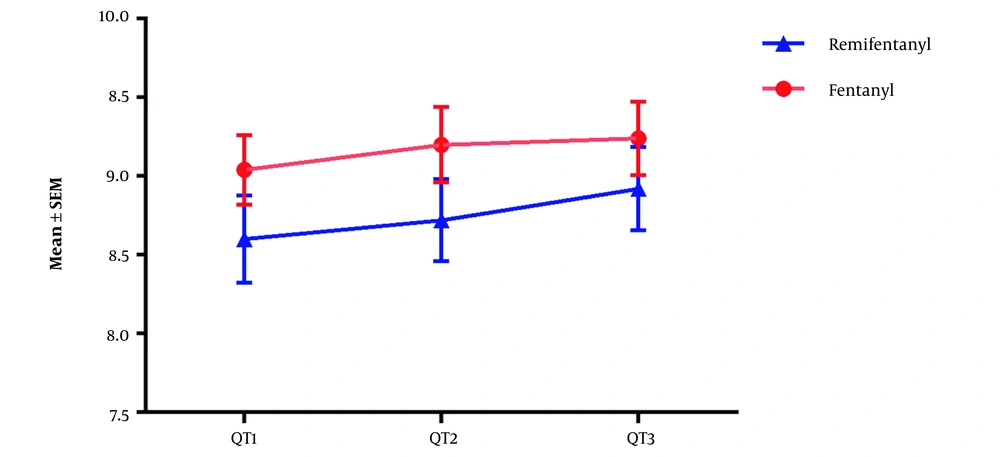
Figure 2.
The trend of QT distance changes by group (QT1: 5 minutes before laryngoscopy. QT2: 1 minute after injection. QT3: Immediately after laryngoscopy)
QT values are given separately in groups of fentanyl and remifentanil in three measurements in Figure 3.
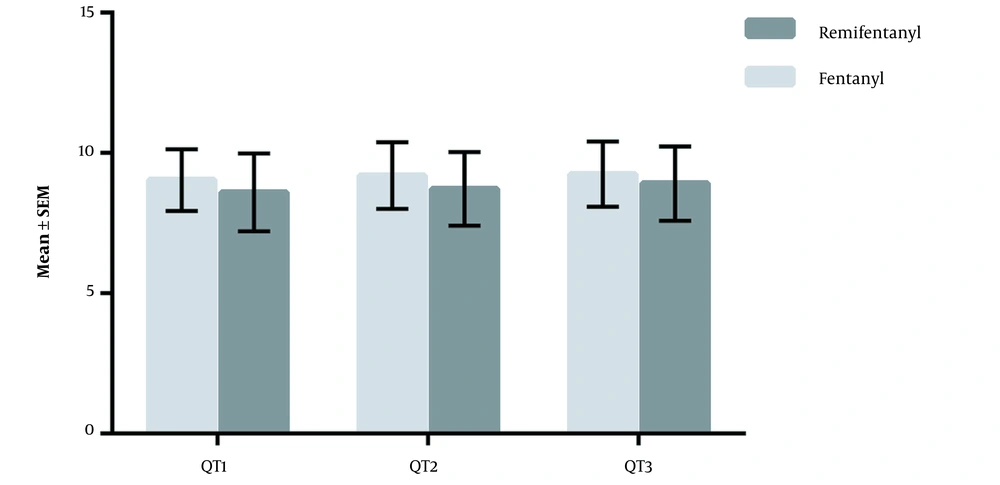
Figure 3.
QT interval values by a group of patients receiving fentanyl and Remifentanil (QT1: 5 minutes before laryngoscopy. QT2: 1 minute after injection. QT3: Immediately after laryngoscopy)
5. Discussion
In the present study, no significant difference was observed in sex distribution and mean age between the two groups of patients. In the comparison of QT interval, no statistically significant difference was observed between the two groups receiving fentanyl and remifentanil in any of the studied times (5 minutes before laryngoscopy, one minute after drug injection, and immediately after laryngoscopy). In group comparison, changes in QT values during the studied time were statistically significant (P = 0.004). But in the comparison between groups, there was no statistically significant difference between the two groups receiving fentanyl and remifentanil (P = 0.235). The results showed that the rate of QT interval changes during three different measurements increased in both groups of patients receiving fentanyl and remifentanil. However, this trend did not show a statistically significant difference in pairwise comparison between QT measurements. Therefore, fentanyl and remifentanil during endotracheal intubation did not have a statistically and clinically significant effect on the QT interval of patients' ECG, and the administration of the above two drugs during intubation is safe.
In the study of Kweon et al., The results showed a better effect of remifentanil 1 µg/kg in reducing the QTc interval during intubation (9), and in the study of Cafiero et al. decreased risk of dysrhythmia was observed, the amount of decreased QT interval dispersion, which is better related to a decreased risk of dysrhythmias, was higher in remifentanil group (10). The above results are not in line with the present study's findings.
O'Hare et al. Reported that remifentanil 0.5 µg/kg was ineffective in controlling increased heart rate and arterial pressure after intubation, but doses of 1.0 and 1.25 µg/kg effectively controlled the response. Therefore, 1.25 µg/kg remifentanil was associated with a decrease in systolic arterial pressure of less than 90 mm Hg in seven patients (11).
Pouraghaei et al. Reported that no significant differences were observed between fentanyl, alfentanil, and sufentanil in cardiopulmonary responses to intubation; there is not any difference between these three opioids in the hemodynamic state of patients, and all are safe (12), which is consistent with the findings of the present study.
In a similar study by Yang comparing remifentanil with fentanyl, the prevalence of systolic blood pressure was significantly higher in the fentanyl group than in the remifentanil group by increasing more than 30% of baseline values during the study period, but the prevalence of systolic blood pressure decreased. < 30% baseline values were significantly lower in the fentanyl group than in the remifentanil group (13).
In a study comparing the effects of remifentanil and fentanyl on changes in blood pressure and arrhythmia in patients undergoing coronary artery bypass grafting, they reported that remifentanil and fentanyl and routine methods were able to inhibit cardiovascular stimulation induced by laryngoscopy and endotracheal intubation. They undergo coronary artery surgery. But remifentanil was more effective than the other two drugs up to three minutes after intubation. (14). The present study's findings also showed that remifentanil and fentanyl could inhibit cardiovascular stimulation caused by laryngoscopy and intubation.
In another study, Min et al. Examined the effects of remifentanil compared to lidocaine on mitigating hemodynamic responses to laryngoscopy and endotracheal intubation and concluded that remifentanil was more effective than lidocaine in reducing the hemodynamic response to laryngoscopy and endotracheal intubation (15).
In another study, Maguire et al. compared the effects of the two drugs. In the alfentanil group, mean arterial blood pressure and heart rate increased in the first minute and during skin incision in comparison with the remifentanil group. While the use of remifentanil compared to alfentanil makes the removal of the endotracheal tube faster, and it concluded that both drugs could control the cardiovascular response resulting from laryngoscopy and endotracheal intubation (16).
In a study, Ko et al. compared the effects of fentanyl and remifentanil on cardiovascular changes following laryngoscopy and endotracheal intubation and concluded that both drugs were effective, but remifentanil was more effective than fentanyl in attenuating the hemodynamic response (17).
5.1. Conclusions
In the present study, in comparing the QT interval, no statistically significant difference was observed between the two groups receiving fentanyl and remifentanil at any of the studied times (5 minutes before laryngoscopy, one minute after drug injection, immediately after laryngoscopy). Therefore, fentanyl and remifentanil during endotracheal intubation did not have a statistically and clinically significant effect on the QT interval of patients' ECG, and the administration of the above two drugs during intubation is safe.