
1. Background
Postoperative pain is the most problematic component for patients undergoing surgery. Postoperative pain relief is the only remedy to eliminate the above problem. Postoperative pain in lower abdominal surgeries is from abdominal wall incision (1). The abdominal wall muscular layer is innervated by nerve afferents that run through the Transversus Abdominis neurofascial plane (2). Though many techniques and many drugs are in use to provide this postoperative pain relief, only opioids give adequate postoperative pain relief. Nevertheless, opioids have highly undesirable effects. Hence the need for regional blocks and local anesthesia drugs is felt to reduce the use of opioids (3). Transversus abdominis plane (TAP) block (4) provides analgesia by blocking the sensory nerve supply to the anterior abdominal wall. It was first described by Kuppuvelumani et al. (4) in 1993 and was formally documented in 2001 by Rafi (5). Course of neural pattern run through the neurofascial plane between the internal oblique and Transversus Abdominis muscle on the basis of many studies, the lumbar triangle of petit (6) found to be the potential access point to block the sensory nerve supply in this neurofascial plane. It is anteriorly formed by the external oblique and posteriorly by the lattismus dorsi, and the iliac crest forms the base of the triangle.
By introducing local anesthetics in TAP via the triangle of petit, it is possible to block the sensory nerves of the anterior abdominal wall before they leave this plane and pierce the musculature to innervate the entire anterior abdominal wall (7).
2. Objectives
We designed this study to evaluate the analgesic potential and duration of TAP block in reducing postoperative pain in patients undergoing different lower abdominal surgeries in the first 24 hrs, the request of the first rescue analgesic needed after TAP block, and the frequency of subsequent rescue analgesic given postoperatively after TAP block in the first 24 hrs.
3. Methods
After obtaining the Institution’s Ethics approval and written informed consent from the patients, the study was conducted in the Department of Anesthesia and postoperative unit. We proceeded with a prospective randomized, double-blind trial in sixty patients of ASA grade I and II who fulfilled the inclusion criteria, such as age group 20 to 60 yrs, elective surgery, and expected duration of surgery 1 to 2 hrs. Exclusion criteria were the surgeries extend to the upper abdomen, maximum handling of visceral organs, delayed surgical procedures, cesarean section, intubation followed by failure in spinal blocks, and unplanned intubations.
The patients were randomized by a sealed envelope to undergo TAP block (n = 30) in the study group (Group T) and (n = 30) in the control group (Group P), there was no TAP block, and only a standard analgesic regimen was administered. In both groups, Visual Analog Scale (VAS) pain scores were observed and documented at 30 min and 4, 8, 12, 16, 20, and 24 hrs postoperatively. Time taken for the first standard analgesic request and subsequent standard analgesic requirement frequency administered were also documented. The time period for the first analgesic request accounted here was the time taken after skin closure and TAP administration to the rescue analgesic supplementation in the study group.
In the control group (Group P), the analgesic regimen used was injection (Inj). Paracetamol 1gm IV and Inj. Tramadol 50 mg IV when a VAS score of four was observed, and the same was considered for subsequent requirement (8). The time period for the first analgesic request in the control group accounted here was from skin closure to the above analgesic regimen administration. After TAP block, the first analgesia request was fulfilled using the same analgesic regimen mentioned above for the control group (Group P), which was administered when a VAS score of four was observed, and the same score was considered for the subsequent analgesic given. Frequency and time were documented.
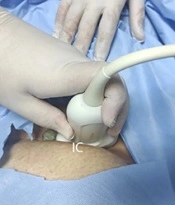
All the patients were given spinal anesthesia using Inj. Bupivacaine 0.5% heavy 3.6 mL, at the end of the surgical procedure in the study group (Group T). The site between the anterio-lateral abdominal wall, iliac crest, and the subcostal margin was cleaned and draped. High-frequency ultrasonography (USG) probe was placed in the above plane; three muscles of the anterior abdominal wall were identified. A 50 mm 23 G needle was introduced anteriorly in the plane of USG probe for identification of neurofascial plane between the internal and transversus abdominis muscle. The needle is directed to approach the transverse abdominis plane (TAP). Once the needle entered the fascial plane, Inj. Ropivacaine 0.375% (15 mL unilaterally or 30 mL bilaterally) was administered after negative aspiration.
Patients were transferred to the recovery room, observation was done for 45 min, and then they were transferred to the postoperative unit. The assessments were carried out at 30 min in the recovery room and 4, 8, 12, 16, 20, and 24 hrs in the postoperative unit. We measured the pain severity using VAS from 0 to 10 (0 = No pain – 10 = Worst pain). The time for the first analgesic request and the frequency of subsequent analgesic requirements were documented.
The sample size calculation of 30 subjects in each group was done by assuming a power of 90% and alpha error of 0.05 based on Sforza et al.’s (9) study where a mean difference of 1.7 was observed in the VAS scale. The statistical tool used for age, sex, and duration of surgery was analyzed using independent t-test. Median, mean, and standard deviation (SD) were used at appropriate places. Chi-square test was used to find the association between the studied groups and VAS Scores. P < 0.05 was considered significant.
4. Results
Sixty patients entered the study and were randomized into two groups. Thirty patients were allocated to each group, including the study group (Group T) and control group (Group P). In both groups, patients received a spinal block single attempt with Bupivacaine 0.5% heavy 3.6 mL. At the end of the procedure, the patients were randomized to the study group. Transverse abdominis plane was easily identified, and the block was easily performed in a single attempt without complication.
The demographic data, duration of surgery, and surgical procedure in the groups were comparable (Table 1). The study group who underwent TAP block had prolonged postoperative analgesia with VAS Scores at 30 min – 0 (0 - 1), 4 hrs – 1 (0 - 4), 8 hrs – 4 (3 - 5), 12 hrs – 1 (0 - 4), 16 hrs – 1 (1 - 2), 20 hrs – 1 (0 - 2), 24 hrs – 1 (0 - 1) when compared with Group P, 30 min – 2 (2 - 4), 4 hrs – 4 (3 - 5), 8 hrs – 3 (3 - 4), 12 hrs – 4 (4 - 5), 16 hrs – 3 (2 - 3), 20 hrs – 3 (2 - 3), 24 hrs – 3 (2 - 3) with P < 0.05 in the first 12 hrs (Table 2). It also delayed the first rescue analgesic request (265 ± 24 min Vs. 66 ± 15 min with P < 0.005) and reduction in subsequent analgesic requirements in the first 24 hrs (1.04 ± 0.26 Vs. 2.3 ± 0.48 with P < 0.05) postoperatively (Table 3). Chi-square test was used to find the association between study groups and the severity of pain scores (VAS scores). It was found that there was a significant difference in the pain scores at 30 min, 4 hrs, 8 hrs, 12 hrs, and 24 hrs (Table 4).
Table 1.
Baseline Patient Characteristics
| Variables | Group T (N = 30) | Group P (N = 30) |
|---|---|---|
| Age | 45.27 ± 7.54 | 47.37 ± 7.80 |
| Gender (m, f) | 12:18 | 9:21 |
| Weight | 53.77 ± 3.67 | 54.77 ± 4.85 |
| Duration of surgery | 97.67 ± 18.28 | 91.83 ± 18.50 |
Table 2.
Postoperative Pain Scores
| Variables | Group T (N = 30) | Group P (N = 30) | P-Value |
|---|---|---|---|
| VAS scores at 30 min | 0 (0 - 1) | 2 (2 - 4) | < 0.05 |
| VAS scores at 4 hrs | 1 (0 - 4) | 4 (3 - 5) | < 0.05 |
| VAS scores at 8 hrs | 4 (3 - 5) | 3 (3 - 4) | < 0.05 |
| VAS scores at 12 hrs | 1 (0 - 4) | 4 (4 - 5) | < 0.05 |
| VAS scores at 16 hrs | 1 (1 - 2) | 3 (2 - 3) | < 0.06 |
| VAS scores at 20 hrs | 1 (0 - 2) | 3 (2 - 3) | < 0.084 |
| VAS scores at 24 hrs | 1 (0 - 1) | 3 (2 - 3) | < 0.1 |
Table 3.
First Analgesic Request and Frequency of Analgesics
| Variables | Group T (N = 30) | Group P (N = 30) | P-Value |
|---|---|---|---|
| Time to first request of rescue analgesic (in min) | 265 ± 24 | 66 ± 15 | P < 0.0001 |
| No of doses of rescue analgesic | 1.04 ± 0.26 | 2.3 ± 0.48 | P < 0.01 |
Table 4.
Association Between the Studied Groups and VAS Scores
| Groups | No Pain | Mild | Moderate | Inferential Statistics |
|---|---|---|---|---|
| VAS, 30 min | χ2 = 37.60, P = 0.000, Significant | |||
| Study group | 23 (77 %) | 7 (23%) | 0 (0%) | |
| Control group | 0 (0%) | 28 (93%) | 2 (7%) | |
| Total | 23 (38%) | 35 (58%) | 2 (3%) | |
| VAS, 4 hrs | χ2 = 45.12, P = 0.000, Significant | |||
| Study group | 3 (10 %) | 25(83%) | 2(8%) | |
| Control group | 0 (0%) | 2 (8%) | 28 (93%) | |
| Total | 3(5%) | 27 (45%) | 30 (50%) | |
| VAS, 8 hrs | χ2 = 23.25, P = 0.000, Significant | |||
| Study group | 0 (0%) | 2 (7%) | 28 (93%) | |
| Control group | 0 (0%) | 20 (67%) | 10 (33%) | |
| Total | 0 (0%) | 22 (37%) | 38 (63%) | |
| VAS, 12 hrs | χ2 = 52.50, P = 0.000, Significant | |||
| Study group | 1 (3%) | 27 (90%) | 2 (7%) | |
| Control group | 0 (0%) | 0 (0%) | 30 (100%) | |
| Total | 1 (2%) | 27 (45%) | 32 (53%) | |
| VAS, 16 hrs | NA | |||
| Study group | 0 (0%) | 30 (100%) | 0 (0%) | |
| Control group | 0 (0%) | 30(100%) | 0 (0%) | |
| Total | 0 (0%) | 60 (100%) | 0 (0%) | |
| VAS, 20 hrs | χ2 = 3.158, P = 0.076, Not Significant | |||
| Study group | 3 (10%) | 27 (90%) | 0 (0%) | |
| Control group | 0 (0%) | 30(100%) | 0 (0%) | |
| Total | 3 (5%) | 57(95%) | 0 (0%) | |
| VAS, 24 hrs | χ2 = 5.45, P = 0.020, Significant | |||
| Study group | 5 (17%) | 25 (83%) | 0 (0%) | |
| Control group | 0 (0%) | 30(100%) | 0 (0%) | |
| Total | 5 (8%) | 55 (92%) | 0 (0%) |
5. Discussion
Postoperative pain management is usually a multimodal approach. However, many techniques like abdominal field blocks, illio-inguinal, and hypogastric nerve blocks are used to directly block the abdominal wall neural afferents. They have long been used for providing postoperative analgesia in patients undergoing lower abdominal surgeries. Effective analgesia has been shown to reduce postoperative stress response (10), accelerate recovery, early mobilization, and discharge (11, 12). Studies have reported so far that TAP block provided adequate postoperative analgesia in patients who underwent lower abdominal surgeries, and it also reduced the frequency of opioid consumption. Liu’s et al.(13) and White (14) studies revealed that local anesthetics, when used for postoperative analgesia, reduce opioid consumption and avoid undue effects caused by opioids and early discharge. Hence in our study, we proceeded with a regional (TAP) block using local anesthetics for postoperative analgesia in patients undergoing lower abdominal surgeries (restricting the use of opioids to the very least and avoiding undue side effects caused by them).
Transversus abdominis plane block was first described by Kuppuvelumani et al. (4) in 1993 and was formally documented in 2001 by Rafi (5). Moreover, O’ Donnell et al.’s (15) study in 2006 proved the efficacy of TAP block for postoperative analgesia and less postoperative rescue analgesics requirements in patients undergoing midline incision abdominal surgeries. Our study proceeded with the same TAP block in lower abdominal surgeries because TAP block was found to be more potential in lower thoracic and upper lumbar abdominal afferents. Jankovic et al. (16) concluded that TAP block holds considerable promise on account of its efficacy, low complication rate, and simplicity. It should be used more often in everyday practice when compared with rectus abdominis sheath, paravertebral, and ilioinguinal/illio-hypogastric blocks. The postoperative analgesic efficacy of TAP block in our study was high, with no complications. Niraj et al.’s (17) study revealed TAP block in patients who underwent appendectomy required less postoperative rescue analgesics. In our study, we administered TAP block for all patients who underwent lower abdominal surgeries and found its efficacy was more and had less postoperative rescue analgesic requirements, especially in surgeries involving lower thoracic and upper lumbar dermatomes.
Khan et al. (18) studied that USG-guided TAP block in lower abdominal surgeries is the efficient mode of analgesia in the intraoperative and immediate postoperative period for patients undergoing lower abdominal surgeries. In our study, we found that TAP block (USG-guided) had a high efficacy potential in postoperative analgesia and also in reducing the frequency of analgesic rescue requirements. Kaur et al. (19) concluded that ropivacaine is a better alternative to bupivacaine. Ropivacaine causes less motor component blockade and more sensory component blockade due to selective action on pain-transmitting fibers. It also has less cardiac and central nervous system toxicity. Considering the above, we proceeded with ropivacaine for better action on the sensory component as it was required for analgesic needs only, which also had less cardiac and central nervous system effects compared to other local anesthetics.
Rouholamin et al.’s (20) study revealed that TAP block with 0.5% ropivacaine played a significant role in reducing postoperative pain following laparoscopic surgeries. It also limited the use of opioids and had no substantial complications. Accordingly, we found in our study that TAP block with ropivacaine 0.375% would be an apt choice in reducing postoperative pain, and this is better observed in patients undergoing lower abdominal surgeries done in spinal anesthesia than general anesthesia. Wan et al. (21) studied the systemic toxic effects of different concentrations of ropivacaine and lignocaine on rats. They found that 0.5% ropivacaine had fewer systemic toxic effects compared to 1% ropivacaine. With the above reference, we chose 0.375% ropivacaine as a safe concentration for this TAP block in our study to prevent systemic toxic effects.
Cuvillon et al.’s (22) study concluded that mixing ropivacaine with lignocaine would have a faster onset but decreased the duration of block. When long and short acting local anaesthetics are mixed and administered, the plasma half-life of short acting local anaesthetics is found to be high. Hence, in the combination of ropivacaine and lignocaine, the concentration of lignocaine is found to be high in plasma, and the systemic toxic effects also will be more because of lignocaine. To achieve a longer duration of action in our study, we chose 0.375% ropivacaine alone for this TAP block. Tsai et al. (23) proved that the posterior approach of TAP block prolongs the duration of analgesia for infra umbilical surgeries, which is followed in our study to achieve the prolonged duration of action.
5.1. Conclusions
TAP block is found to be a simple, reliable, and effective regional block when given with Inj. Ropivacaine 0.375%. It has a high potential to achieve adequate postoperative analgesia in patients who underwent lower abdominal surgeries. It also reduces the postoperative opioids and consumption dose of other analgesics. With the presence of ultrasonography nowadays in every operating room, this TAP block can be routinely recommended as a postoperative pain relief measure in patients undergoing lower abdominal surgeries. It also has the advantage of being less expensive, early mobilization, and discharge compared with a standard analgesic regimen.