
1. Background
Rigid laryngoscopy and tracheal intubation remain the gold standard for airway management despite advancements in airway equipment (1). Laryngoscopy is one of the most painful noxious stimuli, which incites remarkable sympathetic activity during anesthesia and surgery (2). The pressor response is characterized by a sharp increase in the mean arterial blood pressure (MAP) and heart rate (HR), occurring 30 seconds after laryngoscopy and intubation and gradually returning to baseline levels within 5 - 10 minutes (3).
These transient responses are accompanied by potentially hazardous hemodynamic alterations, such as tachycardia, hypertension, dysrhythmia, myocardial ischemia, intracerebral hemorrhage, and elevated intraocular pressure (4).
The pressor response to laryngoscopy and intubation is common in situations where the anesthetic plane is too light, the procedure is prolonged, the vagally innervated posterior epiglottis is elevated by the straight/Miller blade, or the view is anatomically challenging, and more force is used to displace the tongue; therefore, multiple attempts may be required (5).
Numerous prophylactic techniques have been used to mitigate this stress response, such as the injection of local anesthetics, opioids, beta-blockers, alpha 2 adrenergic agonists, vasodilators, magnesium, and higher volatile anesthetic concentrations (6).
Fentanyl, a narcotic with rapid onset and short duration of action, is a component of balanced general anesthesia (GA) (7). Fentanyl may mitigate the hemodynamic stress response by acting on the opioid receptors and lowering sympathetic output (8).
Midazolam has a rapid onset, but its relatively long half-life can result in persistent sedation following its frequent administration (9). The hemodynamic effects of midazolam include a slight decrease in systemic vascular resistance, HR, and systemic blood pressure, and it is believed to preserve hemodynamic stability throughout the intraoperative period (10).
2. Objectives
We aimed to evaluate the hemodynamic stress response mitigation provided by dexmedetomidine and fentanyl-midazolam combination in patients undergoing microlaryngoscopy.
3. Methods
This randomized, parallel, double-blind clinical trial enrolled 60 patients (28 males and 32 females) aged 18 - 65 years, with the American Society of Anesthesiologists (ASA) physical status I - III, who were scheduled for microlaryngoscopy. The study was conducted between March 29, 2021, and July 15, 2022. This study was approved by the Institutional Review Board of Magrabi Eye, ENT, and Dental Center, Doha, Qatar (code: MEEC-IRB-2021-103) and registered on the Iranian Registry of Clinical Trials website (code: IRCT20210117050057N2). Written informed consent was obtained from all patients.
The exclusion criteria were an allergic response to drugs used in the trial, coronary artery disease, pulmonary disease, arrhythmia, pregnancy, renal impairment, morbid obesity, and emergency surgery.
3.1. Randomization and Blindness
Sixty patients were randomly classified into 2 groups (group D and group MF) using a computer-generated sequence. The sequence was sealed in opaque envelopes. Group D received 1 µg/kg of dexmedetomidine plus saline bolus dose over 10 minutes before GA induction, followed by 0.5 µg/kg/h dexmedetomidine plus saline infusions after GA induction. Group MF received 0.8 µg/kg of fentanyl plus 0.05 mg/kg of midazolam over 10 minutes before GA induction bolus dose, followed by 1 µg/kg/h of fentanyl and 0.05 mg/kg/h of midazolam as an infusion after GA induction. Infusions were stopped at the end of the surgery.
The anesthesiologist and surgeon were blinded to the study drugs, and the envelopes were opened immediately before administration by a person who did not participate in the observation. The research solutions were formulated by a devoted pharmacist without further involvement in the trial. The intraoperative and postoperative parameters were examined by a second anesthesiologist who was blinded to the group assignment. Intravenous (IV) propofol (2 - 2.5 mg/kg) and fentanyl (1 µg/kg) were administered to induce GA until loss of eyelash reflex. Intravenous atracurium (0.5 mg/kg) was administered to facilitate endotracheal intubation. Intubation of the trachea was performed using MLScopy tubes of sizes 5 and 5.5 under direct laryngoscopy.
End-tidal sevoflurane 2% in 100% oxygen was used for GA maintenance. Maintenance doses of 0.1 mg/kg atracurium were given IV to immobilize the vocal cords. Once hemodynamics returned to baseline, fixation of the suspension laryngoscope was done.
Supplemental doses of IV propofol (1 mg/kg) were administered whenever the HR or MAP was > 20% of the baseline readings.
The bispectral index maintained between 45 and 60 was used to monitor the depth of anesthesia.
The total number of patients who required rescue analgesics, such as propofol, and the total supplemental propofol given were recorded.
When patients were able to reply to basic verbal instructions, extubation of the trachea was conducted after the administration of lidocaine 4% spray and excluding edema of the cord.
The Ramsay Sedation Score (RSS) was recorded 30 minutes after extubation. Patients received nasal O2 supplementation after achieving full clinical stability.
The heart rate and MAP were measured at baseline, before induction, after induction, at intubation, 1, 2, 3, 5, and 10 minutes, and at the end.
Adverse events were recorded, including hypotension (MAP < 20% of baseline was controlled using 5 mg of IV ephedrine and/or normal saline IVI) and bradycardia (HR < 60 beats/min was controlled using 0.6 mg of IV atropine).
3.2. Sample Size Calculation
G*Power version 3.1.9.2 (Universitat Kiel, Germany) was used to determine the sample size. We performed a pilot study on 10 cases and found that the mean ± SD HR during intubation (our primary outcome) was 81.50 ± 8.87 beats/min in group D and 90.10 ± 8.03 beats/min in group MF. In each group, 30 cases were recruited with a 1.01 effect size, 95% confidence limit, and 95% power, group ratio 1:1; in addition, 6 cases were added to compensate for dropouts.
3.3. Statistical Analysis
SPSS version 26 (SPSS Inc, Chicago, IL, USA) was used for statistical analyses. The data distribution was normal using the Shapiro-Wilk test and histograms. Quantitative data are presented as mean and SD and were examined using the student t-test for unpaired samples. The chi-square or Fisher exact test was used to analyze qualitative parameters expressed as frequencies and percentages. A 2-tailed P-value less than or equal to 0.05 was considered statistically significant.
4. Results
Eighty-nine patients were eligible to participate in this trial; however, 29 were excluded (18 did not meet the inclusion criteria, and 11 refused participation). Therefore, 60 patients were analyzed and followed up (Figure 1).
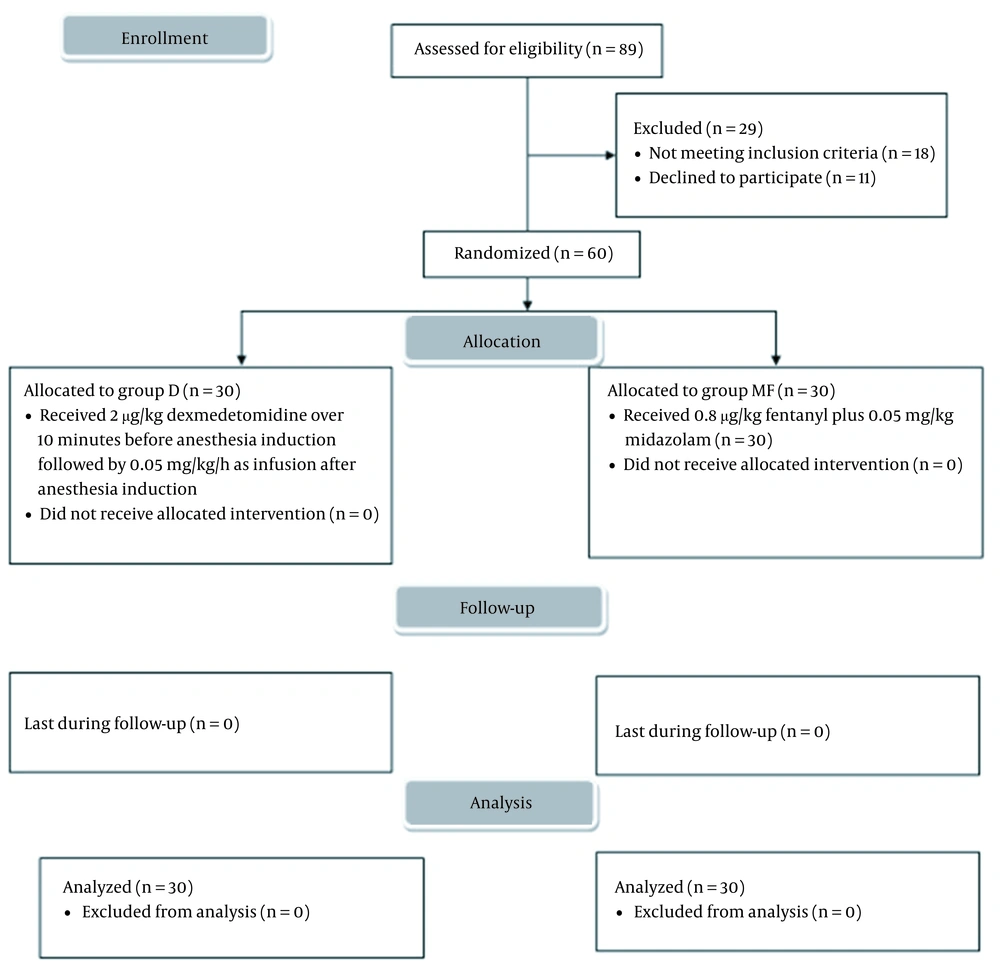
Figure 1.
CONSORT flow diagram of the enrolled participants
The demographic data and duration of intubation and surgery were not significantly different between the 2 groups. The type of surgery was comparable between the 2 groups. The time needed for extubation was comparable between the 2 groups (Table 1).
Table 1.
Patient Characteristics and Duration of Surgery in the 2 Groups a
| Variables | Group D, (N = 30) | Group MF, (N = 30) | P-Value |
|---|---|---|---|
| Age (y) | 44.07 ± 15.95 | 41.73 ± 14.76 | 0.559 |
| Weight (kg) | 63.67 ± 5.82 | 65.7 ± 5.42 | 0.167 |
| Height (m2) | 1.6 ± 0.07 | 1.59 ± 0.06 | 0. 361 |
| BMI (kg/m2) | 24.95 ± 3.31 | 26.19 ± 2.62 | 0.114 |
| Sex | 0.437 | ||
| Male | 12 (40) | 16 (53.33) | |
| Female | 18 (60) | 14 (46.67) | |
| ASA physical status | 0.568 | ||
| I | 8 (26.67) | 6 (20) | |
| II | 16 (53.33) | 20 (66.67) | |
| III | 6 (20) | 4 (13.33) | |
| Hypertension | 6 (20) | 8 (26.6) | 0.761 |
| DM | 10 (33.33) | 9 (30) | 0.781 |
| Duration of intubation (min) | 31.43 ± 8.53 | 32.7 ± 7.99 | 0.555 |
| Duration of surgery (min) | 14.88 ± 6.69 | 13.45 ± 6.56 | 0.407 |
| The time needed for extubation(min) | 3.77 ± 1.04 | 3.37 ± 1.19 | 0.171 |
| Type of surgery | 0.869 | ||
| Diagnostic | 19 (63.33) | 17 (56.67) | |
| Therapeutic | 6 (20) | 7 (23.33) | |
| Laser | 5 (16.67) | 6 (20) |
Abbreviations: BMI, body mass index; ASA, American Society of Anesthesiologists; DM, diabetes mellitus.
a Data are presented as mean ± SD and frequency (%).
Two (6.7%) and 10 (33.3%) patients required propofol in groups D and MF, respectively. The intraoperative supplemental propofol ranged from 0 to 70 mg with a mean (± SD) of 4.33 (± 16.54) mg in group D and from 0 to 80 mg with a mean (± SD) of 22.33 (± 32.34) mg in group MF. The number of patients who required propofol and intraoperative supplemental propofol was significantly lower in group D than in group MF (Table 2).
Table 2.
Rescue Sedation Propofol of the 2 Groups a
| Variables | Group D, (N = 30) | Group MF, (N = 30) | P-Value |
|---|---|---|---|
| No. of patients required propofol | 2 (6.7) | 10 (33.3) | 0.021 |
| Total supplemental propofol (mg) | 4.33 ± 16.54 | 22.33 ± 32.34 | 0.008 |
a Data are presented as mean ± SD and frequency (%).
In the same group comparison, HR and MAP were significantly decreased at all measurement times compared to baseline.
Group D had a reduction in HR from the start of the infusion, which persisted until the end of surgery compared with group MF (P = 0.022, 0.048, 0.032, 0.045, 0.041, 0.026, 0.030, and 0.036). The heart rate was comparable at baseline and before induction in both groups (Figure 2).
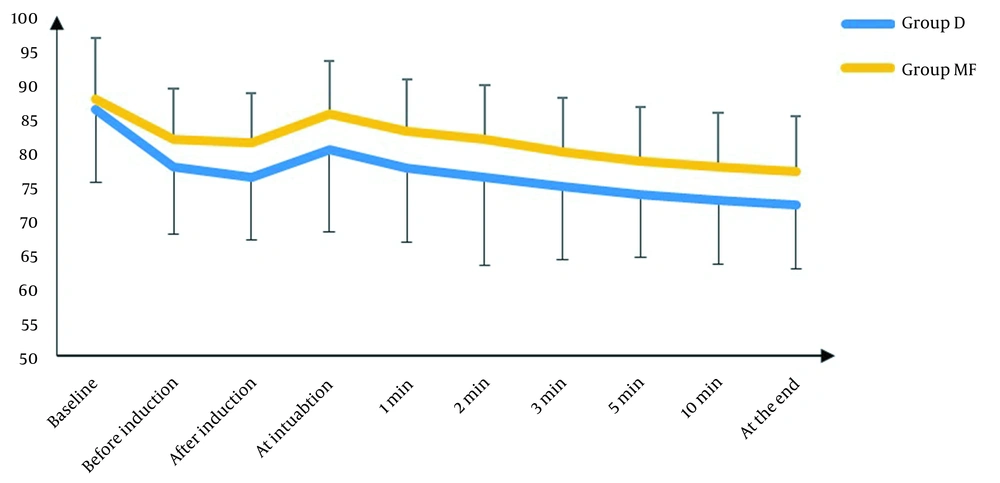
Figure 2.
Heart rate (beats/min) of the studied groups
MAP was comparable between the 2 groups from baseline until the end of surgery (Figure 3).
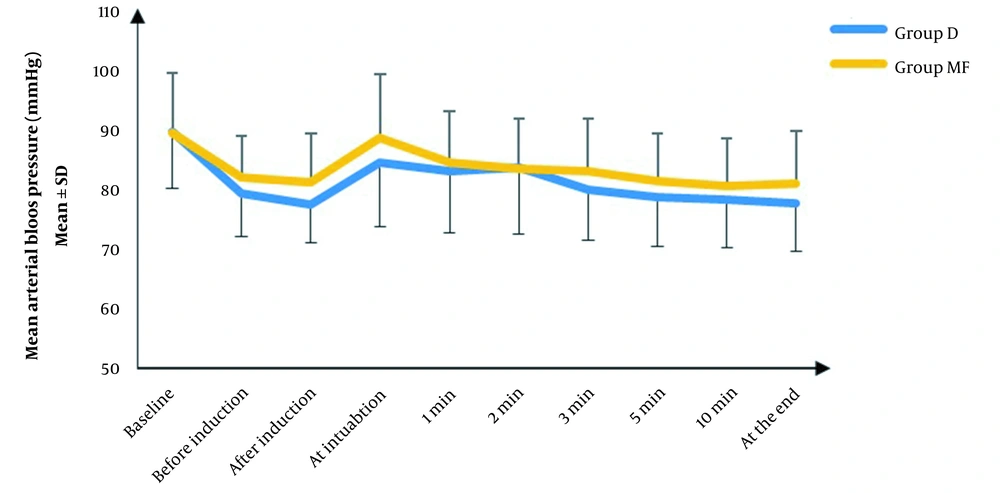
Figure 3.
The mean arterial blood pressure (mm Hg) of the studied groups
The Ramsay Sedation Score 30 minutes after extubation was comparable in both groups (P = 0.552). Most patients in group D (80.0%) were cooperative, oriented, and tranquil, and 20.0% responded to verbal commands (RSS of 2 or 3), whereas 70.0% of patients in group MF were cooperative, oriented and tranquil (RSS of 2), and 30.0% of patients had an RSS of 3 (Table 3).
Table 3.
The Ramsay Sedation Scale at 30 Minutes After Extubation in the 2 Groups
| Variables | Group D, (N = 30) (%) | Group MF, (N = 30) (%) | P-Value |
|---|---|---|---|
| 1. Anxious or restless or both | 0 (0.0) | 0 (0.0) | 0.552 |
| 2. Cooperative, oriented, and tranquil | 21 (70.0) | 24 (80.0) | |
| 3. Responding to verbal commands | 9 (30.0) | 6 (20.0) | |
| 4. Brisk response to stimulus | 0 | 0 | |
| 5. Sluggish response to stimulus | 0 | 0 | |
| 6. No response to stimulus | 0 | 0 |
Hypotension was observed in 7 (23.33%) patients in group D and 3 (10%) patients in group MF. Bradycardia was observed in 6 (20%) patients in group D and 4 (13.33%) patients in group MF. Hypotension and bradycardia were comparable between the 2 groups (Table 4).
Table 4.
Adverse Effects Occurred in the 2 Groups
| Variables | Group D, (N = 30) (%) | Group MF, (N = 30) (%) | P-Value |
|---|---|---|---|
| Hypotension | 7 (23.33) | 3 (10) | 0.299 |
| Bradycardia | 6 (20) | 4 (13.33) | 0.730 |
5. Discussion
Microlaryngoscopy consists of a sequence of stress-filled continuous suspension laryngoscopies that activate the deep pressure receptors in the larynx (16). In high-risk patients, uncontrolled hemodynamic changes during laryngoscopy and intubation produce an increase in HR and MAP, which can result in lethal arrhythmias and myocardial ischemia (17).
Previous medications, such as lidocaine, propofol, esmolol, and clonidine, have not been entirely effective due to their numerous disadvantages (18). Several techniques have been used to control hemodynamic response to stabilize HR and MAP during laryngoscopy and preserve the perfusion of the vital organs (19).
The stress response due to laryngoscopy and intubation can be effectively muted using dexmedetomidine. Anesthetic sparing, opioid sparing, and blunting of excessive hemodynamic reactions during surgery were also noted. Dexmedetomidine reduces the risk of adverse cardiovascular reactions during laryngoscopy and intubation by reducing the release of stress hormones (norepinephrine and cortisol) (20).
The present study aimed to evaluate the efficacy of dexmedetomidine infusion in controlling hemodynamic changes due to its central sympatholytic action, which is responsible for these hemodynamic effects. Dexmedetomidine has a unique pharmacological profile that includes sympatholytic, analgesic, opioid- and anesthetic-sparing actions, and cardiovascular stability, with the added benefit of preventing respiratory depression. Based on previous research, the loading dose of dexmedetomidine in the present study was 1 µg/kg. (21, 22). Lower doses of dexmedetomidine infusions are accompanied by recognition and recall (23).
Our findings confirmed that the number of patients who required propofol and intraoperative supplemental propofol was significantly lower in group D than in group MF.
Basantwani et al. (16) conducted a study on 60 patients undergoing elective microlaryngeal surgery to observe the effect of dexmedetomidine bolus (1 µg/kg) and continued infusion (0.5 µg/kg), finding that the dexmedetomidine group required less rescue analgesia than the placebo group. Bajwa et al. (24) conducted a study on 100 patients scheduled to undergo elective general surgery and observed that the dexmedetomidine group required lower doses of rescue fentanyl to maintain intraoperative hemodynamics. This may be related to the analgesic effects of dexmedetomidine. The heart rate and MAP were significantly decreased at all measurement times compared to baseline in the same group comparison.
Our results were supported by those of the study by Basantwani et al. (16), who observed the effect of dexmedetomidine bolus (1 µg/kg) and continued infusion (0.5 µg/kg) on hemodynamic responses in microsurgery of the larynx and found a decrease in HR from that at baseline starting from loading dose infusion to the end of surgery.
Group D had a reduction in HR compared with group MF from the start of the infusion, which persisted until the end of surgery (P = 0.022, 0.048, 0.032, 0.045, 0.041, 0.026, 0.030, and 0.036). The heart rate was comparable between the 2 groups at baseline and before induction. MAP was comparable between the 2 groups from baseline until the end of surgery. The Ramsay Sedation Score 30 minutes after extubation was comparable between the 2 groups (25).
In agreement with our results, Parikh et al. (26) observed a greater reduction in HR and MAP with the use of dexmedetomidine compared to midazolam-fentanyl during tympanoplasty. This decrease in HR may be attributable to the vasoconstrictive effect of dexmedetomidine mediated by the 2-B receptors, which occurs prior to the central sympatholytic effect (27). Several investigators have utilized 0.5 - 1 µg/kg of dexmedetomidine to prevent the stress response related to intubation (6, 28, 29).
Kumari et al. (30) found that dexmedetomidine considerably attenuated the increase in hemodynamics until 5 minutes after intubation, lowered the propofol induction dose, and produced fewer side effects.
A previous study (31) investigated the impact of dexmedetomidine and saline on the hemodynamic response, reporting that dexmedetomidine significantly decreased MAP and HR compared to saline, possibly because dexmedetomidine affects the stress response by inhibiting the production of stress hormones, such as norepinephrine and cortisol. Jaakola et al. (32) also concluded that dexmedetomidine prevents increases in HR and MAP during intubation.
Previous studies have confirmed our results that dexmedetomidine reduces the stress-induced sympathoadrenal responses elicited by tracheal intubation. Infusions with varying doses of dexmedetomidine were used for this purpose in these trials (33, 34).
This trial had some limitations. First, this was a single-center study with a small sample size that was conducted to prove our secondary outcomes. Second, we did not include a placebo group in this study. Further studies are needed to investigate the effects on hypertensive or cardiac patients and measure plasma catecholamine levels to assess the hemodynamic changes.
5.1. Conclusions
Dexmedetomidine mitigates the hemodynamic changes related to laryngoscopy and intubation more efficiently than a combination of fentanyl and midazolam.