1. Introduction
The Intrathecal drug delivery system (IDDS) was first used in 1981 (Shiley pump, Norwood, MA) for the management of chronic malignant pain (1). It has since been used to manage pain from other nonmalignant conditions as well. Post dural puncture headache (PDPH) is one of the complications associated with IDDS placement (2). We present a patient with persistent spinal headache resulting from cerebrospinal fluid (CSF) leak secondary to the removal of IDDS. The headache was refractory to conservative measures and eventually resolved with surgical management.
2. Case Presentation
A 48-year-old male patient presented with chronic neck pain with cervical post laminectomy syndrome following two cervical spine surgeries with no significant medical problems. The pain was not responsive to conservative medical management including oral opioid therapy. The patient underwent a successful intrathecal opioid trial followed by Intrathecal drug delivery system (IDDS) implantation (Medtronic Synchromed II 40 ml pump) in August 2007. The patient had a history of PDPH following the intrathecal opioid trial before permanent placement and was treated with epidural blood patch to control the headache after failed conservative management. He was followed by his pain physician for intrathecal pump refills and management without problems with good pain control. In December 2013, the elective replacement indicator (ERI) showed 4 months remaining, and non-critical alarm (single tone) started in January 2014. The patient was scheduled for removal of native pump and replacement with new intrathecal pump. In February 2014, the old intrathecal pump was surgically replaced with a new one and it was placed in the same place over the left side of his abdominal wall. Strict aseptic precautions were followed throughout the procedure. He was discharged home the following day without any immediate postoperative complications. The patient followed up with his pain physician weekly during the subsequent 2 weeks. The wound healing was uneventful, and the pump analyses were normal during the follow-up visits. Despite his pain physician’s request, the patient did not follow up with his pain physician for the subsequent four weeks because of bad weather and lack of symptoms.
Six weeks following the IDDS replacement, the patient woke up in the morning complaining of headache, photophobia, and nausea. He also observed redness and warmth over the left lower abdominal incision site. He denied any drainage or fever. The patient presented to the pain clinic later that day. On examination, patient had localized erythema over the left abdominal wall over the surgical area. There were no signs of tracking of redness over flank or paraspinal area (Figure 1). Intravenous antibiotics were started, and, under general anesthesia, the intrathecal pump and the catheter system were explanted through the left lower abdominal and left paraspinal incisions respectively with placement of purse string suture around the paraspinal catheter removal site. The system was withdrawn through the abdominal incision in order to prevent tracking of the infection towards the back. Considering the patient’s symptoms (photophobia, nausea, and headache) and the risk of infection spread from abdominal wound to CNS, the surgical wounds were left open without primary closure under wet and dry dressings. The patient was discharged home the next day with a PICC line on intravenous antibiotics and oral opioid medication. Wound cultures shown methicillin sensitive staphylococcus aureus (MSSA) sensitive to Nafcillin.
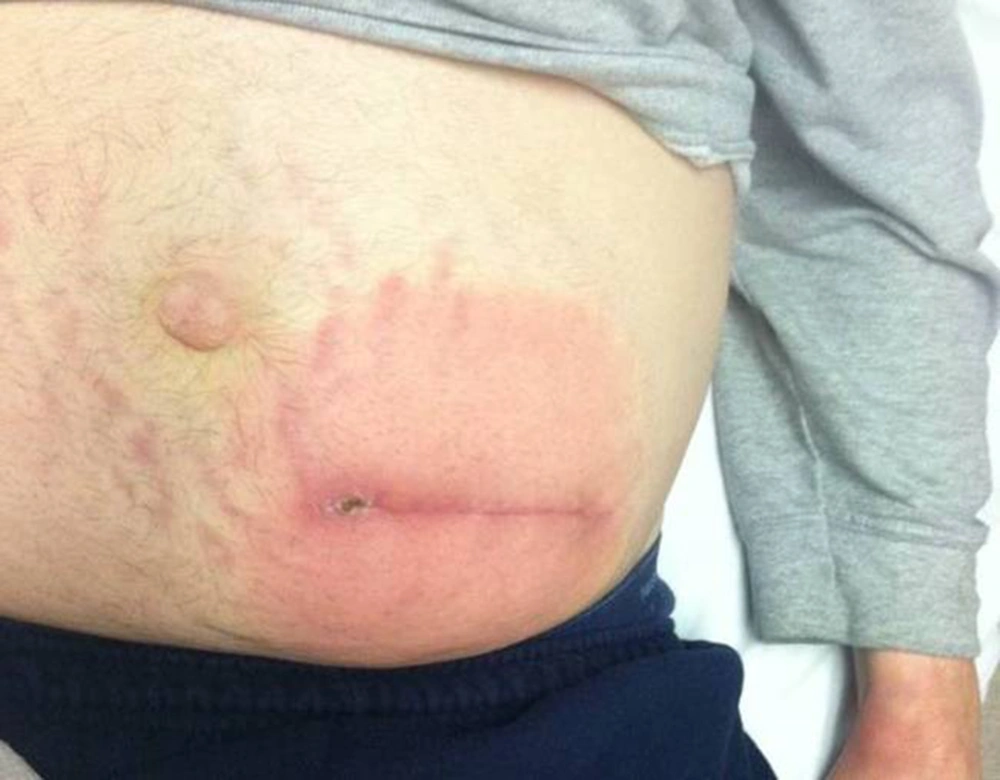
Figure 1.
Infected Left Abdominal Wall Site Before Surgical Removal of IDDS
The patient presented 10 days after explantation of the intrathecal pump to the emergency room with persistent headache worsened with sitting and standing positions. He also had wet dressing over the paraspinal wound. On examination, clear fluid (cerebrospinal fluid-CSF) was noticed leaking from the paraspinal wound (Figure 2). Initially, the patient was managed conservatively with bed rest, oral analgesics, hydration and caffeine for 24 hours (3-6). His symptoms did not resolve and he was referred to neurosurgery for surgical management for persistent and significant CSF leak with severe headache and an open paraspinal surgical wound. He underwent bilateral laminectomies at L2 and L3 with exploration of lumbar wound and dura matter. Immediately after removing the inferior portion of the L2 lamina, the surgeon encountered a brisk CSF leak from a pinhole opening surrounded by ligament and scar tissue. Dural repair of the CSF leak was performed with a tiny piece of muscle using a stitch with 4-0 nylon suture. All the leakage immediately stopped at that point, and there was no extrusion of any rootlets or nerve material (7). The postoperative period was uneventful with complete relief of the headache.
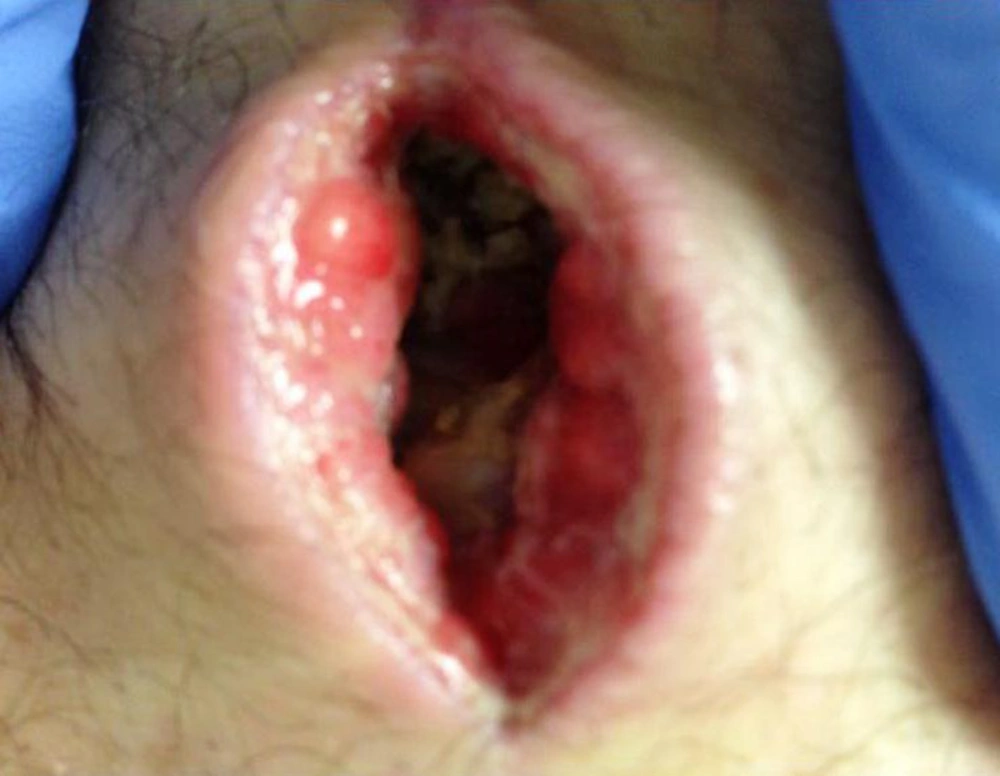
Figure 2.
Paraspinal Open Wound 10 Days After Surgical Removal of IDDS System With Clear Discharge - CSF
3. Discussion
IDDS is used to treat resistant pain conditions (malignant and chronic nonmalignant pain). The device delivers preservative free medications directly into the CSF. The drugs that can be administered intrathecally include Baclofen, Bupivacaine hydrochloride, Clonidine, Hydromorphone hydrochloride, Morphine sulphate, Sufentanil and Ziconotide (8). The intrathecal space is accessed with a 14-gauge Tuohy needle and a catheter is inserted through the needle (9). The pump is placed in an abdominal pocket after dissection and the pump catheter is subcutaneously tunneled and connected to the intrathecal catheter. After removal of the Tuohy needle, a CSF leak is likely to occur around the catheter because of small catheter size compared to Tuohy needle (10).
There were multiple studies on the occurrence of PDPH after spinal anesthesia. A randomized controlled trial (RCT) of 224 non-obstetric patients showed that PDPH occurred in 15.5% of the spinal anesthesia and 1.8% of the epidural anesthesia group (P = 0.0014) (11). The management of PDPH is mainly based on few clinical trials, observational studies and clinical experience. Initially, it is managed conservatively with bed rest, hydration, abdominal binders and medications (Caffeine, Theophylline, antiemetics, analgesics and steroids). Occipital nerve block has been tried without success. When an accidental dural puncture occurs, the catheter can be threaded into the intrathecal space, which helps to seal the initial leak. However, the most definitive therapy is Epidural blood patch, which is used when the headache is debilitating or doesn’t resolve with the above described measures. The success rate of blood patch method reaches 77-96% (12). In cases when the epidural blood patch has ineffective, fibrin glue and Subdural blood patches have been attempted (13, 14).
A recent retrospective review of cases conducted in a single institution showed that up to 23% of the patients developed PDPH symptoms after IDDS implantation (2). The majority of PDPH cases (79%) responded favorably to conservative medical therapy. Approximately 21% of PDPH patients eventually required interventional procedures (epidural blood patch or fibrin glue) for relief. The vast majority of these patients (88%) had full resolution of symptoms following one Epidural Blood Patch (EBP).
However, as with our patient, EBP might not be feasible in patients with CSF leakage externally into the open wound. Transcutaneous leakage of CSF through the lumbar wound is an indication for urgent surgical exploration (1). In such patients, surgical exploration with laminectomy and closure of dura with watertight sutures, fat, muscle or fascial graft at the site of leak is the definitive therapy (15). Conservative management is successful in the majority of patients with PDPH after IDDS implantation (2). Interventional procedures are required in a small fraction of patients for symptomatic relief.
In our patient, conservative management was unsuccessful and there was no possibility of EBP or fibrin glue because of the external leak of the CSF into the paraspinal wound. A surgical exploration and dural repair was performed, resulting in complete resolution of the headache.
Currently, there are limited reports in literature addressing the optimal management of persistent CSF leak after IDDS explantation, and we are convinced that more research is justified in this field.