
1. Background
Intubation and maintaining airway are crucial in managing critically ill patients in the emergency department (ED) (1, 2). Proper placement of tracheal tube maintains airway and supports ventilation in ill patients, and in those with cardiac arrest, respiratory failure, and major trauma (3). Correct tracheal intubation should be confirmed by the physician, otherwise oesophageal intubation can lead to hypoxia with detrimental consequences and even death, all of which can be prevented by early detection of oesophageal intubation (3-8). Correct tracheal intubation can be initially confirmed by visualizing vocal cords during direct laryngoscopy, but this method has limitations such as posterior laryngeal secretions (blood or other secretions), anatomic anomalies (short neck, long incisor teeth, big tongue) that hinder direct visualization of vocal cords (9).
Alternative and secondary methods should be used if correct endotracheal intubation is not confirmed primarily. One of these methods is hearing gurgling sound in the epigastria. Although it can indicate oesophageal intubation, it has high false positive results (3). Another method is auscultation of lung sounds (4, 10, 11). Lung auscultation in crowded environments, such as ED, is difficult and air in the oesophagus and gastric can be heard through chest wall as the lung sounds (9).
Multiple studies have evaluated the accuracy of bedside sonography in confirming endotracheal intubation, all of which have their own limitations. Rosenstein et al. found that transverse tracheal window was the easiest and most reliable method, particularly in novice operators (12). This study was done on cadaver. In a study on 112 patients, the overall accuracy of sonography was near 100 (13). Convex transducer was used in this study and sonography was performed after completion of intubation.
Lahham et al, in their study evaluated real time transverse tracheal sonography to confirm endotracheal intubation by emergency medicine residents and found high sensitivity, but low specificity (14). Low specificity can question the use of sonography as the sole method of transtracheal intubation confirmation. In a study conducted by Adi O et al. a high accuracy was found for bedside sonography in a short period without any side effect, in which sonography was performed after completion of intubation (15).
Although the time lag between intubation and sonography was reported low, even few seconds of ventilation in esophageal intubation could be harmful in an already compromised patient. The sensitivity and specificity of tracheal intubation in the operating room under controlled circumstances was reported to be 100% in 2 studies (12, 16). The accuracy of sonography in the ED might be different from operating room results because of crowded and stressful circumstance of the emergency department, where rapid determination of correct intubation is more critical owing to the patients’ unstable conditions. A study done in 2009 on 30 patients referring to the ED reported high sensitivity and specificity for ultrasonography (17). In the present study, we aimed at evaluating the accuracy of sonography to confirm endotracheal intubation in the ED.
2. Methods
A descriptive analytic study was designed to evaluate the correct placement of endotracheal tube beside sonography. Sonography was done by the attending physician of emergency medicine, who had AIIMS ultrasound trauma life support (AIIMS-UTLS) certificate of AIIMS India. Sonography was done by a physician, who was not involved in the process of intubation, so it did not interfere with intubation. All emergent intubation patients in the ED of Tabriz Imam Reza hospital during 2015 and 2016 entered the study. Patients who were older than 18 years and required emergent intubation were included in the study. Patients younger than 18 years with anatomical abnormality of neck, subcutaneous emphysema, and major trauma, or with extensive hematoma of the neck were excluded from the study. Patients about whom consensus could not be reached were also excluded from the study.
Sonography was done with linear probe frequency of 10 megahertz (GH Healthcare; LOGIQ 200, PRO series; Korea). Probe was placed on the anterior part of the neck transversely just above the suprasternal notch without changing the position of the neck during intubation. Simultaneously with intubation, the passage of orotracheal tube through glottis was observed. Tube passage (Snowstorm) and vocal cord angel widening (bullet sign) were evaluated and both lungs sliding and diaphragm movement were evaluated to confirm correct tube placement and ventilation. Sonography was during intubation so the patients were in supine position; and after applying gel on the probe, the probe was placed on the larynx and anterior of the neck, where tube passage through vocal cords was visible. All the sonographies were performed by an emergency medicine physician.
2.1. Data Analysis
The sample size was calculated with formula for sample size determination in diagnostic studies.The least acceptable sensitivity was 95%, with 95% confidence interval.
Written consensus was obtained from the entourages. This study did not interfere with the treatment process of the patients and did not include any invasive procedures. To evaluate lung sliding, linear probe was placed on anterior chest in midclavicular line in both hemithorax, and lung movement across parietal pleura was seen as slipping. The results of intubation were confirmed or rejected by capnography (18). The results were analysed by SPSS Version 17.01 (SPSS Inc., Chicago, Illinois). Diagnostic tests were done and sensitivity, specificity, positive and negative predictive value of sonography and also the Youden’s Index were calculated.
3. Results
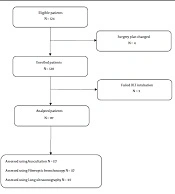
A total of 75 patients entered the study. The mean age of the patients was 61.12. Of the patients, 47 (62.7%) were male and 28 (37.3%) were female. The reason for intubation was the decreased level of consciousness in 22 cases (29.3%), cardiopulmonary arrest in 22 patients (29.3%), respiratory distress in 9 patients (12%), shock in 10 patients (13.3%), and seizure in 1 case. Snowstorm sign was observed in 72 patients (96%). Sensitivity and specificity were 100%. Positive and negative predictive value snowstorm sign were 100%. Youden’s Index was one for snowstorm. Bullet sign was seen in 24 cases (32%). Sensitivity was 33% with the specificity of 100%. Positive predictive value and negative predictive value were 75% and 25%, respectively. Youden’s Index was 33.3%. Lung sliding was seen bilaterally in 63 patients (84%) and unilaterally in 7 patients (9.3%). Lung sliding was not seen in 6.7% of the patients (5 patients). Lung sliding had 87.5% sensitivity and 100% specificity. The positive predictive value and negative predictive value of lung sliding was 100% and 53%, respectively. Youden’s Index was calculated to be 87.5% (Table 1).
Table 1.
Sensitivity and Specificity of Bedside Upper Airway Ultrasonography for Intubation Confirmationa
| Variables | Sensitivity | Specificity | PPV | NPV | Yaden Indexb |
|---|---|---|---|---|---|
| Snowstorm | 100 | 100 | 100 | 100 | 1 |
| Bullet sign | 33.3 | 100 | 100 | 5.9 | 33.3 |
| Lung sliding | 87.5 | 100 | 100 | 25 | 87.5 |
aValues are expressed as percentage.
bYouden’s Index (J = Sensitivity +Specificity - 1) is a statistic that shows the performance of a dichotomous diagnostic test.
4. Discussion
Rapid determination of correct endotracheal intubation is vital and can prevent detrimental consequences of prolonged esophageal intubation. All the available methods have limitations, while sonography is portable, available in almost all of the EDs, reusable, cost- effective, and repeatable. There are different sonographic methods that can be used to confirm endotracheal intubation.
Considering the limitation of previous studies, we designed a study to determine the accuracy of different sonographic sings in identifying endotracheal intubation in the ED, with appropriate sample size, which contained simultaneous approach with intubation. In our study, endotracheal intubation was confirmed by sonography with a high sensitivity and specificity. The sensitivity of snowstorm sign was higher than the other signs, and this sign is noticed simultaneously with endotracheal intubation and prior to inflation of the tube cuff, which takes time and can increase the adverse effects in the case of esophageal intubation. Lung sliding was not visible in 6.7% (n = 5). Sonography of the chest revealed unilateral sliding in 9.3 % (n = 7). Two out of 7 were due to pneumothorax, 4 were the result of right main bronchus intubation, and 1 to chronic underling lung disease. Detecting lung sliding depends on ventilation, which can be affected by a variety of diseases and requires inflation of cuff and ventilation, and in the case of esophageal intubation, it can lead to gastric distention. However, finding the pneumothorax and early detection of 1 lung intubation are important advantages of bedside sonography. The study excluded patients with anatomical abnormality of neck, subcutaneous emphysema, and major trauma with extensive hematoma of the neck, all of which are a challenge for endotracheal intubation and rapid confirmation, and this was the most important limitation of our study. The sample size of this study was small which might have affected the statistical power of the study. Sonography was performed prior to inflating the ETT cuff, which decreased the dire consequences of Bag-Mask Ventilation in case of esophageal intubation; and sonography was performed in real time with intubation. Capnography has its own limitations such as dependence on cardiac output, which is not a concern in confirming intubation with sonography.
4.1. Conclusions
To sum up, bedside sonography can be used to confirm endotracheal intubation with high sensitivity and specificity, and adding transthoracic view to transtracheal view adds the advantage of determining right main bronchus intubation and pneumothorax.