1. Background
Obstructive sleep apnea (OSA) is a sleep-related breathing disorder that affects between 2% and 25% of adults in the general population (1). The vast majority of individuals with OSA are unrecognized (2). Severe OSA has been identified as a major risk factor for perioperative morbidity and mortality (3-6), as emphasized in the practice guidelines of the American society of anesthesiologists (7, 8). Postoperative major adverse cardiac events, unanticipated need for intensive care unit admission, and acute respiratory failure may occur in patients with untreated or undiagnosed OSA whose upper airway integrity is especially susceptible to compromise by residual anesthetics, sedatives, and opioids (1, 9). Polysomnography is considered the definitive diagnostic test for OSA, but cost, time commitment for the patient, and availability of sleep study centers are limiting factors to its routine use (10). As a result, several validated surveys, most notably, the STOP-Bang questionnaire (9, 11-13), are commonly used as screening tools to evaluate patients for OSA with good sensitivity and specificity (14).
Nasal fiberoptic videoendoscopy is an outpatient procedure used for visualization of the upper airway. The technique has an established safety profile, is usually well tolerated with minimal side effects (e.g., epistaxis, coughing, and mild discomfort) (15), and may improve OSA screening. For example, nasal fiberoptic videoendoscopy was previously shown to be efficacious for the diagnosis of OSA in pediatric patients and was also useful to identify airway pathology before surgical treatment of OSA (16). The utility of nasal fiberoptic videoendoscopy for airway management planning in an anesthesia preoperative clinic setting was suggested (17). The authors conducted a proof-of-concept pilot study to evaluate whether airway abnormalities detected using nasal fiberoptic videoendoscopy in the anesthesia preoperative clinic were capable of quantifying the severity of OSA in patients scheduled for elective surgery.
2. Objectives
The current pilot investigation tested the hypothesis that the magnitude of retropalatal and retrolingual narrowing detected using nasal fiberoptic videoendoscopy can predict OSA severity and correlates with polysomnography during anesthesia preoperative clinic assessment of patients scheduled for elective surgery.
3. Methods
3.1. Patient Selection
The Clement J. Zablocki VA Medical center human studies subcommittee approved the protocol. Written informed consent was obtained from each participant. Thirty patients (ASA physical status 2 and 3) scheduled for orthopedic, urologic, otolaryngologic, vascular, or neurosurgical procedures were recruited and assessed in the anesthesia preoperative clinic. Patients with a history of coronary artery disease (stable or unstable angina pectoris, evidence of inducible myocardial ischemia, or myocardial infarction within six months of the study), ventricular arrhythmias, acute or chronic kidney disease (serum creatinine concentration > 2 mg/dL), hepatic insufficiency, severe chronic obstructive pulmonary disease, nasal obstruction that prevented fiberoptic videoendoscopy, and limited mouth opening or neck extension were excluded from participation. Demographic data (including any history of previous difficult endotracheal intubation) were recorded. The STOP-Bang questionnaire was administered by trainees as part of the preoperative evaluation before nasal fiberoptic videoendoscopy was performed.
3.2. Nasal Fiberoptic Videoendoscopy
A single investigator (PJK) with extensive experience performed all of the nasal fiberoptic videoendoscopy examinations to assure consistency. Topical local anesthesia (consisting of 4% lidocaine mixed with phenylephrine (200 mcgs)) was applied into the right nares and upper oropharynx using an atomizer with the patient in sitting position. A fiberoptic videoendoscope (Olympus ENF-VH, Tokyo, Japan) was then gently passed through the right nares into the nasopharynx. As the endoscope was advanced, the patency of the retropalatal and retrolingual lumens was graded as “fully open”, “partially narrowed”, “very narrowed”, or “closed” (Figure 1). A scale of 1 through 4 was used to quantify these corresponding grades for statistical analysis. The endoscopist also rendered a prediction about the relative severity of OSA based on each patient’s airway examination.
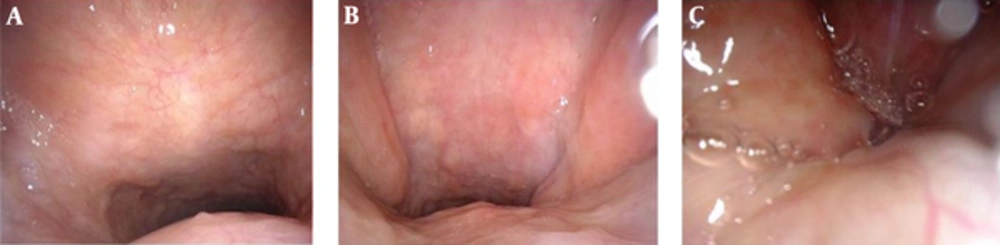
Figure 1.
Typical Nasal Fiberoptic Videoendoscopy Photographs Demonstrating “Fully Open” (Panel A), “Very Narrowed” (Panel B), and “Closed” (Panel C) Retropalatal Narrowing
3.3. Polysomnography
Patients were referred to the sleep medicine service for polysomnography. Apnea was defined as cessation of airflow for ten seconds or more, whereas hypopnea was defined as a ten-second interval of reduced airflow. The total number of apnea and hypopnea events per hour of sleep was quantified as the Apnea Hypopnea Index (AHI). The severity of OSA was defined as “none”, “mild”, “moderate”, or “severe” when AHI < 5, 5 to 15, 16 to 30, or > 30 events per hour, respectively. A scale of 1 through 4 was used to quantify these corresponding AHI ranges for the purposes of statistical analysis.
3.4. Statistical Analysis
The normality of data distribution was determined using the Shapiro-Wilk test. Normally distributed data are expressed as mean ± standard deviation whereas data that were not normally distributed are expressed as median (interquartile range (range)). Categorical data are presented as raw numbers and percentages. Spearman’s rank correlation coefficient was used to determine the relationship between polysomnography OSA severity and other variables. Analyses were performed using StatPlus: macLE software (AnalystSoft, Vancouver, BC, Canada). The null hypothesis was rejected when P < 0.05.
4. Results
Twelve of 30 patients did not complete polysomnography and were excluded. One patient underwent upper airway surgery after nasal fiberoptic videoendoscopy but before polysomnography. Another patient with a known upper airway malignancy received radiation therapy between the endoscopic examination and polysomnography. These two patients were also excluded. Thus, a total of 16 patients were included in the analysis (Table 1). Polysomnography demonstrated that OSA severity was “none”, “mild”, “moderate”, or “severe” in 2, 4, 5, and 5 patients, respectively, using apnea-hypopnea index criteria. Retropalatal and retrolingual luminal narrowing was observed in 3 (2 - 3 (2 - 3)) and 2 (2 - 2 (1 - 3)) patients, respectively (Table 2). Retropalatal (0.71 (0.32 - 0.90), Spearman’s r (95% confidence interval); P = 0.0048) but not retrolingual (0.42 (-0.11 - 076); P = 0.11) narrowing was significantly (P < 0.05) correlated with the severity of OSA observed with polysomnography. STOP-Bang score and body mass index were also significantly correlated with polysomnography OSA severity, whereas clinical impression was not (Table 2).
Table 1.
Demographics, Medical History, and Medicationsa
| Variables | Value |
|---|---|
| Age, y | 63 ± 9 |
| Sex, men/women | 15/1 |
| Height, cm | 180 ± 8 |
| Weight, kg | 108 ± 29 |
| Body surface area, m2 | 2.26 ± 0.30 |
| Neck circumference, cm | 44 ± 4 |
| Interincisor distance, cm | 5.2 ± 0.7 |
| Thyromental distance, cm | 6.8 ± 1.3 |
| Mallampati classification | 3 (3 - 4 (2 - 4)) |
| Medical history | |
| Hyperlipidemia | 11 (69) |
| Hypertension | 8 (50) |
| Diabetes mellitus | 7 (44) |
| Affective disorder (PTSD, anxiety, depression) | 7 (44) |
| Chronic obstructive pulmonary disease | 6 (38) |
| Hypothyroidism | 5 (31) |
| Atrial fibrillation/flutter | 3 (19) |
| Gastroesophageal reflux disease | 3 (19) |
| Lymphoma | 2 (13) |
| Peripheral vascular disease | 2 (13) |
| Previous difficult intubation | 2 (13) |
| Medications | |
| Statin | 10 (63) |
| Antihypertensive | 8 (50) |
| Beta-agonist inhaler | 6 (38) |
| Opioid | 6 (38) |
| Oral hypoglycemic | 6 (38) |
| Thyroid hormone | 5 (31) |
| Antidepressant | 5 (31) |
| Gabapentin | 4 (25) |
| Aspirin | 3 (19) |
| Insulin | 2 (13) |
| Proton pump inhibitor | 2 (13) |
| Warfarin | 2 (13) |
Abbreviation: PTSD, Posttraumatic Stress Disorder.
aN = 16; data are mean ± SD, median (interquartile range (range)), or No. (%).
Table 2.
Comparison of OSA Severity versus Polysomnographya
| Variables | Spearman’s r (95% CI) | P Value | |
|---|---|---|---|
| Polysomnography OSA severity | 3 (2 - 4 (1 - 4)) | - | - |
| Retropalatal narrowing | 3 (2 - 3 (2 - 3)) | 0.71 (0.32 - 0.90) | 0.0048 |
| Retrolingual narrowing | 2 (2 - 2 (1 - 3)) | 0.42 (-0.11 - 0.76) | 0.11 |
| STOP-bang score | 6 (4 - 6 (3 - 7)) | 0.65 (0.21 - 0.87) | 0.0072 |
| Body mass index, kg.m-2 | 33 ± 7 | 0.64 (0.20 - 0.87) | 0.0091 |
| Clinical impression | 3 (3 - 3 (2 - 4)) | 0.44 (-0.09 - 0.77) | 0.093 |
Abbreviation: OSA, Obstructive Sleep Apnea; CI, Confidence Interval.
aN = 16; data are mean ± standard deviation or median (interquartile range (range)).
5. Discussion
The results of the current pilot investigation suggest that nasal fiberoptic videoendoscopy quantification of retropalatal luminal narrowing may be a useful tool for assessing the severity of OSA in the anesthesia preoperative clinic. A strong correlation (Spearman’s r = 0.71; P = 0.0048) between retropalatal narrowing and OSA severity defined using polysomnography was observed, supporting the hypothesis that airway narrowing at the retropalatal pharynx is useful to estimate OSA severity in conscious adults. The ability to not only identify OSA but also quantify its severity during preoperative assessment is important because of the well-established link between OSA severity and perioperative morbidity and mortality (1, 9). The STOP-Bang questionnaire is a commonly used tool that, in general, is adequate for defining presence or absence of OSA, but this screening instrument is less effective for predicting its severity (14). A study of 746 patients screened with both the questionnaire and a formal sleep study found that a STOP-Bang score of four or greater provided reasonable sensitivity (60%) and specificity (61%) for the presence of OSA, but the questionnaire’s sensitivity and specificity dropped to 44% and 32%, respectively, when attempting to distinguish mild from moderate-to-severe OSA using this and other cut-off scores (14). Polysomnography is considered the best test for establishing the diagnosis and severity of OSA, but limited polysomnography resources often hamper the ability of anesthesia providers to stratify patients with moderate-to-severe OSA. For example, the ability of the Veterans health administration system (in which the current authors practice) to conduct polysomnography studies is restricted because of a limited number of certified sleep laboratories, resulting in wait times of several months or more (10). The current results suggest that nasal fiberoptic videoendoscopy assessment of retropalatal airway narrowing may be useful alternative approach to polysomnography for quantifying OSA severity.
Otolaryngologists routinely use fiberoptic laryngoscopy or videoendoscopy for preoperative airway assessment (18-21), but anesthesiologists are less familiar with these techniques despite their expertise with fiberoptic bronchoscopy for endotracheal intubation (22, 23). Transnasal fiberoptic endoscopy is relative easy to perform, is generally safe and well tolerated, and is very useful for the evaluation of upper airway pathology in the clinic setting (24). Some anesthesiology groups, including the current authors, have used nasal fiberoptic videoendoscopy to provide additional information about the airway before surgery. For example, Rosenblatt et al conducted fiberoptic endoscopic airway evaluations immediately before proceeding to the operating room in 138 patients undergoing elective upper airway surgery and showed that such examinations frequently changed the airway management plan, decreased the need for awake endotracheal intubation, and identified patients in whom administration of neuromuscular blockers may be contraindicated before intubation (25). Kallio, Cox, and Pagel first described the use of preoperative anesthesia clinic videoendoscopy for airway management planning in an elderly man with tracheomalacia and subglottic stenosis after a hemilaryngectomy (17). In this case, the videoendoscopy results had a direct impact on the patient’s subsequent anesthetic management. The current observation that the degree of retropalatal airway narrowing correlates with OSA severity was anticipated because previous studies have shown that the retropalatal hypopharynx is the most common site of airway obstruction during drug-induced sleep endoscopy (16, 26). In contrast, retrolingual airway narrowing in the sitting position was not predictive of OSA severity, mostly likely because the majority of patients with OSA do not have substantial airway narrowing at that location (16).
The current results must be interpreted within the constraints of several potential limitations. First, sample size of patients studied in this single-center pilot study was quite small (n = 16). A more comprehensive prospective clinical trial is required to confirm the validity and possible applicability of the current observations. Second, the patients enrolled here were at high risk for OSA (STOP-Bang questionnaire, 6 (4 - 6 (3 - 7)); BMI, 33 ± 7). It is unclear whether nasal fiberoptic videoendoscopy grading of retropalatal luminal narrowing would exclude OSA in patients with lower risk of the sleep disorder. Third, most of the patients included in the study were men. Whether the current findings can be extrapolated to women requires further investigation. Fourth, quantification of the degree of airway narrowing was somewhat subjective in this study and would require strict standardization to assure lack of variability between investigators in future prospective studies of the nasal fiberoptic videoendoscopy technique. Fifth, a single individual (PJK) performed all of the nasal fiberoptic videoendoscopy evaluations to assure consistency, but this investigator also conducted the history and physical examination and confirmed the STOP-Bang questionnaire administered to each patient. Thus, possible bias in the grading of the magnitude of airway narrowing cannot be entirely excluded from the analysis. Finally, although nasal fiberoptic videoendoscopy is well tolerated in most patients (16, 26), the procedure can be mildly uncomfortable and is known to be associated with relatively minor complications that may make some patients resistant to participation. The patients enrolled in the current study had no difficulty tolerating nasal fiberoptic videoendoscopy, and no complications were observed.
In summary, the current pilot study results suggest that nasal fiberoptic videoendoscopy quantification of retropalatal airway narrowing may be a useful tool for assessing the severity of OSA in the anesthesia preoperative clinic. The current findings document a proof-of-concept feasibility of nasal fiberoptic videoendoscopy as a screening tool for OSA in conscious patients during anesthesia preoperative evaluation that may justify further prospective clinical trials of this technique.