
1. Background
Coronary artery disease (CAD) is considered as a major public health problem and is the leading cause of morbidity and mortality worldwide (1). Research findings have shown that CAD is the most commonly explained cause of heart disease in the developed countries (2). According to available reports, CAD prevalence and coronary risk factors in Iran, similar to other Middle Eastern countries, are higher than in Western countries (3). Researchers believe that a vast majority of CAD patients do not respond to medical treatments, and coronary artery bypass grafting (CABG) surgery is still the treatment of choice for these patients as it increases survival rates and quality of life (4, 5).
Open heart surgery is a painful procedure due to sternum opening, tissue damage, and inflammation in the incision area and in areas involving sternal prolonged retraction and mediastinal tube placement (6, 7). Evidence suggests that more than half of patients undergoing surgery suffer from inadequate pain relief (8, 9). Insufficient relief of post-operative pain can lead to adverse events like pulmonary, cardiovascular, gastrointestinal, musculoskeletal, endocrine, and psychiatric disorders, such as pneumonia, tachycardia, and increased oxygen demand, muscle weakness, hyperglycemia, depression, chronic intractable pain, deep vein thrombosis, infection, chronic pain, sleep disturbances, and depression, delaying discharge of patients (10-12). Researchers also reported a significant relationship between post-operative pain control and recovery (9), return to daily activities, and mood of patients (13).
Several pharmacological and non-pharmacological approaches have been proposed for relieving post-operative pain. Among pharmacological therapies, opioids play the most important role in the analgesic regimen (14), but using them requires long-term hospitalization. Also, side effects such as respiratory depression, urinary retention, nausea, vomiting, ileus, sedation and eventually, drug dependence, have limited the long-term use of these drugs. Therefore, the use of non-pharmacological methods such as acupuncture, music, and behavioral exercises has become more popular. The use of these methods not only reduces the overall side effects of drugs due to less consumption, but also prevents the conversion of acute pain to chronic pain (15, 16).
There are limited studies on the effects of acupressure on pain after CABG surgery. In a review study, researchers found contradictory results on the role of complementary therapies in correcting post-operative side effects. Although the types of complementary therapies varied in the reviewed studies, the researchers suggested further research regarding the efficacy of complementary therapies in overcoming cardiac surgery side effects (17). Therefore, the present study was designed to determine the effect of acupressure on pain severity in patients undergoing CABG and admitted to an intensive care unit (ICU).
2. Methods
This double-blind clinical trial was carried out from October 2017 to January 2018 to determine the effect of acupressure on pain severity in patients undergoing coronary artery graft and admitted to the of ICU Shahid Chamran Hospital affiliated to Isfahan University of Medical Sciences, Isfahan, Iran. This clinical trial was registered in the Clinical Trial Registration System of Iran with the code: IRCT20170826035913N2. We obtained approval of the Research Council of Rafsanjan University of Medical Sciences and a code of ethics from the Research Committee of the University (code of ethics: IR.RUMS.REC.1396.73). Then, one of the researchers selected the samples based on the inclusion criteria after submitting the letter of recommendation and obtaining consent of the officials of Shahid Chamran Hospital. The researcher visited the hospital and explained the study objectives to candidates for CABG surgery and obtained their written consent in order to be enrolled in the research.
The inclusion criteria consisted of informed consent to participate in the study, no history of the use of acupressure for any purpose, absence of scars, scratches, and deformities at the point of acupressure, ability to speak and understand Persian language, no hearing impairment, no history of open heart surgery, no known psychological illnesses, no advanced neuropathy, and no addiction to alcohol or drugs.
The exclusion criteria were patient’s unwillingness to continue with the research for any reason, lack of feeling heat or weight, swelling and numbness at the point of acupressure, the occurrence of acute complications after CABG surgery such as depressed level of consciousness, bleeding, cerebral complications, renal complications, pulmonary complications, congestive heart failure, myocardial infarction, or deep vein thrombosis.
The data collection tool was a demographic checklist including items on age, sex, marital status, duration of heart disease, occupation, educational level, body mass index (BMI), economic status, and place of residence, and the 10-degree visual analog scale (VAS). Data collection was performed via face-to-face interviews by someone other than the therapist who was blinded to group allocations.
After CABG surgery, and immediately after complete recovery from anesthesia, removal of the tracheal tube, and stability of the vital signs within 6 and 7 hours post surgery, pain severity was measured using the VAS scale. The samples were divided into intervention and control groups based on the severity of pain and gender using the stratified random sampling and minimization methods (18). The severity of pain in the two strata was categorized as moderate pain (pain score of 4 - 6) and severe pain (pain score of 7 - 10), and gender was stratified into men and women. The first patient entered into the classes of the groups in a simple random way and the rest based on the total number of samples per class. Sampling continued until the intended sample size was obtained. Considering the fact that several factors can affect pain (e.g., age, medical conditions, and previous experiences of the patient), and the effects of these factors ultimately appeared in the pre-test pain severity, the pre-test pain severity and gender were considered in group matching.
In the intervention group, bilateral pressure was applied on the organs at the LI4 point for 20 minutes in 10-second pressure and 2-second resting periods. The applied pressure was about 3 - 5 kg, such that the patient could feel warmth, numbness, and weight. In the control group, the touch was applied without pressure in the same pattern and at the same point as the intervention group. Pain severity was then measured immediately (within 5 minutes) and 20 minutes after pressure and touch in both groups by the researcher’s assistant, who was blinded to group allocations. Acupressure and touch were performed by one of the researchers who had received adequate training in this field. In terms of anatomy, the location of the LI4 point is at the back part of the hand between the first and second metacarpal bones and almost along the radial bone (Figure 1).
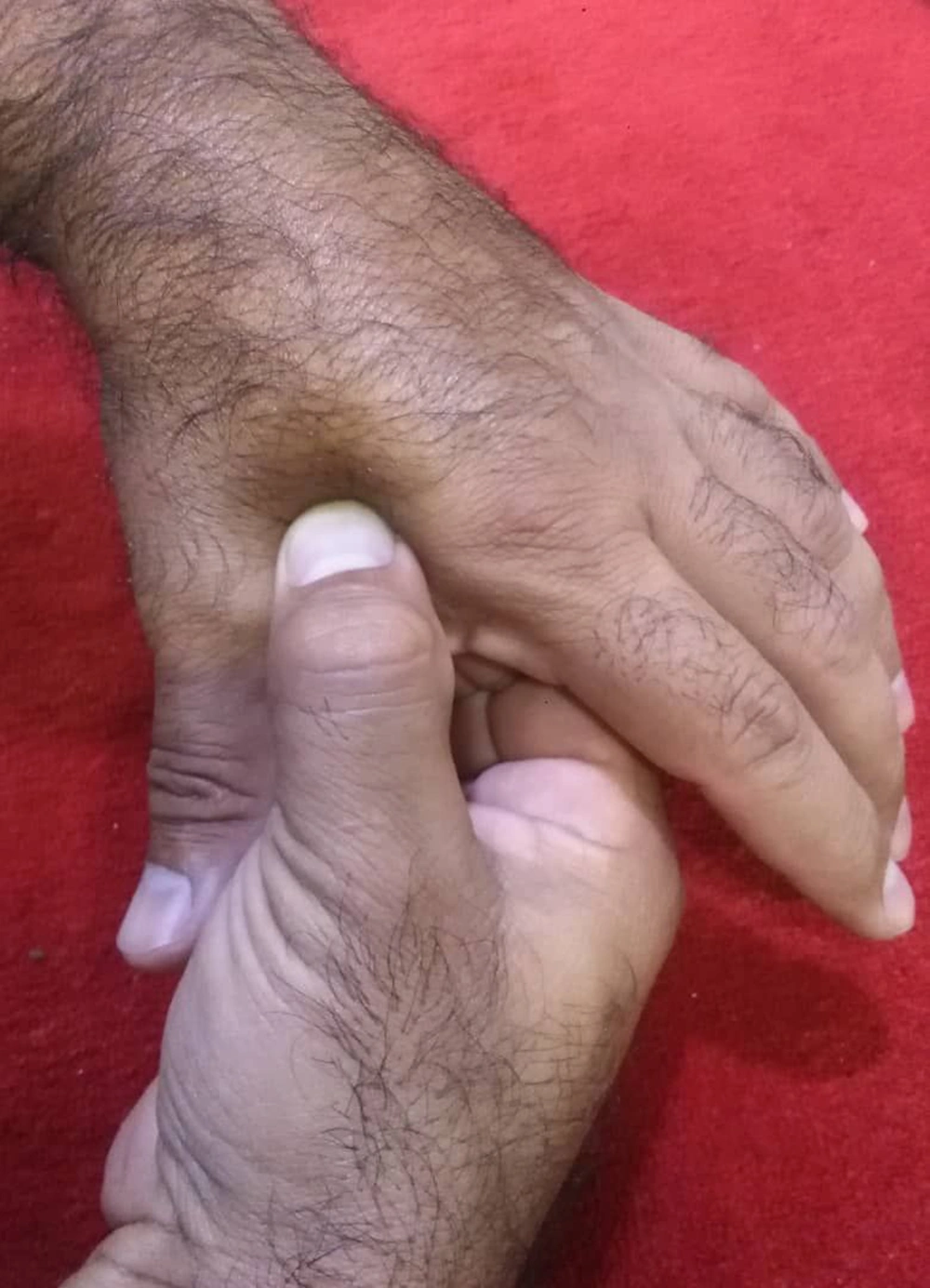
Figure 1.
LI4 acupressure point
It should be noted that routine treatments and care were provided for both groups.
In addition to pain severity, the frequency of receiving opioid and non-opioid analgesics within the first post-operative day (24 hours) was also evaluated and secondary consequences in both groups were compared.
In Shahid Chamran Hospital, post-operative pain management in patients undergoing CABG is started after admission to CCU, under the supervision of an anesthesiologist. To relieve mild pain and sometimes to routinely postpone the onset of pain in these patients, 100 mg diclofenac sodium is used on admission, which is repeated each 6 hours based on physician’s order. Some cardiac surgeons also prescribe the intravenous use of Paracetamol at a dose of 500 - 600 mg every 6 hours. Further, if the patient has mild to moderate pain during the first few hours of admission to ICU, with an anesthesiologist’s diagnosis, he will receive 3 - 5 mg morphine or 25 - 50 mg Meperidine intravenously. In the event of severe pain, patients are given intravenous midazolam at a dose of 1 - 5 mg, and intravenous infusion of propofol is considered with the opinion of an anesthesiologist.
In this study, only patients who were totally alert at 6 to 7 hours after surgery and were extubed were assigned to the study groups and patients who needed persistent intravenous infusion of drugs in order to delay consciousness and extubation were excluded.
Data analysis was performed in SPSS version 16 using Kolmogorov-Smirnov test, Chi-square test, Fisher’s exact test, t-test for independent groups, Mann-Whitney U test, and repeated measures analysis of variance (ANOVA). P value less than 0.05 was considered statistically significant.
3. Results
The data analysis results showed that the mean age of the patients was 61.50 ± 9.59 years (age range: 29 - 80 years). The results indicated that the distribution of the absolute and relative frequency of classes of gender, marital status, and economic status were the same in both groups, and therefore, the two groups were similar in this regard. In terms of other demographic variables such as level of education, age, place of residence, and BMI, there was no significant difference between the two groups (Table 1).
Table 1.
Comparison of Demographic Characteristics of the Studied Groupsa
| Control Group | Intervention Group | P Value | |
|---|---|---|---|
| Age (mean ± SD) | 63.63 ± 9.97 | 59.37 ± 8.83 | 0.063b |
| Educational level | 0.067c | ||
| Illiterate | 13 (37.1) | 18 (51.4) | |
| Less than diploma | 13 (37.1) | 15 (42.9) | |
| Diploma and university | 9 (25.7) | 2 (5.7) | |
| Place of residence | 0.779c | ||
| Urban | 23 (65.7) | 24 (68.6) | |
| Rural | 25 (52.2) | 11 (47.8) | |
| Body mass index | 0.122c | ||
| Normal | 17 (48.6) | 17 (48.6) | |
| Overweight | 14 (40) | 8 (22.9) | |
| Fat | 4 (11.4) | 10 (28.6) | |
| Smoking history | 0.198d | ||
| Yes | 5 (14.3) | 1 (2.9) | |
| No | 30 (85.7) | 34 (97.1) |
aValues are expressed as No. (%) unless otherwise indicated.
bt-test for independent groups.
cChi-square test.
dFisher’s exact test.
Based on the examination of the patients’ medical records, the results of Mann-Whitney U test showed that the two groups were not significantly different in terms of duration of heart disease.
To evaluate pain score variations during successive measuring periods and variations of pain score over time taking into account the effect of groups, repeated measures ANOVA was performed. The results showed that the effect of time (P = 0.001) and group (P = 0.001) and the interaction between time and group (P = 0.001) were statistically significant (Table 2).
Table 2.
Comparison of Mean Pain Severity Scores in the Two Study Groups at the Three Stages of Measurementa
| Intervention Group | Control Group | P Valueb | |
|---|---|---|---|
| Before intervention | 5.25 ± 0.25 | 5.45 ± 0.25 | 0.001 |
| Immediately after intervention | 4.91 ± 2 | 5.45 ± 0.20 | |
| 20 minutes after intervention | 2.60 ± 0.20 | 5.68 ± 0.20 | |
| P valuec | 0.001 | 0.05 > |
aValues are expressed as mean ± SD.
bTime and group interaction effect of Greenhouse-Geisser.
cAdjustment for multiple comparisons: Bonferroni.
Statistical modeling was used to evaluate changes in the inter- and intra-group pain score trend at different times of pain severity measurement.
In the intra-group evaluation of the changes in pain score in successive measurements, the results showed that in the intervention group the mean of pain score changes between the three steps of pain measurement was significantly different in a pair-wise manner (P = 0.001). However, in the control group, pair-wise comparison of changes in pain score between the three stages of measurement showed no significant difference.
There was no significant difference between the two study groups with regards to changes in the pain score in the pre-intervention phase. Immediately after the intervention, the mean changes in pain score were significantly different between the two groups (P = 0.059). Finally, the comparison of mean changes in the pain score between the groups was statistically significant (P = 0.001) at 20 minutes after the intervention.
Figure 2 depicts that pain score among the successive measurements in the intervention group has a significant decreasing trend, but there was a slight increase in pain in the control group, which was not statistically significant.
Also, the results of the Mann-Whitney U test reflected a significant difference between the two groups in terms of the frequency of opioid and non-opioid analgesics received within the first 24 hours after surgery, (P = 0.001 and P = 0.012, respectively). Thus, the frequency of receiving opioid and non-opioid analgesics was more in the control than in the intervention group.
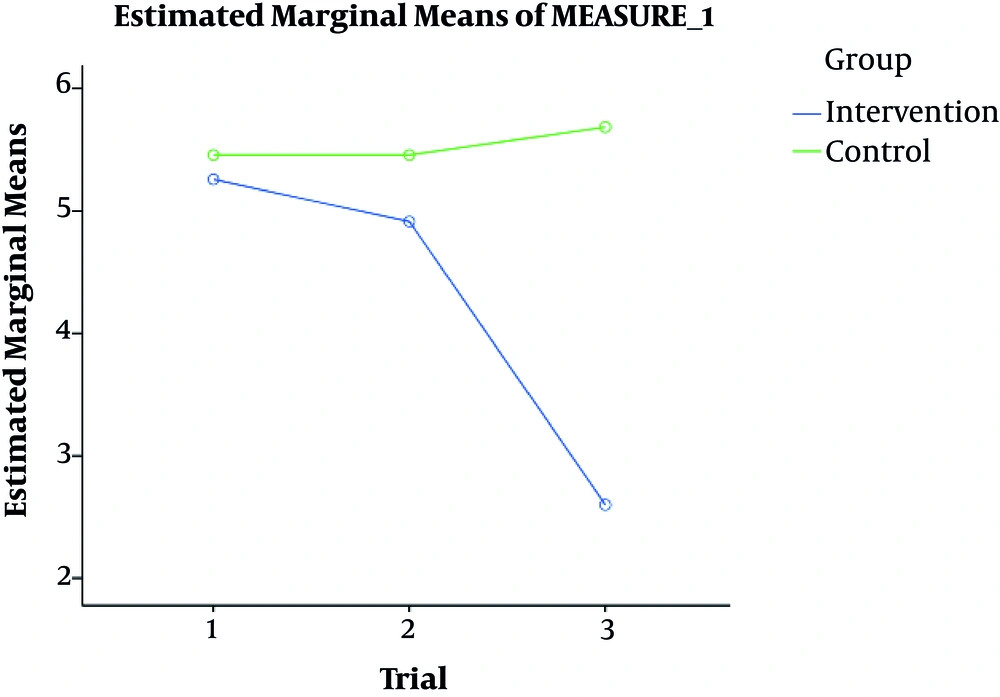
Figure 2.
Comparison of the mean pain scores at various study times and groups, and their mutual interaction using iterative size analysis
4. Discussion
According to the results of the study, acupressure intervention at the LI4 point for 20 minutes together with routine therapies could significantly reduce the pain severity of patients undergoing CABG surgery when compared with touch at the same point during the same time period. There are limited studies on the effect of acupressure on pain in patients undergoing CABG surgery. However, the impact of other complementary therapies on various post cardiac surgery outcomes has been widely considered by researchers and conflicting results have been reported.
Bergmann et al. (19) showed that acupressure reduces the symptoms of depression and improves the quality of life in these patients, and it declines pressure pain sensitivity in stable ischemic heart disease patients. Bastani et al. (20) compared the effect of acupressure at the ST36, P6, and LI4 points on the pain associated with the removal of chest tube in patients undergoing open heart surgery with cryotherapy and control groups, and concluded that as a non-pharmacological method, acupressure was better in controlling the sudden pain caused by this procedure compared to cryotherapy and control. However, Kin et al. (21) did not succeed in reducing pain, nausea, and vomiting in patients undergoing cardiac surgery using the acupressure bands at the P6 point. The researchers did not find a statistically significant difference between their groups in terms of pain severity and the rate of receiving analgesics and antiemetic drugs.
Massage therapy is also considered by many researchers as one of the most widely used complementary therapies for relieving pain in patients undergoing cardiac surgery. Several reviews have shown its positive effect on relieving pain, anxiety, fatigue, and tension in patients undergoing cardiac surgery. However, there is a contradiction in results on complementary therapies (22, 23). In general, researchers recently studied the effects of different complementary therapies on cardiac surgery outcomes in a literature review. They stated that although the therapeutic methods employed were significantly different, and in most studies, interventions could improve the post-operative outcomes in these patients, some studies did not find any evidence on correction of outcomes. Therefore, researchers suggested that the existing evidence is insufficient for determining the efficacy of complementary therapies in improving post cardiac surgery outcomes, and further studies are needed to provide more robust and conclusive evidence as the efficacy of these methods in patients undergoing cardiac surgery (17).
4.1. Limitations and Suggestions
This study had some limitations, the most important one being not considering the role of cultural and social context, personal characteristics, and psychological traits in the perception and experience of pain. However, we tried to minimize the impact of these intervening factors by matching the samples of the three groups based on the severity of pain in pre-test. Also, visual analogue measurement of pain may not be a familiar method for the elderly that constituted the majority of the research samples.
Since the use of acupressure in pain relief after cardiac surgery has not attracted the attention of researchers, and there is also no consensus among researchers as to the protocol of acupressure intervention to relieve postoperative pain, further studies with a more detailed methodology is suggested to find a more effective pressure point and provide a more accurate protocol.
4.2. Conclusion
According to this study, acupressure intervention at the LI4 point had better performance in relieving pain after CABG surgery than touching at the same point.