
1. Context
Many countries have asked people to stay-at-home and isolate themselves during the COVID-19 outbreak that started in December 2019 (1). The rapid spread and outbreak of COVID-19, which caused the deaths of many people in just 2 months, revealed how lethal is this virus (2). The COVID-19 outbreak has had a profound impact on the world’s education system and closed the doors of many schools and universities. Undoubtedly, the spread of COVID-19 created huge challenges for the world’s educational systems that nobody has seen that since the development of technology and distance instruction (3). The COVID-19 outbreak has had a profound impact on the world’s education system and closed the doors of many schools and universities (4). In countries such as Iran, COVID-19 has changed people’s living conditions, created confusion, anxiety, and fear of disease transmission, and closed all schools (5). Although Iran is trying to control COVID-19, the geographical extent of the country and wide distances amongst provinces have made it difficult to tackle the outbreak (6). Following the COVID-19 outbreak, China was the first country that closed all schools to reduce and deal with the spread of the disease. In Iran, after the COVID-19 spread in late February, the Ministry of Education and Ministry of Science, Research, and Technology have repeatedly ordered to close universities and schools: in the hope to decline the spread of the disease after the New Year rituals (Nowruz); however, the growing trend of the disease was such that 987 people were infected and 54 cases died on March 1, 2020 (7). By early April, the prevalence rate rose to 50,468 cases and 3,160 deaths (8). This growing trend has led authorities to consider online classes as a substitution for face-to-face training. In this way, not only it has been attempted to counter the COVID-19 spread, but also the educational process of schools and universities wasn’t ceased. World Health Organization suggested employing online educational strategies, such as radio, podcasts, television, or electronic learning, for continuing the learning procedure and temporary school closures (9).
The education systems faced challenges that shifted them toward using online learning while they were not prepared for that. Early March 2020, the spread of the COVID-19 caused all universities and schools in Iran to be closed following the health protocols and presidential directive. It continued after the new year holidays, in the middle of April 2020, from elementary, secondary, high school education to universities. As a result of the new situation, administrators of schools and universities had no option except to instruct teaching staff to use various applications for online teaching. Indeed, given the problems caused by COVID-19 in the world, online education is the best method to teach various courses: since this type of training has been growing for years, and it has provided new opportunities for students, professors, and educational planners and institutes (10). However, online education has its specific issues and challenges, including unfamiliarity with new technology and methods of dealing with unknown challenges, for many professors and universities (11). The results of a study in Georgia that is performed on 950 students who were using online education showed that the speedy transition to the online model of education was successful (12). In fact, most of the previously carried out studies examined the clinical treatment of COVID-19, and no study has investigated the effect of this virus on schools and educational systems or challenges and opportunities of online learning, which, in this critical situation, can be an appropriate alternative to traditional classrooms. Although schools’ closures have certainly helped to prevent the COVID-19 spread, using online education as a substitute for traditional classes is not easy. The current review aimed to investigate online education and to provide specific instructional strategies to summarize online teaching experiences for teachers who might use online education in similar situations.
2. Evidence Acquisition
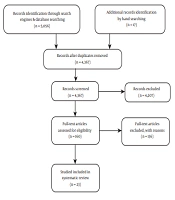
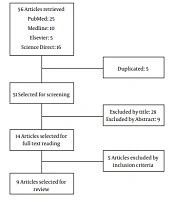
The flow chart of the study procedure is shown in Figure 1. PubMed, Medline, Elsevier, and Science Direct databases were reviewed from 2002 to 2020 using the following keywords: “COVID-19”, “Online Education”, “Distance Learning”, and “Outbreak”. These keywords were used individually or combined with each of the following: “Cross-sectional”, “Perspective”, “Longitudinal”, and “epidemiology”. In PubMed, medical subject headings (Mesh) were used. The current review study aimed to review online education, and some specific instructional strategies are presented to summarize online teaching experiences for teachers who might use online education in similar situations. Articles were additionally screened to guarantee qualification. The keywords checklist was used by an independent reviewer who carried out the search based on the inclusion criteria, and articles were eliminated if online education was due to weak aspects.
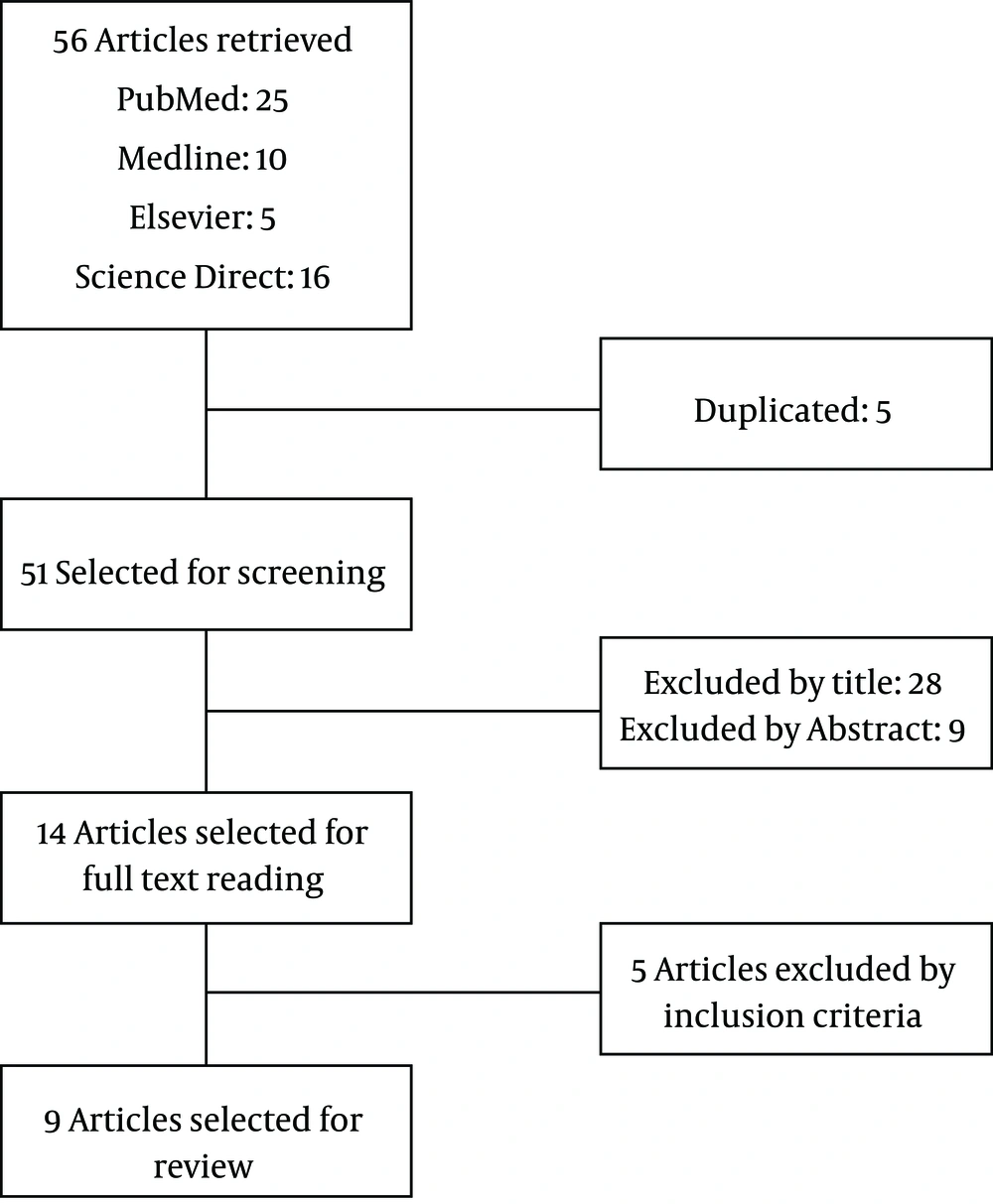
Figure 1.
Flow chart of the review process
2.1. Inclusion Criteria
Studies were retrieved for this review if they met the following inclusion criteria:
1) Studies that reported online education.
2) Studies that were conducted in various educational systems.
3) Studies with the main objective of using educational systems, especially in critical situations.
3. Results
Selected articles for review are reported in Table 1.
Table 1.
Articles Selected for Review
| Author/Reference | Year | Study Design | Outcomes |
|---|---|---|---|
| Basilaia et al. (13) | 2020 | Cross-sectional | In this study, several services were used as new forms of education, i.e., (1) Gmail, for exchanging data; (2) classroom, for creating learning conditions; (3) forms; for creating quizzes, (4) calendar, for scheduling distance lectures; (5) drive, for recording; (6) Jamboard and drawings, used as a whiteboard for drawing and writing; (7) hangouts Meet, for live lecture conditions; and (8) open broadcast studio (OBS), for storing lectures. All of these 8 platforms were tested and could be used as new forms of education. |
| Martin (14) | 2020 | Perspective | COVID-19 outbreak has impacted students’ confidence in using online learning, and the author provided five important points to improve students’ learning. (1) Instruction should be well-organized; (2) content should have high-quality; (3) motivation is needed for student’s self-regulation; (4) the relation between teacher and student is of crucial importance for completing education; and (5) mental health is essential for students and learning. |
| Liguori and Winkler (3) | 2020 | Perspective | It is not believed that educational systems should replace traditional methods for online education, but distance learning should be progressed as soon as possible. |
| Liyanagunawardena and Aboshady (15) | 2018 | Perspective | The impact of health education provided by massive open online courses on emerging infectious diseases in the developing countries is investigated, and it’s figured out that this online teaching method not only has influenced health, but also reduced costs, supported efficient content delivery, and increased user’s access to the content. |
| Maggio et al. (11) | 2018 | Perspective | This study has assessed the transfer to online teaching and concluded that the mismatch in online teaching by professors has led to students’ dissatisfaction; hence, they suggested the Pratt’s five teaching perspectives to deal with this problem and to help professors to have a better perspective of online teaching. |
| Gazza (16) | 2017 | Cross-sectional | This study has reviewed experiences in online nursing education and found various differences between online education and traditional classroom teaching. |
| Kennedy (17) | 2002 | Cross-sectional | The author has compared the dimensions of distance in traditional education and distance learning education provided for health students and showed that teacher-student communication time was 29 percent better than class-centered communication time, and distance learning-training problems can be reduced with the strong potential of this type of training. |
| Ried (18) | 2010 | Cross-sectional | This study has examined the online teaching of basic statistics to PhD students in pharmacy who were divided into four groups. After several training sessions, the results demonstrated no difference in the final exam scores of the students assigned to the online and traditional classroom teaching methods. Hence, it is concluded that basics statistics can be taught online. |
| Carabantes (19) | 2010 | Longitudinal | A study conducted in Chile that aimed to examine distance education from 2004 to 2009 has indicated that online education met educational needs and allowed people to continue their education without any space and time limitation. |
4. Conclusions
The study concludes with five important principles for online education: (1) The computer servers may not be able to host a large scale of users because all the courses were switched to online education mode, and it has caused huge issues. So, teachers and students should be informed in advance, and faculty stuff needs to set a plan to solve these problems; (2) teaching content should be divided into several modules for increasing students’ focus; (3) in traditional teaching methods, body language and teachers’ voices are important tools. On the other hand, in online education, only “voice” could function, so teachers should slow down their speech to help students to take key knowledge points; (4) using teaching assistants, such as WhatsApp and other social media, for providing consultations and answering the questions; (5) combined use of online learning and offline self‐learning. In this way, students should read the course literature and send brief papers based on their reading before class (20). Educational systems and universities are the fundamental pillars of each country, therefore paying attention to the new methods of teaching, such as online education and preparing teachers at various levels, is essential. The spread of COVID-19 enforced universities to change their structure of educational approaches to online ways immediately (3). Although the COVID-19 outbreak is a disaster for the health of the communities, it should be considered as an opportunity (21), especially for educational systems that set the plan for the future and to enhance the substructures of the educational new generation, like online learning.
In the current situation, online education provides access to education for many students, and in the coming years, this access will be promoted (9). However, it should be noted that when teachers and professors use online education, their views and beliefs about teaching may change, which leads to students’ dissatisfaction and confusion. University teachers should be familiar with this possible dissatisfaction, and they can enjoy online teaching by increasing awareness (10). The present study found that studies conducted in most parts of the world have supported online education, even though there are problems with the transition from classical to modern teaching. World education may undergo several changes after the COVID-19 outbreak: since in the past, online education was considered only as an alternative or educational aid, but after the COVID-19 outbreak, efforts are being made to apply this kind of education in all parts of the world. Therefore, it is essential to pay special attention to the appropriateness of infrastructures required for online education in educational systems, so that in the future, in addition to reducing the prevalence of COVID-19 and similar diseases in schools and universities, the educational costs and environmental pollution would be decreased.