
1. Background
The COVID-19 pandemic has changed lifestyles, activities, and occupations (1), and the education process has been no exemption in this regard. The outbreak of COVID-19 has led to the lockdown of education institutes worldwide (2). This crisis has also worsened the existing educational inequalities. The manner of providing education by universities has needed some fixing, and new education methods were proposed to improve education. However, these methods have yet to be applied broadly (3). The start of this pandemic created growing concerns in scientific circles around the restriction of education. Furthermore, universities faced a significant challenge and had to demonstrate their ability to use advanced technology (software and hardware).
Eventually, several months of hard work led to the rapid promotion of virtual education environments in different forms, such as online education (4). The start of the COVID-19 pandemic turned virtual education into a necessity rather than a choice. Virtual education employs the internet and other technologies to transfer educational materials and communicate with them (5). There are two forms of virtual education: (1) synchronized online education; and (2) non-synchronized (or offline) education (6). Several different offline virtual education software and systems are used in other countries with various components, including spaces for sharing educational materials, rooms for dialogues and conversations, discussion, surveying, examination, and reporting. Different platforms are used for virtual education in Iranian universities of medical sciences. The smart university of Medical Sciences supports Navid Software, explicitly developed for university Learning. This system was broadly utilized during the COVID-19 pandemic to teach theoretical courses at the Tabriz Faculty of Dentistry. Synchronized (online) virtual education is also provided via software like Adobe Connect. These systems need high-speed internet and connect to the program with a computer set at a specified time (7).
Despite many problems, the COVID-19 pandemic has increased awareness about the advantages of distance education. Therefore, identifying the challenges and opportunities of virtual education can help educational institutes, teachers, and students to make plans for future uses of virtual education.
2. Objectives
This study aims to analyze the challenges and possibilities posed by virtual education, both online and offline, during the COVID-19 pandemic at the Tabriz Faculty of Dentistry.
3. Methods
This descriptive cross-sectional study was conducted in the faculty of Dentistry of Tabriz University of Medical Sciences in 2020. All students present in the clinical wards of the faculty were included in the study. The transfer students were excluded.
The primary tool was a researcher-made questionnaire. The questionnaire examined the students’ views concerning the advantages and disadvantages experienced in online and offline education platforms. Each problem was analyzed using a five-point Likert scale (low, low, average, large, and very high). The validity of the questionnaire was evaluated with a suitable content validity method. The questionnaire was sent to ten Tabriz University of Medical Sciences professors who were experts in medical education, and the questionnaires were corrected based on their input. The questionnaire reliability was also evaluated using Cronbach’s alpha coefficient. The Cronbach’s alpha coefficient of 0.72 was obtained for the questionnaire, which shows acceptable reliability for its structure and items. In addition, a section was specified for writing further explanations concerning the advantages and problems of virtual education. The questionnaires were distributed among all the students who attended different departments of the faculty of dentistry for practical courses during the COVID-19 pandemic. The questionnaires were collected after five days, and incomplete questionnaires were excluded. The collected data were processed and analyzed using SPSS software version 17 and descriptive statistical methods (frequency and percentage), and the Kruskal-Willi’s test was used.
STROBE cross-sectional reporting guidelines are used to prepare this article (8).
4. Results
A total of 167 general dentistry students participated in this study. About 76 male students (45.5%) and 91 female students (54.5%) completed and returned the questionnaires. The return rate was 86.4%. Table 1 provides the participating students’ age and academic level information.
Table 1.
Age and Academic Year of Participants
| Variables | No. (%) |
|---|---|
| Age (y) | |
| 22 | 53 (31.7) |
| 23 | 43 (25.7) |
| 24 | 62 (37.2) |
| > 24 | 9 (5.4) |
| Academic year | |
| Fourth-year | 56 (33.6) |
| Fifth-year | 48 (28.7) |
| Sixth-year | 63 (37.7) |
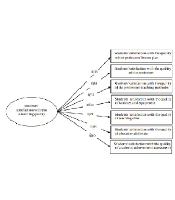
The item with the most satisfaction rate was the availability of offline educational content at all times. The second most satisfying factor was the possibility of interaction with professors in the Navid system. The two items that gained the students’ least satisfaction was the connection to online classes and the volume of virtual content in one session. Table 2 presents students’ answers, and Figure 1 shows how satisfied students were with the virtual education of theoretical courses.
Table 2.
Opinion of Students Regarding Virtual Education
| Items | Satisfaction Rate (%) |
|---|---|
| The volume of virtual content in one session | 54 |
| Quality of the offline educational content | 76 |
| Accessibility of offline educational content | 95 |
| Connection to online classes | 52 |
| Interaction with professors in the Navid system | 78 |
| Interaction with professors in online classes | 64 |
| designated assignments | 69 |
| Professors’ feedback on assignments | 59 |
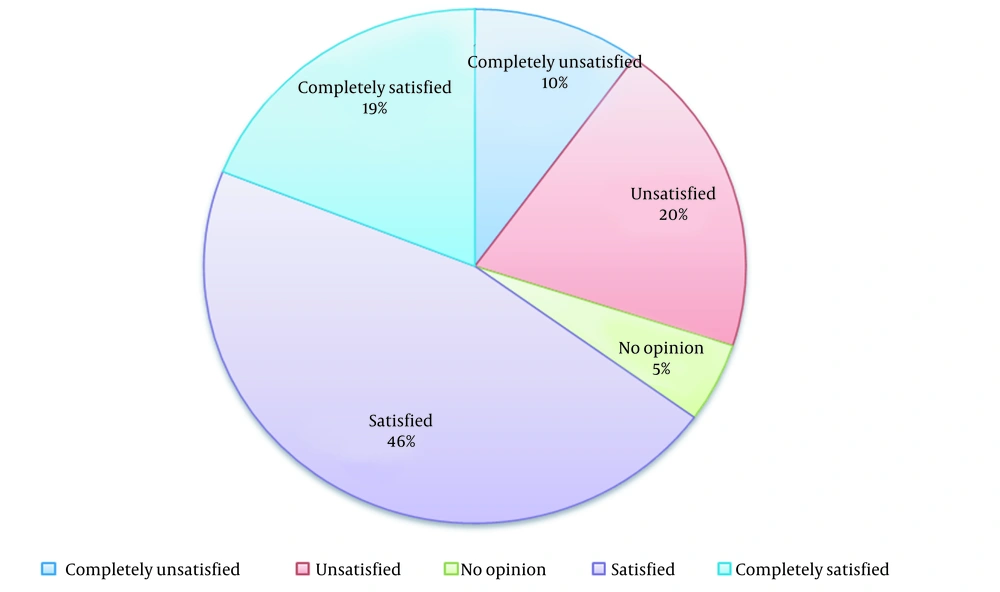
Figure 1.
The overall satisfaction rate of students regarding virtual education (%). Satisfied students with the virtual education of theoretical courses
The Kruskal-Walli’s test results showed no significant relationship between students’ different ages and academic levels with their satisfaction levels. There was a significant difference between the satisfaction level of female and male students (P = 0.02). Post hoc analysis showed that the females were more satisfied with offline content than the males (P = 0.01). In addition, the female students were more satisfied with the provided assignments and feedback (P < 0.001). There was no significant difference between males and females regarding the other items.
As explained in the questionnaires, students believed virtual education was the best option during the COVID-19 pandemic; otherwise, education had to be suspended. In addition, uploading materials on the avid system allowed students to study them as frequently as needed and arrange their study time by their habits. Students also stated that giving assignments in every session will enable them to participate more deeply in the learning process. Professors’ comments and feedback on the submitted assignments, especially those provided promptly, promoted students’ learning. As mentioned by students, the disadvantage of virtual education is that some professors fail to give feedback and comments. According to students’ answers, the lack of eye contact between students and professors is a problem of offline education.
Synchronized (online) education had significant problems related to facilities, connectivity status of professors and students, and internet speed. Students have also pointed out that online classes are short on attention spans. The feeling of being present in the actual classroom was the key advantage of this educational method. According to the students who participated in this study, offline education classes did not add to their stresses or worries.
5. Discussion
This study reported the dentistry students’ comments and views concerning virtual education’s advantages, disadvantages, and restrictions during the COVID-19 pandemic. Students were asked to offer their opinions on the comparison between virtual and face-to-face education. The interaction between the student and professors does not happen efficiently in online education. However, online classes enhance interactions because there are discussion rooms and facilities for offering feedback and comments on assignments in most online education systems, which does not exist in conventional classes (9).
This study shows that online education systems can be relatively simple due to their flexibility. Besides, education would be cancelled during the COVID-19 pandemic without online education systems. Nonetheless, there are some challenges in this respect. Bojovic et al. showed that the lack of eye contact between professors and students lowers the efficiency of online classes (10). In the present study, similarly, some students mentioned their dissatisfaction over having no eye contact with their professors.
Interactions between professors and students and social support are critical elements in students’ educational progress (11). Restrictions in connection to the internet caused some problems in the first months of the COVID-19 pandemic. However, infrastructures gradually improved and paved the way for virtual education. Proper arrangements ought to be made by universities so that the necessary infrastructure is prepared for enhanced learning experiences. A study in Nepal reached a similar finding about connectivity to the internet during the COVID-19 pandemic. The authors also stated that since most family members were at home due to social distancing, it might be difficult for some students to find a quiet place to attend online classes (12).
The students reported their attention span to be shorter in online classes than theirs in face-to-face classes, which is consistent with the results of other studies (13). A possible solution is micro-learning (preparation of short and practical online materials) (14). Another highly effective solution is blended learning, i.e., a combination of face-to-face and offline education, which can positively affect the results. The positive impacts of the flipped class, as a kind of blended learning, have been proved by different studies (15). Cortez showed that most students preferred blended learning to online classes (16). Both professors and students have more chances to interact with this method, which offers advantages of both online and offline education methods.
Participation in conversations in virtual education systems’ discussion rooms opens up a good opportunity for students to exchange views with professors and each other. In addition to improving education, this reduces the feeling of isolation created during the COVID-19 pandemic (17).
In the present study, student’s satisfaction with the feedback provided for their assignments was moderate. Student motivation is enhanced when formative assessments are used during semesters, and students are given prompt feedback on their assignments, examinations, and activities in discussion rooms. Yilmaz et al. showed that immediate feedback is one of the essential advantages of virtual formative assessments (18).
The results showed that female students were more satisfied with offline content and assignments than male students. Ferraro et al. showed no significant difference between the perspective of female and male students regarding virtual education (19). A possible explanation for this difference might be the fact that there are cultural differences between the two countries.
Many studies on virtual education have observed an increase in students’ stress levels in virtual education (20, 21). However, the students did not report this issue. This finding can be explained by the differences in the types of virtual education methods employed by different studies. Compared to offline classes, synchronized online classes intensify stress and worry. Furthermore, surveyed students in other studies had different cultural backgrounds and diverse conditions of access to facilitates of virtual classes. The spread of the COVID-19 pandemic has profoundly affected the psychological health of many people worldwide. As a result, many students suffer from stress and concerns (22). This psychological state may lower the adaptability of students to the application of virtual education (23). Studies have demonstrated that virtual education can develop a phobia about the disconnection of the internet. Moreover, long hours watching computer monitors can negatively affect students’ sleep quality (24).
The advances in technology, together with the shifts in lifestyles, have rendered the use of virtual education inevitable. The outbreak of COVID-19 has only precipitated the establishment of this system for education. Moreover, since the proper infrastructure has been laid and teachers and university staff have gained experience, virtual education will continue after this pandemic.
This study had a significant limitation: Only clinical departments were included, and introductory science courses were not studied. The subject of virtual education in dentistry should be explored more qualitatively for a more in-depth understanding of the challenges and opportunities.
5.1. Conclusions
The COVID-19 pandemic turned virtual education into the principal component of education. Although its application was very limited in the past, the virtual education of dentistry theoretical courses can be efficient. Students’ level of satisfaction with this method is acceptable. Different education techniques encourage student-based learning. In addition, it is recommended to make education materials less cognitively demanding and to include more interactive activities in education.