
1. Context
E-commerce, a domain of the digital economy, encompasses all financial and commercial transactions made on computer networks and the pertaining commercial processes (1). E-commerce used to rely on non-Internet communication via independent information exchange standards and protocols. However, the development of the Internet markedly reduced the costs of using e-commerce (2, 3). E-commerce is essential in healthcare to meet patients’ increasing demands and provide high-quality and cost-effective healthcare services at healthcare centers (4, 5).
Medical cost optimization has improved the quality of hospital services and healthcare products (6). Similarly, deploying and commercializing a new form of commerce, i.e., e-commerce, will represent the market in various distribution channels as a source of economic growth and sustainability (7). Still, the emergence of E-commerce in the healthcare industry has pushed IT personnel not only to move beyond designing and maintaining the infrastructure but also to rethink several aspects of dealing with clients (e.g., privacy and data security) (8).
Today, e-commerce not only expands to online sales but also encompasses the transportation of products and services, as well as information exchange via online networks (9). Additionally, e-commerce offers a better flow of information in different forms, such as electronic data exchange and direct communication with providers. By using e-commerce, healthcare centers can improve their competitive performance by improving their rate of data transfer, cutting errors, upgrading the precision of received and sent data, reducing the storage inventory, planning logistics and inventory control, and developing quicker product delivery platforms (10).
Despite numerous benefits of e-commerce for producers, service providers, and patients, the application of e-commerce has been hindered by technological issues and several factors such as different technological standards, users’ culture & behaviors, delayed product delivery, poor connection links, weak computers, high costs, tiresome tracking, unreliable services, slow network-based data transfer, and, finally, safety issues. So, the most serious challenge in using e-commerce is the provision of suitable technological infrastructure (11-13).
Like in other countries, electronic health and e-commerce have been implemented to some extent in Iran. Nevertheless, there are many obstacles, such as the lack of standard programs (due to multiple data formats), the high cost of electronic health systems (hardware, software, and maintenance), legal problems due to the refusal of electronic documents by judicial courts, technical problems (e.g., network and server problems), and health care providers’ resistance to change. Also, the acceptance of E-commerce by patients and healthcare providers is a controversial issue. Studies on the factors influencing the acceptance of using E-commerce by hospitals are limited, which encouraged us to conduct the present study to explore this topic more closely.
2. Evidence Acquisition
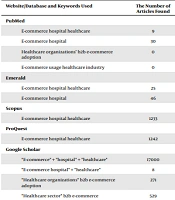
In this narrative review conducted in 2022, we searched PubMed, ProQuest, Scopus, Emerald, and Google Scholar to gather articles published from 2010 to 2021 using keywords such as e-commerce, healthcare, and hospital (Table 1).
Table 1.
Details of the Search Keywords Searched and the Number of Articles Retrieved in Each Database
| Website/Database and Keywords Used | The Number of Articles Found |
|---|---|
| PubMed | |
| E-commerce hospital healthcare | 9 |
| E-commerce hospital | 30 |
| Healthcare organizations' b2b e-commerce adoption | 0 |
| E-commerce usage healthcare industry | 0 |
| Emerald | |
| E-commerce hospital healthcare | 25 |
| E-commerce hospital | 46 |
| Scopus | |
| E-commerce hospital healthcare | 1233 |
| ProQuest | |
| E-commerce hospital healthcare | 1242 |
| Google Scholar | |
| "E-commerce" + "hospital" + "healthcare" | 17000 |
| "E-commerce hospital" + "healthcare" | 8 |
| "Healthcare organizations" b2b e-commerce adoption | 271 |
| "Healthcare sector" b2b e-commerce | 529 |
Inclusion criteria for studies were being conducted on e-commerce applications in the medical and health centers in Iran and in the world and being published from 2010 to the end of December 2021. Only studies written in English or Persian were included. Exclusion criteria in this phase were the role of e-commerce in the study being inconspicuous, being irrelevant to healthcare centers, not mentioning effective research parameters in the abstract, and unavailability of the full text.
After screening, a qualitative evaluation of the papers was independently performed by two supervisors of the study (members of the research team). Disagreements were resolved by a third researcher.
3. Results
The initial search retrieved 20,398 papers, which were imported into Endnote software. After removing duplicates and the items falling out of the specified time range, 15,071 remaining papers entered into the second screening phase, where their titles and abstracts were read carefully, resulting in the exclusion of 14,998 additional papers. Then the full texts of the remaining papers (n = 73) were evaluated, and 62 papers were omitted due to their titles being irrelevant to the topic. Finally, ten papers were selected according to the inclusion and exclusion criteria and after excluding duplicates and irrelevant articles. Table 2 summarizes the results of the selected studies.
Table 2.
Description of the Results of the Selected Studies
| Authors | Publication Year | Objectives | Methods | Identified Factors | Results |
|---|---|---|---|---|---|
| Kong et al. (14) | 2021 | Examining the acceptance of AI in e-commerce in the healthcare industry | Questionnaire and TOE framework | Data transparency, cost pressure, relative benefits, laws, and regulations | The effectiveness of the identified factors in the TOE framework was confirmed. |
| Bedoya Reina et al. (15) | 2021 | A review of haven healthcare center’s disruption of the US healthcare system | A review of measures taken in haven | Identifying strategies for reducing healthcare costs and promoting patient satisfaction in the US | They confirmed Amazon Inc.’s specialty and capability in e-commerce, e.g., logistics, supply, and large-scale data management, supporting haven's efforts to resolve healthcare inefficiencies. |
| Fedushko et al. (16) | 2021 | A review of e-commerce, eHealth strategies, and administrative activities in the UK | A review of e-commerce measures in the UK | Identifying secondary specialties such as blockchain, IT health, virtual and augmented reality, sensors, personal genomics, telemedicine, big data, eHealth, mobile health, electronic medical/health records, AI, and machine learning | Presenting governmental and private sector investment levels in the UK healthcare domain and mentioning the 93.89 billion USD market of e-commerce, and in the UK, e-commerce constituted 30% of the country’s economy. E-commerce also had a 6.1% share of the gross domestic product (GDP) of the UK. |
| Shahzad et al. (4) | 2020 | Examining the effect of COVID-19 on the use of e-commerce in the Malaysian healthcare industry | The TOE framework and a questionnaire | Organizational preparedness; having e-commerce knowledge; supply chain integration; technological infrastructure; External pressure | Organizational preparedness, knowledge of e-commerce, and supply chain integration have significant positive effects. On the other hand, IT infrastructure and external pressure have negligible effects on the use of e-commerce. |
| Rajak and Shaw (17) | 2019 | Evaluation and selection of mHealth apps | AHP and fuzzy TOPSIS techniques | User satisfaction; performance; ease of use and learning; quality of information | “User satisfaction”, “performance”, “ease of use and learning”, and “quality of information” were the most critical factors in the evaluation and selection of mHealth apps. |
| Nilashi et al. (18) | 2016 | Identifying the factors affecting or hindering the acceptance of HIS in Malaysia | AHP technique | Environmental; human-related; organizational; technological | Technological factor (weight: 0.467) was identified as the most crucial factor in accepting HIS. This factor was followed by environmental (0.277), organizational (0.160), and human-related (0.095) factors, respectively, as the major factors in HIS acceptance, according to experts. |
| Chao et al. (19) | 2014 | Proposing a B2B evaluation management model to assess the organizational factors in hospitals and identify the relationships between B2B benefits | Mixed methods: qualitative (content analysis) and quantitative (questionnaire) | IT maturity; IT investment evaluation methods; IT evaluation resource allocation; user information needs an assessment process; B2B benefits | IT maturity positively and significantly affected the acceptance of IT investment evaluation methods, and the precise and complete user information need assessment positively and significantly affected IT evaluation and resource allocation. These factors, in turn, markedly and positively affected the realization of B2B benefits. The results also revealed that the IT maturity level relatively affects hospitals’ ability to allocate IT evaluation resources. |
| Lin et al. (20) | 2011 | Compatibility between organizational B2B policy, IT maturity, and evaluation methods on B2B performance in Australian healthcare organizations | Qualitative content analysis | Organizational B2B strategy and policy; organizational IT maturity; IEM; BRM; B2B benefits; B2B satisfaction | There is a positive relationship between organizational B2B strategy and policy, organizational IT maturity, effective use of IEM and BRM, B2B benefits, and satisfaction level |
| Peikari and Rezazadeh (21) | 2021 | Determining the relationship between professional errors and UTAUT factors for using the electronic prescription system of the Social Security Organization by pharmacists in Isfahan (Iran) via the UTAUT model | Descriptive-correlational | Expect effort; reduction of professional errors; pharmacists’ expected performance; facilitators; social factors; Intention to accept technology | The expected effort and a reduction in professional errors affected the expected performance of pharmacists (P < 0.001). The expected performance, effort, facilitators, and social factors significantly shaped the intention to accept (P < 0.001). The intention to accept and facilitators significantly influenced the acceptance of the system (P < 0.001). |
| Motallebzadeh et al. (8) | 2019 | Evaluating the influence of factors affecting the acceptance of electronic health services from the viewpoints of social security insurance employees | Descriptive-correlational | Systemic factors; perceived benefit; perceived simplicity; attitude toward the application; the behavioral decision for use | Significant relationships existed between systemic factors and perceived benefits; systemic factors and perceived simplicity; perceived simplicity and perceived benefit; perceived benefit and attitude towards the application; perceived simplicity and attitude towards the application; perceived benefit and behavioral decision for use; and attitude towards the application and behavioral decision for use |
Abbreviations: AI, artificial intelligence; B2B, business-to-business; TOE, technological organizational, and environmental; AHP, analytic hierarchy process; HIS, hospital information system; IEM, investment evaluation methodology; BRM, benefits realization methodology.
4. Discussion
The current research reviewed studies on e-commerce and the factors affecting its acceptance in the healthcare industry. Although there are relatively few studies on e-commerce, the results of our study indicated that the use of various technologies in the healthcare industry has improved healthcare quality. As our results showed, the goal of technology, according to the studies reviewed, was to accept e-commerce and information technology in the healthcare industry. Most studies showed that the benefits of e-commerce in healthcare-related, environmental, financial, organizational, human-related, and technological factors could be exploited to benefit physicians, nurses, patients, and healthcare centers.
Fedushko et al. noted the investment benefits of e-commerce and eHealth and highlighted the importance and success of AI and machine learning in health promotion. They also reported a rise in the investments made by governmental and private UK companies in healthcare in 2019 and 2020, demonstrating the significance of health technology and e-commerce in healthcare in terms of both profitability and service quality improvement (16).
Compared to eHealth, mHealth, as an e-commerce component, has shown various applications due to its system’s portability and flexibility. Also, mHealth can be used in rural regions where it is difficult to have regular access to medical facilities. Therefore, it can be an inexpensive alternative for providing healthcare services to citizens. Compared to traditional healthcare providers, mHealth can reduce healthcare costs (22, 23) and provide all health-related information required for a healthy lifestyle (24). It is also a beneficial tool in the management of chronic health-compromising diseases.
Also, due to a large number of health-related apps, deciding on their appropriateness for users has become extremely difficult (22). A barrier to the acceptance of e-commerce in the healthcare system is the lack of a framework for evaluating mHealth apps. Thus, Rajak and Shaw (17) proposed a relatively comprehensive framework for assessing mHealth apps. This framework has several managerial outcomes and can be adopted by developers to rank mHealth apps. Also, the program’s performance can be promoted using the framework proposed by Rajak and Shaw, and physicians can suggest appropriate healthcare apps to their patients based on this framework.
Hospitals’ ability to allocate resources to IT evaluation has intermediary effects on the relationships between organizational drivers such as investment evaluation methodology (IEM), user information need assessment, IT maturity, and e-commerce realization (19). Four primary factors, including human-related, technological, organizational, and environmental elements, influence decision-making on accepting e-commerce and other technologies. External pressures are also vital in shaping the acceptance of E-commerce and similar technologies in hospitals. These external pressures that come from competitors and the government can reduce acceptance. Another serious challenge in hospitals and healthcare centers’ accepting e-commerce is the selection of a proper framework to implement e-commerce. In order to overcome this challenge, Kong et al. (14) and Shahzad et al. (4) presented an optimal framework and method.
Studies show that investment in E-commerce does not always result in profits. Due to their complementary nature, organizational factors and drivers must be managed together, not separately. Focusing on one driver from strategic alignment and ignoring other drivers and factors will not lead to optimal performance. Therefore, researchers have proposed that decision- and policy-making managers, especially hospitals’ chief IT managers, should precisely assess all the factors affecting investments in E-commerce and ensure the correct assessment of the IT maturity level, adoption of proper methods for IT investment evaluation, assessment of users’ needs, and IT evaluation resource level (20, 21).
The Iranian Ministry of Health and Medical Education and Iran’s Social Security Organization are seriously pursuing the elimination of paper prescriptions and traditional insurance cards and replacing them with online registration of medical orders (24). Peikari and Rezazadeh (21) examined the relationship between professional errors and factors using an integrated model for the acceptance and use of theoretical technology. They argued that using the electronic prescription system has reduced professional and operation errors by users and promoted the pharmacy’s financial and non-financial performance. Other advantages of this system include its ease of use and the existence of facilitators, as well as external and social factors.
Electronic services provide users with easy access to organizational facilities and garner clients’ trust as the most outstanding capital of organizations. Still, their popularity is reported to be very low among users of healthcare organizations, and a small percentage of the goals of the electronic service system has been met in these organizations (8). An examination of the organizations that provide electronic services in Iran shows that the acceptance of electronic services by users is limited, and these services have not found their rightful place in organizations and cannot completely fulfill their crucial role. Motallebzadeh et al. (8), studying barriers to the acceptance of electronic services, reported that access to technological facilities (e.g., information security and Web skills) was an important indicator of the systemic factors (e.g., reliable information exchange and easy performance of organizational tasks) that could affect the perceived benefits and acceptance of electronic services according to the technology acceptance model. These items will ensure the benefits of electronic service systems for users. Systemic factors can also influence users’ perceptions of the benefits of electronic services. According to Tavili and Ramezani Qomi (25), chief organizational managers can show their support for the deployment of electric service systems by providing facilities needed for the implementation, installation, and execution of such systems, such as software, hardware, and other requirements.
The present study was limited by the small number of studies conducted on the acceptance of e-commerce in healthcare centers and hospitals. It is expected that eHealth and E-commerce technologies will have a more prominent role in the promotion of Iran’s healthcare system because health information systems and technology are intertwined and rapidly growing in the country. Evidence shows that researchers in Iran have fallen behind other countries in studying e-commerce applications in the health sector. This delay can be attributed to health policy-makers and managers’ lack of familiarity with the significance and position of e-commerce, as well as due to the state-run nature of most Iranian healthcare centers. As such, healthcare managers need to become aware of the latest technology-based systems and their positive outcomes in all aspects, such as healthcare service quality improvement, healthcare centers’ financial performance improvement, and more accessible service provision. Therefore, relevant institutions must develop the necessary guidelines to pave the way for researchers in this area.
5. Conclusions
The positive effects of e-commerce in healthcare include healthcare service quality improvement, enhanced financial performance, and facilitated service provision. It is suggested that health centers equip themselves with adequate hardware and software to be able to easily install and run e-commerce and E-health so that personnel can be familiarized with and accept using them.