
1. Background
Acculturation is a complex process of adapting to the prevailing culture (1). According to social science, it contains learning the culture of another society, which is formed as a result of basic communication between two or more groups (2). Although several studies have investigated determinants of individuals' acculturation and their effects on different characteristics of people, few studies have regularly investigated the effect of culture on cognitive tasks among different people and groups (1).
Brown believed that language is a part of a culture, and through that, we can argue that culture is a part of a language. Hence, they are so intertwined that are never separated (3). Language is extremely valuable to humans, through which we can understand, communicate, and exchange information (4). The process of education also takes place through language (both oral and written) and attempts to continue and/or preserve the unity of society by the transmission of cultural heritage and human civilization (5). Concerning the acculturation, one of the most important issues is the individual's second language, which leads them to be bilingual (6). In fact, the mother tongue is a language that each person has been exposed since birth, also known as the first language. In societies where children are mostly bilingual, the first language is the one the child prefers to use, and the second language is the one that s/he is not the mother tongue or the first language of a country but is a means to communicate (for example, in education or administrative affairs) and is widely used in the society (7, 8). In most part of the world bilingualism is a common issue, therefore, is considering as a norm to adapt to the environment as well as an effective factor in learning. Language development stems in the structure of the mind, emotions, and development of a child's talents, and bilingualism, as an objective and psychological reality, can play an important role in the structure of the mind and the development of one's talents (9, 10).
Bilingualism has many effects on the person, the most important of which is cognitive development, since the person's language and cognition are interrelated. According to the literature (11), there is a strong correlation between language and cognitive development, in that the bilinguals are better in classifying goals, creativity, concept formation, metalinguistic awareness, perceptual stability, problem-solving, role-play, scientific concepts, social sensitivity, and understanding complex rules, as well as executive functions. Currently, there is no consensus between neuropsychologists regarding the exact definition of the nature of executive functions, yet most researchers agree that it is a comprehensive system with a key role in regulating cognition and behavior (12-14). The executive functions are widely defined as a set of abilities used by people to achieve their goals and are considered as good predictors for academic achievements (15). Broadly speaking, executive functioning refers to directing behavior towards achieving goals. Overall, the executive functions components include planning, organization skills, selective attention, inhibition control, and receiving and properly keeping cognitive information (16). According to Robbert & Penington (1996), executive function is an umbrella term composed of planning, inhibition, working memory, and attention control (17).
In a research project titled " Bilingualism: the good, the bad, and the indifferent. Bilingualism: Language and Cognition", Bialystok (2015) investigated the effect of bilingualism on the development of cognition (i.e., executive functions) (18). Considering the studies on the advantages of bilingualism and its effective factors, this finding indicated that attention is a fundamental procedure that initiates a wide range of differences in bilingual children from infancy. Sorge, Toplak, and Bialystok (2016), in a research titled "Bilingualism in Children's Executive Function" on children aged 8 to 11 years old, investigated children's ability to control attention and their bilingualism (19).
As a multi-culture nation with several ethnic groups, Iran is ranked 16th in the world concerning ethnic and linguistic diversities, with 24% similarity (20). Iran consists of six main ethnic groups, including Persians (50%), Azaris (23%), Kurds (11%), Arabs (5%), Turkmen (3%), and Baluch (3%) (21). In this division, Lurs are considered as a subgroup of Persian speakers while they are classified as a separate ethnic group. It indicates that unlike the American society that has become a multicultural society, due to migration of different ethnicities and races, Iran has been originally a multi-ethnic society and this diversity must naturally be incorporated in educational curricula.
In this sense, ethnic and linguistic diversity is one of the key features of Iran society, and the country is composed of several ethnicities. In this line, the current study aimed to investigate and explain the brain functions of students in multicultural and bilingual regions, based on people's acculturation.
2. Objectives
The current study aimed to predict the ethnically diverse students’ brain executive functions based on their acculturation.
3. Methods
This is an applied research in terms of purpose and a correlational survey.
3.1. Participants
The study population consisted of all female and male first and second high school students in Gol Tappeh region (the subordinate area of Kabudar Ahang city in the province of Hamedan) studying in the academic years of 2017-2018. According to the report of the Education Department of Gol Tappeh, in total 1019 students were living in this region, of which 554 were male and 465 students were female, including non-Persian speaking students as diverse ethnicity students. Based on Cochrane table, the sample size was determined as 279.18. Hence, 280 subjects were recruited using the relative stratified sampling method (120 females and 160 males).
Cochrane formula:
In which n is the sample size, N is the population size, and d is the error size that is considered as 0.06. P= 0.5, and q= 0.5;
It worth noting that to collect data, some factors were examined and controlled in the samples, such as the full authority of the participants in completing the questionnaires, absence of hearing, vision, and speech problems, lack of hospitalization in psychiatric hospitals, no history of losing a beloved one during the past 6 months, no history of dropout, and not using psychiatric drugs.
3.2. Evaluations and Analysis
In this study, the following tests were used as pre- and post-tests.
3.2.1. Behavior Rating Inventory of Executive Functions
Gioia Isguith & Kenworthy executive functions questionnaire (2000) was developed to examine various aspects of the functions of the anterior part of the frontal lobe of the brain (22). There are 4 versions of the BRIEF:
1. Preschool BRIEF for preschool children (2 - 5 years old) with a report form for parents and teachers.
2. The initial version of BRIEF for children aged 6-11 years old with separate forms for parents and teachers.
3. BRIEF self-report for adolescents aged 11-18 years old.
4. BRIEF for adults aged 18-90 years old with separate self-report and recipient forms.
In this study, we used the behavioral rating inventory of executive functions for adolescents aged 11-18 years old. This inventory contains 55 items, scored on a three-point Likert scale, ranging from "never" (1) to "often" (3). Seven main executive functions assessed by the inventory include inhibit, self-monitor, shift, emotional control, task completion, working memory, and organization. The validity and reliability of this inventory are confirmed by Shhabi using the test-retest methodology (23). The internal consistency coefficient of the inventory ranged from 0.87 to 0.94, indicating a good internal consistency for all items (23).
Since the BRIEF inventory for adolescents has not been implemented in Iran, the validity of this inventory was approved by 3 professors in Psychology and Educational Sciences and 2 professors in Linguistics and English language. Considering that this inventory has been used in other countries and regarding the validity and reliability mentioned in the previous parts, this inventory was used in the present study.
3.2.2. Marin Acculturation Scale
This scale was originally developed for Spanish-speaking societies (24). This scale consists of 12 items which are based on a five-scale response scale. Participants are asked for their certain behavioral preferences (such as language usually spoken at home, the people they prefer to contact, etc.). These items are scored on a five-point Likert scale. This scale has 3 components:
1. Language use: contains 5 items to evaluate skill and preferences of participants in speaking in different conditions and issues;
2. Media use: contains 3 items to evaluate respondents' preferences in using the media;
3. Social group interaction: contains 4 items dealing with people's social interaction preferences.
The Asian version of this scale was used in this study, which has been translated into Persian. Validity and formal validity of the translated version were confirmed by university professors in Educational Psychology, English Language, and Linguistics.
Examples of Marin acculturation scale items:
The Likert scale for this scale:
1 = only Kurdish/Turkish.
2 = Kurdish/Turkish more than Persian.
3 = Kurdish/Turkish and Persian equally.
4 = Persian more than Kurdish/Turkish.
5 = only Persian.
The sum and means of each sub-scale were calculated to obtain the acculturation scale. A higher score indicates higher levels of acculturation and, vice versa. An average score indicates that the person is bilingual. Different versions of this scale are developed for various ethnic groups.
The Asian version of this scale was used in this study. Before using, the scale was modified and translated for Persian-speakers, and speakers of Kurdish and Turkish, according to the geographical location of Hamedan. The reliability of this scale, based on Asian respondents and Cronbach's alpha coefficient, was 0.92.
4. Results
As mentioned before, data were analyzed using the Pearson correlation coefficient, multiple regression, and step-by-step regression. As shown in Table 1, there was a significant association between acculturation and components of inhibit, task completion, working memory, and organization. In other words, the higher the level of acculturation, the better is the executive functions of inhibit, task completion, working memory, and organization. To investigate the model of regression of the brain executive functions, multiple regression was used (Tables 2 - 4).
Table 1.
The Correlation Between Acculturation and Brain Executive Functions (and Components)
| Variables | 1 | 2 | 3 | 4 | 5 | 6 | 7 | 8 | 9 |
|---|---|---|---|---|---|---|---|---|---|
| 1 | Culture | 1 | |||||||
| 2 | Functions | 0.3a | 1 | ||||||
| 3 | Inhibit | 0.278a | 0.407a | - | |||||
| 4 | Self-control | 0.082 | 0.246a | 0.092 | - | ||||
| 5 | Shift | -0.007 | 0.393a | 0.073 | 0.094 | - | |||
| 6 | Control | -0.137 | 0.328a | 0.064 | 0.89 | -0.013 | - | ||
| 7 | Completion | 0.198b | 0.624a | 0.01 | -0.136 | 0.147 | 0.094 | - | |
| 8 | Working memory | 0.21b | 0.359a | -0.001 | -0.049 | 0.091 | -0.129 | -0.336a | - |
| 9 | Organize | 0.193b | 0.342a | 0.143 | -0.128 | -0.102 | -0.08 | 0.218b | -0.282a |
aP < 0.01.
bP < 0.05.
Table 2
. The Coefficients of Multiple Regression of the Association Between Acculturation and the Brain Executive Functionsa
| Variable (Factor) | B | Standard Deviation | Beta | T | Significance Level |
|---|---|---|---|---|---|
| Fixed value | 17.615 | 1.062 | 16.59 | ||
| Acculturation | 0.094 | 0.027 | 0.3 | 3.49 | 0.001 |
aThe criterion variable: brain executive function.
Table 3.
The Analysis of Multiple Regression of Association Between Acculturation and the Brain Executive Functiona
| Change Source | Square Sum | Degree of Freedom | Square Mean | Statistic F | Significance Level | R | R2 |
|---|---|---|---|---|---|---|---|
| Regression | 237.936 | 1 | 237.936 | ||||
| Remaining | 2400.672 | 123 | 19.518 | 12.191 | 0.001 | 0.3 | 0.09 |
| Total | 2638.608 | 124 |
aPredictor variable: acculturation, Criterion variable: brain function.
Table 4.
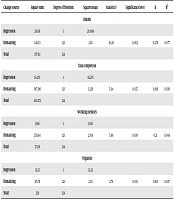
Step-by-Step Regression of the Association Between Acculturation and the Components of Brain Executive Functions
| Change Source | Square Sum | Degree of Freedom | Square Mean | Statistic F | Significance Level | R | R2 |
|---|---|---|---|---|---|---|---|
| Inhibit | |||||||
| Regression | 29.09 | 1 | 29.098 | ||||
| Remaining | 348.53 | 123 | 2.83 | 10.26 | 0.002 | 0.278 | 0.077 |
| Total | 377.63 | 124 | |||||
| Task Completion | |||||||
| Regression | 16.276 | 1 | 16.276 | ||||
| Remaining | 397.196 | 123 | 3.229 | 5.04 | 0.027 | 0.198 | 0.039 |
| Total | 413.472 | 124 | |||||
| Working Memory | |||||||
| Regression | 11.96 | 1 | 11.96 | ||||
| Remaining | 258.84 | 123 | 2.104 | 5.68 | 0.019 | 0.21 | 0.044 |
| Total | 27.08 | 124 | |||||
| Organize | |||||||
| Regression | 12.22 | 1 | 12.22 | ||||
| Remaining | 315.78 | 123 | 2.56 | 4.76 | 0.031 | 0.193 | 0.037 |
| Total | 328 | 124 | |||||
The variance of the multiple regression model was significant (P < 0.001) (Table 4). The results showed that, based on R2, the acculturation score could predict about 30% of brain function variance. Also, the results of the step-by-step regressions analysis presented, in the above table showed that the regression model was significant for four subscales (P < 0.001). As this table shows, based on the R2, the acculturation score could predict about 7%, 4%, 4%, and 3% of the variances of inhibit, task completion, working memory, and organize, respectively.
5. Discussion
The present study aimed to predict the brain executive functions in students of multicultural regions of Hamedan Province, based on the students' acculturation. As Turkish and Kurdish languages, apart from Persian, are common in this area, most students are bilingual. Based on the findings, there was a significant positive association between acculturation and brain executive functions, especially concerning four components of inhibit, task completion, working memory, and organize. It means that higher acculturation in a multicultural society can lead to better performance in the components of inhibit, task completion, working memory, and organization. Other components of executive functions (i.e., self-regulation, shift, and emotion control) were not significantly associated with acculturation. In other words, their increase does not translate into better performance in the fields of self-regulation, shift, and emotion control.
Our literature review revealed that few studies have investigated the association between acculturation and different cognitive levels in different societies. Hence, it was difficult to find studies for comparing the findings. The findings of the present study were somehow consistent with studies by Agranovich & Puente (2007) as well as Victor, Wen, Razani et al (2007) (25, 26). Victor, Wen, Razani et al (2007) argued that the bilinguals with higher acculturation had positive functions only in task activities such as numerical distance tests and language tests, demonstrating that acculturation causes significant differences in some cognitive levels. This finding is consistent with the findings of the present study; in that it was indicated that four components of executive functions were parts of cognitive levels. Also, in a study on young Americans and Europeans, Agranovich & Puente (2007) reported that the level of acculturation caused no significant difference in executive tests (25). These findings are somewhat different from the results of the present study; they mentioned no difference in the functioning and the executive functions, while the present study discussed and revealed levels of change in four components of the executive functions. In addition, the results of the present study are in line with the results found by Khaled and Bigdeli (2015), which reported the very important role of acculturation on all cognitive and neuropsychological levels; while the present study investigated the effect of acculturation only on four components of executive functions and other three components showed no significant association with acculturation (27).
There were significant differences among participants regarding executive functions, resulting, in part, from developmental and growth differences and from different interactions (28). In addition, executive functions are a set of cognitive skills with a key role in regulating learning and behavior. Several studies mentioned the executive functions capacity in early childhood in predicting academic achievements in students of mathematics and literacy for reading and writing (29). Executive functions can be considered as a set of interrelated components in adults and children, including planning, regulating, inhibit (ability to refuse to respond), working memory (ability to keep information in mind and manipulating them properly), and attention, which facilitate purposeful behavior (30, 31).
There is no consensus among researchers on the components of executive functions, but most of them believed that three components of inhibit, working memory, and planning are the main ones (32, 33). Vigotsky described the effects of social-cultural factors on the development of cognition and executive functions in two macro and micro levels. At the macro level, the organization of the society, its history, and cultural background provide the person with organized strategies, through which the person's cognitive activities are directed. At the micro-level, people's interactions and mental interactions are realized, and the effectiveness of culture occurs through social interactions. The experienced adults direct and organize individuals' cognitive activities through communicating knowledge about tools, objects, application, and practice (34).
5.1. Limitations
The present study, like other studies, had limitations. Considering the ethnic, racial, and linguistic diversity in Iran, there was no specialized native questionnaires, and all studies on evaluating the students' brain executive functions were conducted on children at ages before adolescence, and there was no tool to calculate validity and reliability for the adolescent age group in Iran. In addition, the samples were limited to the first and second high school students. The population consisted only the students of Gol Tappeh region in Kabudar Ahang city of Hamedan province. Therefore, it is suggested to conduct similar studies in other cities and provinces with cultural diversity, and the teachers dealing with monolingual, bilingual or multilingual students in all parts of the country have to be aware of different cognitive levels of each person, including executive functions to recognize each student's strengths along with observing individual differences and hence, they can help students to foster their self-confidence, talents, and creativity. In fact, teachers act like a gardener who are seeking to grow students' talents in a healthy environment.
5.2. Conclusions
This study demonstrated that acculturation has a positive significant association with brain executive functions, especially with the four components of inhibit, task completion, working memory, and organization. It means that higher acculturation in a multicultural society can translate into better performance in the components of inhibit, task completion, working memory, and organization. In the present study, we investigated seven components of executive functions and only four showed a significant association. The findings of the present study can be used by teachers working in multicultural regions to gain a right understanding of students' individual differences according to their capacity of executive functions as well as organizing the process of learning based on their working memory and the complexity of the task.