Significant population movement in the 21st century has led to an expanded interest in acculturation research and the demand for culturally and psychometrically sound measures (
1). Acculturation happens when people from diverse cultural backgrounds come into continuous first-hand contact, and is defined as the process by which individuals adopt the attitudes, values, customs, beliefs, and behaviors of another culture (
1,
2). The concept of acculturation was originally proposed by Redfield, Linton, and Herskovits, and through the years, a variety of approaches are suggested to conceptualize and measure acculturation (
3,
4).
The linear and orthogonal approaches are two leading conceptualizations of acculturation. The linear framework treats the acculturation process as a linear shift from the state of being fully un-acculturated to fully acculturated to the host country culture (
5,
6). In other words, it posits that individuals can only adhere to one culture at a time, and as they adopt the host culture characteristics simultaneously, they lose or give up the characteristics of their traditional culture (
6,
7). In contrast, in an orthogonal framework, adherence to the traditional culture and adoption of the host culture characteristics are independent processes moving along two separate continuums. It postulates that immigrants have the ability to balance both their culture of origin and the new culture (
6,
8). Berry, who espoused an orthogonal approach (
9), proposed acculturation as a two-dimensional construct with one dimension relating to the level of maintenance of the culture of origin and the second to the level of identification with the new culture. According to the two independent components, individuals could be categorized as separated (i.e., high in the culture of origin, low in the host culture), integrated (i.e., high in both cultures), assimilated (i.e., high in the host culture, low in the culture of origin), or marginalized (i.e., low in both cultures).
A wide range of measures and instruments are adopted to address the dimensionality and variation of acculturation in different cultural domains (
10). In 1987, the Suinn-Lew Asian self-identity scale (SL-ASIA) was devised by Suinn et al. (
11), in response to significant interest in the research literature of the Asian-American population, and due to the lack of objective measures of acculturation. The SL-ASIA is now the most commonly used scale to measure acculturation among Asians (
2,
11). The SL-ASIA is originally a 21-item self-report scale devised based on the initial conceptualization of acculturation as a unidimensional or linear process (
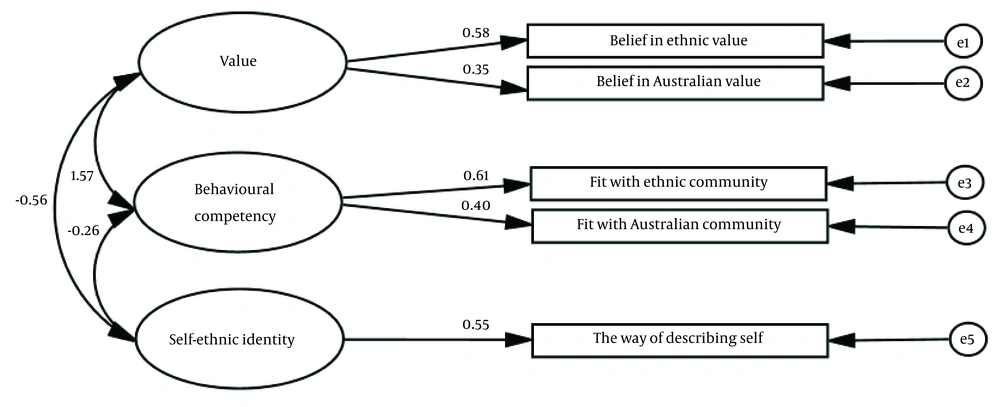
12). In the most recent version, five extra items are added to the scale to provide an additional method to bidirectionally classify responses. These items are included as the items 22 to 26, adjacent to the original 21-item SL-ASIA, and measure various aspects of acculturation comprising values, sense of behavioral competencies, and self-identity. Scores fall into one of four acculturation categories, including assimilation, integration, separation, and marginalization (
10,
13). The inclusion of the five extra items to the original SL-ASIA allows for examining both the linear and orthogonal acculturation models in the same inventory, and thus a more precise and comprehensive assessment of acculturation. Although many studies apply the 26-item SL-ASIA to address both the linear and orthogonal approaches, there is a paucity of studies examining the consistency between the two approaches (
6,
14,
15). In order to achieve the quality assessment outcomes from SL-ASIA, evaluating the potential convergence or non-convergence between the linear and orthogonal approaches is of great value, and further studies in this area are strongly advocated (
6).
Psychometric properties of the original SL-ASIA are addressed in a wide range of literature. The legibility and writing quality, satisfactory test-retest reliability over a short time, and adequate internal consistency of the scale are confirmed in numerous studies (
2,
13,
16). A meta-analysis review of published studies from 1987 to 2013 reporting the application of any version of the SL-ASIA showed that all reliability scores of this instrument range acceptable to excellent (
2). Another review of 22 studies found that the 21-item SL-ASIA had good legibility and writing quality (
13). The face and concurrent validities of the scale are also supported in many studies. A study on the validation of the SL-ASIA among Asian-American migrants showed a significant correlation between the 21-item SL-ASIA scores and demographic variables reflecting levels of Asian-American identity, and thus demonstrated a satisfactory concurrent validity of the scale (
12). Another study measuring the validity of SL-ASIA among a sample of Chinese and Filipino-Americans also supported the concurrent validity of the scale by showing a significant correlation between the 21-item SL-ASIA scores and six demographic variables assumed to reflect the level of acculturation, such as age on arrival, years of residence, and years of school attendance in the host country (
17).
The evidence regarding the validity of the SL-ASIA is still unclear due to the gaps in previous research. First, there is still a shortage of studies evaluating the construct validity of SL-ASIA, since the earlier studies are mostly deficient in using powerful statistical procedures (i.e., factor analyses) to firmly establish the structural validity of the scale (
16). For example, in two previous studies on validating the 21-item SL-AISA, the factorial validity of the scale was measured using principal components analysis (PCA), which had some disadvantages compared with factor analysis as a more recent method of measuring construct validity (
17-
19). In addition, while the SL-ASIA is the most commonly cited instrument to evaluate acculturation among Asian immigrants, all validity studies are conducted among East, South-East, and South Asian population groups (including Chinese, Korean, Vietnamese, Indian, Hmong, Filipino, Cambodian, and Japanese), and to date, no study is established on the validity of the SL-ASIA among other Asian populations such as the ones from the Middle East (
12,
17,
18,
20,
21). Moreover, the SL-ASIA is mostly validated among US immigrants and rarely among immigrants to other parts of the world (
2,
13). Furthermore, there is a lack of research on the validity of the 26-item SL-ASIA, as to the best of authors’ knowledge, no attempt is made to validate the extra five items of the scale (direct contact with Dr. Suinn-Lew) (
14,
15).
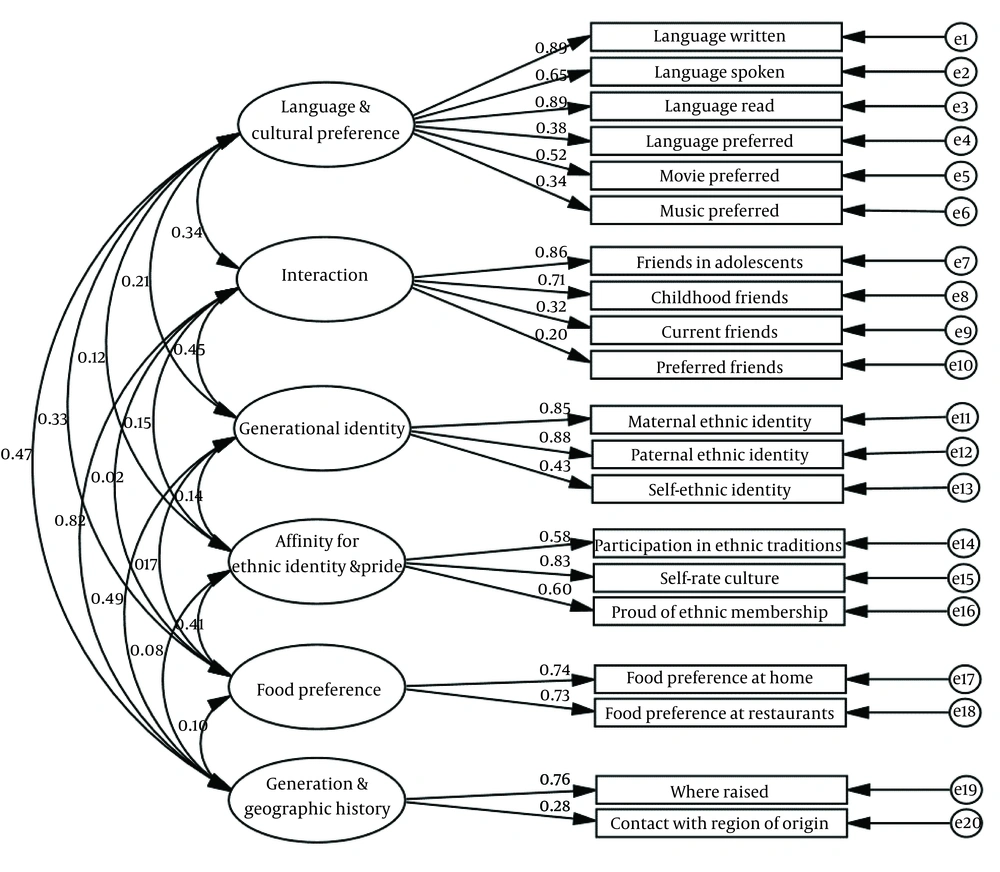
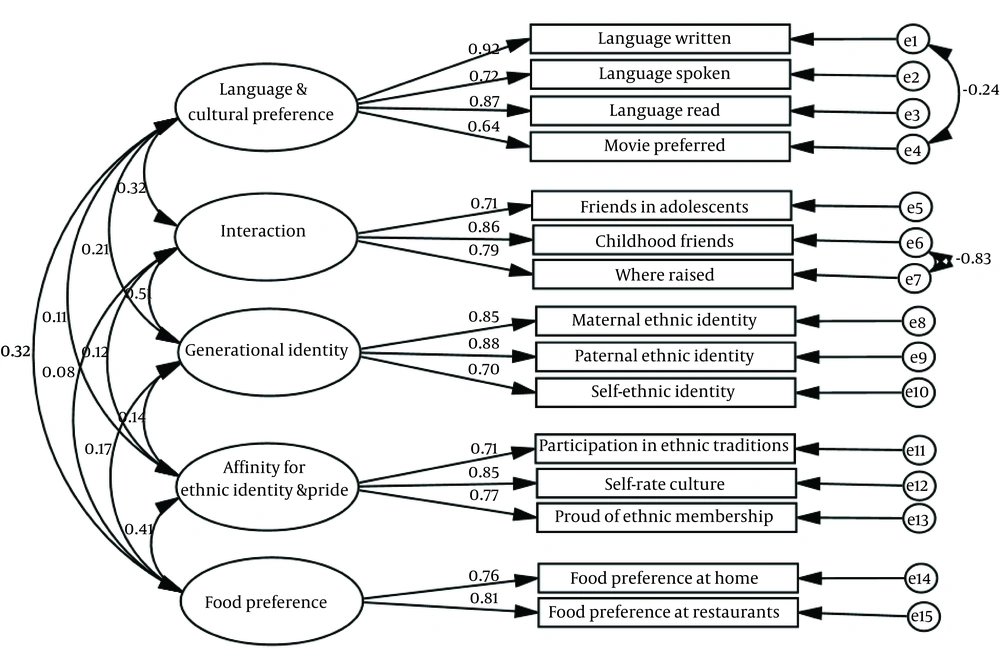
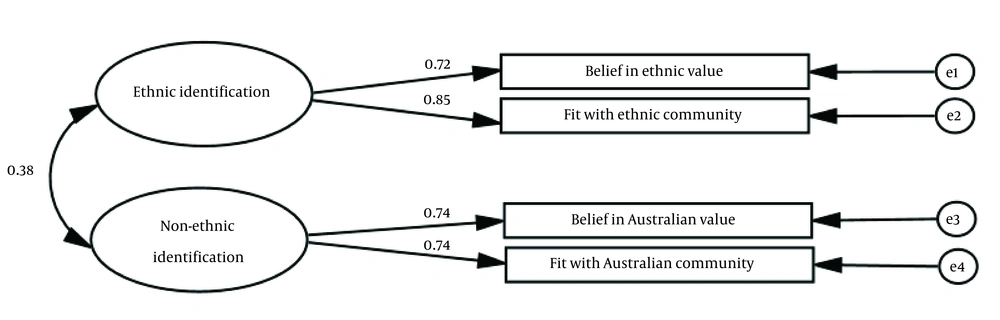
On this basis, the current study aimed at validating the 26-item SL-ASIA using confirmatory factor analysis (CFA), and also exploring the agreement between the outcomes of the linear and orthogonal approaches of acculturation using SL-ASIA. The population under study was the first-generation young adult Middle Eastern (ME) migrants in Australia. Australia is considered one of the countries with the largest immigration population and characterized by a relatively high level of ethnic diversity. Over 28% of Australians are from diverse cultural and linguistic backgrounds and are migrants from other parts of the world (
22). The Middle East is an important source of migrants to Australia since it is one of the most crisis- and conflict-prone regions in the world (
23-
25). ME migrants constitute a large population group in Australia, and thus it is crucial to investigate information concerning their acculturation from both research and practice perspectives (
23,
26). The current study focused on first-generation young adult migrants that compared to other age groups have a higher migration rate for Australia and the world (
27,
28). Since they typically seek work or study, the process of settling in the host country can be complex and protracted for them. They are involved in a wide range of demanding and often stressful tasks due to negotiating education and employment pathways, along with learning a new language and understanding and navigating a completely unfamiliar culture and society (
29-
31). If they are from refugee backgrounds, these challenges are compounded by limited or low English language skills, the traumatic nature of the refugee experience, less access to social and cultural capital, and more vulnerability to racism and discrimination (
29). This applies to many young adult ME migrants since about 60% of recent refugees to Australia are from Middle East (
26); given that, and considering the dearth of appropriate measures of acculturation in young adult migrants, it seems essential to establish a suitable scale addressing the acculturation of young adult ME migrants in Australia (
32).