
1. Background
Specific learning disorder (SLD) is characterized by experiencing problems in learning, reading, and writing skills or mathematics (1). The problems usually start during early childhood and do not conform to the child’s overall intelligence ability. The disorder results from certain interactions between some genetic and environmental factors, which involve those brain functions that are related to receiving information and responding to information. Executive functions generally include psychological functions, organizing functions, working memory, attention, problem solving, verbal reasoning, cognitive flexibility, planning, and initiation as well as monitoring of activities (2). “Executive functions” is actually an umbrella term covering most of the cognitive items, which take place in the frontostriatal or prefrontal regions in association with other neural pathways; thus, the execution of targeted behaviors will be intended, flexible, relevant, scheduled, and appropriate (3).
Cognitive flexibility means the individual’s ability to execute practically, differently, or to change thoughts in response to changes in situation (4). This is a major area in which the children with specific learning disorders experience problems (5). Planning, which is a complex and dynamic activity, is actually to design, control, measure, and improve consecutive actions. With respect to his/her futuristic view and with an awareness of changes taking place in instantaneous situations, the individual selects, executes, and analyzes appropriate plans (6). The ability to inhibit inappropriate responses, impulses, or interfering information is called response inhibition (7). Barkly (1997) suggests that the inhibition of the response of a multi-dimensional structure requires 3 interconnected processes: (a) the inhibition of dominant response to an event, (b) cessation of the current response or response pattern and creating a lag or opportunity to make appropriate decision as to responding or continuing, and (c) protecting the lag and self-directed responses from rival responses, which occur in this interval (interference control) (8). The inhibition is actually the futuristic aspect of thought and behavior as to the executive functions, with which a normal individual can prevent the occurrence of dominant behaviors and exhibit targeted behavior. Children with learning disorders are defective in planning and response inhibition (5, 9). Attention is one of the most important aspects of cognition in humans, which is generally known as focus and awareness, and is subcategorized into 4 subcategories – i.e., sustained attention, selective attention, divided attention, and shifting attention – each of which is controlled by a specific cerebral region (10). Selective attention means deliberately selecting the targeted stimulus and concurrently ignoring the irrelevant stimuli; children with learning disorder are also defective in this area (9).
Toll et al. investigated the predictability of learning disorders in math by evaluating executive functions. They measured the response inhibition, shifting, and working memory and concluded that the working memory could predict learning disorders in math (11). In a meta-analysis, Booth et al. emphasized that children with reading disorders experienced problems in such executive function as keeping information in working memory, inhibition of irrelevant information, and accessing the information stored in long-term memory (12). In a longitudinal study on children with learning disorders, Rebecca bull et al. concluded that the short-term visual memory could predict math problems and executive functions could also predict learning problems in these children (13). In a study on executive functions in students with learning disorders, Fairleigh and Noame indicated that students with learning disorders in math were defective in many executive functions and students with reading disorders were defective in response inhibition, planning, and flexibility (14). Studying the impacts of executive functions on learning disorders in math, khosrorad et al. indicated that students with this disorder were defective in working memory, planning, problem solving, selective attention, and changing focus (9).
2. Objectives
Based upon the above literature, most of the studies have focused on children with math learning disabilities and, as a result, cognitive flexibility, planning, and attention have not been dealt with in children with reading disorders. On the other hand, the significance of executive functions in the etiology of these disorders has been stressed in the recent decade. With respect to this body of knowledge and the lack of a specific therapeutic method to treat this problem in children with reading disorders, it may be helpful to analyze the relationship between executive functions and reading problems in children with specific learning disorders in order to design a therapeutic protocol. Thus, the purpose of this study is to determine the relationship between executive functions and reading problems in children with a specific learning disorder.
3. Methods
In this cross sectional study, 29 children with a specific learning disorder were selected conveniently using the following formula. One clinical psychologist and 1 pediatric psychiatrist confirmed the diagnosis of SLD, separately using DSM_IV_TR diagnostic criteria for SLD. Moreover, children with SLD were screened using the NAMA Reading and Dyslexia Test so that children with RLD can be selected. In addition, participants met the following inclusion criteria: (a) aged between 7 and 12 years old, (b) scored within a normal range with regards to the Intelligence quotient, and (c) not to be afflicted with acute medical or genetic conditions. The exclusion criteria included: (a) taking medicine that can affect the results of this study according to the psychiatric and (b) history of visual or auditory impairments (s) having comorbid disorders such as attention deficit/ hyperactivity disorder or autism.
The research population included all children with SLD who were referred to the centers for children with learning disorders, in 2016, in Esfahan. The study was approved by the ethics committee for human experiments, Isfahan University of Medical Sciences, Isfahan, Iran and informed consents were obtained from parents of children before assignment. All information regarding the participants remained confidential and participants were allowed to leave the study whenever they wanted.
The NAMA Reading and Dyslexia Test, the Tower of London, the Stroop Color and Word test, and the Wisconsin card sorting test were administered.
To analyze data, the partial least squares (PLS) method with P < 0.05 was used, which is a variance-based method and has its own advantages. We used the Smart PLS software version 2.
In the covariance-based method, known as covariance-based structural equation modeling (CBSEM), assumption like continuity and normality of variables are essential, whereas there are no such requirements in PLS and the non-continuous and non-normalized variables (hence, the 2-value variables) could be analyzed.
3.1. The NAMA Reading and Dyslexia Test
The NAMA Reading and dyslexia test was normalized by Reza Karami Noori and Alireza Moradi to identify dyslexia in children referred to learning disorder centers. This test has 10 sub-tests including: reading words, reading chain of words, rhymes, naming images, comprehension, understanding words, removing vocals, reading non-words, cues of letters, as well as cues of categories. This test was performed for 5 years on 1614 students including 770 boys and 844 girls in 5 different grades in the cities of Tehran, Sanandaj and Tabriz. After data collection and statistical analysis, raw scores and norm scores were obtained for each grade in each city (15).
3.2. The Tower of London (TOL)
TOL test is a well-known test for assessment of executive functions, specifically to detect deficits in planning and organization and has acceptable construct validity in this regard. The validity of this test was reported to be 0.79 (16).
3.3. The Stroop Color and Word Test
One measure of executive function was originally developed in 1935 by Stroop to measure selective attention or focused attention and response inhibition. It measures the ability of an individual to shift the cognitive set (17) and provides a way of scoring cognitive inhibition (18, 19). The Stroop is used frequently to test the function of the frontal lobe. There are 3 components to this task. First, the therapist asks the individual to name a series of color words (Word task). Then, the therapist asks the individual to name the color of a bar (Color task). Third, the therapist asks the individual to name Color-Word on which the names of colors were printed in conflicting ink colors (i.e., the word “red” in blue ink) (20).
3.4. The Wisconsin Card Sorting Test (WCST)
WCST is utilized to assess problem solving and decision making. Variables of this test includes: total errors, perseverative errors, non-perseverative errors, trials to first category, conceptual level responses, categories obtained, and failure to maintain the set. WCST is manually administered to 6 categories or 128 cards and is scored using the computer-scoring program (21).
4. Results
The subjects of this study were 29 elementary school children in grades 1 - 5 with reading disorders, including 23 boys (with the frequency of 79.23%) and 6 girls (with the frequency of 20.68%).
The average scores and the standard deviation of the NAMA Test indicators are presented in Table 1; the planning, Stroop, and cognitive flexibility are shown in Table 2.
Table 1.
The Mean Score and Standard Deviation for the NAMA Reading and Dyslexia Test
| Subtests | Mean | Standard Deviation |
|---|---|---|
| Reading words | 19.00 | 1.52 |
| Reading chain of words | 11.07 | 1.25 |
| Rhymes | 9.00 | 1.52 |
| Naming images | 38.00 | 0.011 |
| Comprehension | 10.38 | 1.66 |
| Understanding words | 11.23 | 1.16 |
| Removing vocals | 8.23 | 1.09 |
| Reading non-words | 8.61 | 1.14 |
| Cues of letters | 18.84 | 1.14 |
| Cues of categories | 39.69 | 2.21 |
Table 2.
The Results for the Wisconsin card Sorting Test, the Stroop Color and Word Test, and the Tower of London Test
| Tests | Components | Mean | Standard Deviation |
|---|---|---|---|
| The Wisconsin card-sorting test (cognitive flexibility) | Preservation obtained categories | 10.87 | 2.33 |
| Total errors | 18.00 | 1.52 | |
| Total correct | 10.07 | 1.25 | |
| The Stroop Color and Word test | Response inhibition | 7.00 | 1.52 |
| Selective attention | 11.00 | 0.011 | |
| The Tower of London test (planning) | Time of the test | 9.38 | 1.66 |
| Score of the test | 10.23 | 1.16 |
4.1. Overall Analysis of the General Model
Figure 1 illustrates the path coefficients of our model. The number on the line is the coefficient of path, indicating the effect of the independent variable on the dependent variable; the higher the number is, the greater the effect of the independent variable on the dependent variable will be. Positive and negative values indicate direct and indirect relationships, respectively.
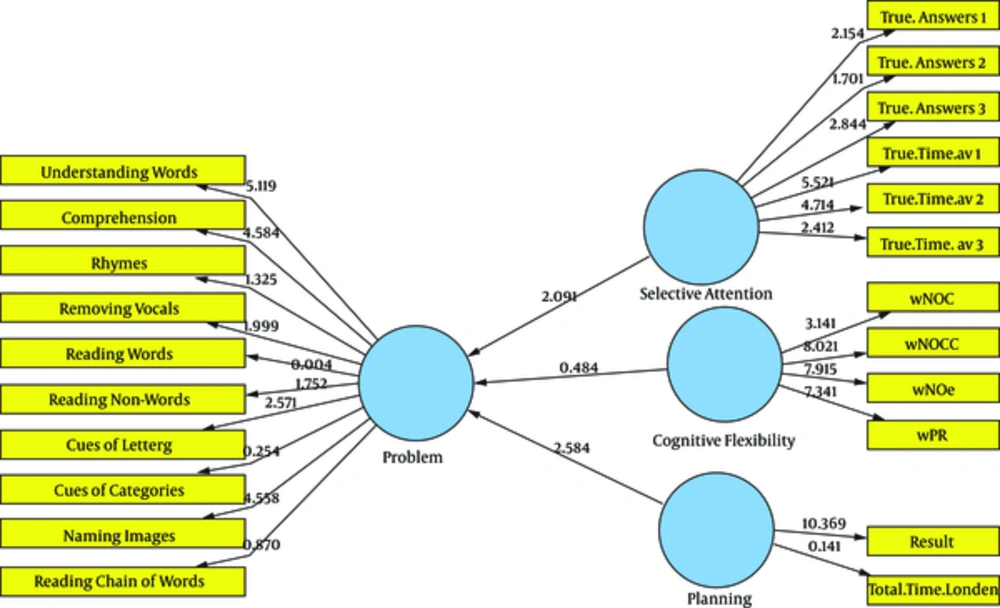
Figure 1.
The Path Coefficients of Model
Figure 1 shows the values of ‘t’ statistic, which is calculated by the Boot-Strping method. The values higher than 1.96 means that the path coefficients of these values are meaningful with a 95% degree confidence. The values lower than 1.96 make the path rejected. In other words, the path coefficients of these values are not statistically meaningful and are random. According to Figure 1, it is obvious that one path lacks the meaningful coefficient; therefore, its assumptions are removed.
Hypothesis number 1: Selective attention is related to reading problems and the ability to predict learning troubles. According to Figure 1, the path coefficient of this hypothesis is -0.37. According to Figure 2, the value of ‘t’ statistic for this path and this hypothesis is 2.073, which is higher than the critical value of 1.96 for the certainty level of 95%. Thus, this hypothesis is statistically approved.
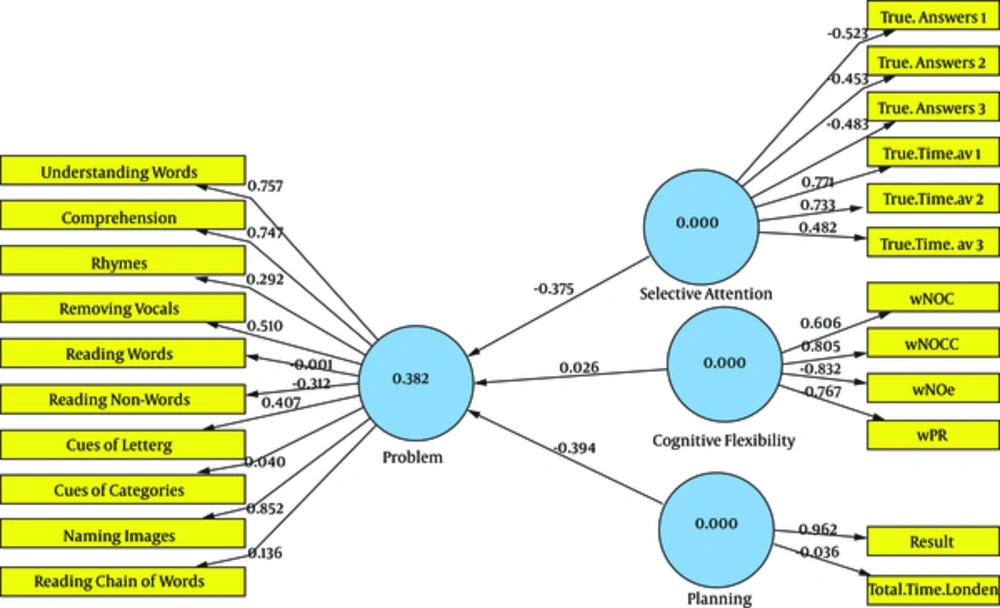
Figure 2.
The Value of ‘t’ Statistic for Path and Hypothesis
Hypothesis number 2: Cognitive flexibility is related to reading problems and can predict reading problems. According to the the path coefficient of this hypothesis is 0.026. According to Figure 2, the value of ‘t’ statistic for this path and this hypothesis is 0.38, which is lower than the critical value of 1.96 for the certainty level of 95%. Thus, this hypothesis is not statistically approved.
Hypothesis number 3: Planning is related to reading problems and can predict reading problems. According to Figure 2, the value of ‘t’ statistic for this path and this hypothesis is 2.512, which is lower than the critical value of 1.96 for the certainty level of 95%. According to Figure 1, the path coefficient of this hypothesis is -0.39. Thus, this hypothesis is not statistically approved.
4.2. Summary
Table 3 shows the status of the hypotheses modeled in this study. From 3 statistical hypotheses, 2 were approved and 1 was not.
Table 3.
Indices of Evaluating Univariate and Multivariate Normality after Removing the Outlier Dataa
| Variables | Minimum | Maximum | Skewness | Kurtosis |
|---|---|---|---|---|
| Dyslexia | 7.68 | 24 | 0.310 | 0.420 |
| Correct responses of Stroop | 11 | 41 | 0.174 | 1.73 |
| Time of responses of Stroop | 8.82 | 41 | 0.064 | 0.191 |
| Time of the test of TOL | 16 | 40 | -0.188 | -0.268 |
| Score of the test of TOL | 14 | 39 | -0.315 | 0.776 |
| Obtained categories of WCST | 9 | 50 | 0.532 | 1.92 |
| Preservation of WCST | 4.81 | 55 | 0.844 | 0.468 |
| Total correct of WCST | 8 | 72 | 0.463 | -0.969 |
| Total error of WCST | 4 | 14 | 0.285 | -0.393 |
aCritical ratio = 1.74; Mardia coefficient (multivariate) = 5.12.
Table 4.
Fit Indices of the Suggested Model and the Modified Model
| Indices | CMIN/DF | GFI | AGFI | IFI | TLI | CFI | PNFI | RMSEA |
|---|---|---|---|---|---|---|---|---|
| Accepted range | 1 to 5 | More than 0.9 | More than 0.8 | More than 0.9 | More than 0.9 | More than 0.9 | More than 0.5 | Less than 0.08 |
| Preliminary suggested model | 2.15 | 1.13 | 0.91 | 1.35 | 0.81 | 0.85 | 0.64 | 0.082 |
| Fitness status | Fit | Fit | Fit | Fit | Not fit | Not fit | Not fit | Not fit |
| Final modified model | 2.09 | 1.08 | 0.85 | 1.22 | 0.94 | 0.96 | 0.61 | 0.059 |
| Fitness status | Fit | Fit | Fit | Fit | Fit | Fit | Fit | Fit |
5. Discussion
This study aimed to investigate the relationship between response inhibition, planning, selective attention, and cognitive flexibility with reading difficulties in children with SLD. A significant relationship was also reported between selective attention and reading difficulties in children with SLD, which are consistent with the results obtained by Soltani et al. (19). They compared 10 children with mathematical learning disabilities to 10 typically developed children between the ages of 8 to 12 years old. After analyzing the results obtained from the Stroop test, it was found that students with learning disorders took more time to name the cards than the controlled group and therefore, they concluded that children with mathematical learning disabilities have lower selective attention compared to typically developed children (19). Denckla investigated the relationship between learning and attention deficit; of course, in this study, he investigated overacting children with learning disorders and attention deficits. He concluded that there is a meaningful relationship between attention deficits and learning in these children, which is considered as a fundamental basis of learning (20).
Attention deficits may be a basis of cognitive and educational problems in a child. Data processing needs attention. Among the stimuli, which are received by sensory receptors from surroundings, those are fully processed that are selectively paid attention (noticed) (21).
Selective attention requires focusing on some mental activities and ignoring others. In fact, selective attention is focusing on required stimuli and receiving necessary information in order to do the tasks. Selective attention is extremely necessary for educational activities such as reading, due to the fact that it helps the individual keep reading while the amount of other information and stimuli interfere with the reading process (22).
It seems that, due to the limited capacity of attention and the large amount of surrounding stimuli, children lack the ability to learn to distinguish between main and required stimuli and the unnecessary ones (21). Therefore, they cannot selectively focus on the information that is necessary for reading and cannot differentiate between necessary and non-necessary data.
The result of this study indicated that there was no significant relationship between cognitive flexibility and reading problems in children with learning disorders. These results aren’t consistent with the results obtained by Cole, LG Duncan, A Blaye (23), Bull et al. (13), Evelyn S. Johnson et al. (24), Moura et al. (25), and Fairleigh et al. (14).
Cognitive flexibility is the ability of the individual to show appropriate responses in dealing with new situations, which is very important in performing activities of daily living, such as homework assignments. Johnson et al. showed that children with mathematical learning problems have moderate difficulties in processing visual working memory information and intense difficulties in cognitive processes of executive functions. They showed that the most prevalent deficits in RLD belonged to phonological processes, processing speed, and verbal working memory (24). In a study by Cole, P., Duncan, LG, and Blaye, in which they studied the prediction of reading skill through cognitive flexibility, they concluded that this concept is related to reading comprehension. However, this essay also referred to the limited references for the study and confirmed the need for further studies (23).
Rebeca Bull et al., in a longitudinal study between work memory, short-term memory, and executive function in preschool children of 7 years, concluded that the executive function could predict the general learning of these children (13). Fairleigh and Noame, in a study on the executive functions of people with learning disorders indicated that people with math learning disorders have difficulty in many executive functions and people with reading disorders have difficulty in response inhibition, planning, and flexibility (14).
Simoes MR and Pereira M, investigated the executive function in children with reading disorders. In this study, the speed of processing, flexibility, planning, and fluidity of the word was studied in 50 children with reading disorders and 50 normal children between the ages of 8 and 12 in Portugal. After comparing the 2 groups, significant defects were observed in the processing speed, flexibility and fluidity of the word, while there was no significant difference in planning between the groups (25).
Probably the reason for the difference in the obtained results regarding cognitive flexibility in this study can be explained by the use of the Wisconsin sorting card tool. Also, the number of samples and even the severity of the disorder were different in the above studies, which could be the reason for the difference in the obtained results.
Significant relationships were also reported between planning and reading difficulties in children with SLD, which is consistent with the results obtained by Mclean and Hictch (26), Fairleigh and Noame (14), MirMahdi et al., (27) and Denckla (28). Planning is the ability to design, observe, evaluate, and modify consecutive actions (28). According to Mclean and Hictch, children with mathematical learning disabilities have the greatest difficulty in organizing, planning, and response inhibition compared to normal children (26). Mirmahdi et al., also showed that children with mathematical learning disorders have difficulties in organization and planning (27). Denckle also believed that children with attention deficit/hyperactivity disorder have difficulty in learning due to an impaired planning ability as an executive function (28).
The results of this study are also inconsistent with the results of Moura O, Simoes MR, and Pereira M’s studies, which were on the planning from executive function (25). In their study, there was no significant difference in planning between groups after comparing executive functions between children with learning disorders and normal children. The reason for the difference in results can be attributed to the difference between the samples and the measured (measuring) instruments.
In explaining this finding, it can be said that theplanning skill is another component of executive functions that is related to reading comprehension. Successful comprehension fairly depends on higher-level executive skills such as reasoning, critical analysis, planning, and organizing (29). People who are good in reading comprehension are more likely to use more cognitive and metacognitive solutions, which includes planning (30). Conversely, children who are deficient in reading comprehension are usually weaker than their normal peers on a scale that requires organized response and planning. For example, they copy complex geometric shape in such a way that is less organized and structural, and they require a longer time to plan for completing the visual problem solving tasks (31). Hence, children with reading disorders hardly use cognitive and meta-cognitive solutions such as planning, and therefore, they perform weaker in planning tasks.
In general, the results of this study are consistent with the research literature on the problems of executive functions in children with learning disorders. Of course, most studies have been conducted on children with learning disorders in math and this study is one of the first studies that investigated 4 areas of executive function in children with reading disorders. The “executive function” skills is in fact import cognitive, which is occurred by the frontal area or frontostriatal area in conjunction with other neural networks; therefore, targeted behaviors will be executed in a planned, flexible, relevant, scheduled, and appropriate way (30). Furthermore, due to the effect of these networks on learning and reading, the reason of the relationship between executive function and reading problems in children with learning disorders could be explained better.
5.1. Conclusion
Regarding the outcome of this study that suggests there is the relationship between response inhibition, planning, selective attention, and reading problems in children with specific learning disorder, the severity (intension) of reading problems of these children could be reduced by designing appropriate therapeutic interventions for the sake of improved executive functions.