
1. Background
Trauma is defined as the acute contact of the body with mechanical energy, heat, electricity, chemicals, or radioactive rays beyond the body’s tolerance. Injuries resulting from trauma have been a significant health concern globally, caused by various factors such as vehicle accidents, falls, altercations, and other causes (1-3). Trauma is a common cause of morbidity and mortality in humans, occurring in different parts of the body. Trauma is any type of penetrating or non-penetrating wound or injury inflicted upon the human body by external agents, either intentionally or unintentionally. In addition to imposing direct and indirect social and economic costs on society, trauma is recognized as the fourth leading cause of death in humans (4-9). Trauma encompasses various types, one of which involves injuries to the brain and spinal cord system (10).
Traumatic spinal cord injuries refer to spinal cord damage resulting from driving, falls, sports, and violence. This injury is a devastating complication that, depending on its extent and severity, causes enormous changes in the health and lifestyle of the affected individual (11, 12). In terms of spinal injury classification, injuries include spinal cord injuries and bony injuries. Factors that highlight the importance of attention to spinal injuries include the high costs of injuries in developed countries and high mortality rates in developing countries, the geographical spread of causes leading to early or delayed spinal injuries following vertebral damage, disability, and depression (13). Regarding the prevalence of head trauma in Iran, the study by Sadeghi and Mohammadi can be referenced. In this meta-analysis involving a sample size of 99,306 from 22 articles, the prevalence of head trauma was reported as 26.2%, indicating its considerable impact (14).
Another type of trauma involves orthopedic injuries. Lower limb injuries are one of the common complaints in the emergency department, including injuries involving blood vessels, bones, soft tissues, and nerves, which can be affected separately or concurrently. The most common sites for lower limb fractures are the tibia and femur, which lead to numerous complications for patients (15, 16). Orthopedic injuries not only cause psychological, social, and economic problems for the patient and their family but can also result in long-term physical disabilities. Paying attention to the mechanism of injury can specify the likelihood of fractures in different environments and various physical activities, providing necessary warnings to individuals regarding the prevention of these injuries (17-19). Orthopedic diseases lead to complications such as pain. For instance, in the meta-analysis study by Hatefi et al., 25.4% of children had musculoskeletal pain, with knee pain at 22% and shoulder pain at 29.3% (20).
Factors influencing orthopedic and spinal traumas include accidents, falls from heights, as well as underlying diseases such as osteoporosis and rheumatoid arthritis (RA) (21-23). The RA is a debilitating, systemic autoimmune disease characterized by chronic joint inflammation, progressive destruction, joint deformity, and limitation in daily life activities. The prevalence of RA worldwide is about 1%, typically appearing in middle age, during the third to fifth decades of life. The RA is an autoimmune disease characterized by chronic inflammation in the synovial tissue of the joint, leading to the destruction of multiple joints and ultimately severe disability (24-27).
The RA is an autoimmune disease of unknown etiology, where progressive destruction of joints and surrounding tissues is observed during its course. With a high prevalence, RA is the most common inflammatory and destructive joint pain worldwide, most frequently affecting the small joints of the hands and feet, though any synovial joint can be involved. Various factors contribute to the development of RA. One of these factors is infection. Microbial infections are implicated in the pathogenesis of RA, with Staphylococcus aureus, viral infections, pericarditis, and periodontal infections being proposed in the pathogenesis of RA (28-30). Regarding the prevalence of rheumatic diseases, the Davatchi et al.’s study, with a sample size of 75,149,669, showed that musculoskeletal complaints were reported in 44.7% of the individuals surveyed within the last 7 days. Reported issues included shoulder complaints at 15.6%, hands and fingers at 10.2%, and the hip at 8.3%. The RA itself was reported in 0.37% of the patients (31).
2. Objectives
Given the importance of patients with RA, this study was conducted with the aim of determining the clinical characteristics and outcomes of spinal and orthopedic traumas in patients with RA.
3. Methods
In this study, patients who were admitted to Imam Khomeini Hospital due to spinal trauma or orthopedic trauma between the beginning of 2022 and the end of 2024 were included. The inclusion criteria for this study comprised patient presentation and admission due to a confirmed diagnosis of spinal or orthopedic trauma, the patient being within the age range of 18 to 65 years, and a documented history of RA according to the records in the patient’s medical file. Patients with incomplete records were excluded from the study.
For data collection, the researchers designed a researcher-made checklist based on a review of published articles (32, 33). This checklist contained demographic information about the patients, as well as questions regarding spinal injuries, orthopedic injuries, and combined injuries, which were completed with a “Yes/No” format.
To adhere to ethical codes, the researchers obtained the Research Ethics Code (IR.MEDILAM.REC.1403.233) and followed the university’s research ethics guidelines at all stages. Furthermore, patient information was reported in a summarized manner, and the confidentiality of the data in the patient files was maintained. All individuals involved in data extraction possessed the necessary expertise and experience regarding the research objectives, the checklists used, and patient medical records.
Quantitative data analysis was performed using descriptive statistical tests (including reporting the number and percentage of observed cases) and inferential tests entered into SPSS version 16 software. The significance level in this study was set at P < 0.05.
4. Results
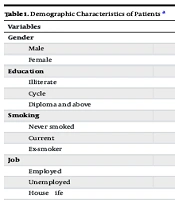
The demographic characteristics of the patients are shown in Table 1. According to the findings, out of 155 patients with RA, 36 patients were hospitalized due to SCI, 91 patients due to orthopedic trauma, and 28 patients due to orthopedic and SCI trauma. Regarding the gender of the patients, it was shown that 42.9% of them were male and 57.1% were female. Also, most of the patients had a cycle level education (53.6%), trauma due to road traffic crashes (39.3%), and had a discharge status from the hospital (57.1%).
Table 1.
Demographic Characteristics of Patients a
| Variables | Spinal Cord Injury (N = 36) | Orthopedic Injury (N = 91) | Orthopedic and SCI (N = 28) |
|---|---|---|---|
| Gender | |||
| Male | 17 (47.2) | 42 (46.2) | 12 (42.9) |
| Female | 19 (52.8) | 49 (53.8) | 16 (57.1) |
| Education | |||
| Illiterate | 9 (25) | 38 (41.8) | 2 (7.1) |
| Cycle | 23 (63.9) | 29 (31.9) | 15 (53.6) |
| Diploma and above | 4 (11.1) | 24 (26.4) | 11 (39.3) |
| Smoking | |||
| Never smoked | 10 (27.8) | 41 (45.1) | 12 (42.9) |
| Current | 20 (55.6) | 36 (39.6) | 15 (53.6) |
| Ex-smoker | 6 (16.7) | 14 (15.4) | 1 (3.6) |
| Job | |||
| Employed | 13 (36.1) | 31 (34.1) | 6 (21.4) |
| Unemployed | 11 (30.6) | 17 (18.7) | 5 (17.9) |
| Housewife | 9 (25) | 34 (37.4) | 9 (32.1) |
| Retired | 3 (8.3) | 9 (9.9) | 8 (28.6) |
| Mechanism of trauma | |||
| Assault/violence related | 2 (5.6) | 12 (13.2) | 5 (17.9) |
| Road traffic crashes | 16 (44.4) | 42 (46.2) | 11 (39.3) |
| Fall | 17 (47.2) | 30 (33) | 10 (35.7) |
| Other | 1 (2.8) | 7 (7.7) | 2 (7.1) |
| ICU admission | |||
| Yes | 30 (83.3) | 29 (31.9) | 24 (85.7) |
| No | 6 (16.7) | 62 (68.1) | 4 (14.3) |
| History osteoporosis | |||
| Yes | 17 (47.2) | 55 (60.4) | 20 (71.4) |
| No | 19 (52.8) | 36 (39.6) | 8 (28.6) |
| Outcome | |||
| Discharge | 31 (86.1) | 83 (91.2) | 16 (57.1) |
| Death | 5 (13.9) | 8 (8.8) | 12 (42.9) |
a Values are expressed as No. (%).
According to the findings, a significant relationship was observed between the type of trauma and the mortality status of the patients. Specifically, in patients with RA who were hospitalized due to orthopedic and SCI trauma, the mortality rate was higher than in other patients (Table 2).
Table 2.
Comparison of Patient Survival Status According to Patient Demographic Characteristics a
| Variables | Survivor | Non-survivor | All Patients | P-Value |
|---|---|---|---|---|
| Gender | 0.65 | |||
| Male | 60 (46.2) | 11 (44) | 71 (45.8) | |
| Female | 70 (53.8) | 14 (56) | 84 (54.2) | |
| Type of trauma | 0.004 | |||
| Spinal cord injury | 31 (23.8) | 5 (20) | 36 (23.2) | |
| Orthopedic injury | 83 (63.8) | 8 (32) | 91 (58.7) | |
| Orthopedic and SCI | 16 (12.3) | 12 (48) | 28 (18.1) | |
| Mechanism of trauma | 0.51 | |||
| Assault/violence related | 12 (9.2) | 7 (28) | 19 (12.3) | |
| Road traffic crashes | 63 (48.5) | 6 (24) | 69 (44.5) | |
| Fall | 47 (36.2) | 10 (40) | 57 (36.8) | |
| Other | 8 (6.2) | 2 (8) | 10 (6.5) | |
| Smoking | 0.94 | |||
| Never smoked | 53 (40.8) | 10 (40) | 63 (40.6) | |
| Current | 59 (45.4) | 12 (48) | 71 (45.8) | |
| Ex-smoker | 18 (13.8) | 3 (12) | 21 (13.5) |
a Values are expressed as No. (%).
There was also a correlation between infection and VAP in patients with mortality, and the mortality rate in patients with infection and VAP was higher than in other patients (Table 3).
Table 3.
Comparison of Patient Survival Status According to Patient's Clinical Symptoms a
| Variables | Survivor | Non-survivor | All Patients | P-Value |
|---|---|---|---|---|
| Sepsis | 0.33 | |||
| Yes | 37 (28.5) | 6 (24) | 43 (27.7) | |
| No | 93 (71.5) | 19 (76) | 112 (72.3) | |
| VAP | 0.018 | |||
| Yes | 14 (10.8) | 5 (20) | 19 (12.3) | |
| No | 116 (89.2) | 20 (80) | 136 (87.7) | |
| Infection | 0.000 | |||
| Yes | 18 (13.8) | 10 (40) | 28 (18.1) | |
| No | 112 (86.2) | 15 (60) | 127 (81.9) | |
| ARDS | 0.08 | |||
| Yes | 21 (16.2) | 6 (24) | 27 (17.4) | |
| No | 109 (83.8) | 19 (76) | 128 (82.6) | |
| AKI | 0.28 | |||
| Yes | 15 (11.5) | 2 (8) | 17 (11) | |
| No | 115 (88.5) | 23 (92) | 138 (89) |
a Values are expressed as No. (%).
5. Discussion
This study was conducted to investigate the clinical characteristics of patients with RA hospitalized due to orthopedic and spinal cord injuries. In the study by Karimiyarandi et al. in Iran (32), 270 patients hospitalized due to road traffic injuries (RTIs) with spinal cord fractures (SCF) and general orthopedic fractures (GOF) were examined. According to the findings, in the SCF group, 39 cases (14.4%) involved the cervical spine, 38 cases (14.1%) involved the dorsal spine, 62 cases (23%) involved the lumbar spine, 43 cases (15.9%) involved the sacral spine, and 88 cases (32.6%) involved multiple trauma. In the GOF group, 64 cases (23.7%) involved the clavicle/shoulder, 38 cases (14.1%) involved the upper limbs, 72 cases (26.7%) involved the lower limbs, 29 cases (10.7%) involved the pelvis, and 67 cases (24.8%) involved multiple trauma (32). A key difference between the results of the current study and that of Karimiyarandi et al. (32) is that the latter only examined patients hospitalized specifically due to RTIs. In contrast, the cause of hospitalization was not a criterion in the present study; all hospitalized patients with a history of RA who presented with trauma were investigated. Furthermore, a study by Najdaghi et al., with a sample size of 25,986 trauma patients and 1,167 spinal trauma cases, showed a significant difference in the mechanisms of injury to the spine. The observed injuries were most frequent in the lumbar area, followed by the thoracic area (34).
In the prospective study by Shayesteh Azar et al., orthopedic injuries that were initially missed in patients with multiple trauma were investigated. According to the findings, the types of injuries included fractures of the clavicle, acetabulum, scaphoid, femoral neck, metacarpal, calcaneus, lateral malleolus, and hip dislocation. The frequency of these missed injuries was 5.8%, and in 44.4% of these cases, the identification of these injuries led to a change in the treatment plan from non-surgical to surgical management (35). The results of this study are consistent with the findings of the current study regarding the presence of orthopedic fractures in the patients.
In the study by Mohamed and Merza, 210 patients referred to the Rheumatology Department were examined, and after confirming the diagnosis of RA, the status of their spinal radiographs was evaluated by two experienced radiologists. If a vertebral injury was present, the fractures were classified into three categories: Wedged, biconcave, and crushed. According to the findings, at least one type of fracture was present in 27.8% of women and 52% of men. The factors contributing to vertebral fractures included osteopenia, osteoporosis, older age, lower education level, and male gender (33). Additionally, another study demonstrated a link between RA and an increased risk of fracture, reporting high rates of forearm, femur, lower leg, and rib fractures in these patients. Moreover, a meta-analysis by Xue et al. involving 13 articles indicated that the incidence of fractures, including vertebral and hip fractures, was higher in patients with RA compared to those without RA (36).
One limitation of this study is the reliance solely on patient clinical records without conducting in-person clinical examinations. Therefore, it is recommended that future studies adopt a prospective approach. Furthermore, all patient information from the moment of hospital admission should be recorded, and the diagnosis of RA should be definitively confirmed using clinical examinations, diagnostic test results, clinical documentation, and patient interviews.
5.1. Conclusions
Given that the mortality rate in patients with both orthopedic trauma and spinal cord trauma is higher than in other patients, it is essential that these patients be given higher priority.