
1. Background
One of the most significant roles of the family unit is to promote marital satisfaction, which profoundly impacts overall life satisfaction. Maintaining marital satisfaction requires effort from both spouses and is influenced by various factors. Sexual function (SF) and sexual satisfaction are important determinants of marital satisfaction. The SF is a fundamental aspect of human behavior and life, shaped by psychological, social, and biological factors. Furthermore, sexual health is defined as the harmony and integration of the physical, emotional, rational, and social aspects of human sexuality, leading to personal development and the strengthening of intimate relationships within the family (1-4).
The SF disorders can have adverse effects on individuals, including physical and emotional disturbances. Such disorders may lead to decreased self-confidence, compromised mental health, anxiety, stress, and reduced life satisfaction, among other negative outcomes (5-7). In women, physical sexual dysfunction can manifest as lack of sexual desire, pain during sexual activity, inability to achieve orgasm, or a combination of these issues (8). Factors affecting sexual dysfunction in women include genetic, hormonal, physical, psychological, and pharmacological influences, with medications such as diuretics, antidepressants, and oral contraceptives having notable impacts (9, 10).
Previous studies have shown that SF and satisfaction are affected by a variety of psychological and physical illnesses. Sexual dysfunction in couples may result from physiological, psychological, biological factors, or the side effects of medications. Diseases affecting the central nervous system (CNS), such as cervical discopathy (CD) and lumbar discopathy (LD) diseases, have been shown to influence SF status (11-15).
Discopathy refers to disorders affecting the intervertebral discs. In LD, the discs between or adjacent to the lumbar vertebrae are involved. The LD is a common cause of back pain, with risk factors including height, weight, gender, occupation, daily activities, and work type (16-18). Back pain is a major reason for seeking medical consultation and hospital admission, and it is a significant indication for surgical intervention. Pain and discomfort in the lower back are common symptoms of many musculoskeletal and non-musculoskeletal conditions, with a high prevalence in the community. Although pain usually resolves within one to four weeks for most patients, in conditions such as discopathy, pain may become chronic and significantly impact patients’ quality of life and marital satisfaction (19-21).
Given the importance of SF, it should be considered a critical aspect of human life, particularly in the diagnosis and treatment of patients with disc disease. However, sexual issues are rarely discussed with these patients during medical visits. Despite the significance of this issue, there are limited global studies on SF disorders in patients with lumbar and cervical disc disease, and this topic has received little attention in Iranian society. For example, Moradi et al. reported that lumbar disc herniation can cause sexual dysfunction in women (22).
2. Objectives
Given the significant role of SF, this study was conducted to compare SF scores in patients with CD and LD diseases with those of a healthy control group.
3. Methods
This case-control study was conducted in Ilam city, Iran, in 2025. The patient group included 48 individuals with CD and 48 individuals with LD. The control group comprised 48 healthy individuals without any underlying disease.
Diagnosis of CD or LD in the patient group was confirmed by an Associate Professor of Spine Surgery through clinical examination, detailed medical history, and review of radiological findings, including magnetic resonance imaging (MRI). Patients meeting the inclusion criteria were informed about the study objectives, interviewed, and provided written informed consent.
Inclusion criteria were: Iranian nationality; voluntary and informed consent; age between 18 and 60 years; ability to read and write; being married and monogamous; absence of chronic disease or any underlying condition affecting SF (such as diabetes, cardiovascular diseases, musculoskeletal diseases, etc.); no history of psychiatric illness; no use of medications affecting SF; having had sexual intercourse within the past 6 months; and having chronic back or neck pain for more than 6 weeks.
Exclusion criteria included: Pain score of 8 or higher; not living with their spouse (e.g., spouse employed in another city); spouse having a disorder or disease affecting SF; recent stressful life event within the past 3 months (e.g., death of a family member); pregnancy or breastfeeding; and incomplete or incorrectly completed questionnaires. The instruments used in this study were as follows:
1. Demographic information form.
2. Visual Analog Scale (VAS) for pain assessment: This tool scores pain on a scale from 0 to 10 (23, 24), with 10 indicating the most severe pain.
3. Female Sexual Function Index (FSFI): A 19-item questionnaire assessing SF across six domains over the preceding four weeks. A zero score indicates no sexual activity. Each domain has a maximum score of 6, and the maximum total score is 36. The Persian version has been validated for reliability and validity by Mohammadi et al. (25).
4. Brief Sexual Function Inventory (BSFI): An 11-item questionnaire for men, covering five subscales, scored with a 5-point Likert scale (0 - 4). Lower scores indicate poorer SF (26-29).
This research was part of a General Practitioner (GP) doctoral thesis. The study was conducted after obtaining ethical approval (IR.MEDILAM.REC.1402.290). All ethical guidelines outlined by the University’s Ethics Committee — including informed consent, data confidentiality, and adherence to the Declaration of Helsinki — were strictly followed. Given the study’s focus on SF and possible cultural sensitivities, interviews were conducted by researchers of the same gender as participants.
Data were analyzed using SPSS version 18, employing descriptive and inferential statistics (frequency, mean ± SD, independent t-test, analysis of variance, and chi-square).
4. Results
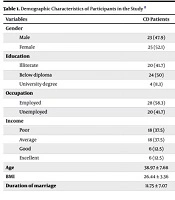
The results indicated no significant differences between the study groups regarding demographic variables such as gender, education, occupation, income, age, Body Mass Index (BMI), and duration of marriage; thus, the three groups were matched for potential confounding variables (Table 1).
Table 1.
Demographic Characteristics of Participants in the Study a
| Variables | CD Patients | LD Patients | Control Group | P-Value |
|---|---|---|---|---|
| Gender | 0.33 | |||
| Male | 23 (47.9) | 28 (58.3) | 30 (62.5) | |
| Female | 25 (52.1) | 20 (41.7) | 18 (37.5) | |
| Education | 0.43 | |||
| Below diploma | 20 (41.7) | 16 (33.3) | 24 (50) | |
| Diploma | 24 (50) | 28 (58.3) | 20 (41.7) | |
| University degree | 4 (8.3) | 4 (8.3) | 4 (8.3) | |
| Occupation | 0.05 | |||
| Employed | 28 (58.3) | 31 (64.6) | 39 (81.3) | |
| Unemployed | 20 (41.7) | 17 (35.4) | 9 (18.8) | |
| Income | 0.21 | |||
| Poor | 18 (37.5) | 13 (27.1) | 14 (29.2) | |
| Average | 18 (37.5) | 12 (25) | 19 (39.6) | |
| Good | 6 (12.5) | 15 (31.3) | 14 (29.2) | |
| Excellent | 6 (12.5) | 8 (16.7) | 1 (2.1) | |
| Age | 38.97 ± 7.68 | 38.77 ± 7.85 | 38.43 ± 8.43 | 0.94 |
| BMI | 26.44 ± 3.36 | 26.28 ± 3.08 | 26.29 ± 3.22 | 0.96 |
| Duration of marriage | 11.75 ± 7.07 | 12.18 ± 7.78 | 11.31 ± 6.2 | 0.83 |
Abbreviations: CD, cervical discopathy; LD, lumbar discopathy; BMI, Body Mass Index.
a Values are expressed as No. (%) or mean ± SD.
Among female participants, the mean ± SD SF score in the CD group was 27.81 ± 3.82, in the LD group was 22.31 ± 5.89, and in the control group was 30.26 ± 2.76 (Table 2).
Table 2.
Comparison of Sexual Function Dimension Scores in Women a
| Variables | CD Patients | LD Patients | Control Group | P-Value |
|---|---|---|---|---|
| Sexual desire | 4.35 ± 0.96 | 3.12 ± 0.91 | 4.60 ± 0.86 | 0.000 |
| Sexual arousal | 4.55 ± 0.99 | 3.40 ± 0.99 | 5.06 ± 0.68 | 0.000 |
| Vaginal lubrication | 5.01 ± 0.99 | 5.0 ± 1.0 | 5.41 ± 0.59 | 0.003 |
| Orgasm | 4.64 ± 0.64 | 3.28 ± 1.35 | 5.02 ± 0.82 | 0.000 |
| Sexual satisfaction | 4.81 ± 0.82 | 4.09 ± 1.13 | 5.36 ± 0.62 | 0.000 |
| Pain during intercourse | 4.34 ± 0.83 | 3.36 ± 1.45 | 4.81 ± 1.19 | 0.000 |
| Total mean score | 27.81 ± 3.82 | 22.31 ± 5.89 | 30.26 ± 2.76 | 0.000 |
Abbreviations: CD, cervical discopathy; LD, lumbar discopathy.
a Values are expressed as mean ± SD.
Among male participants, the mean ± SD SF score in the CD group was 26.80 ± 5.83, in the LD group was 24.60 ± 4.57, and in the control group was 36.29 ± 1.98 (P < 0.05, Table 3).
Table 3.
Comparison of Sexual Function Dimension Scores in Men a
| Variable | CD Patients | LD Patients | Control Group | P-value |
|---|---|---|---|---|
| Sexual desire | 4.52 ± 1.35 | 3.39 ± 1.23 | 6.97 ± 0.95 | 0.000 |
| Erection | 7.28 ± 1.88 | 7.21 ± 1.31 | 9.06 ± 1.03 | 0.000 |
| Ejaculation | 5.68 ± 1.02 | 6.01 ± 0.73 | 7.5 ± 0.92 | 0.01 |
| Problem assessment | 7.12 ± 2.12 | 6 ± 2.29 | 9.43 ± 1.1 | 0.000 |
| Overall satisfaction | 2.2 ± 0.86 | 2 ± 0.90 | 3.31 ± 0.46 | 0.000 |
| Total Mean score | 26.80 ± 5.83 | 24.60 ± 4.57 | 36.29 ± 1.98 | 0.000 |
Abbreviations: CD, cervical discopathy; LD, lumbar discopathy.
a Values are expressed as mean ± SD.
For male patients in the LD group, the mean ± SD SF score among those with pain scores of 1 - 3 was 28.40 ± 2.31, and for those with pain scores of 4 - 7 was 21.69 ± 3.61. In the CD group, the mean ± SD was 30.12 ± 1.74 for pain scores 1 - 3, and 21.11 ± 6.35 for pain scores 4 - 7. Among female LD patients, the mean ± SD SF score for pain scores 1 - 3 was 27.61 ± 5.95 and for pain scores 4 - 7 was 19.82 ± 3.91 (Table 4).
Table 4.
Comparison of Sexual Function Scores According to Patients' Perceived Pain Intensity a
| Variables | CD Patients | LD Patients | P-Value |
|---|---|---|---|
| Pain score in male | 0.000 | ||
| 1 - 3 | 30.12 ± 1.74 | 28.40 ± 2.31 | |
| 4 - 7 | 21.11 ± 6.35 | 21.69 ± 3.61 | |
| Pain score in female | 0.000 | ||
| 1 - 3 | 29.58 ± 2.24 | 27.61 ± 5.95 | |
| 4 - 5 | 22.81 ± 2.73 | 19.82 ± 3.91 |
Abbreviations: CD, cervical discopathy; LD, lumbar discopathy.
a Values are expressed as mean ± SD.
5. Discussion
In this study, the highest SF scores were observed in the control (healthy) group, followed by the CD group, and then the LD group, with statistically significant differences among the groups. Similarly, Moradi et al. reported reduced SF in women with acute lumbar disc herniation (22). Keefe et al. found that 39% of patients experienced sexual dysfunction (30). GamalEl Din et al. also reported the highest SF scores in the control group, followed by the cervical and LD groups, consistent with the present findings (31). These results confirm those of other studies, highlighting the importance of addressing pain due to discopathy and the lack of attention by non-specialist physicians to this aspect of patients' lives. There is a need for appropriate screening, patient education, and planning to address SF in these patients.
In both male and female groups, statistically significant differences were observed in all dimensions of SF across the three groups. Consistent with this, Panneerselvam et al. found that more than half (54.5%) of patients reported decreased sexual activity frequency after the onset of lumbar disc herniation (32). Studies indicate that patients with back pain have a higher prevalence of sexual disorders compared to the general population, including decreased sexual satisfaction and desire in both sexes, erectile dysfunction in men, and pain during intercourse in women (33).
The present study’s findings align with those of Akbas et al., who reported that despite the negative effects of LD on sexual life, physicians often overlook patients' sexual problems (34). Common sexual problems in men include loss of sexual desire, erectile dysfunction, and orgasmic dysfunction (35). Women may experience loss of sexual desire, sexual aversion, lack of lubrication, orgasmic dysfunction, vaginismus, and pain during intercourse (36). Studies suggest that women are more frequently and severely affected, which may explain the significant decrease in sexual desire due to uncomfortable or painful sex (37). These disorders, whether occurring alone or in combination, affect various aspects of the sexual experience. The results indicate the necessity for healthcare providers to address sexual health in patients with lumbar and cervical disc herniation. Gender differences in sexual dysfunction are influenced by physiological, psychological, and social factors that shape the pain experience. Therefore, given the importance of healthy SF for individuals and its impact on family and societal well-being, greater attention should be paid to this issue in patients with lumbar and cervical disc disease.
In this study, sexual desire scores were lower in the lumbar and CD groups than in the healthy group. Chronic pain can directly and indirectly reduce sexual desire, with the fear of exacerbating back pain during sex being a significant factor (38). Chronic pain and movement limitations can make sexual activity difficult or painful, resulting in reduced sexual desire, erectile dysfunction in men, or pain during sex in women. These effects, which extend beyond physical symptoms to impact relationship dynamics, often lead to decreased sexual activity in both sexes (39). Akkurt et al. found that the total SF score and frequency of weekly sexual intercourse were lower in patients with back pain than in controls, concluding that LD is associated with reduced SF (40), consistent with the present findings. GamalEl Din et al. reported significant differences in satisfaction, pain, and overall SF score between the CD and control groups (31).
Various studies have examined SF and satisfaction among individuals experiencing pain. Yilmaz et al. found that patients with myofascial pain syndrome had lower sexual satisfaction than controls (41). Ferrari et al., in a qualitative study involving 26 interviews with patients suffering from low back pain, found that pain was a limiting factor for sexual activity (42).
Limitations of this study include participant reluctance due to embarrassment, time constraints, and impatience in completing questionnaires. The researcher addressed these issues by explaining the importance and objectives of the study. A major strength of this study is that it is the first to investigate SF in men and women with chronic pain due to lumbar and CD in Iran and Ilam.
The study's findings highlight the importance for medical staff treating discopathy patients to recognize that, in addition to pain and other primary issues, these patients also face secondary challenges such as impaired SF, which can severely affect their quality of life. Proper assessment and intervention can help improve SF, quality of life, and ultimately, the well-being of patients, their families, and society as a whole.
5.1. Conclusions
Given that SF scores in patients with cervical and lumbar disc disorders were lower than in healthy individuals, appropriate interventions should be implemented to enhance sexual satisfaction among these patients. It is also recommended that consultation with a midwife or gynecologist be included in the treatment process to improve patients' sexual health.