Addiction is a dependence on a stimulus that, despite its negative effects, provides psychological pleasure, increasing the desire for repeated use (
1). Addiction, especially drug addiction, is a major global issue with profound physical and psychological effects. It is regarded as a "social disease" that undermines the cultural, economic, and social stability of nations. Addictive substances can be classified into three categories based on their effects: Depressants, hallucinogens, and stimulants. They can also be divided into two types based on their origin: Natural and synthetic (
2).
Although traditional addiction treatments and counseling methods are well-established, the rise of synthetic stimulants introduces new challenges. These substances, easily produced without the need for cultivation or international trade, are widespread because their chemical precursors are readily accessible in various industries. The widespread availability of these substances makes supply control challenging, directly affecting demand reduction efforts. Moreover, the effects of over 700 stimulants on the human brain and body remain largely unexplored, complicating effective treatments.
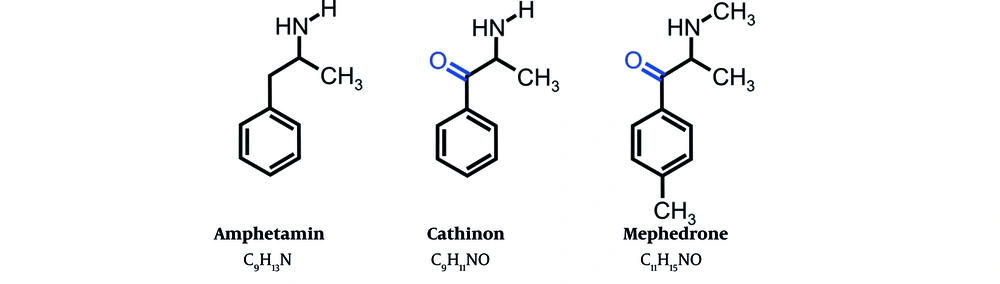
Cathinone is an active compound found in the leaves of the khat plant, which has amphetamine-like properties and is commonly chewed in some African countries. Structurally, cathinone is similar to amphetamine, with the key difference being the presence of a carbonyl group in the cathinone molecule (
Figure 1) (
3).
Comparison of the molecular structures of cathinone, mephedrone, and amphetamine
A wide range of cathinones are currently misused as stimulants, particularly among young people. Some of these substances have limited medical applications. Methcathinone was originally used as an antidepressant but was withdrawn from clinical use due to instances of misuse (
4). Diethylpropion is another cathinone analog currently used as an appetite suppressant. Some studies have reported neurotoxic effects of this drug in laboratory animals (
5).
In vitro studies on human and animal cells have demonstrated that cathinones significantly elevate levels of dopamine, norepinephrine, and serotonin. Due to their structural similarities with other stimulants, cathinones share functions such as stimulating the release of monoamine neurotransmitters and inhibiting their reuptake in the synaptic cleft (
6,
7). In addition, in vitro studies have shown that all cathinones, particularly mephedrone and MDPV, have the ability to cross the blood-brain barrier (
8).
Among cathinone derivatives, mephedrone, methylone, and MDPV have garnered significant research attention due to their widespread use and associated health concerns. Mephedrone, in particular, has been shown to induce the release of dopamine in the striatum of rodents, both when administered alone or in combination with methamphetamines. Mephedrone was first synthesized in 1929 (
9) and became popular as a recreational substance in some countries starting in 2003 (
10). In 2008, it was introduced as a new psychoactive substance by the European Monitoring Center for Drugs and Drug Addiction (
11).
A study in England revealed that 20 percent of ecstasy pills contain mephedrone, and the presence of this substance in the stimulant market is rapidly increasing. Mephedrone has been present in Iran since 2011 and is known among young people by slang names such as "Mef", "Salt", "Meow Meow", "Bath Salts", and "Ivory Wave". It is frequently used in combination with other substances, including bath salts, which often contain both mephedrone and MDPV (
12).
Mephedrone is typically a white powder but can also be found in tablet or capsule form. It’s mainly inhaled or taken orally, with doses ranging from 0.5 to 1 gram per session (
13). Effects begin within 15 to 45 minutes and last 2 to 5 hours (
14). Overuse can cause euphoria, hallucinations, nausea, anxiety, elevated blood pressure, confusion, tremors, and other symptoms. Compared to ecstasy, mephedrone is associated with a stronger urge for repeated use, with inhalation linked to higher dependence compared to cocaine (
13,
15). It inhibits norepinephrine reuptake and exhibits sympathomimetic effects (
7,
16,
17).
In Iran, approximately 10 percent of addicts are women. A study by Khajedalooee and Dadgar Moghadam in 2013 found that visible congenital abnormalities at birth were significantly more prevalent in infants whose mothers were addicted during pregnancy, compared to those born to non-addicted mothers (
18). Research shows that substance abuse during pregnancy, including heroin, methadone, codeine, and morphine, poses risks to both the mother and child. The use of these substances is associated with complications such as fetal growth restriction, premature birth, stillbirth, and microcephaly (
19-
21).
The use of psychoactive drugs has not been as widespread as traditional drugs like cocaine, resulting in less information about their side effects during pregnancy. However, it has been shown that these substances decrease the consumer's appetite, leading to poor fetal growth. Prolonged use of ecstasy can cause long-term learning difficulties in infants and memory impairments later in life (
22).
The cerebellum, located in the posterior cranial fossa and forming the roof of the fourth ventricle, is connected to the brainstem by three pairs of peduncles: Superior, middle, and inferior. Its primary function is to coordinate reflexes and voluntary muscle movements, regulating muscle tone, maintaining posture, and ensuring that movements are precise and efficient (
23). The metencephalon, a part of the developing brain, forms the cerebellum. Initially, the upper lateral plate enlarges, and the posterior sections bend to create rhomboid edges, which eventually converge to form the cerebellar plate, consisting of the vermis and hemispheres. The cerebellar cortex after birth includes differentiated Purkinje cells, the molecular layer (ML) at the surface, and the internal granular layer (IGL) beneath the Purkinje cells (
24). The ventricular layer, which gives rise to cerebellar nuclei and Purkinje cells, becomes the ependymal layer once Purkinje cells are positioned beneath the external granular layer (EGL) (
25). As the cerebellum matures, its cortex folds into folia, and the EGL undergoes peak proliferation shortly after birth. Granule and Purkinje cells attain their final size postnatally, marking the completion of cerebellar development (
26).