
1. Background
Encoding is a neural process that transforms information into memory traces. Depending on a number of factors such as deep processing, some of the traces may be recoverable (retrieved) when needed. Elderly people face difficulties in the encoding process as part of aging (1). This is partly evidenced by more time and effort necessary for elderly adults to encode identical amount of information when compared to those of the younger adults (2, 3). In addition, investigations on aging and divided attention showed that elderly people had more difficulties to perform well when their encoding process, versus retrieval, is stressed (4, 5).
To investigate encoding, intentional tasks were used in which subjects know ahead of time that their memory is tested. They may be asked to perform a judgment that orientate to the physical (e g, to determine if alphabetic O is in the word) or semantic (e g, to determine if an item referred to by a word is a living or abstract concept) properties of the information which should be remembered. In other situations, subjects may be instructed to encode their own strategies (6).
The current study aimed to examine intentional encoding processes in elderly adults by the event-related potential (ERP) technique. A study and recognition of subsequent memory effect (SME) paradigm was adopted. Subjects in this type of paradigm, engage in a study phase to encode new information and then a test phase to check if they are able to recognize the encoded information. When the remembered (successfully encoded) and forgotten (missed) trials of the study phase were compared, ERPs of trials remembered were typically associated with a greater positivity. The difference of neural activities between the remembered and forgotten trials is known as the SME (7). This effect at P550 (an ERP component occurs around 550 ms post-stimulus) is suggested to index updating working memory and the effect at late positive complex (LPC; occurs around 700 ms post-stimulus and afterwards) to index binding and elaborative processes (8, 9).
2. Objectives
The current study aimed to examine intentional encoding processes in elderly adults by the ERP technique.
3. Methods
3.1. Participants
Fifteen elderly subjects enrolled into the study with a mean age of 65.3 ± 4.9 years and 7.7 ± 3.0 years of education. All of them were right-handed, native Chinese speakers, had a normal or corrected-to-normal vision and had no history of neurological or memory complications. Signed informed consents were obtained from all subjects before the experiment. This project was approved by the research committee of the relevant authority.
3.2. Stimuli and Procedure
Stimuli were Chinese characters referring to various objects. They were presented on a computer monitor by the STIM2 software (Compumedics Neuroscan, Charlotte, NC, USA). The used paradigm was based on that of Tellez-Alanis and Cansino (10). There were two randomized study/encoding blocks (40 trials each) and four randomized recognition/test blocks (40 trials each). The timing of each study and recognition trial is shown in Figure 1. Subjects were asked to memorize the Chinese characters for a later memory test in the study phase. The subjects determined whether the Chinese characters were the ones that had been studied earlier in the recognition phase. They responded to the trials using a 4-key controller. They were cued to refrain from unnecessary blinking of the eyes and body movements to reduce movement-related artifacts during the ERP experiment.
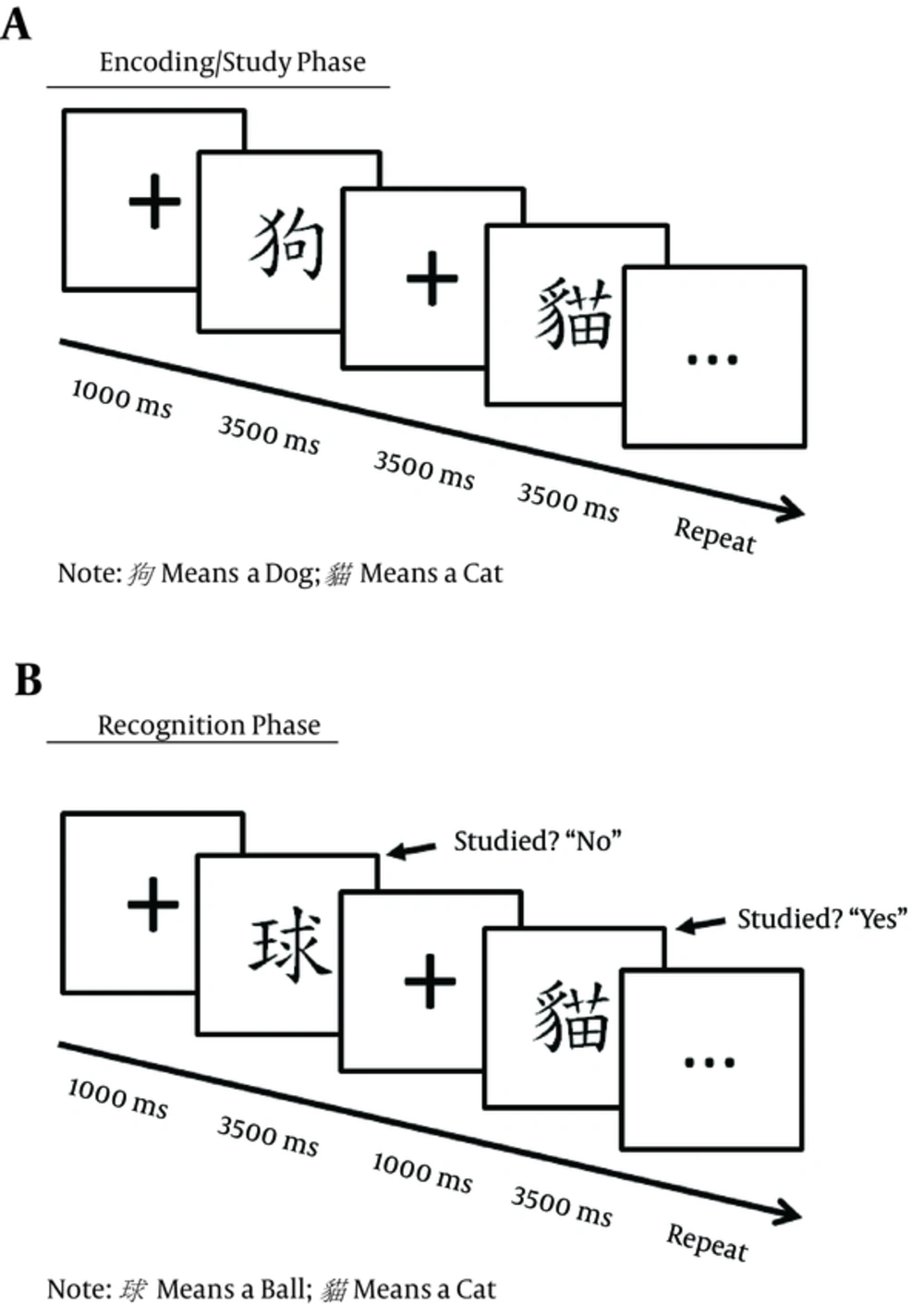
Figure 1.
Timing and Diagrammatic View of Two Trials in the Study and Recognition Phases
3.3. Data Acquisition
Electroencephalograms (EEG) data were gathered using a 128-channel electrode cap (referenced to left-mastoid with less than 5 kOhm impedance) placed on subjects’ head. The ground electrode was positioned on the forehead. The NuAmps amplifier (NeuroScan Labs, Sterling, VA) was employed to record data. The recoded parameters were 1, band-pass filter at 0.5 - 40 Hz and; 2, sampling at 1,024 Hz. Impedances on other channels were established at less than 10 kOhm. Vertical and horizontal electrooculogram (EOG) data were gathered to oversee subjects’ eye movements.
Recordings obtained at encoding phase were pre-processed utilizing the edit 4.3 software (Compumedics Neuroscan, Charlotte, North Carolina, USA). They were transformed using a linked-mastoid reference. Digital filtering from 0.1 Hz to 30 Hz (24 dB/oct, zero-phase shift) was then performed; following ocular artifacts correction. Data were cut into epochs from 200 ms before stimulus onset to 1,000 ms after onset and baseline was adjusted to the pre-stimulus time window. Epoch rejection was set at ±75 μV. The remaining epochs were sorted and averaged subject to correctly identified or missed/forgotten at recognition phase.
3.4. Data Analysis
Accuracy and reaction time of the responses at recognition phase were the behavioral data. D-prime measure (d’) was calculated since it is a more accurate estimate of recognition performance where false alarm rates are considered (11).
Mean amplitude of the EEG data was computed between 120 ms and 240 ms, 240 ms and 360 ms, 360 ms and 700 ms, and 700 and 1000 ms from six midline sites/channels (Fz, FCz, Cz, CPz, Pz and Oz) and 18 sites from the two hemispheres (F3/F4, FC3/FC4, C3/C4, CP3/CP4, P3/P4, O1/O2, F7/F8, FT7/FT8, and T7/T8). The sites were subject to global repeated-measure ANOVAs to compare the mean amplitude differences between responses (corrected identified/missed) and sites (24 levels). If any of the main or interaction effects of global analyses were found significant, further analysis was performed in the specific window. The 4-way specific ANOVAs compared the responses (corrected identified/missed), anterior–central-posterior sites (anterior: F7, F3, F8, F4; central: T7, C3, T8, C4; posterior: P7, P3, P8, P4), hemispheric sites (left: F7, F3, T7, C3, P7, P3; right: F8, F4, T8, C4, P8, P4) and inferior-superior sites (inferior: F7, F8, T7, T8, P7, P8; superior: F3, F4, C3, C4, P3, P4). Post-hoc test was performed for any significant interaction effects. Greenhouse-Geisser correction was applied to results where the sphericity requirement was not met.
4. Results
4.1. Behavioral Results
At recognition phase, percentage of correct judgements was 70.7% ± 8.6% and false alarm rate was 30.9% ± 13.9%. Mean reaction time of correct judgements was 647 ± 195 ms and that of false alarm responses was 700 ± 229 ms; the d-prime of recognition performance was 1.1 ± 0.5.
4.2. ERP Results
ERPs of a selection of nine electrodes are shown in Figure 2. No significant differences were found between correctly identified and missed ERPs between 120 to 240 and 700 to 1000 ms in the global test. A significant effect only showed between 240 to 360 ms and 360 to 700 ms global tests. The follow-up test for 240 to 360 ms window showed marginal significance in responses (F (1, 14) = 4.259, P = 0.058). There were no significant interactive effects for this time window. The follow-up test for 360 to 700 ms showed significant response again (F (1, 14) = 9.279, P = 0.009). In addition, significant response x inferior-superior sites effects (F (1, 14) = 6.409, P = 0.024) indicated a larger positivity (in other words, larger SME) in the superior sites when a correct response was given. In all the windows that showed significant results, ERPs of correctly identified trials were more positive than ERPs of the missed trials. This is typical for ERP studies that use a similar paradigm.
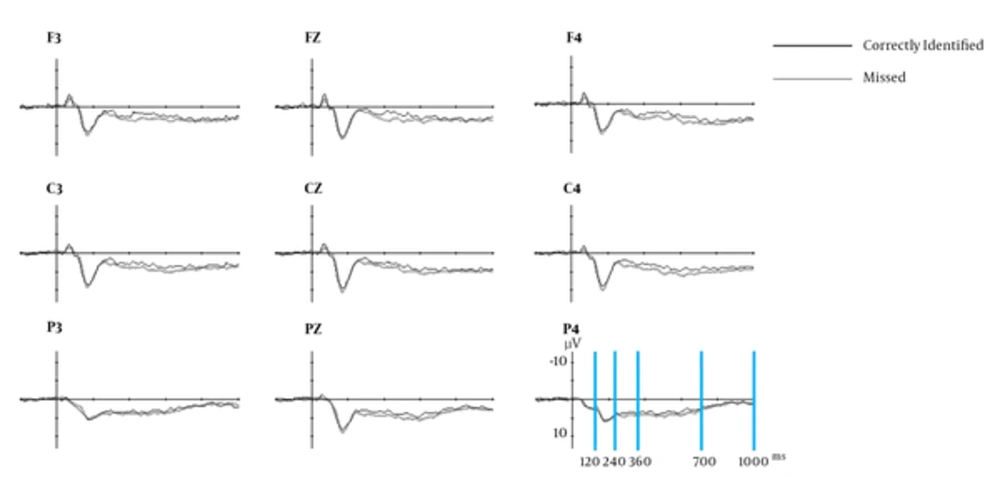
Figure 2.
Event-Related Potentials Regarding a Selection of Nine Electrodes
5. Discussion
The current study aimed to examine the intentional encoding processes of elderly adults by the ERP technique. Behavioural data included reaction time and accuracy. A comparison of accuracy data with those of other studies indicated that this group of elderly adult performed well in the recognition phase, though the results did not appear as good as those of the ones associated with a semantic memory strategy (10, 12). Semantic processing of information enhances memory (13). The reason may be that elderly adults tend not to use a more effective memorization technique such as the semantic strategy, when they are not instructed to (14).
SMEs are the differential neural activities of ERPs between successfully encoded and forgotten trials. The effects were often identified from 360 to 1,000 ms post-stimulus (8, 9). SME at 240 to 360 ms windows is coincided with conceptual processing and access to semantic memory. It indexes updating of working memory at 360 to 700 ms and the elaborative processing of information at 700 to 1000 ms (12).
The electrophysiological results at 240 to 360 ms window appeared to indicate that elderly adults attempted to utilize their semantic memory to enhance their memory or semantic-like processing when there was the intention to remember. Subjects also seemed to be able to update the working memory with the newly formed representation; since the SME was significant between 360 and 700 ms and the effect had a typical scalp distribution. The emergence of this SME depended on the task requirement. When the task required perceptual processing, it is either not consistently identified or could be a negative effect (i e, missed trials elicited more positivity) (13, 15). When the task requirement included orientating to the semantic properties of the item, the effect emerged reliably and was in the usual positive pattern. Therefore, consistent with 204 to 360 ms interval, encoding operations from 360 to 700 ms may be more or less in line with a semantic-like processing.
Aging might affect intentional encoding processes underlying SME at LPC more, since the effect was not significant in this time window. It could suggest that healthy elderly people might have difficulties to perform elaborative encoding to enhance the memorability of the information. The insignificant SME at LPC could suggest a decreased ability to bind concepts together as well. In the investigation by Weyerts et al. (16), subjects were required to create semantic associations between two words (associative encoding in which binding occurs between these concepts) or to process the two words presented independently (non-associative encoding). In the condition that only requested for associative encoding, a significant SME was reliable. Their research indicated that binding concepts together could be an important process indexed by SME at LPC latency window. Since this group of elderly people did not demonstrate differentiated ERPs at LPC, it may indicate a decreased ability to form associations (binding) necessary for effective memory encoding.
This study had a decent number of subjects. However, inclusion of additional encoding conditions might allow further comparisons and better understanding of strategies that could be more effective for the healthy elderly. Overall, behavioral and ERP evidence suggested that healthy elderly adults attempt to encode in asemantic-like fashion when a specific encoding instruction was not provided. Encoding difficulties faced in aging may be partly due to a decreased ability to elaborately process newly formed representations and perform binding of concepts.