


1. Introduction
The COVID-19 pandemic, caused by a coronavirus, is a recent challenge for healthcare systems worldwide. Coronaviruses belong to the general family of RNA viruses and cause many various clinical symptoms. To name a few, we can mention coughing, fever, fatigue, headache, myalgia, diarrhea, vomiting, and mild abdominal pain after 2 - 14 days of exposure (1-3). The variety of these clinical symptoms may lead to difficulties in establishing the correct diagnosis on time. Furthermore, these symptoms may lead to unnecessary investigations, and therefore extending hospital stay, issuing adverse outcomes, and exposing more stress and workload on the healthcare resources. In this study, we explained 2 cases admitted to Modarres Hospital with unusual postoperative anastomotic failure.
2. Case Presentation
2.1. Case 1
A 72-year-old man with a history of ischemic heart disease was referred to the hospital with severe abdominal pain. He underwent colonoscopy due to chronic constipation and weight loss the day before his admission. His pain was spread over the abdominal part; he had no previous operation and known drug allergies. However, symptoms such as coughing, fever, and fatigue were observed 1 week before his admission.
His vital signs showed a blood pressure of 90/60 mm Hg, body temperature of 38.5°C, and heart rate of 110/min. Physical examination demonstrated generalized abdominal tenderness prominently in the upper abdomen with guarding and rebound tenderness. The upright chest X-ray showed pneumoperitoneum. The patient’s laboratory findings are shown in Table 1. Emergency laparotomy was performed, and exploration revealed a perforated peptic ulcer in the second part of the duodenum, which was repaired using an omental patch. The polymerase chain reaction (PCR) test for COVID-19 was positive the day after the operation.
Table 1.Laboratory Tests of the 2 Cases
| Lab Test | Case 1 | Case 2 |
|---|---|---|
| WBC (× 103/μL) | 11.1 | 4 |
| HB (g/dL) | 14.7 | 11.3 |
| PLT (× 103/μL) | 216000 | 310000 |
| lymphocyte count | 4.5% | 16% |
| COVID-19 PCR | Positive | Positive |
| COVID-19 (CT) | 35.2 | 35.1 |
| SARS-CoV-2 IgM (mg/dL) | 0.2 | 0.1 |
| SARS-CoV-2 IgG (mg/dL) | 0.1 | 0.1 |
| CRP (mg/L) | +2 | +3 |
Anastomotic leakage was suspected two days after surgery based on bilious secretions from the embedded drain. Therefore, total parenteral nutrition (TPN) was started, and the patient was referred to our hospital. In Modarres Hospital, conservative treatment was continued, but 9 days after the first surgery, a massive upper gastrointestinal bleeding occurred, and he underwent emergency laparotomy for the second time because of hemodynamic instability. During surgery, disrupted anastomosis was observed in the second part of the duodenum full of clots. After gastrotomy, an active bleeding ulcer on the lesser curvature was detected and suture-ligated using a 2 - 0 silk suture. After controlling the bleeding, the duodenal stump was closed using separate stitches, and loop gastrojejunostomy and tube duodenostomy were performed.
The pathology report showed fibrino-leukocytic exudate and underlying granulation tissue formation compatible with gastric ulcer. Because of high stress during 2 operations, we started oral fluids 5 days after surgery based on a multidisciplinary team plan. Unfortunately, 1 week after the second surgery, evidence of anastomotic leakage appeared again by bilious discharges of drains (Figure 1), but this time the leak was contained, and the patient had good oral tolerance without abdominal symptom or signs of acute abdomen; thus, we continued conservative management based on the multidisciplinary team plan. Unfortunately, his respiratory status was worsened because of the COVID-19 infection, and he passed away 20 days after the second surgery.
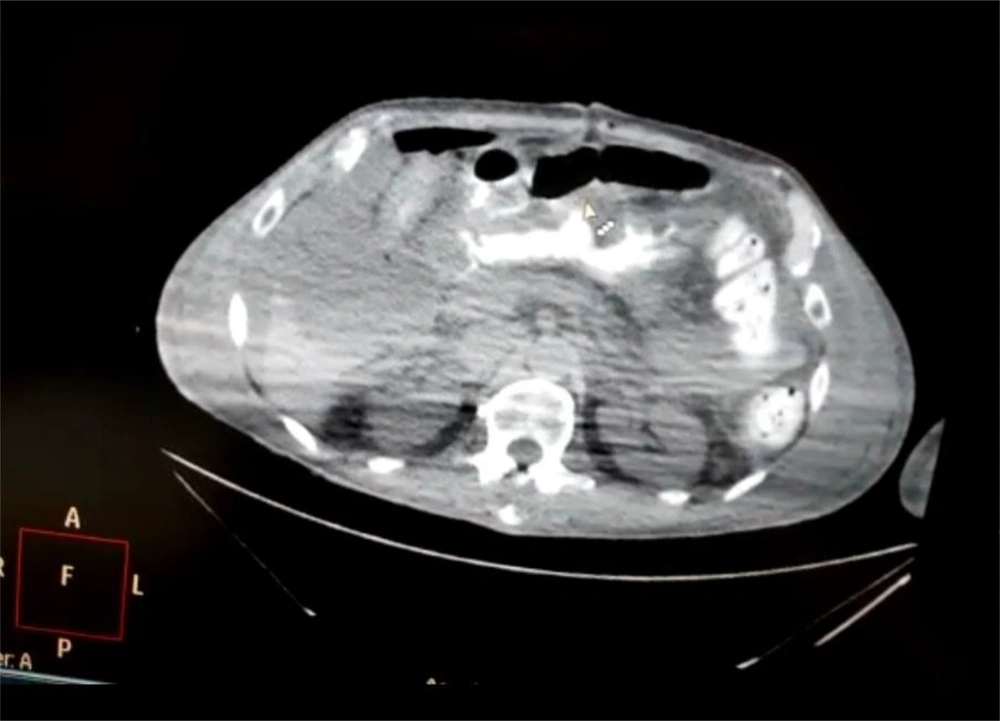
Figure 1.
Gastrojejunostomy leak
2.2. Case 2
A 65-year-old woman presented to the emergency department of Modarres Hospital with abdominal pain. Her pain was spread over the abdomen with no history of previous surgery. She had a history of cured tuberculosis and had no known drug allergies. Physical examination showed a blood pressure of 110/60 mm Hg, body temperature of 38.5°C, and heart rate of 90/min. Physical examination also demonstrated generalized tenderness, distended abdomen, and decreased bowel sounds. The patient’s laboratory findings are presented in Table 1. Abdominal plain X-ray showed distended loops of the small intestine and multiple air-fluid levels. An abdominopelvic computed tomography (CT) scan with intravenous (IV) and oral contrast was performed, which demonstrated a closed-loop obstruction in the ileum. She underwent emergency laparotomy, and an ischemic closed loop of the small intestine was discovered. After resection of the closed loop, primary anastomosis was performed. The pathology report showed a small intestinal wall with transmural necrosis, abscess formation, and mixed inflammation. Three days after surgery, her respiratory symptoms started, and the PCR test showed positive results for COVID-19 infection 5 days after surgery. Except for her mild respiratory problem, the postoperative period was uneventful, and she was discharged from the hospital with good oral tolerance 5 days after surgery.
About 14 days after surgery, she was returned to the hospital with bilious discharge from the midline incision and generalized abdominal pain. Abdominal CT showed leakage from the anastomosis in the jejunum (see Figure 2). During emergency laparotomy, anastomotic leakage was detected in the previous anastomotic site, and a tube jejunostomy operation was performed to create a controlled intestinal fistula. After the second operation, oral fluids were routinely ordered, and the patient had no postoperative problem, but her O2 saturation was decreased 5 days after surgery; thus, she was intubated. An abdominal CT scan showed no leak, but unfortunately, she died 11 days after the second surgery.
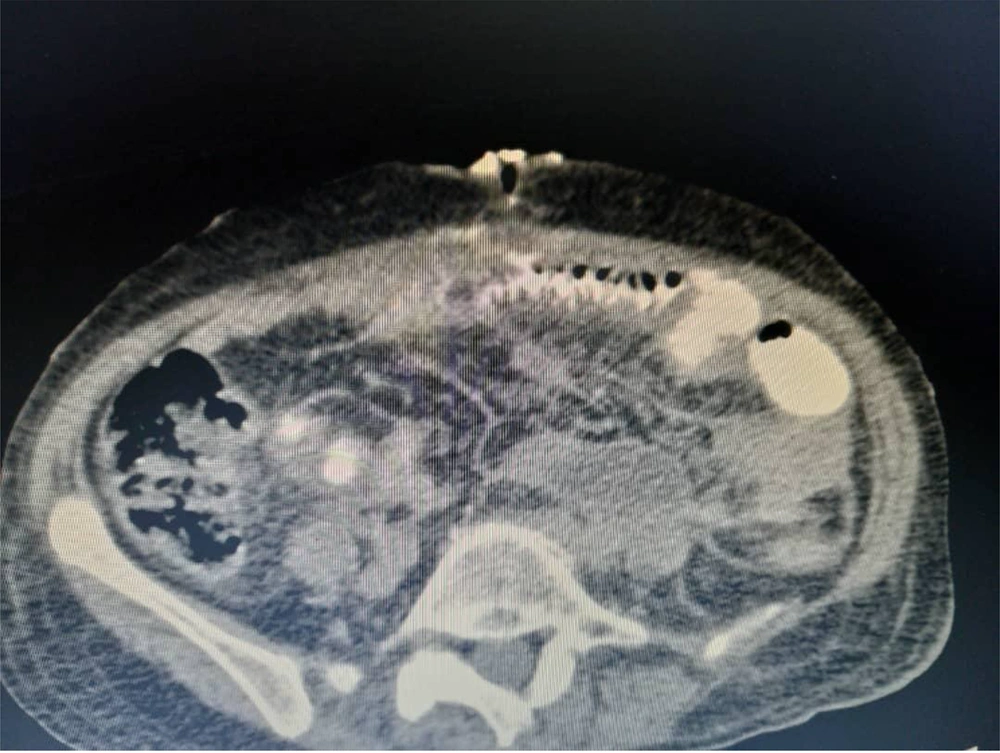
Figure 2.
Computed tomography with leakage far from the anastomosis in the jejunum
3. Discussion
In December 2019, patients with pneumonia of unknown cause were diagnosed in Wuhan, China. Later, it was linked to an unknown beta coronavirus, named 2019-nCoV; after both MERS-CoV and SARS-CoV, 2019-nCoV is the seventh member of the family of coronaviruses that infect humans.
Since its outbreak, studies have reported that respiratory symptoms, such as fever, cough, dyspnea, and respiratory illness, represent the most common symptoms (1).
Recent studies have shown that several gastrointestinal symptoms, such as abdominal pain, diarrhea, and vomiting, can also be observed in 2019-nCOV patients (2, 3).
Herein, we described 2 cases with unusual anastomotic leakage who were later diagnosed with COVID-19. In a 72-year-old man with a perforated peptic ulcer in D2 and signs of leakage after the first operation and during the second operation due to massive unexpected hemorrhage, we found fully disrupted anastomosis on the second part of the duodenum. Accordingly, the suture ligature of the bleeding ulcer with the closure of the duodenal stump and loop gastrojejunostomy and tube duodenostomy were performed. During the postoperative period, he developed dyspnea, and the diagnostic test of SARS-CoV-2 confirmed him as a case of COVID-19. Unfortunately, 1 week after the second surgery, evidence of anastomotic leakage appeared again by bile discharge from drains; although it was managed conservatively, he died because of respiratory failure.
In the other case, a 65-year-old woman was admitted to the emergency ward with closed-loop small bowel obstruction. After emergency laparotomy, resection of ischemic bowel with primary anastomosis was performed. The same as the previous case, she developed dyspnea, and the diagnostic test resulted positive for COVID-19. After 2 weeks, she was admitted to the hospital with signs of anastomotic leakage that was subsequently confirmed by abdominal CT; although it was managed conservatively, she died because of respiratory failure due to COVID-19.
So far, our observations and also the literature show that the coronavirus has a wide range of tissue distribution, causing the release of a high number of pro-inflammatory cytokines that damage the microvascular system and initiate an abnormal activation of the coagulation system. The result will finally be seen as small-vessel vasculitis and extensive microthrombi (4-6).
Microangiopathy in different organs of COVID-19 patients was reported. This problem may involve the kidney, lung, intestine, and eyes (7-9). To our knowledge, these cases were unique in that intestinal microangiopathies can cause very severe problems, weaken the body, and eventually death, as we have seen in these 2 cases.
In these cases, the first operation was inevitable, and the problem arose after surgery. This report shows that active COVID-19 patients should be managed differently, and surgeons should be aware of their anastomotic repair problem.
Our recommendation for an uneventful operation in COVID-19 patients is to avoid elective intestinal surgery in active COVID-19 patients, and surgery should be postponed until their symptoms resolve and IgM titer rise.
For emergency surgery in active COVID-19 patients, the surgeon should be aware of their postoperative complications, and protective measures should be taken to avoid these problems.




