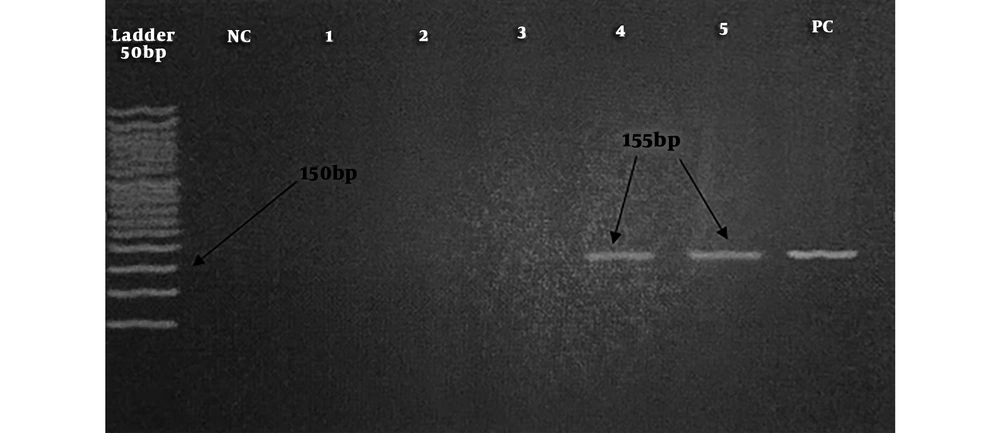
The association between human enterovirus (EV) infection and acute gastroenteritis is well documented (
5-
18). In our study, 21/85 (24.7%) patients with acute diarrhea were positive for EVs. The prevalence of EVs in children with gastroenteritis has been reported in different parts of the world. Alcala et al. (Venezuela, 2018) detected EVs in 37.9% of children with gastroenteritis (
5). Chitambar et al. (Mumbay, 2012) observed EVs in 40% of children with gastroenteritis, which was higher than the prevalence found in this study (
26). Bubba et al. (Milan, Italy, 2015) found that 28/111 (25.2%) patients with gastroenteritis were EV-positive (
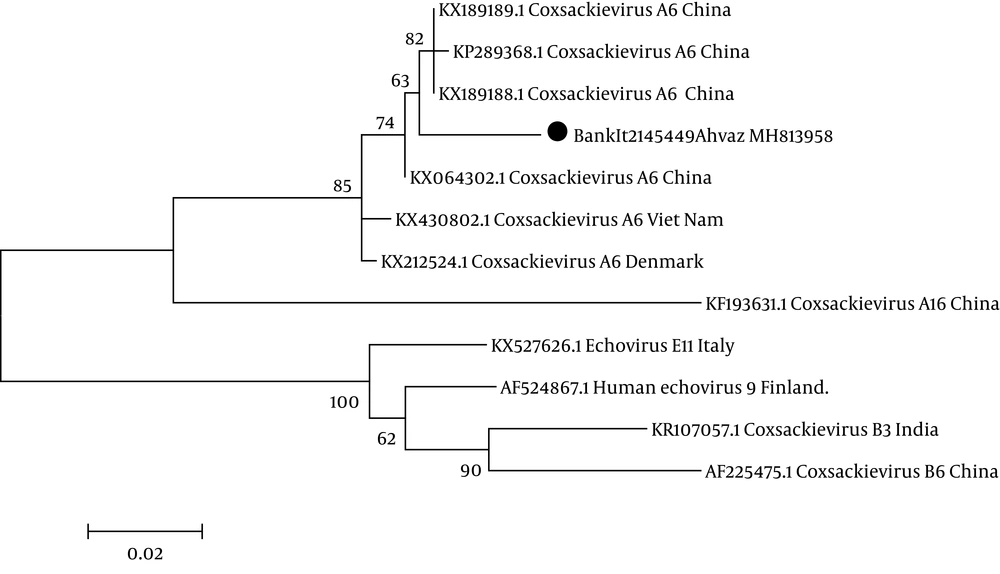
27); this finding is in concordance with our results (24.7%). The frequency of EVs was not significantly different between males and females (14.11% vs. 10.58%; P > 0.05). In the present study, the obtained results of sequencing and blasting of the 5’-UTR region showed that one of the isolated serotypes from a two-year-old male showed 99% nucleotide identity to coxsackievirus A6 responsible for hand, foot, and mouth disease in China and Vietnam (
28,
29), and 98% nucleotide identity to coxsackievirus A6 isolated in China (
30). The role of coxsackievirus A6 in gastroenteritis in children was also reported by Chansaenroj et al. in Thailand (
8). Another coxsackievirus A strain was also associated with gastroenteritis in children. Shobha et al. (Mumbay, 2012) reported coxsackievirus A13, 17, 19, and 21 in patients with gastroenteritis (
26). The results of sequencing and blasting of the 5’-UTR region of the other EV strain isolated from a one-year-old female patient showed 96% nucleotide identity to echovirus 9 isolated from a small child at the clinical onset of type 1 diabetes in Finland and 94% nucleotide identity to echovirus 9 isolated from patients with aseptic meningitis in South Korea (
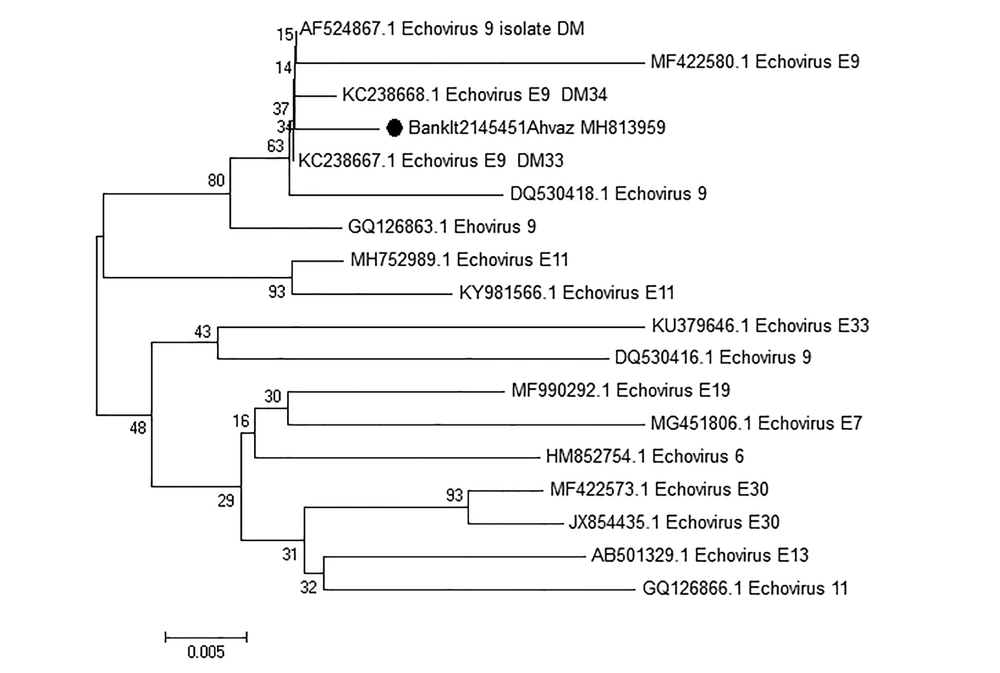
31,
32). Other echovirus serotypes have been also associated with gastroenteritis in children. Shobha et al. (Mumbay, 2012) found echovirus serotypes 21 and 32 in patients with gastroenteritis (
26).
The results of the phylogenetic tree exhibited that isolated coxsackievirus A6 was clustered with isolated coxsackievirus A6 causing hand, foot, and mouth disease in China (KX064302.1) and Vietnam (KX430802.1). The results of sequencing and blasting of the 5’-UTR region showed that isolated echovirus 9 showed 96% nucleotide identity to isolated echovirus 9 in Finland (KC238667.1).
In this study, EVs associated with acute diarrhea was detected in all age groups except for 37- 48-month age group. The highest rates of EVs were detected in patients’ age group of < 12 months (10/85; 11.76%) and 49 - 60 months (6/85; 7.05%).
The current study investigated the frequency of EVs associated with acute diarrhea and observed its occurrence only in autumn and winter seasons. The rate of EVs was found higher in winter than in autumn (P = 0.001). Shobha et al. (Mumbay, 2012) reported the high prevalence of EVs in autumn (40%) and winter 30% (
26). Bubba et al. (Milan, Italy, 2015) documented the high prevalence of EVs in winter and autumn (
27). To the best of our knowledge, it is the first report of EVs to cause acute diarrhea in Iran.
Viral intestinal infections are the most common cause of acute infectious diarrhea in children. Over the past decade, there have been major advances in the understanding of viral gastroenteritis etiology. Group A rotavirus is responsible for the majority of acute diarrhea cases in young children worldwide (
28). Furthermore, other viruses like norovirus, adenovirus, enterovirus, bocavirus, sapovirus, astrovirus, calicivirus and more recently, torovirus and parechovirus have been associated with acute infectious diarrhea in children (
33,
34).