
1. Background
Coaches play a critical role in the prevention of musculoskeletal injuries due to their specialized knowledge with regards to their knowledge on sport-specific common injuries, injury prevention, fitness/conditioning, individual technique development, training programs, mental training, and preparation of players (1). Millions of South African youths participate in various team sports (2). Unfortunately, a large number of these participants have sustained musculoskeletal injuries. The cause of such injuries can be attributed to improper technique and conditioning methods implemented by coaches. Injuries can be described as “any musculoskeletal complaint newly experienced due to competition and/or training during a tournament that received medical attention regardless of the consequences with respect to absence from competition or training” (3).
Sports coaching occurs in an unpredictable, dynamic, and multi-dimensional environment, implanted inside a particular social and cultural setting (4). Successful coaches are the individuals who adjust their coaching to fulfill the needs of their specific training condition. However, what comprises a specialist mentor is yet vague (5). It may very well be seen as a procedure that is improvement oriented, coach-driven, and happening inside the bounds of a solitary sport (4).
Research has shown that over recent years, youth sports has grown comprehensively, and so too has the need for qualified coaches. This has resulted in the development of the International Sport Coaching Framework (ISCF) (6). The ISCF provides a standard for evaluating and developing coaching qualifications, encourages education and training, and outlines ethical guidelines and practice standards, which in turn could lead to a decrease in the amount of injuries (6, 7).
There are different ways to prevent sport injuries, which include factors such as technique, previous injuries, and parental pressure, or winning a game (6). Research primarily focuses on the potential causes of injuries in youth sports, often stressing the unique physiologic and biomechanical aspects of the growing body, while research into the effect of life stress is growing (2, 8, 9). Further, anecdotal evidence implies that improper training methods, lack of proper sport-specific techniques, and/or poor coaching are factors associated with musculoskeletal injuries (2). In addition, different genders present with different types of injuries and prevention methods (10, 11). Research suggests that females sustain more overuse injuries when compared to males (12). These male-female discrepancies in injury patterns could be due to differences in strength and flexibility (13-16) and other physiological and anatomical parameters (17-20).
Rugby requires a large amount of running, which can lead to tendinitis in the knee or lower leg, medial tibial stress syndrome and bursitis, which are all mistreated injuries (21, 22). In rugby, the player’s position largely influences the type of injuries sustained. Hookers and flankers typically sustain the most injuries, followed by the forwards. During scrumming the locks are the most vulnerable to facial cuts and “cauliflower ear” (outer disfigurement to the ear brought about by repeated blows), while rucks and mauls cause injuries to fingers and thumbs (23).
Netball players require speed, agility, power, and dynamic balance, all of which could cause injuries mostly in the lower leg, especially in the knee and ankle (24, 25). Thus, investigating the understanding of coaches in relation to injuries is essential since their knowledge regarding injuries could prevent injuries.
2. Objectives
The purpose of the study was to determine the extent to which sport coaching knowledge translates to the injuries and prevention of injuries in youths participating in netball and rugby.
3. Methods
3.1. Participants
Investigators contacted 43 (21 rugby and 22 netball) coaches and invited them to participate in a study on how sport coaching knowledge translates to the prevention of injuries in adolescents. Following the electronic mail, via the use of a face-to-face method of distribution and collection, a 79% response rate (n = 34) was obtained. Of the participants that agreed to take part in the study and of the 18 netball coaches, 14 were female, and two were male. All of the 16 rugby coaches were male. Coaches who were currently in a position where they coached adolescents playing netball or rugby were contacted using addresses on websites and public directories. Participation was voluntary, and all coaches were assured confidentiality before participating and signed consent forms. The study was approved by the Institutional Review Boards of the University of Zululand. Coaches had a mean coaching experience of 16 ± 8.7 years. All coaches that participated had a minimum level 1 coaching or BokSmartTM certificate, with the majority having an appropriate three-year Bachelor’s degree qualifying them to coach these particular sports.
3.2. Procedures
An adapted version of the Nash and Sproule questionnaire was used for the collection of the data (1). The questionnaire used in the study was adapted from research conducted by the Australian Sports Commission (ASC) (1). The questionnaire had been developed and validated by focus groups and pilot studies (1). Section A of the questionnaire collected demographical and background data but also contained questions that were pre-designed according to the purpose of the study. An injury report was used in order to record injuries on a weekly basis. Coaches completed the form and sent feedback retrospectively once the season was completed. Moreover, some deep and exploratory questions were set based on the type of answers to understand the depth of perception and views of the participants, especially in relation to the injury rates of players. Lastly, the section required coaches to indicate whether they completed a first aid course, as well as the amount of training hours’ players completed every week. To enable a participant to answer “yes” to the question on whether they had completed first aid courses, they must have completed a minimum of a level 2 course, which was communicated in advance. To successfully complete the first aid level 1 course, participants needed to show competence in casualty management, which includes responsive and suspected spinal injury, adult and child resuscitation, severe bleeding, assistance with chronic medical conditions such as asthma, secondary survey, wound care, treating burns, bones and joint injuries, as well as multiple casualty management. Completion of the level 2 first aid course required participants to have gained competence in performing rescue carries, assisting with chest injuries, poisoning, eye injuries, heat and cold injuries, and two rescuer cardiopulmonary resuscitation (CPR). The following four sections (B to D) encompassing issues within coach education (i.e. course organization, course qualification, coach assessment, and coach learning, which included the coaches’ perceptions of their coaching educational experiences). Sections B to D required the participants to rate their responses using a four-point Likert scale. Questionnaires were distributed among participants along with informed consent. It took approximately 20 minutes to complete. All participants completed the questionnaire in its entirety without missing a question.
3.3. Statistical Analysis
The analysis of these data was carried out using a number of different techniques, outlined by Nash and Sproule (1). These techniques were determined by the type of data. The participants’ demographic data, as well as some sport related background, presented descriptively as percentages (1). Quantitative data were summed and presented as percentages to determine the educational framework and knowledge of sport coaches on injury prevention. Numerical data was obtained through questions on coaches’ sport knowledge, first aid level, and sport injuries. Participants’ knowledge was measured using a standardized scoring system and summation (1). Each participant’s score was used to calculate the mean of knowledge in different years of experience intervals. Injury occurrence was compared to the number of training hours per week. This study made use of the Statistical Package for Social Sciences (SPSS) version 22 for Windows (SPSS Inc., Chicago, IL, USA), which calculated the descriptive statistics including the means, standard deviations, ranges, and percentage differences of the data collected.
4. Results
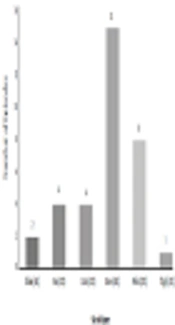
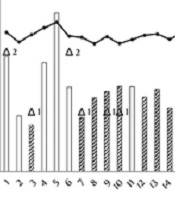
When comparing netball coaches’ knowledge through experience and first aid level for the zero to four years of coaching experience, the knowledge and experience was 76.4%, and the first aid level was 33.3%. However, both the knowledge through experience and the first aid level for the nine to 12 years and 13 to 16 years of coaching experience were 100% (Figure 1).
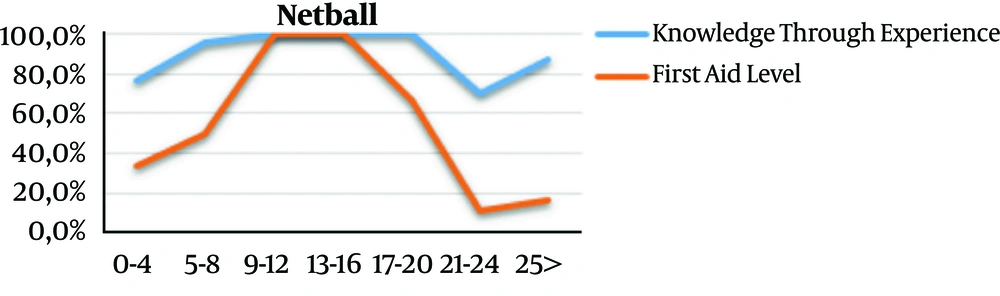
Figure 1.
Netball coaching knowledge, experience, and first aid level
The level achieved in the zero to four years in rugby coaching knowledge through experience was 59.1% in comparison with coaches that had a first aid level of 71%. The achieved levels in the 17 to 20 years of coaching knowledge through experience and first aid level were 100%. In the levels of coaching experience of higher or equal to 25 years, it was found to be 45.5%, with a first aid level of 33% (Figure 2).
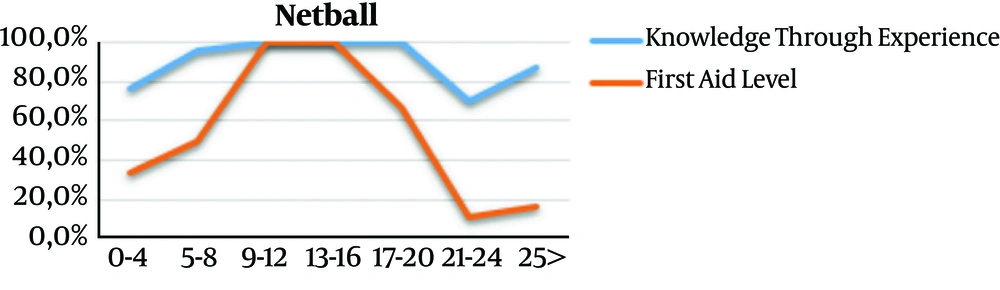
Figure 2.
Rugby coaching knowledge, experience, and first aid level
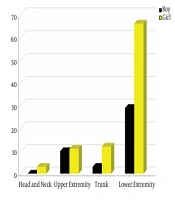
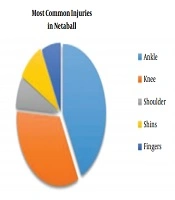
The results indicated that ankle injuries were most common (90%) among netball players, followed by the knee (70%), shoulder (50%), lower leg (20%), and finger (15%) injuries (Figure 3). This study found that knee injuries were the most prominent (81%) among rugby players according to coaches, followed by the shoulder (50%), ankle (40%), head, and neck (31%), and hamstring (25%) injuries (Figure 4).
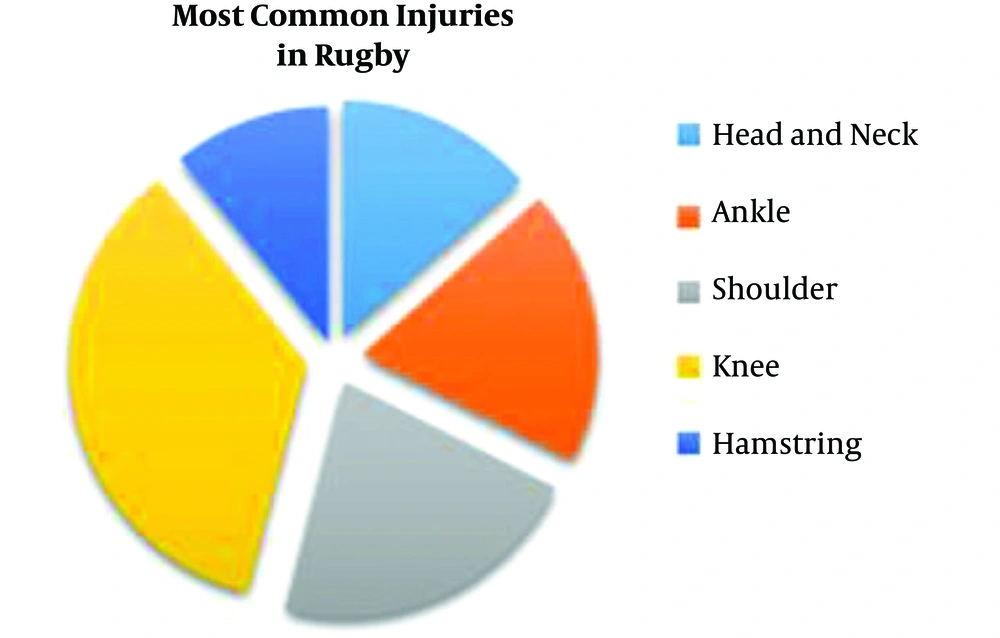
Figure 3.
Most common injuries in Rugby
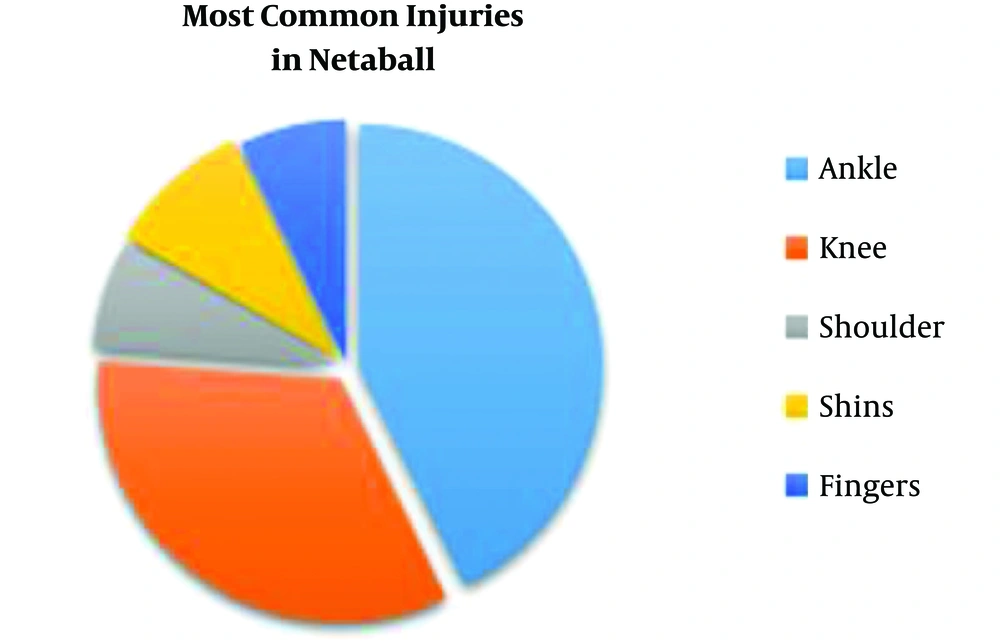
Figure 4.
Most common injuries in Netball
The amount of injuries caused by the training hours, were 13% when training for six hours’ netball while injury prevalence was 32% with rugby training. For 10 hours of training, netball players’ injury prevalence was 10%, and rugby players’ 17%. For the duration of 15 hours of netball training, injury prevalence was 58%, and in rugby players 25% (Figure 5).
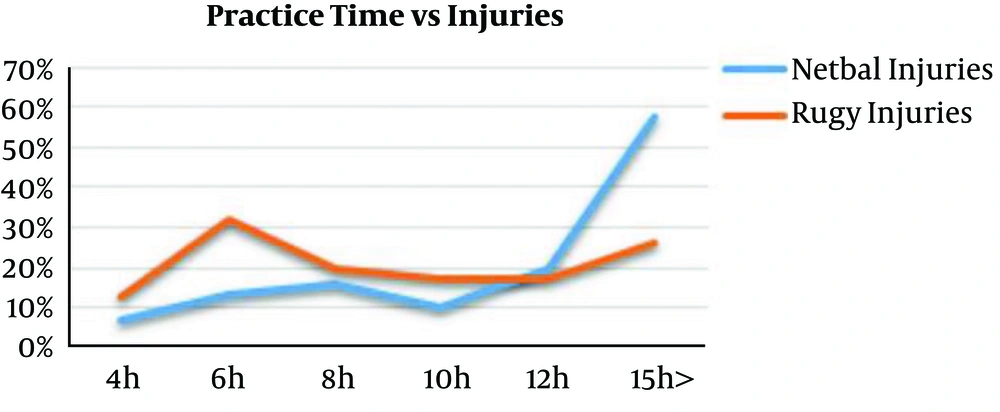
Figure 5.
Practice time vs. Injuries
5. Discussion
The objective of this study was to examine the extent to which sport coaching knowledge translates to injuries and prevention of injuries in adolescents participating in netball and rugby. According to the results, the netball coaches with nine to 12, and 13 to 16 years of coaching knowledge, had 100% first aid knowledge. This was likely as a result of them understanding the importance of first aid in sport performance and their coaching enthusiasm (2). In this regard, the results demonstrated that netball coaches in the beginning of their coaching careers, use their knowledge and experience gained from playing the sport, and only utilize a small amount of coaching experience to guide their teams (2).
With regards to rugby coaches, their knowledge gradually increased with experience over the years. In the 17 to 20 years of rugby coaching experience interval, 100% of the coaches had appropriate knowledge and first aid knowledge. This finding supports the BokSmart’sTM coach-targeted approach (26). The BokSmartTM program emphasizes injury prevention behaviors in players, which is hypothesized to lead to a decrease in injuries (27). This is as a result of the knowledge that occurs from coaching rugby players of a larger team with more players that have specific physical, physiological, perceptual, and skill demands (28). The rugby union training practices in preparation for competitive demands have predominantly focused on physical and physiological demands (28). However, RugbySmartTM also focuses on decreasing overall injury rates (29, 30) and this has resulted in more “safe” behaviors (30). Overall, there has been significant changes in the awareness and knowledge of the coaches’ and players of the BokSmartTM injury prevention program. In the levels of coaching experience of higher or equal to 25 years, it was found that only 33.3% of coaches had an appropriate first aid level. This might be that coaching has primarily been informed by biophysical knowledge for the past two decades (31).
The netball coaches in this study found that ankle injuries were the most common, followed by the knee, shoulder, lower leg and finger injuries. However, previous research found that netball players generally believe that knee and ankle injuries are the most prominent injuries (32). This study also revealed the prominence of shoulder injuries in netball players. This is due to the direct contact that occurs when netball players contest for the ball (32). The greatest percentage of injuries in netball reported in this study and in previous research are lower limb injuries. This is likely due to the awkward landings in netball, which has previously been reported as the most common mechanism of injury (33). These injuries occur because coaches do not make use of pre- and post-season conditioning programs. Also, previous research and this study found that many coaches lack first aid knowledge when attending to injuries, which, if treated appropriately, could prevent a minor injury from becoming a greater injury (34).
This study found that knee injuries were the most common rugby injuries, followed by shoulder, head and neck, and hamstring injuries. Previous research has demonstrated that these injuries mostly occur due to improper technique during contact with players, which occurs due to coaches’ lack of knowledge with regards to technique and training methods (35).
The amount of injuries caused by the training hours, were 13% when training for six hours of netball while injury prevalence was 32% with rugby training. For 10 hours of training, netball players’ injury prevalence was 10%, and rugby players’ was 17%. For the duration of 15 hours of netball training, injury prevalence was 58%, and in rugby players 25%. These findings demonstrate that 10 hours of training induced optimally conditioned and skilled players to decrease injury prevalence during netball and rugby training. This might be as a result of the coaches overtraining players when they have limited time available to train. Similarly, too many hours of training can result in injuries, especially overuse injuries. This was similarly found in previous research, which demonstrated that increased training time exponentially increases off and on-field injury prevalence (36). This shows that coaches lack experience in selecting appropriate training load for optimal training benefits. Also, the pressure placed on coaches and players to win plays a role in the increased training time (37). The coach’s knowledge of monitoring and carefully scheduling of field and gymnasium sessions to help and avoid fatigue and training-related injuries will aid in minimizing injuries (36). As such, coaches need to attend training courses in coaching to prevent injuries (38, 39). Further, this study and previous studies have demonstrated that coaches with more knowledge and experience are of the opinion that longer training sessions could result in more injuries, and instead use stricter program designs and higher intensity games (40).
5.1. Limitations
The study was voluntary, which influenced the number of coaches that participated. This limited the participation of coaches that had varying levels of professional coaching experience.
5.2. Conclusions
First aid experience by most rugby and netball coaches was not sufficient. This was exacerbated by the coaches not using pre- and post-conditioning programs. Coaches with nine to 12 years and 13 to 16 years experience had the most knowledge as most of these coaches have done their first aid course and have sufficient knowledge through experience. Also, more injuries occur when the training hours are too few or too many. This study demonstrated that 10 hours of training does not result in injuries while optimally conditioning players. This study highlights the need for coaches to improve their knowledge in relation to injuries and injury prevention, along with factors that act as a preventative measure and promote players’ well-being.