
1. Background
As stated by the World Health Organization (1), overweightness or obesity is at its highest point and has reached epidemic levels worldwide (1). Overweightness or obesity is defined as when a person's weight exceeds what is specified for height (1). Furthermore, it is estimated that obesity in developing countries will increase to 50% by 2025 (2). Obesity is linked to serious health hazards (3). Although aging is natural, obesity is more likely to be seen in older adults (4). Aging obesity, in addition to its association with sarcopenia and loss of muscle mass (5), is also a concomitant pathology in chronic pain conditions (6). Exercise is especially crucial when an individual is attempting to slim down or stay fit (7).
Some people, such as those with obesity, poor fitness, aging problems, neurological and respiratory disorders, have limitations that may restrict their potential to carry out sports activities on the ground (8). Researchers have found that aqua training can greatly increase body activity compared with ground training (9). A characteristic feature of aqua training is that the force acting in water is low-impact (10). While the water's greater resistance results in more energy expenditure and heart rate than air, its physical activity also involves the entire body (2). Studies have also shown that body, during immersion in water up to the shoulder, “loses” 90% of its heaviness (11, 12). For this reason, exercise in water is especially favorable for obese people, who are at further risk of orthopedic injuries secondary to exercise.
The composition of the human body changes significantly from puberty to old age, even in healthy people, which has been entirely proven. Meanwhile, literature studies support aqua training to promote body composition variables (12-14). Some other researchers have not acknowledged the impact of aqua training on human body composition (15-17), and still, there are disagreements regarding the effect of aqua training on body composition variables (11). The WATERinMOTION (WiM) delivers a high-energy, low-impact exercise for any ages, skills, and fitness levels. Its training session format includes a warm-up, conditioning, and a cooling-down phase (18, 19). It also mixes with the musical tempo. This music is specially designed to let people in any age group participate, and the choreography is tailored to the music (18, 19).
2. Objectives
There is only one case in which the effectiveness of WiM aqua training has explicitly been evaluated on the body composition of sedentary elderly women (19). Since some studies have pointed out gender disparities between men and women in various aspects (14, 20-22), it would be interesting to generalize these findings to older men. The objective of this investigation was to identify whether a short-run WiM program without dietetic supervision can effectively stimulate changes of anthropometric and body composition variables in overweight/obese, sedentary elderly men. We hypothesized that WiM effects on body composition variables after two weekly sessions during four weeks of moderate to vigorous exercise improved anthropometric and body composition variables in elderly men compared with those who led a sedentary lifestyle.
3. Methods
3.1. Study’s Population and Design
Seventy sedentary elderly men (mean age of 70.5 ± 4. 4 years) were recruited from volunteers who had applied to the Ukrainian Sports Center (Kyiv, summer 2019) for this cross-sectional study. Given a potential population of 85 people and a 95% level of confidence with five confidence intervals, the size of the sample using the following equation was not less than 70 people (11, 23).
The participants were allowed to conduct the study with the permission of their attending doctor. A team of a physician and three instructors provided the participants with study details. Inclusion criteria included men 65 years and older with a BMI of ≥ 25 kg.m-2 (11, 12), a minimum score of three in the assessment of self-reliant life, a sedentary lifestyle, and more than 18 points from cognitive status in the mini-mental state examination (18, 19). Exclusion criteria included participants who missed three successive sessions or more than one-third of the total session or had weight-loss supplements or medication (such as replacement hormone therapy). The participants were derived from a convenience sampling and then randomly (using a manual lottery) distributed into two groups: WiM (n = 35, two weekly sessions each included 55 minutes on WiM aqua training) or control group (n = 35, at the same time in sitting state). This study lasted a month. The study protocol was regulated with all relevant institutional strategies and policies under the Helsinki Declaration. Informed consent forms and study protocol were approved by the Institutional Research Ethics Committee. The volunteers submitted their signed informed consent form to participate in the study one week before the start. In the pre-starting study, instructions were given to fill out a diary to monitor their eating habits over 4-day (3-day throughout the week plus weekend), and a similar post-study method was accomplished for reporting altered eating habits throughout the study (11, 12, 19). Every two weeks, everyone was tracked down and asked to keep their free time, food, and exercise.
3.2. Body Measurements
Anthropometric measurements were made on participants wearing light clothes and no shoes, pre - and post-study. Height (by a stadiometer) and weight (by model 5002 of Scale-Tronix, USA) of participants were measured to 0.1 cm and 0.1 kg accuracy, respectively. BMI is a pattern that considers “an individual's weight unit in kilograms divided by the height squared in meters” (1). Before the first aqua training session, the research team calculated the participants’ BMI from height and weight data (11, 12). Being overweight means a BMI of 25.0 kg.m-2 or higher, while a BMI of 30 kg.m-2 or more is set as obese (1). Waist circumference (WC) assessment is known as a vital sign in clinical practice (3). It is measured at the end of normal expiration at the midpoint between the last rib and the iliac crest on the horizontal plate (19, 24).
BIA 310A- a tool for measuring total body water (BW), fat mass (FM), and fat-free mass (FFM) - made by Biodynamics, USA was used to obtain data on human body composition (11, 12, 19). Researchers have confirmed the data's reliability (25). Gray's equation for older people was used to predict the FFM from data obtained with BIA (19, 26). Details: FFM (in Kg) = 0.00151 (height2 in cm) - 0.0344 (resistance in ohms) + 0.14 (weight in Kg) - 0.158 (age in full years) + 20.387; FM (in kg) = Weight - FFM.
3.3. The WiM Program
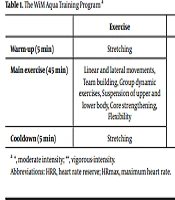
WIM courses were held in the indoor swimming pool with a depth of 1.30 m. The temperature of the pool water was between 28 to 30°C, which is recommended for fitness classes (27), was chosen around 30°C (18, 19). The WiM training session format includes a warm-up, conditioning, and a cooling-down phase. More detailed descriptions of WiM aqua training are provided in Table 1.
Table 1.
The WiM Aqua Training Program a
| Exercise | Week | Intensity | Frequency | |
|---|---|---|---|---|
| Warm-up (5 min) | Stretching | 4 weeks | 55-70% of HRmax* | 2 times/week |
| Main exercise (45 min) | Linear and lateral movements, team building, group dynamic exercises, suspension of upper and lower body, core strengthening, flexibility | 70 - 85% of HRmax** | ||
| Cooldown (5 min) | Stretching | 55 - 70% of HRmax |
Abbreviations: HRR, heart rate reserve; HRmax, maximum heart rate.
a *, moderate intensity; **, vigorous-intensity.
As stated in Table 1, WIM aqua-training intensity was considered moderate to vigorous, accounting for 70-85 of the maximum heart rates (11, 19, 28). Heart rate measurements were performed by Polar Electro Oy - a waterproof device made by Kempele, Finland - in all WiM sessions. The WiM also mixes with the musical tempo. This music is specially designed to let people in any age group participate, and the choreography is tailored to the music (18, 19).
3.4. Statistical Analysis
Statistical data were analyzed by the statistical package for the social sciences (SPSS) - IBM Corp., Armonk, NY, USA- Version 21.0 for Windows. All data were expressed as means ± standard deviations, and the Shapiro-Wilk test verified their normal distribution (P > 0.05). The homo- or heterogeneity of the studied variables in the pre-study was carried out using Levene’s test. The comparison of pre/post-study was carried out using the study's data analysis with paired t-test. The statistical significance was set at the 95% level with P ≤ 0.05. Still, since the type I error is increased when performing multiple statistical tests, Bonferroni correction was also used to adjust the probability values (P). To obtain the Bonferroni corrected p values, the original p-value was divided by the number of analyses performed. Therefore, the level of statistical significance decreased from 0.05 to 0.008. The comparison of two independent groups was carried out using an analysis of covariance (ANCOVA).
4. Results
The mean age and height of the WiM group were 70.7 ± 4.2 years and 163.2 ± 6.2 meters, respectively, and in the group of control were 70.4 ± 4.5 years and 164.1 ± 5.5 meters, respectively. Other demographics of participants, such as weight, BMI, and variables assessed in groups at pre-and post-study, are shown in Table 2.
Table 2.
Pre/Post-study Data of Participants’ Anthropometric and Body Composition Variables a
| Group/ Variables | Weight (kg) | WC (cm) | BMI (kg. m-2) | FM (kg) | TBW (L) | FFM (kg) |
|---|---|---|---|---|---|---|
| WiM | ||||||
| Pre-study | 92.6 ± 12.1 | 103.7 ± 10.3 | 34.8 ± 0.9 | 43.2 ± 11.3 | 36.2 ± 4.7 | 45.7 ± 7.4 |
| Post-study | 91.2 ± 12.6 b | 102.0 ± 10.7 | 34.3 ± 0.9 b | 42.5 ± 11.0 b | 36.0 ± 4.5 | 45.9 ± 7.3 |
| Control | ||||||
| Pre-study | 92.1 ± 13.4 | 104.2 ± 11.2 | 34.2 ± 0.8 | 43.0 ± 11.3 | 36.4 ± 4.8 | 46.2 ± 6.9 |
| Post-study | 92.4 ± 13.3 | 104.5 ± 11.1 | 34.3 ± 0.9 | 43.1 ± 10.9 | 36.5 ± 4.9 | 46.1 ± 7.1 |
| P ANCOVA c | < 0.001 | 0.005 | < 0.001 | < 0.001 | 0.004 | 0.005 |
Abbreviations: WiM, WATERinMOTION; WC, waist circumference; BMI, body mass index; FM, fat mass; TBW, total body water; FFM, fat-free mass.
aData are reported as mean ± SD.
bP value < 0.008 in comparison with pre-study.
cDifferences between groups.
Pre-study, no significant differences were observed between the groups on their weight (P = 0.648), WC (P = 0.584), BMI (P = 0.323), FM (P = 0.576), TBW (P = 0.464), FFM (P = 0.793), and were homogenous (P > 0.05). This study was finished by all participants. No events such as any refusals, dropouts, and side effects were reported in this study.
Pre/post-study, significant interactions (P < 0.008) on weight (-1.4, P = 0.002), BMI (-0.5, P = 0.003), and FM (-0.7, P = 0.005) were detected in the WiM group, which suggest their improvement. However, no significant differences were observed in WC (P = 0.01), TBW (P = 0.028), and FFM (P = 0.043). Furthermore, comparing the groups in the post disclosed significant differences in anthropometric measurements (weight and WC) and body composition variables (BMI, FM, TBW, and FFM) (Table 2).
5. Discussion
The world's aging population is on the rise. It is predicted that the world’s aging population will increase from 962 million people currently up to 1.4 billion by 2030, 2.1 billion by 2050, and 3.1 billion by 2100 (29), which prompted us to design this study for elderly people. Furthermore, few studies have evaluated the effectiveness of WiM aqua training in elderly women leading a sedentary lifestyle and focused exclusively on the body’s composition (19). While gender differences were confirmed in different aspects (14, 20-22), it would be interesting to generalize these findings to older men. The current study shows that anthropometric measurements (weight and WC) and body composition variables (BMI, FM, TBW, and FFM) were significantly improved after two weekly sessions over four weeks, from moderate to vigorous WiM aqua training without dietetic supervision, in the elderly men compared to those who led a sedentary lifestyle.
Although aqua training as an exercise is thought to be an effective behavioral tool for improving age-related physiological changes because of its ability to enhance both physical performance and the composition of the body (30), its advantages seem contradictory (11). Studies of other types of aquatic exercises within three days/week for 12 weeks in elderly obese women (16), three days/week for 16 weeks (17) in women aged 40 - 65 years, and three days/week for 12 weeks (15) in young women did not reveal significant changes in the variables of weight, BMI, and FM. Here, we observed that the outcomes of our study are not consistent with these conclusions and defend this contradiction regarding the effects of aquatic exercises on the anthropometric measurements and body composition of elderly men. Pre/post-study, statistically significant alterations in body weight, BMI, and FM were observed during WiM aqua training (Table 2). At the end of the study, statistically significant alterations in body weight, WC, BMI, FM, TBW, and FFM were observed between the study groups (Table 2). This contradiction may be since any calorie-burning kind of exercise raises the chance of changes in body weight and composition (31). WiM appears to provide more mobility in aerobic conditions than other types of aquatic exercises. Thus, reducing body fat mass via the energy imbalance by the built-in resistance from the viscosity of the water is greater and makes the push more effective with any perfect movement (11, 32). The energy costs of WiM aqua training have not been offset by the number of calories consumed, and maintaining calorie deficit through aqua training has a positive effect on anthropometric and human body composition variables (11, 19).
A review of the researchers' work indicates some studies whose findings are consistent with and support our conclusions. These studies include aquatic exercises on body composition variables for two days/week for six weeks (33), three days/week for two months (13), and three days/week for 12 weeks (8, 11, 12), which reflect the reduction in weight, FM and BMI in adults and the elderly. In addition to the participation of elderly men with a sedentary lifestyle, another novelty of the present study is that WiM was linked to the reduction in weight, FM, and BMI, while the duration of its program was about four weeks compared to six, twelve, or more. About the time it takes to improve body weight and composition, different authors advocate different approaches. Some authors suggested exercising three days/week for four weeks (34), while others endorsed the program "three days a week for 12 weeks" (35). In our study, participants engaged in physical exercises two days/week for one month (or about four weeks). In part, these findings are similar to our previous study in older women (19). However, there is a gender difference in fat loss indicators in young people during physical activity due to the ability to react differently to physical exertion and the high dependence of fat mobilization on its distribution in the body (22). These significant health benefits can provide clinical usages for the study.
Pre/post-study, no statistically significant alterations in WC, TBW, and FFM were observed in the WiM group (Table 2). However, as mentioned above, statistically significant alterations were observed between them at the end of the study between groups (Table 2). This may be due to the short-run implementation of WiM compared to other studies. Bone density and blood flow during muscular activity depend on FFM and are directly related to exercise (36). WiM provides this work by the built-in resistance from the viscosity of the water that makes the push through in any movement made (32). The changes in WC were positive in our study, but it was insignificant for the WiM group. On the contrary, a study found that older people had a more significant reduction in WC when walking in the water and over 24-48 weeks (28), which could explain its better outcome than the current result. Elevated WC caused by visceral fat can be a hazard factor for cardiometabolic and arthritis illnesses (37). It is difficult for obese people to exercise and overcome the resistance of water even if they exercise in water (11-13). Consequently, the speed and intensity of activity may be insufficient to have a more significant impact on weight and other variables studied since both are directly linked to the outcomes of the exercise.
In the case of the control group, there were insignificant improvements in the anthropometric measurements and human body composition variables. Although this change is not statistically significant, continuing this trend may lead to a substantial increase in them over time.
5.1. Limitations and Suggestions
Although the study results seem promising, the limitations should be handled with caution. These outcomes may not be observed outside of older men due to age - and gender-related metabolic differences. In addition, this study could not compare and/or analyze land-based exercise or other water-based exercise schemes. Recommendations for later studies consist of applying randomized controlled trial allocation and sampling so that the study population has the opportunity to be selected. Also, study about other age and gender groups is recommended.
5.2. Conclusions
A short-run, non-diet-supervised WiM program suggests supporting a loss in weight, FM, and BMI in overweight/obese, sedentary elderly men. The findings will enable physicians and instructors as health professionals to suggest WiM as aqua training to theose patients who cannot engage in sports activities on the ground and thereby help to improve their health.