1. Background
Many female athletes, especially those in aesthetic and weight-dependent sports, are chronically energy deficient. This energy deficiency can be hazardous, impairing their performance, increasing the risk of injury, and threatening their overall health. These athletes often face pressure to reduce their body mass and body fat to levels below what is considered healthy. Dancers, in particular, are at risk of these health issues due to an extreme desire for an ideal body contour for better performance and the high training demands of a competitive environment (1). The syndrome of relative energy deficiency in sport (RED-S), formerly known as the female athlete triad, results from an imbalance between energy intake and expenditure and can lead to numerous negative health and sports performance consequences beyond the well-known triad of osteopenia, eating disorders, and menstrual abnormalities (1, 2). Additional consequences include impaired metabolic function, such as a decline in resting metabolic rate (RMR), hormonal level changes, the inability to reach peak bone mass, and growth and developmental impairments in adolescents (1, 3, 4). When energy intake is lower than expenditure, a state of low energy availability can occur, which may be associated with eating disorders. Furthermore, high training volumes and/or overzealous weight loss methods can contribute to negative energy balance in dancers (1, 5). Previous research on elite dancers has reported low energy availability, eating disorder behaviors, and related negative health consequences (6, 7).
Historically, dance has been popular in Iran since at least the sixth millennium BC. As a defining characteristic of Iranian tribes, this art reflects their interpretation of the world. Among ancient Iranian people, dance served as a form of play or performance used in mourning, celebration, or prayer ceremonies by performers who were skilled in music, dance, physical activities, and speech techniques. This art held a prominent place during the Sassanid era and was even included as part of the curriculum for primary school students (8). Despite the numerous physical education and health clubs in Iran today and the popularity of dance among Iranian females (9), there has been no research on the energy balance of these high-risk groups in the literature.
2. Objectives
This study aims to assess the dietary intake and energy consumption of nonprofessional student female dancers as a preliminary investigation into this topic.
3. Methods
This study was a cross-sectional analysis involving 25 female nonprofessional dancers across three health clubs in Tehran, Iran. Participants signed an informed consent form, and the study received approval from the ethical committee of Shahid Beheshti University of Medical Sciences, Tehran, Iran. All participants were university students, physically healthy without any major underlying medical conditions. They had been dancing regularly for approximately three months, three days per week, for about one hour per session. Dietary intake was assessed using self-reported food diaries and recall interviews on three different days: One dance day, one working day without dance, and one weekend day without dance. Participants who did not complete the food diary adequately or respond appropriately to questions were excluded from the study. The nutrient intake was converted to grams of proteins, carbohydrates, and fats, and the total consumption of these macronutrients was calculated based on their mean over the three days. Then, total energy intake (TEI) was calculated according to the caloric equivalents of these macronutrients: 4 kcal per gram for carbohydrates and proteins, and 9 kcal per gram for fats.
Total energy expenditure (TEE) was calculated as the resting energy expenditure (REE) multiplied by the physical activity level (PAL) (10). REE was estimated using the validated Harris-Benedict equation for women (11, 12). Energy needs for dancing were calculated as 4.5 Metabolic Equivalents (METs), code 03025, based on the compendium of physical activities report for Middle Eastern dancing (13). Energy expenditure on working days without dance (EEW) was calculated by multiplying REE by a physical activity level of 1.58 (14). Energy expenditure on rest days without dance (EER) was calculated by multiplying REE by a physical activity level of 1.25 (15). Energy expenditure on dance days (EED) was adjusted for the specific duration of dancing (1 hour) performed at an intensity of 4.5 METs, calculated as EED = (EEW/24) * (24 - 1 hour) + (0.9 * 4.5 * mass in kg * 1 hour).
Total energy expenditure was calculated as the mean of energy expenditures over three different days in a week: Three days with dance, three working days without dance, and one rest day. Total energy intake was calculated as the mean of energy intakes over the same days. Energy balance was determined by subtracting total energy intake from total energy expenditure. The average 7-day intake of protein and carbohydrates as g/kg/day was compared with the goal of 1.4 to 1.6 (mean 1.5) g protein/kg/day and the average need of 4 g/kg/day for carbohydrates for dancers (1, 16). Mean energy intake from fat as a percentage of total energy intake was compared with the recommended 20 - 35% (mean 27.5%) for dancers (17).
Statistical analysis was conducted using paired t-tests (comparing mean TEE and TEI), one-sample t-tests (comparing data with recommended values), and SPSS software (version 7). A P-value of less than 0.05 was considered statistically significant.
4. Results
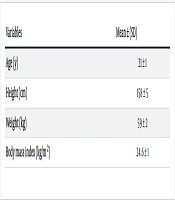
Tables 1 and 2 display the basic demographic characteristics of the participants as well as the mean Total Energy Expenditure (TEE), Total Energy Intake (TEI), and macronutrient intake of the participants.
Table 1.
Demographic Features of the Dancers
| Variables | Mean ± (SD) |
|---|---|
| Age (y) | 21 ± 1 |
| Height (cm) | 158 ± 5 |
| Weight (kg) | 59 ± 2 |
| Body mass index (kg/m2) | 24.6 ± 1 |
Table 2.
Shows the Mean TEE, TEI, and Macronutrient Intake of Participants a
| Variables | Total (3 Dance Day + 3 Working Day + 1 Rest Day)/7 | Dance Day (3 Days) | Working Day (3 Day) | Rest Day (1 Day) |
|---|---|---|---|---|
| Energy (kcal/day) | ||||
| Expenditure | 2166.5 ± 400 | 2437 ± 510 | 2072 ± 420 | 1639 ± 303 |
| Intake | 1394 ± 256 | 1235 ± 223 | 1496.4 ± ± | 1562 ± 259 |
| Balance | - 772.7 ± 450 b | - 1202 ± 600 b | - 575.6 ± 421a | - 77 ± 65 |
| Carbohydrate (G/day) | 135.5 ± 22 | 115 ± 19 | 149 ± 25 | 156.7 ± 29 |
| G/kg/day | 2.29 ± 0.7 | 1.94 ± 0.5 | 2.5 ± 0.8 | 2.6 ± 1 |
| % of TEI | 38.8 ± 5 | 37.2 ± 6 | 39.8 ± 6 | 40.1 ± 7 |
| Protein Fat (G/day) | 68.4 ± 14 | 61 ± 23 | 73 ± 15 | 77 ± 16 |
| G/kg/day | 1.15 ± 0.3 | 1.03 ± 0.2 | 1.2 ± 0.4 | 1.3 ± 0.4 |
| % of TEI | 19.6 ± 3 | 19.7 ± 3 | 19.5 ± 2 | 19.7 ± 2 |
| G/day | 64.2 ± 22 | 59 ± 21 | 67.6 ± 25 | 69.7 ± 29 |
| G/kg/day | 1.08 ± 0.3 | 1 ± 0.2 | 1.14 ± 0.5 | 1.18 ± 0.5 |
| % of TEI | 41.5 ± 8 | 42.9 ± 7 | 40.6 ± 7 | 40.1 ± 8 |
a Values are expressed as mean ± SD.
b Indicates statistical significance with P values less than 0.05.
Mean Total Energy Expenditure (TEE) was calculated as the average of Energy Expenditure on Rest days (EER) for one day, Energy Expenditure on Working days without dance (EEW) for three days, and energy expenditure on dance days (EED) for three days as follows: Mean Resting Energy Expenditure (REE) = 1311.5 Kcal, Mean EER = 1639 Kcal, Mean EEW = 2072 Kcal, Mean EED = 2437 Kcal.
There was a significant difference between the mean total energy expenditure and total energy intake over the 7-day period (P-value = 0.015). Significant differences were also observed between mean energy intake and expenditure on dance days and working days (P-values were 0.007 and 0.025, respectively), but not on rest days (P-value = 0.081).
Regarding macronutrients, significant differences (P-value = 0.035) were found between the mean daily protein intake of participants over 7 days (1.15 g/kg/day) and the target intake range of 1.4 to 1.6 (mean 1.5) g protein/kg/day for dancers. Additionally, the average daily intake of carbohydrates over the 7-day period was 2.29 g/kg/day, which was nearly half of the average requirement for dancers (4 g/kg/day) (P-value = 0.005). Mean energy intake from fat was approximately 41.5% ± 8%, which was statistically higher than the recommended 20 - 35% (mean 27.5%) for dancers (P-value = 0.015).
5. Discussion
Our findings reveal a significant negative daily energy balance among participants during the 7-day period, and specifically on working and dance days, but not on rest days. Similar findings have been reported in previous studies of professional dancers in the UK, New Zealand, Greece, and Poland (17-20). To date, there has been no data about dancers in Iran, making this study the first of its kind on this topic. Although the average BMI of our participants fell within the normal range, dancers are prone to an obsession with being physically thin and often exhibit body image distortion (21). While not specifically questioned about their body image in this study, fears of weight gain and desires to slim down are common among dancers. Additionally, given the limited professional dance opportunities in Iran (22, 23), dancers may engage in dancing for other reasons, such as medical recommendations for weight reduction or prevention of weight gain. Therefore, it is expected to observe unhealthy weight reduction behaviors along with body image distortion in this group of athletes. Body dissatisfaction is common among dancers of all ages, often leading to a distorted body image, which in extreme cases can progress into a body image disorder (24). Moreover, eating disorders are prevalent among these athletes, with a reported lifetime prevalence of 50% among professional dancers and up to 26.5% among young dancers (25). In a recent cross-sectional study involving 124 national professional dance students from Norway, 50% of participants self-reported mental health issues, including depression, anxiety, low self-esteem, body image concerns, and eating disorders (26). A strong correlation between BMI and dieting behaviors in dancers has also been documented (27, 28). Chronic negative energy balance and malnutrition in dancers can lead to numerous health problems, including chronic fatigue, an increased risk of injury, osteopenia, stress fractures, and menstrual dysfunction (29, 30). Consequently, an energy intake of more than 30 kcal/kg of fat-free mass (FFM) is recommended to prevent negative energy balance and its adverse health consequences (1).
Our data regarding protein and carbohydrate intake reflect a similar pattern. Our participants consumed less protein and carbohydrates than the recommended amounts for dancers. Although underreporting is a possibility, particularly in this age group, and must be considered when interpreting the data (31), low intake of protein and carbohydrates in dancers has also been reported in other studies (17, 32, 33). Restricted energy intake can lead to deficiencies in both macronutrients and micronutrients among dancers. A recent study on 17 student dancers in the USA found that they consumed less than the recommended amounts of protein, carbohydrates, calcium, iron, and potassium for an active population (32). Limited food choices can also pose a problem. The convenience of selecting and preparing food, taste preferences, and advice from other athletes can influence athletes' food choices. Athletes, more than other groups, are likely to adhere to dietary fads and harbor misconceptions about nutrition. Such beliefs may lead dancers to unnecessarily restrict genuinely healthy foods, resulting in insufficient nutrient and energy intake (34).
Dancers require optimal skill, strength, and endurance for peak performance, and these deficiencies can lead to chronic malnutrition and its health consequences, as well as a reduction in their athletic performance. The risk of injury increases as dancers develop low bone mineral density and become prone to fragility or stress fractures (35). Adequate post-exercise protein consumption is necessary for the repair and remodeling of skeletal muscle and connective tissue (36). In situations of negative energy balance, such as during weight reduction, there is a down-regulation of muscle protein synthesis, so the need for protein intake is higher (1.6 - 2.4 g/kg/day) to prevent proteolysis and optimize muscle protein development (37). Moreover, adequate carbohydrate intake plays a crucial role in exercise metabolism, especially for optimal glycogen recovery and fatigue prevention, particularly in high-intensity dance (38). In this study, the mean energy intake from fat was higher than the recommended value for dancers. This finding, along with the previously mentioned underreporting, may explain why the BMI of participants was within the normal range despite the negative energy balance. High fat consumption among dancers has been reported in previous studies as well (17, 39), indicating nutritional malpractice. Low nutritional knowledge among dancers may also contribute to this issue (40), and it could be linked to underlying eating disorders, such as binge eating in dancers (17). In our study, high fat intake is likely related to unhealthy dietary habits and eating behaviors, which are common among Iranian students (41). A cross-sectional correlational study on 224 nursing students in Iran reported a significant relationship between nutritional literacy and eating behaviors among participants (42). Another study on 412 university students in Taiwan found that nutrition literacy significantly predicted healthy eating behavior (43). Therefore, developing strategies to increase nutritional literacy in university students, especially among student dancers like our participants, is crucial for preventing these unhealthy nutritional behaviors.
Most of the negative energy balance in our study was related to dance days (- 1202 kcal). This partly may be related to exercise-related anorexia (ERA) which is temporary suppression of appetite following moderate to high intensity exercise (44). ERA is mostly described in non-professional athletes like our participants. Nevertheless, if anorexia in our dancers acted as an influential factor in the low energy intake of dancers, it is unclear whether it would have been due to ERA or reflection of underlying eating disorders such as anorexia nervosa. Over-estimation of the physical activity of participants is a less likely explanation for this large energy deficiency on dance days. The assumption of the intensity of dance in our participants as a moderate intensity (4.5 MET) exercise is the rationale according to the type of dance (Iranian low-impact dance) they were doing. Also, this dance-related intensity is placed at the bottom of the range of dance-related METs in the last update of the compendium of physical activities (13). In favor of this idea, our participants were nonprofessional amateur dancers and less likely to tolerate more high-intensity activities for 3 consecutive sessions in a week.
Our study has some limitations. In addition to under–reporting of food intake which was discussed previously, we could not do a body composition analysis because of a lack of validated equipment. So, the FFM of dancers and energy intake accordingly could not be evaluated. Also, we did not investigate the presence of eating disorders in our participants. Physical activity measurement of dancers was not based on more accurate objective methods such as wearing acetometers. Our participants all were students which may be not representative of all female dancers in this age group. The small sample size and lack of a control group (nondancers) make specific data relationships with dancers impossible. Future studies must be planned regarding these issues.
It appears that Iranian female nonprofessional dancers are at risk of negative energy balance, particularly during dance days, which may be due to a fear of weight gain or as a weight reduction strategy. Additionally, low protein and carbohydrate intake, coupled with high fat consumption, suggest an improper nutritional strategy for achieving these probable goals. Therefore, consulting with experienced sports nutritionists and other related specialists, including psychiatrists, for these high-risk populations is highly recommended. Further research, taking into account the limitations of this study, is essential for a better understanding of Iranian dancers' nutritional behaviors and can greatly benefit this population.