1. Background
Motocross is one of the most popular motorized off-road sports, characterized by riding on irregular natural terrain of hard earth and/or sand with various obstacles throughout the course. High-level motocross riders experience greater physical and physiological demands compared to other off-road motorized modalities (1) with a high incidence of injury (2-5). In this regard, the aims of physical training should be to improve physical performance as well as reduce the possibility of sports injuries. There has been a large increase of motocross riding worldwide with an increasing number of practitioners considered amateurs who are seeking to improve their specific physical preparation for the sport. Amateur motocross races are held on a motocross track (distance between 1,200 and 2,500 meters) with a duration ranging from 15-30 minutes, depending on the competitive event. Thus, riders’ movements in motocross are continuous and acyclic, requiring constant isometric contractions of the arms and legs to control the motorcycle (weight~100 kg) due to constant and rapid changes of direction, jumps, curves, and braking. In this context, studies have been conducted to evaluate the physical and physiological demands placed on high-level motocross riders (1, 6-9). On the other hand, these findings may not represent the physiological responses of amateur motocross riders. Owing to the extreme physical and physiological demands of this sport and the low fitness level of some participants, amateur riders often experience fatigue, primarily of the forearms. This symptom is known in the motocross world as arm pump (8). Muscle fatigue can result in a decreased performance of specific motor actions used in this sport during the race and this consequently affects the competitive performance of the rider. Additionally, a high fatigue index can increase risks of accidents and injuries during motocross practice. Therefore, investigation of the acute metabolic and physical responses would be of interest for amateur participants, providing more specific characterization of a motocross training session.
2. Objectives
In this regard, the current study aimed to evaluate neuromuscular response and blood lactate concentrations following a motocross training session in amateur riders. The knowledge of neuromuscular and metabolic variables required by the sport can provide important information for coaches in the planning and prescription of physical training sessions. This information should support improving physical tolerance and competitive performance by amateur riders.
3. Patients and Methods
3.1. Subjects
Motocross riders competing in a state-level (Sao Paulo) amateur motocross competition (ranked among the top 15) were invited to participate in this study. Nine male motocross riders agreed to participate in the study and had the following attributes: mean age 22.7 ± 2.8 years; body weight 72.2 ± 7.1 kg; height 174.3 ± 4.3 cm; and body mass index (BMI) of 23.77 ± 2.7 kg/m2. The inclusion criteria for participation in the study were: at least 2 years of amateur experience in state-level competitions and training with a motorcycle at least twice a week. Participants were excluded if they had a neuromuscular disorder or injury 1 month prior to the study. All subjects completed a questionnaire to assess their health status and signed an informed consent form after receiving information about the research and experimental protocol. This study was approved by the Research Ethics Committee of the Methodist University of Piracicaba (Protocol No: 52/12).
3.2. Experimental Procedure
This cross-sectional study tested the following parameters prior to (pre) a motocross training session: (a) lactate concentration using a capillary blood sample (b) handgrip strength for both hands; and (c) horizontal jump ability. Following these measures, the riders performed 3 laps on the motocross track to warm-up and familiarize themselves with the track and obstacles. A rest interval of 3 minutes was provided prior to the start of the motocross training session and the riders were instructed to perform the course at their own maximal speed. The training session involved riding of 20 minutes on a 1.6 km motocross track in accordance with the standards of the Brazilian Confederation of Motorcycling. Each rider performed the training session with their own motorcycle; however, all participants used a 250-cc four-stroke motorcycle to induce similar physical efforts and physiological responses. The weather was clear with temperatures ranging between 24°C and 28°C. Additionally, the track was dry and all the riders performed the training session under the same conditions between 8:00 and 11:30 (a.m.). After the training session, the concentrations of blood lactate were measured at zero, 3, 5, 8 and 10 minutes following the end of the training session. The handgrip strength for the right and left hands and a horizontal jump test were performed immediately following the measures for blood lactate removal (10 minutes after the training session). The subjects were instructed to eat a light meal an hour before the training session and freely drink water.
3.3. Handgrip Strength Test
The handgrip strength of the right and left hands was determined with a manual mechanical dynamometer (TKK Grip Strength Dynamometer 0-100 kg, Takei, Japan), according to Hanten et al. (10). The riders assumed a standing position with their shoulders and wrists in a neutral position and elbows extended. After a clear voice command, the subjects were instructed to perform the handgrip movement at maximum muscle strength. Three repetitions were performed on both hands with an interval of 30 seconds between each attempt for the same hand. We considered the highest values obtained for analysis and the values are expressed in kilograms (kg).
3.4. Horizontal Jump Test
The determination of horizontal jumping ability was performed using the procedures described by Maulder and Cronin (11). Subjects were positioned with the trunk upright and feet parallel with toes behind the starting line. They were instructed to squat (ca. 120° knee angle) as quickly as possible and jump forward for maximal distance. Three tests were attempted with rest intervals of 30 seconds between each test. The longest distance achieved was considered for analysis and the values are expressed in centimeters (cm). All participants performed this test without motocross boots and kneepads.
3.5. Blood Lactate Analysis
To determine the metabolic response of the training session, we evaluated the blood lactate concentrations before and after the training session. Blood samples (25 µL) were collected from the fingertips into heparinized capillary tubes and transferred to microtubes containing 50 µL of 1% sodium fluoride. The lactate concentration was analyzed via an electro-enzymatic method with a lactate analyzer (YSI 2300 Stat Analyzer, Yellow Springs Instruments, Yellow Springs, OH, USA). Blood lactate concentrations are expressed in millimoles (mM).
3.6. Statistical Analysis
Data normality was assessed by the Shapiro-Wilk test. All data showed normal distribution, so the Student’s t-test was used to compare the handgrip strength and horizontal jump test distances. One-way, repeated measures analysis of variance (ANOVA) followed by a Turkey’s post-hoc test were used for comparisons in the blood lactate values. The level of significance was set at p ≤ 0.05. Data are expressed as mean ± standard derivation (SD).
4. Results
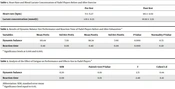
Table 1 describes the handgrip strength and horizontal jump tests data. There was a significant difference (t = 4.68; P = 0.002) in the pre-values of handgrip strength between the right and left hands. After the training session the values of handgrip strength were significantly lower for the right (t = 3.96; P = 0.004) and left (t = 3.34; P = 0.010) hand. In addition, there was no significant reduction (t = 1.26; P = 0.241) in horizontal jump ability. The results of blood lactate concentrations showed significant changes in the following periods: post (P = 0.001; 6.5 ± 2.7 mM), 3 minutes (P = 0.001; 5.2 ± 1.9 mM), 5 minutes (P = 0.001; 4.6 ± 1.8 mM), and 8 minutes (P = 0.01; 4.1 ± 1.5 mM), when compared with the pre-value (2.29 ± 0.7 mM). 10 minutes following the training session there was no longer a significant difference (P > 0.05; 3.4 ± 1.4 mM). The peak concentration for blood lactate was 6.5 ± 2.7 mM immediately following the training session. Figure 1 shows the concentrations of blood lactate.
Table 1.
Values for Neuromuscular Responses for Pre- and Post-Motocross Training Session (n = 9) a
| Evaluation | Pre | Post | P Value |
|---|---|---|---|
| Handgrip Strength Right Hand, kg | 52.2 ± 6.4 | 46.2 ± 8.1 | 0.004 |
| Handgrip Strength Left Hand, kg | 48.0 ± 4.9 | 43.6 ± 5.4 | 0.010 |
| Horizontal Jump, cm | 218.6 ± 21.9 | 213.2 ± 22.3 | 0.241 |
a Data are expressed as mean ± SD.
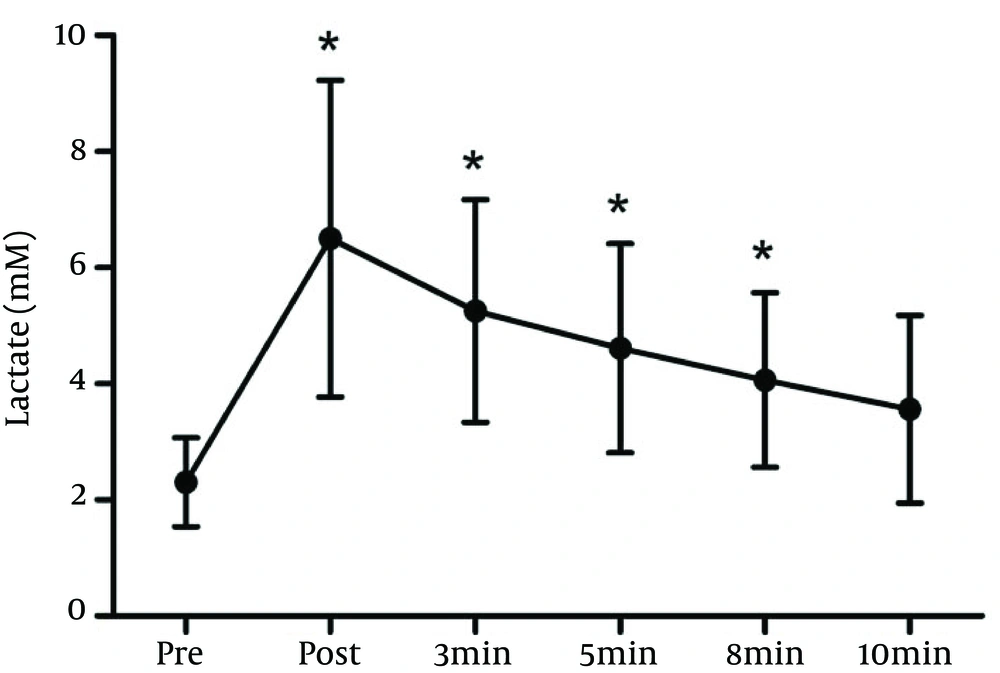
Figure 1.
Data are expressed as Mean ± SD (n = 9). * Significant differences compared with the Pre-value.
5. Discussion
The present study aimed to evaluate the blood lactate and neuromuscular response to a motocross training session in amateur riders. The main findings were: (a) significant anaerobic metabolism demands; (b) decreased handgrip strength in both hands; and (c) no change in horizontal jump ability following the training session. Studies conducted to evaluate the physical and physiological requirements for high-level competitive motocross riders show values of heart rate close to the maximum predicted (1, 6-8), oxygen consumption ~ 71% of maximum (6), blood lactate concentrations between 5–6 mM (1, 8), oxidative stress (8), and decreased handgrip strength (1, 6, 7, 9). These data demonstrate that high-level competitive motocross results in high physiological and physical demands. Alternatively, these data are not reproducible in amateur motocross riders since the physical and technical performance would be expected to be inferior in this population. In our study, concentrations of blood lactate in amateur riders remained elevated up to 8 minutes post-training session, with a peak value of 6.5 mM. These suggest a significant contribution of the glycolytic pathway and our results are consistent with data reported for high-level motocross riders (1, 9). Therefore, a significant amount of anaerobic metabolism occurs during motocross due to continuous neuromuscular demands with muscular contractions in the upper and lower limbs. A decline in muscle strength (% of maximum strength) is considered a valid indicator of muscle fatigue (12). In this sense, the handgrip strength data in our study showed a significant reduction of 11.5% and 9.2% for the right and left hands, respectively, after a motocross training session in amateur riders (Table 1). During a training session there are frequent isometric contractions occurring to control the motorcycle with constant manipulations of the clutch (left hand), front brake (right hand) and accelerator (right hand). This constant activity significantly induces fatigue of the flexor muscles that control the fingers and wrist, resulting in decreased handgrip strength in both hands. Some studies have reported that motocross riders have greater muscular strength capacity in the left hand despite being the non-dominant hand. This difference is attributed to frequent use of the clutch (1, 5), and professional riders are probably riding much more and have done so for many years. In contrast, we observed in amateur riders greater handgrip strength in the right hand. These data can be expected because the accelerator and brake are constantly used by the right hand. Additionally, in modern motorcycles clutch levers are usually hydraulic and require less physical effort by the left hand. This fact may have contributed to the difference in muscle strength between the right and left hands, as all riders in our study reported the right side as dominant. While motocross requires frequent muscle contractions of the lower limbs; however, we found that a motocross training session resulted in no significant change in the horizontal jump test values for amateur riders. In this context, Konttinen et al. (7) evaluated the neuromuscular response of amateurs and professionals during motocross and found that the average relative electromyographic activity was significantly reduced for the lower limbs compared with the upper limbs. Therefore, due to the lower demand for lower extremity muscle strength, we observed no significant decline in the neuromuscular performance of lower limbs caused by fatigue in amateur motocross riders. Further, the rest interval of 10 minutes may have been sufficient to recover from acute fatigue of the lower limbs. On the other hand, the horizontal jump is a non-specific test and may not reflect the isometric leg muscle strength exercised in the motocross training. The present study confirms greater involvement of the upper limbs of amateur motocross riders completing a continuous effort lasting 20 minutes, which is the official duration of the amateur category. Our study has some limitations that need to be addressed. Firstly, This study involves amateur motocross riders and these physical and physiological acute responses do not represent professional riders. Secondly, our study design included only a training session and may not reflect the demands of a motocross race. Despite these limitations, our data provides insights to inform coaches on how to manipulate physical training sessions for amateur motocross riders to improve strength and conditioning. In conclusion, amateur motocross riders conducting a training session required a significant demand for anaerobic metabolism resulting in decreased handgrip strength. These data indicate that it is important for physical training to target improved anaerobic and neuromuscular performance for upper limbs in amateur motocross riders. Future research is required to assess the influence of an official amateur motocross race on the acute physical and physiological response.