1. Background
Restless legs syndrome (RLS) is a neurological movement disorder that affects a large number of people (1). RLS prevalence studies show that 10% of the adult population is affected by this disorder (2). The outbreak of the disease is more common in end stage renal disease (ESRD) patients than general population (3). 20% to 70% of the dialysis patients report symptoms of RLS (4). Some studies also indicate that 33% of ESRD patients suffer from RLS (3). Restless legs syndrome has been shown to have a significant impact on the quality of life of the patients on hemodialysis mainly because of the poor quality of sleep and inadequate rest (2).
RLS is a disorder that gives the patient unpleasant sensations in his limbs, especially legs. These sensations make an urge to move the legs to stop the sensations (5). The syndrome is a sensorimotor disorder that is characterized by restlessness symptoms that lead to an irresistible urge to move some body parts (2). This comes in the evening after sitting for a long time and the sensations are expressed in tickling, pain, itching, and stretching feelings. The symptoms of RLS may appear at any age; 12% of RLS symptoms appear before ten (6). But overall, RLS often appears in middle age (5). Many factors of RLS are unknown or hereditary (7), but it is usually most common in people suffering from chronic renal diseases, diabetes, iron deficiency anemia, Parkinson’s, neuropathy, pregnancy, use of caffeine, calcium channel blocker drugs, lithium, and sedative drugs withdrawal (5).
The special criteria for diagnosis of RLS have been introduced by the international restless legs syndrome study group (IRLSSG) and including; 1) a uncontrolled urge to frequently move the limbs due to RLS symptoms, 2) temporary relief of the unpleasant symptoms by moving; 3) worsening of the symptoms after resting or lack of movement, 4) worsening of the symptoms in the evening or at night (8).
Worsening of the symptoms in night in patients with moderate to severe RLS leads to sleep disorder. As a result, RLS patients may experience anxiety and sleep deprivation or drowsiness during the day that can disrupt the daily functioning of the patient (9). Also RLS causes sleep disorder, daily fatigue, depression, disruption of the ability to work and social isolation (10). These problems lead to poor quality of life and have adverse effects on social activities and family life (9). Regarding this information, studies have shown that the reduced quality of life in hemodialysis patients with RLS is possible because of inadequate sleep quality and quantity (2). Common medications for RLS has been dopamine agonists or benzodiazepines, but the drugs have some side-effects (1). Initially, to treat RLS, non-pharm logical treatments like sleep hygiene, warm bath, massages, reduction of stimulating factors such as caffeine and alcohol should be tried (11). Recently, some researcher has been conducted on the effect of changing lifestyle like performing exercises (1). Since the symptoms of the syndrome appear or worsen in resting and immobility times, these symptoms may improve by moving. Therefore, moderate exercise can be helpful (2). Exercises like walking, massaging, stretching, swimming, and stationary cycle can help relieve symptoms (12). The effects of exercise on RLS symptoms are unknown. A research by Ohayon et al. (13) in 2002 showed that severe physical activities like high intensity sports just before bedtime exacerbate the symptoms of RLS. Also Aukerman and Sakkas concluded that a daily mild exercise program can alleviate the RLS symptoms (1, 2).
2. Objectives
Review of recent studies showed that we need more research about the effects of exercise on RLS symptoms. Therefore, the present study aims to assess the effects of stretching exercises on severity of RLS symptoms in patients on hemodialysis because stretching exercises are easily applicable by the patients and are applied on legs and don’t cause disruption in dialysis.
3. Patients and Methods
3.1. Design and Sample
This study was a randomized controlled trial conducted on hemodialysis patients from the hemodialysis ward of Hasheminejad Hospital affiliated to Tehran University of Medical Sciences in Tehran. Given the study by Aukerman et al. (1) with a confidence interval of 95% and testing power of 90%, the sample size was calculated 13 for each group, but totally 18 people were considered for each group considering the possible dropout, so 36 people were enrolled.
3.2. Inclusion and Exclusion Criteria
The inclusion criteria were having diagnostic criteria for RLS according to IRLSSG, age over 18, at least 6 months since the start of dialysis treatment, being on the weekly list of dialysis for 3 times a week and each time for 3 to 4 hours, having no mental or physical disability, being completely alert, having acceptable hearing and speaking ability for answering the questions, absence of any infection, injuries, and peripheral neuropathy or vascular problems in legs, absence of orthopedic problems, and confirmation of RLS by physician in research centers. The exclusion criterion was refusal to do the stretching exercises for 3 consecutive sessions and overall 6 sessions.
3.3. Procedure and Instruments
To identify the patients with RLS, initially, four diagnostic criteria were given to all the patients at the hemodialysis ward. Patients, who answered “yes” to all 4 questions, were examined by the physician for confirmation of RLS. The patients with RLS were included in the study consensually and randomly divided into intervention and control groups. Initially, the stretching exercises were taught to the intervention group during two sessions. After the training, the intervention group participated in 8 weeks of a stretching exercise program three times a week during the last two hours of hemodialysis session and each time for 30 minutes. The researcher closely monitored the exercises. Each session involved 5 minutes of initial warm-up. Then, the participants did stretching exercises on legs for 20 minutes and then cooled down for 5 minutes.
The stretching exercises that were confirmed by a sports medicine specialist were applied to the legs and included hip rotation to the sides, quadriceps stretch, knee to chest stretch, hamstring stretch, gluteal stretch, straight leg raise, side lying leg lift and so on. Each muscle was stretched to three sets of ten. Duration of each stretching was 5 seconds. After training sessions these exercises was performed by the participants under the supervision of the researcher.
For assessment of the effect of stretching exercises on severity of RLS we used the international RLS study group (IRLSSG) Scale. This scale was completed at baseline, at the end of the 4th week, and at the end of the 8th week by the subjects. The demographic information was collected by a questionnaire. The scale for assessing the severity of RLS involved 10 items each having 5 options. Every question had 0 to 4 points. The maximum score was 40 and a high score indicated the severity of disease. The participants with less than 10 points were mild, 11 to 20 points were moderate; 21 to 30 points were severe and above 31 was very severe. All interviewers and personnel who handled the questionnaires were blinded to study allocation of the participants.
In order to determine content validity and reliability of the IRLSSG questionnaire, Cornbrash’s alpha coefficient was used in this study. The validity of IRLSSG questionnaire was 0.87.
The Data were collected in two months in 2012 and were analyzed using SPSS16 software program and Fisher’s statistical test, two-sample Kolmogorov-Smirnov test, t-test and ANOVA. A P value < 0.05 was considered statistically significant. The study was introduced and approved by the Ethics Committee of the Tehran University of Medical Sciences in 09 September 2012. All participants signed written consent after full explanation of the procedure.
4. Results
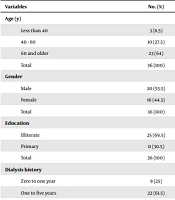
After screening all the patients who were in the list of hemodialysis ward and identifying patients with RLS, 36 people were included in the study. They were divided randomly into two 18-member control and intervention groups. One patient was excluded from the intervention group because of not completing stretching exercises sessions, and two patients were excluded from the control group (one of them had died and the other one was not cooperative). In total, the study continued with 33 people (17 patients in the intervention group and 16 patients in the control group). According to the results, 51.5% of the participants were men and 30.3% were above 66-years-old. Most participants were married (63.6%) and jobless or retired (78.1%). The most common diseases among the participants were hypertension (48.5%) and diabetes (42.4%) and the most used drug was amlodipine (45.5%). The results also showed that 100% of the participants were unaware that they were suffering from RLS and they did not take any medications to relieve symptoms of RLS. An overwhelming majority of the participants (87.9%) did not do exercises and any sports regularly. Most of the participants were suffering from medium to severe of RLS and there was no meaningful difference between the intervention and control groups in the beginning of the study. Repeated ANOVA test showed that the severity of RLS scores (according to IRLSSG scale) decreased meaningfully in the intervention group by 8 weeks, but these scores didn’t change significantly in the same period in the control group (P < 0.001) (Table 1).
Table 1.
| Variable | Baseline (A) | End of 4th Week (B) | End of 8th Week (C) | ANOVA Test |
|---|---|---|---|---|
| Control group d | 19 ± 4.78 | 18.43 ± 4.47 | 19.06 ± 4.71 | 0.55 |
| Intervention group e | 18.94 ± 5.44 | 17.47 ± 5.1 | 12.41 ± 3.79 | < 0.001 |
a Total severity of RLS scores range from zero to 40 with higher values being indicative of severe RLS symptoms.
b P < 0.05 are considered significant.
c Values are expressed as Mean ± SD.
d A and B, NS (P = 0.262); A and C, NS (P = 0.937); B and C, NS (P = 0.307).
e A and B, SN (P = 0.001); A and C, SN (P < 0.001); B and C, SN (P < 0.001).
Also the results of t-test show that the changes in the severity of RLS symptoms before intervention and after 4 weeks were not statistically meaningful between intervention and control groups. However, the changes were meaningful at the end of the 8th week (P < 0.001) (Table 2).
Table 2
| Variable | Intervention Group d | Control Group e | t-test Value | P Value |
|---|---|---|---|---|
| Baseline (A) | 18.94 ± 5.44 | 19 ± 4.78 | -0.33 | 0.97 |
| End of 4th week (B) | 17.47 ± 5.1 | 18.43 ± 4.47 | -0.57 | 0.56 |
| End of 8th week (C) | 12.4 1± 3.79 | 19.06 ± 4.71 | -4.48 | < 0.001 |
a Total severity of RLS scores range from zero to 40 with higher values being indicative of severe RLS symptoms.
b P < 0.05 are considered significant.
c Values are expressed as Mean ± SD.
d A and B, SN (P = 0.001); A and C, SN (P < 0.001); B and C, SN (P < 0.001).
e A and B, NS (P = 0.262); A and C, NS (P = 0.937); B and C, NS (P = 0.307).
5. Discussion
In this study, the severity scores in the intervention group were 18.94 in the beginning and it decreased to 12.41 at the end of the 8th week. The changes are totally significant, but not in the control group. The present research indicated that stretching exercises for 8 weeks (24 sessions) on legs during hemodialysis improves the RLS symptoms (Figure 1).
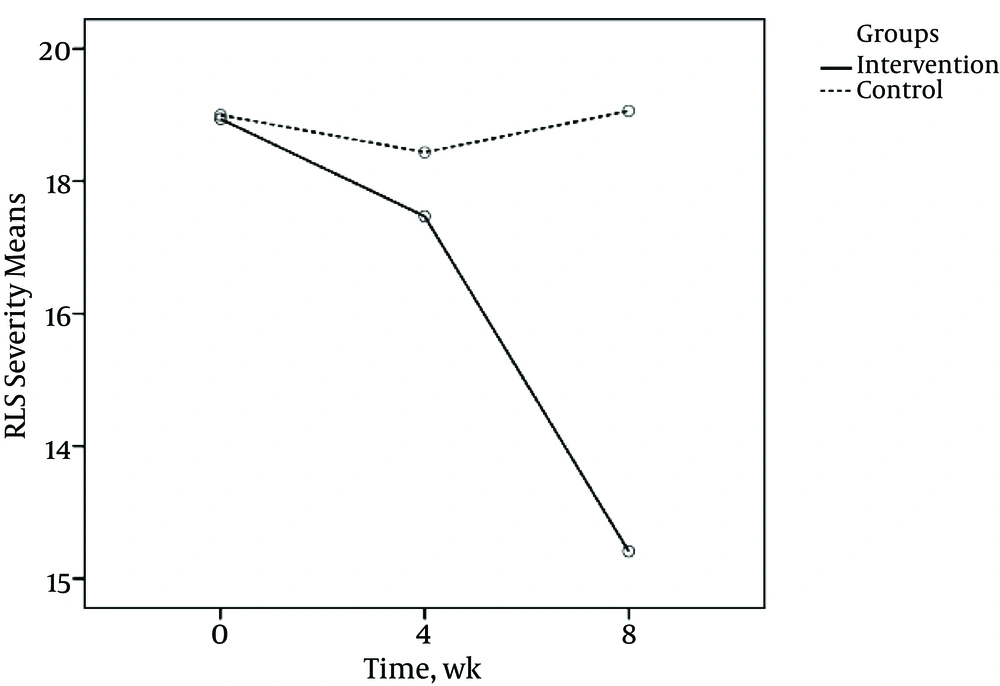
Figure 1.
No changes in the RLS severity scores were found in the Control Group while statistically significant differences were found only between week 0 and week 8 for the intervention group (P < 0.05).
Since the hemodialysis patients are often disabled and they spend most of their time on dialysis beds, they are usually inactive. Therefore, the proposed stretching exercises can be very helpful because they focus only on lower body limbs and have no side effects such as disruption in the hemodialysis treatment due. The results of this research are compatible with the other studies. Sakkas et al. (2) showed that aerobic exercises (as a mild sport) during hemodialysis reduce the severity of RLS symptoms in 16 weeks. Aukerman et al. (1) showed that meaningful changes in the severity of RLS symptoms are observed from onset of first week to the end of 6th week. However, in this study no meaningful change was detected after the 6th week to the end of 12th week. Therefore, 8 weeks exercise can suffice to prove the effectiveness of stretching exercises on the severity of RLS symptoms. In contrast, some researchers like Ohayon et al. (13) showed that relatively severe physical activity like high intensity sports before bedtime is meaningfully linked to the severity of RLS symptoms. Therefore, hemodialysis patients are recommended to avoid severe and hard sport programs especially before bedtime. According to this fact, the present study examined the effects of intradialytic mild or moderate stretching exercises. The present research also showed that most participants (78.51%) were jobless or retired that leads to inactivity. Since the RLS symptoms appear or worsen in immobility, physical activity improves the symptoms (13). Therefore, having a mild, regular exercise program can help to alleviate the RLS symptoms and will enhance the health of the people suffering from the syndrome. Scientists believe despite the fact that the real cause of RLS is still unknown; the syndrome is more common among diabetic patients (5). On the other hand, diabetes is one of causes of renal failure; it is more common among hemodialysis patients. This study proved this finding too. Because in our findings, the most common diseases in patients suffering from RLS were diabetes. Regarding the positive effect of stretching exercises on hemodialysis patients, nurses in charge of diabetic patients are also recommended to train them in the exercises to improve their life quality. This study has found that the most common drug used by the participants is amlodipine. This drug blocks calcium channels and is used for heart diseases. According to different studies, people who use calcium channel blockers are more vulnerable to RLS (5). It seems that there is a meaningful relation between this drug and RLS. It is recommended that further studies are needed to assess this relationship.
An absolute majority of the participants in this study did not perform any exercises regularly. Although hard exercises, particularly before sleep can worsen the RLS symptoms and may lead to sleep disorder and chronic insomnia, moderate or light exercises program can be helpful during the day to improve RLS symptoms.
This study showed that regular stretching exercises on legs during hemodialysis can help alleviate the severity of RLS symptoms. The exercises have no side effects and no cost and can be done without help. Nurses can help alleviate the RLS symptoms by training the patients and thus take a positive step towards healthcare objectives.