1. Background
Within team sports, the ability to change direction is considered a fundamental component. According to recent research, in soccer games, players perform up to 700 turns and swerves with different magnitudes at varying angles (1). Players’ re-training fitness screening tests are generally performed as a way of gaining a fuller understanding of their physical capacity, with test batteries usually including a test of agility. In this context, one of the well-documented speed and agility tests used is the Illinois change of direction test (ICODT) (2). It is a standard test involving several straight line sprints (SLS), and rapid change of directions (CODs) in varying sides and magnitudes. However, this test has been suggested not to match many intermittent sports’ effort patterns due to its relatively long duration of execution (3). It has also been further suggested that it does not represent soccer specific movements within the game (4, 5). Recently, a shorter version of the ICODT has been suggested (i.e. Modified Illinois COD Test) (MICODT) (3). The MICODT involves a reduced number of CODs (7 CODs vs. 9 CODs) and shorter distances to be covered (30 vs. 60 meters) when compared to the ICODT, respectively. More precisely, the MICODT is composed of multiple CODs with 4 of them being performed toward the right direction (use of the left leg to push towards the new running direction), while only 3 CODs are performed to the left side (use of the right leg to turn). Even if the MICODT has been previously suggested as a means to appropriately assess soccer players’ change of direction performance, it may be biased by its asymmetry mixed to the laterality of the players (6, 7). Indeed, players who preferentially change direction to the right will potentially have a better COD performance than those who preferably turn left. Moreover, strength asymmetry between players’ legs may impact COD performance. Indeed, lower limbs strength represents a determinant factor of COD performance among young soccer players (8). Therefore, strength asymmetry between the two legs may play an important role in sports with asymmetric kinetic patterns like soccer (6, 7). Typically, soccer players use their dominant leg (DL) to manipulate the ball (i.e. kicking or passing) whereas the no dominant leg (NDL) is often used to support the body and to provide stability (9). Therefore, the more frequent engagement of the DL compared to the NDL, may induce strength difference between the two legs and therefore it may impact COD performances to both sides (6, 8). In that regard, in a study of young elite and professional soccer players, a higher proportion of muscle strength imbalances were reported in young soccer players in comparison to senior players (8).
The MICODT examines the COD performance of soccer players through the use of only one scenario which involves more CODs with NDL vs. DL (for right leg dominant players). However, understanding COD differences between legs during left and right directional changes is of fundamental importance within all levels of football due to the determination of whether or not soccer players have a preferred cutting direction and lower limb strength imbalance. The effect of the leg dominance on COD tests among young soccer players has not been well studied. The choice to include young soccer players in the present study is due to the higher strength imbalances in this category of age (8, 10).
2. Objectives
Therefore, the aim of this study was to compare COD performance of the MICODT to the inverted modified Illinois COD test (I/MICODT) (an inversed pattern of the original circuit of the MICODT).
3. Patients and Methods
3.1. Participants
Forty-six right-footed male young soccer players were randomly chosen among members of successful first division soccer club of the Tunisian National League 1 (17.2 ± 1.6 years-old, 176 ± 6.2 cm, body mass = 70.4 ± 7.1 kg). The participants involved had been regularly involved in competitive soccer for 6 years or more. Testing sessions were administered during the competition phase (Fourth month of the season), where training schedule consisted of approximately 4 training-sessions and one official game per-week. The study was conducted according to the declaration of Helsinki and the protocol was approved by the institutional ethics committee. All participants and their parents/guardians reviewed and signed written consents.
3.2. Design
Tests were carried out on a 3rd generation synthetic soccer turf, at the same time of day (9 to 11 AM) to ensure no change or influence of circadian rhythms. Environmental temperature ranged between 16 - 18°C, humidity between 65 - 70% with no rain and non-windy conditions. Players were asked to wear adapted soccer boots in a consistent way through the experiment. Boots were adapted to the turf and allowed players to have good adherence to the pitch. Two familiarization sessions were performed during the two weeks preceding the testing session. After a standardized warm-up of 15 minutes, players were required to perform a total of four trials: two trials of the MICODT and two trials of the mirrored version of this test (Inverted MICODT) (I/MICODT). A recovery period of 2 minutes rest was applied between each trial, and the trials order (of the two trials of each test) was randomized and counter-balanced. One week before the final measurements, a pilot study was conducted among 30 players (2 trials per each COD test) in order to examine the reliability of the tests.
3.3. Change of Direction Tests
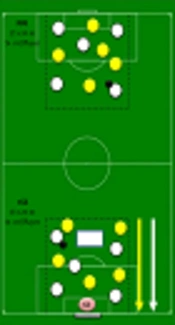
The MICODT involves players to sprint from point A to point B as indicated in Figure 1. Two timing gates (Brower Timing Systems, Salt Lake City, UT; accuracy of 0.01 second) were used, one at the start and one at the finish line. The MICODT was performed according to the original version, where the initial COD was performed with the NDL to the right direction (Figure 1A). Furthermore, players performed an inversed/mirrored pattern of the original circuit of the MICODT, where the first COD was conducted with the DL to the left direction (Figure 1B). No technical advice was given as to the most effective movement technique, and strong verbal encouragement was provided during each trial. Two minutes of recovery were given between trials within each circuit and five minutes between versions. Two trials were performed for each circuit and the best one (shortest time) was selected for statistical analysis.
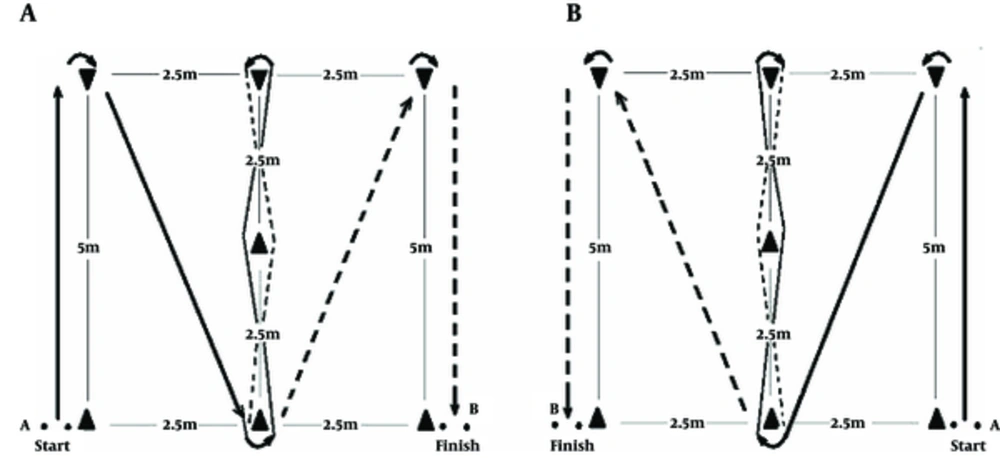
Figure 1.
A, Diagram of the modified illinois change of direction test (MICODT); B, the inverted modified illinois change of direction test (I/MICODT).
3.4. Statistical Analysis
Statistical analyses were performed using SPSS software statistical package (SPSS Inc., Chicago, IL, version. 18.0). Paired t-tests were used to determine whether significant differences existed between time performance of the MICODT and the I/MICODT as a within-subjects measure. Players were thereafter stratified into MICODT group or I/MICODT group according to their best performance and independent t- tests were used to determine whether significant differences existed between time performance of the MICODT and I/MICODT groups.
Effect sizes were also calculated and reported (small < 0.4, moderate = 0.4 - 0.70, large > 0.70) (11). Reliability of the measures was assessed with a Cronbach’s model intra-class correlation coefficient (ICC), standard error of measurements (SEM) and coefficient of variation (CV) according to the method of Hopkins (12).
4. Results
The ICC, SEM, and CV values for all measures demonstrated ‘high reliability’: MICODT (ICC = 0.88, SEM = 0.12, CV = 2.09%), I/MICODT (ICC = 0.89, SEM = 0.13, CV = 2.27%, respectively). Furthermore paired t-test showed no significant differences between trials of each test for all the variables measured. In addition, paired t-test showed no significant differences (P > 0.05, ES = 0.05) between the performances recorded during the MICODT and I/MICODT (11.93 ± 0.53 vs. 11.96 ± 0.58, respectively) when analyzed as pooled data (Table 1). When players were stratified into MICODT group or I/MICODT group according to their best performance, the results showed that the I/MICODT group performed significantly better than the MICODT group (11.69 ± 0.47 vs. 12.00 ± 0.49; P < 0.04, ES = 0.66) (Table 2).
Table 1.
Mean Difference Between The Two Versions of Tests a
| Criterion Measures | MICODT (n = 46) b | I/MICODT (n = 46) b | Means Difference | Effect Size | 95% CI For Mean | |
|---|---|---|---|---|---|---|
| Lower | Upper | |||||
| Test | 11.93 ± 0.53 | 11.96 ± 0.58 | -0.122 | 0.05 | -0.03 | 0.06 |
Abbreviations: I/MICODT, Inverted modified Illinois change of direction test; MICODT, modified Illinois change of direction test.
a P < 0.05.
b Values are expressed as mean ± SD.
Table 2.
Mean ± SD of MICODT and I/MICODT Groups a
| Criterion Measures | MICODT (n = 22) b | I/MICODT (n = 24) b | Means Difference | Effect Size | 95% CI For Mean | |
|---|---|---|---|---|---|---|
| Lower | Upper | |||||
| Test | 12.00 ± 0.49 | 11.69 ± 0.47 | 0.30 | 0.66 | 0.01 | 0.59 |
Abbreviations: I/MICODT, Inverted modified Illinois change of direction test; MICODT, modified Illinois change of direction test.
a P < 0.05.
b Values are expressed as mean ± SD.
5. Discussion
The aim of this study was to compare time performance of the Modified Illinois Change of direction test MICODT and the inverted version of this test (I/MICODT) tests among young elite soccer players. The main result of this study was that there was no significant difference between time performances of the two versions of tests when analyzed as pooled data. However, referring to the individual responses of players, the analysis showed that 52% (n = 24) of players had a significantly better time performance in the I/MICODT when compared to MICODT. In other words, more than half of the participants in this study had a better time performance when they performed the I/MICODT (where the dominant leg (DL) is more involved than the non-dominant leg (NDL) (with obviously, less than the half of players (48%, n = 22) showing an opposite result).
The results reported in the present study may be related to the strength asymmetry between the DL and the NDL among soccer players. Indeed many studies reported that because of the more frequent engagement of the DL in mobility tasks (i.e. kicking or passing) compared to the NDL (support of the body), this induces asymmetry of strength and/or functional use between the two legs (6, 13, 14). In this context, Lehance et al. (8) reported that the DL was stronger than the NDL in young elite soccer players. Furthermore, Thorborg et al. (10) also reported that the DL was 14% stronger than the NDL in young elite soccer players. In addition, Young et al. (15) reported that for a single-COD to the left side, the right leg strength of young soccer (right DL) players correlated more strongly than the left leg. However, the converse was not true; that is, left leg did not correlate more strongly than the right leg with performance in turning to the right. The findings of the present study are in line with a previous study among Australian footballers that have compared two versions (original version and inverted version) of AFL agility tests (16). The study reported that 61% of players were faster during the original version of the test that involved more COD with the DL whereas, only the remaining 39% performed better when the test involved more COD to the right direction (NDL). However, the previous study has not indicated the leg dominance of players and therefore, players were stratified in conjunction to their completion time of the two versions of the test.
Because players need to be able to change direction quickly while maintaining body control (17), dynamic balance asymmetry between DL vs. NDL may also explain the result of the present study. In that regard, a previous study reported that dynamic balance was better with the NDL when compared to the DL (18). The result of this previous study supports the notion that the NDL is often used to provide stability, while the DL is used for dynamic tasks (9). In soccer players, the kicks and passes are mainly performed with the DL, with the NDL serving as dynamic support. Therefore exposing the latter to a great amount of solicitation and probably this ‘‘training effect’’ is one of the major causes of the reported results. Future studies should compare dynamic balance of the two legs and its implication in COD performance asymmetry.
The results of the present study suggest that coaches and physical trainers should propose COD tests which involve equally the DL and the NDL. Another alternative would be to use asymmetrical tests, but consider proposing them in both original and inverted/mirrored version. Furthermore, technical and physical staff should work for reducing leg asymmetry among soccer players. This could dampen the asymmetrical discrepancies in agility performances. In this context, unilateral strength exercises may be proposed for soccer players in order to reduce strength asymmetry between the two legs. Nevertheless, the aim here is not to cancel this difference, as per reasons of players’ laterality and/or soccer asymmetry, there might always be a certain degree of asymmetry in soccer players. In that regard, previous studies of functional testing have proposed that scores of the ‘‘weaker’’ leg exceed 85% of the ‘‘strongest’’ leg performance, if this is to be accepted, the between leg asymmetry falls into ‘‘normal’’ values.
Findings from this study indicate no significant difference between MICODT and I/MICODT among young male soccer players when analyzed as pooled data. However, referring to the individual responses, the MICODT appropriately assessed less than the half of players. Therefore, in soccer players the COD ability should be monitored and assessed through analysis of (1) an identical number of directional changes of both sides (DL vs. NDL) in order to eliminate the effect of bilateral strength or technique deficiencies; or (2) performing the asymmetrical agility tests in original and inverted/mirrored versions.