
1. Background
Currently, cardiovascular disease is the leading cause of death worldwide among all non-communicable disease (17.5 million deaths or 46%) (1) with systemic arterial hypertension (SAH) being the main cause (2). It is estimated that about 1.5 billion people (22%) are hypertensive (1). In Brazil last year, the cost of treatment of SAH was $9 million, according to the Brazilian public health service database (3).
Modifiable factors that contribute to the high prevalence rates of SAH are eating food containing too much salt and fat, overweightness and obesity, and physical inactivity (1). On the other hand, studies have highlighted that a single session of exercise can reduce blood pressure (BP) to below resting values in the elderly (4), individuals with diabetes (5-8), and both hypertensive (9) and normotensive (10) individuals. This phenomenon is known as post-exercise hypotension (PEH). Moreover, some studies demonstrated that the magnitude of PEH is associated with a long-lasting decrease in BP in normotensive and hypertensive individuals (10-12), supporting that exercise can be a protective factor against the development of SAH. This, for instance, justifies the investigation of post-exercise BP response on normotensive individuals. Furthermore, the post-exercise BP response has been frequently used for the detection and prediction of coronary artery disease and arterial hypertension (13-15), highlighting the importance of post-exercise BP measurements regardless of the studied population.
Several studies have investigated the effects of different exercise modes (e.g. aerobic vs. resistance) (6), intensities (4), and durations (16) on BP responses during the post-exercise recovery period. Studies regarding the effects of different sports modalities, especially martial arts, have also been performed, such as: Tai Chi Chuan (TCC) (17, 18), jiu jitsu (19), and judo (20) However, only Simao et al. (20) and Lu and Kuo (18) investigated the effects of a single judo and TCC session on post-exercise BP responses. Until now, no study has explored the BP responses after a single Contact Karate (CK) session, which appears to have distinct physiological characteristics compared to the aforementioned modalities (21, 22). For example, CK is more dynamic and has movements performed at higher speed.
Moreover, Mynarski et al. (23) showed that CK created higher energy expenditure compared to all combat sports investigated, and it caused higher energy expenditure that was associated with lower resting BP (24, 25). Thus, it is reasonable to infer that CK seems to be the most effective of all combat sports in reducing BP. In addition, it is estimated that approximately 1 million people practice CK in Brazil, and more than 20 million practice it throughout the world (26, 27), suggesting that this form of exercise may prevent SAH.
It is worth mentioning that the scientific literature related to combat sports has hardly been explored, especially regarding health-related variables (i.e. post-exercise BP reduction). Most studies have investigated performance-related parameters in athletes, making the evaluation of health-related variables (such as PEH) a scientific gap. Therefore, investigations related to this issue have been strongly encouraged (28).
Furthermore, the prescription of combat sports either as prophylactic or therapeutic purposes is still based on practical experience rather than on scientific evidence. Much of what is hypothesized about this subject is based on studies using other exercise modes, such as aerobic or resistance training, and the conclusions are often extrapolated to various sports, keeping the literature (for researchers and combat sports enthusiasts) lacking in depth. Thus, exercise physiologists at all educational levels, scientists whose research focuses on BP response to exercise, and persons interested in martial arts may benefit from this research.
2. Objectives
Given the previous findings, the purpose of this study was to assess the effects of a single CK session on post-exercise BP responses in young adults. We hypothesized that CK could be effective in promoting PEH.
3. Patients and Methods
3.1. Sample
After approval from the research ethics committee of the Catholic University of Brasilia (approval n. 198/2010) and signing of the informed consent form, 32 adult males participated in the study. The average age of the subjects was 28.2 ± 6.7 years, the average weight was 77.0 ± 5.7 kilogram, the average height was 176.0 ± 4.7 centimeter, and all participants had at least 6 months of CK practice. Criteria for participation in the study included: A, between 18 and 35 years of age; B, having at least 6 months of CK practice; C, not having any kind of bone, muscle, or joint injury that would preclude performing the experimental sessions; D, membership as an athlete in the Okikukai Uechi-ryu Brazil, Aguas Claras, Distrito Federal; and E, experience in state-level competitions.
3.2. General Procedures
After a clinical evaluation and medical history performed by a cardiologist, the volunteers were instructed to not perform any kind of exercise throughout the duration of the study and not to ingest alcoholic beverages and caffeine in the 24 hours prior to the experimental sessions. The experiment consisted of two training sessions (i.e. CK session and control session (CON)) performed in a randomized order at the same time of day with an interval of 48 hours between sessions. The sessions were performed in a temperature and humidity controlled environment (18°C to 22°C and 50% to 70%, respectively).
3.3. Contact Karate Session
Initially, to measure BP at rest (Microlife BP 3AC1-1) and heart rate (HR) (Polar FS1), the volunteers remained seated for 20 minutes with their legs uncrossed, feet touching the floor, back relaxed and supported on the chair, arms positioned at the same height of the heart (at the medium point of the sternum or fourth intercostal space), free of clothes, with their palms facing upwards and elbows slightly flexed, as previously described (21). After rest, the volunteers practiced a 50 minutes session of CK. HR was monitored throughout the whole session. BP data regarding the post-exercise recovery period was collected at each fifteen minutes during a one-hour period.
The CK session was divided in four stages: A, from the 1st to the 10th minutes, where the volunteers performed a warm-up that consisted of calisthenics and relaxed punching and front-kicking (without tension); B, from the 11th to the 30th minutes, in which the CK techniques were conducted (punching and kicking) with the volunteers pairing with a colleague; C, from the 31st to the 60th minutes, where a CK fight (Kumite) was performed, with the volunteers alternating among each other; and D, the 60 minutes post-exercise recovery period, in which BP was measured at each 15 minutes.
3.4. Control Session
During the CON session the volunteers had the same measurements as in the CK session. However, no exercise was performed and the individuals remained seated during the whole time.
3.5. Statistical Analysis
A priori, statistical power of 95% was calculated for the study, considering the statistical model used (split-plot ANOVA), an effect size of F = 0.25, two sessions (CK and CON), five repetitions (rest and 15th, 30th, 45th, and 60th minutes of the post-exercise recovery period), and α = 0.05. Normality and homogeneity were analyzed using the Shapiro-Wilk and Levene’s tests, respectively. Data were expressed in mean (±) standard deviation. To compare values between and within groups, a split-plot ANOVA was performed with Scheffe’s procedure post-hoc. In case any of the dependent variables did not have sphericity according to the Mauchly’s test, the Greenhouse-Geisser’s ε degrees of freedom correction was used to analyze the F statistics. The level of significance utilized was P ≤ 0.05. All data were analyzed using SPSS 15 for Windows (IBM, Inc., Chicago, IL, USA).
4. Results
In response to the single CK session, SBP, DBP, and MAP were significantly lower during the post-exercise recovery period compared to pre-exercise rest (Table 1) and when compared to the same periods of the CON session (Table 1 and Figure 1). It is noteworthy that the CK session would be considered high-intensity exercise (29), as it was performed with average HR of 174.2 ± 5.8 b/min, which represents 90.9 ± 4.7% of the participants’ maximal HR.
Table 1.
Mean Absolute Values of SBP, DBP, and MAP at Rest and During Post-Exercise Recovery Periods (Rec) in CK and CON (N = 32)
| Rest | Rec15 | Rec30 | Rec45 | Rec60 | |
|---|---|---|---|---|---|
| SBP (mmHg) | |||||
| CK | 125.9 ± 4.7 | 117.4 ± 5.6a,b | 112.3 ± 5.4a,b | 111.3 ± 5.0a,b | 111.7 ± 5.4a,b |
| CON | 125.4 ± 2.3 | 123.9 ± 2.6 | 123.8 ± 2.8 | 123.7 ± 2.9 | 123.8 ± 2.7 |
| DBP (mmHg) | |||||
| CK | 78.8 ± 2.7 | 72.3 ± 3.5a,b | 69.3 ± 1.8a,b | 68.7 ± 1.7a,b | 69.8 ± 2.7a,b |
| CON | 78.7 ± 2.6 | 77.6 ± 2.1 | 77.7 ± 2.2 | 77.8 ± 2.2 | 77.9 ± 2.3 |
| MAP (mmHg) | |||||
| CK | 94.5 ± 3.1 | 87.4 ± 3.5a,b | 83.6 ± 2.7a,b | 82.9 ± 2.4a,b | 83.7 ± 3.2a,b |
| CON | 94.1 ± 2.4 | 92.8 ± 2.9 | 93.1 ± 2.0 | 92.9 ± 1.9 | 93.0 ± 1.9 |
Abbreviations: CK, Contact Karate Session; CON, Control Session; Rec, Recovery.
aP < 0.05 in Relation to Rest.
bP < 0.05 vs CON at the Same Moment.
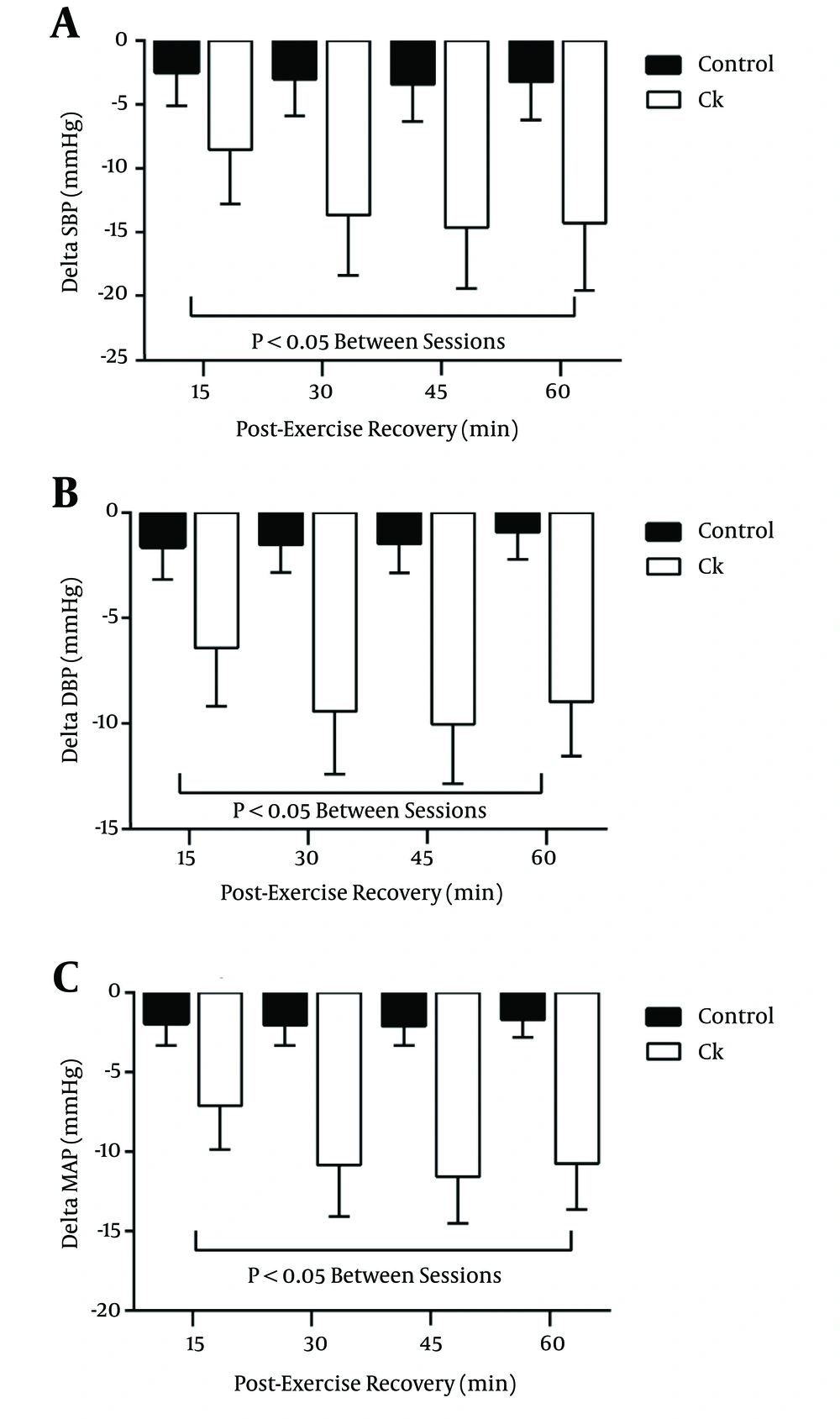
Figure 1.
Delta Values of SBP, DBP, and MAP During Post-Exercise Recovery Periods (Rec) in CK and CON
5. Discussion
The purpose of this study was to assess the effects of a single CK session on post-exercise BP responses in young adults. This topic is important, as the scientific literature related to combat sports has hardly been explored, especially regarding health-related variables (i.e. post-exercise BP reduction). Most studies have investigated performance-related parameters in athletes, making the evaluation of health-related variables (such as PEH) a scientific gap, but important for future research (28). Thus, this information is unique and can be applicable for combat sports and programs for prevention of hypertension.
The results of the present study indicated that a single CK session was effective in promoting PEH in young normotensive adults. This disagrees with Simao et al. (20) in which 12 hypertensive judo students practiced a training session and showed no significant BP reductions in the post-exercise recovery period. However, during all periods (10th to 60th minutes of post-exercise recovery) in their study, the SBP and DBP remained visually lower than values at rest, with decreases of 8.6% and 9.3% in SBP and DBP, respectively.
The differences in our findings can be partially explained by the peculiar characteristics of judo training, which presents great upper and lower limb isometry (21). This could favor an increase in peripheral vascular resistance (30) due to blood flow blockage promoted by concentric contractions (31), which can attenuate a hypotensive response induced by exercise. In the Friedman et al. (31) study, for example, leg blood flow was interrupted when a leg extension isometric contraction was performed above 20% of one repetition maximum (RM). Consequently, in this type of exercise, the energy provided for muscle contraction comes predominantly from anaerobic pathways. Therefore, both oxygen uptake and cardiac output increase mildly, which could result in a lower shear stress for this type of exercise, thus attenuating the dilation-induced PEH.
On the other hand, CK is a dynamic exercise mode (22) that may decrease peripheral vascular resistance due to shear stress promoted by the increase in cardiac output. A higher shear stress favors the release of vasodilating substances inducing a BP reduction during the post-exercise recovery period (30).
Another aspect that can explain the differences between the present study and the one performed by Simao et al. (20) is the intensity of the training session, since studies investigating PEH in individuals with diabetes (5-8), normotensive and hypertensive (9), and elderly (4) have suggested that exercises with higher metabolic and hemodynamic stress result in a greater and longer PEH. This happens as the result of a greater mechanical stress, and consequently, a greater release of vasoactive agents (4, 5, 7, 9).
The present study demonstrated that the participants maintained a mean HR of 174.2 ± 5.8 b/min during the CK session, which represents 90.9 ± 4.7% of the maximum HR (HRmax) estimated for their age. Ahmaidi et al. (32), investigating the cardiovascular responses of judo and kendo athletes during combat, found similar or slightly lower HRmax values (89% and 86% for judo and kendo, respectively). This could be one of the causes for the non-occurrence of BP decrease in the Simao et al. (20) study.
However, Lu and Kuo (18) evaluated the effects of a TCC training session on the BP responses of middle-aged (52.8 ± 7.5 years) normotensive individuals (118.4 ± 12.8 mmHg). They demonstrated that TCC promoted PEH, since the volunteers showed significantly lower SBP and MAP values, when compared to rest, at the 30th and 60th minutes of the post-exercise recovery period.
Despite this, the mechanisms surrounding the decrease of BP during the post-exercise recovery period in TCC seem to be different than the one described earlier (4, 33). Other studies have shown that the relative intensity of TCC sessions are 52% and 70% of HRmax (34), which are lower than the values reported by Ahmaidi et al. (32) and of those in the present study. Lu and Kuo (18) suggested that the relaxation induced by TCC can promote PEH through a significant increase in parasympathetic nervous activity, as measured by heart rate variability. They found an increase in the high frequency (HF) indicator, a marker of vagal activity, from 22.8 ± 14.6 to 28.2 ± 16.1 normalized units (nu) in the 30th minutes and to 30.6 ± 18.4 nu in the 60th minutes of the post-exercise recovery period. In addition, the values of the low frequency/high frequency ratio (LF/HF), an indicator of sympathetic nervous activity, significantly decreased in both the 30th and 60th minutes after exercise.
Once CK requires a high recruitment of motor units, one of the mechanisms that may be involved on PEH is the modulation of the autonomic nervous system through substance P released during muscle contraction. The arousal of the neurokinin-1 receptor during exercise causes it to undergo internalization after exercise, dampening the GABA interneuron’s solitary tract nucleus and redefining the baroreflex to a lower level after exercise. This occurs by reducing the transmission to baroreceptor second-order neurons, increasing the excitement of the ventral caudal lateral medulla, increasing inhibition of the rostral ventral lateral medulla, and finally reducing the activity of the autonomic sympathetic nervous system, causing PEH (35). Moreover, as a result of high-intensity exercise inducing sheer stress on blood vessels, the release of substances such as nitric oxide and prostaglandins occurs, and in turn may also decrease vascular tone and promote PEH (36, 37). Even though studies have shown the efficiency of martial arts in decreasing BP values after acute sessions (20) and longitudinal training (18), the effects of CK on BP was previously unknown in the literature. Therefore, future studies on the acute and long-term effects of CK on BP responses and the mechanisms involved are necessary, especially in people with hypertension.
The fact that we have not investigated the mechanisms that may be involved in BP reduction after a session of CK can be considered a limitation of this research. Nevertheless, to our knowledge this is the first study that investigated the effects of one CK session on post-exercise BP responses. In addition, these data are important, since it is estimated that approximately 1 million people practice CK in Brazil and more than 20 million practice it throughout the world (26, 27). Therefore, this martial art could be a useful tool for the prevention of SAH.
As a practical application, the results of the present study suggest that CK can be used as an alternative method for the prevention of hypertension. In addition, formal programs of physical exercise (aerobic and resistance) still have a high frequency of non-adherents (~ 45%), and lack of motivation is one of the main reasons (38). Thus, alternative methods of physical exercise, such as martial arts, may be an option, by producing an important social interaction environment, creating a motivating and longstanding atmosphere. Therefore, it is suggested that karate coaches create this atmosphere, allowing greater adherence by its practitioners, taking advantage of this situation constantly.
5.1. Conclusion
We found that a single session of CK was effective in reducing BP in young normotensive adults and that this BP reduction may last for at least 60 minutes after exercise. These findings suggest that this martial art may be useful for prevention of SAH. On the other hand, the effectiveness of CK on BP control for special populations and the possible mechanisms involved need to be investigated. Thus, applying the results of the present study should be done cautiously.